
PolkaWar (PWAR) Airdrop Details: What Happened and Where It Stands in 2026
The PolkaWar (PWAR) airdrop was never a get-rich-quick scheme. It was a gamble wrapped in a game-and most people who took part lost money. If you’re reading this because you heard about a "free PWAR airdrop" and think you can still claim tokens, stop. The airdrop ended years ago. What’s left is a cautionary tale about how crypto promotions lure people in, then vanish with their hopes.
What Was the PolkaWar Airdrop?
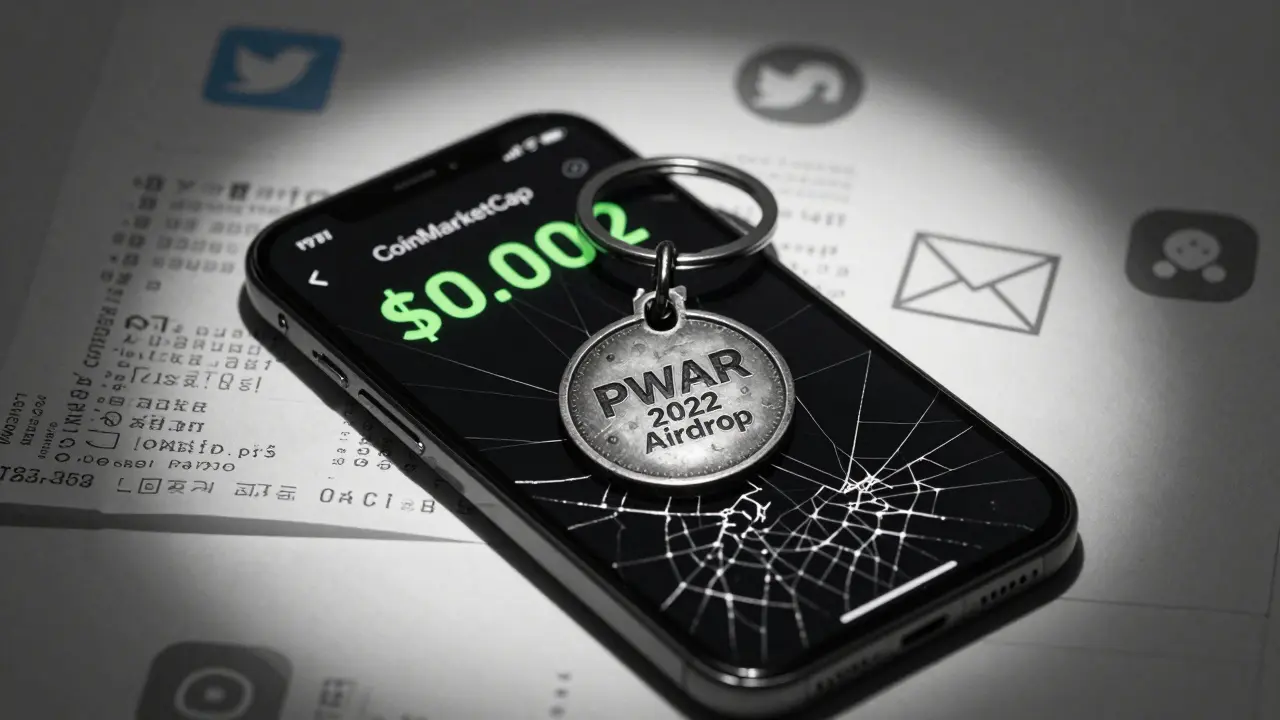
In 2022, CoinMarketCap ran a promotional campaign offering up to 75 PWAR tokens to users who completed simple tasks: signing up, verifying their email, and following PolkaWar on social media. The total value of the airdrop was $30,000. That sounds generous-until you realize how little each token was worth at the time. Back then, PWAR traded around $0.15. Seventy-five tokens meant about $11.25 in free crypto. For most, that was a nice bonus. But the real story isn’t the free tokens-it’s what happened after.How PolkaWar Worked (And Why It Failed)
PolkaWar wasn’t just a token. It was a blockchain-based fighting game built on Binance Smart Chain. Players controlled NFT characters-Warriors, Archers, Magicians-each with unique weapons like the Tessen or Magic Vase. You could level up, fight in arenas, and trade gear on its own NFT marketplace. There was even a "Logistics" arm that promised to ship real-world replicas of your NFT weapons. It sounded cool. A play-to-earn game with physical rewards? That was the pitch. But the game never took off. Player counts stayed low. The combat mechanics felt clunky. And the tokenomics? Broken. The total supply of PWAR was capped at 100 million tokens. By 2026, 82.82 million were already in circulation. That’s a massive flood of supply. And with almost no new players joining, demand dried up. No one was buying gear. No one was trading NFTs. The marketplace sat empty.The Price Crash: From $1.20 to $0.002
PolkaWar’s all-time high was $1.199606. That was in late 2021, during the peak of the NFT and GameFi bubble. Today, it trades at $0.00204. That’s a 99.8% drop. The 24-hour trading volume? Around $40,000. For a project that once promised to be a major player in blockchain gaming, that’s dead. Compare that to top GameFi titles like Axie Infinity, which still moves over $10 million daily-even after its own crash. The price isn’t just low. It’s meaningless. You can’t buy anything with it. Exchanges like Binance list it with wildly different prices depending on the region. Some show $0.000599. Others say $0.001948. That’s not market efficiency-that’s confusion. And confusion scares off any serious investor.
Why the Airdrop Was a Trap
CoinMarketCap didn’t create PolkaWar. They just gave it exposure. Airdrops like this are marketing tools. Projects pay to get in front of millions of users. For PolkaWar, the airdrop worked-on paper. Thousands claimed tokens. But most didn’t even know what they were getting. Here’s the harsh truth: If you held onto those 75 PWAR tokens after the airdrop, you lost 98% of your value. Even if you sold immediately, you were lucky to cash out at $0.10-$7.50 for your "free" tokens. Most people didn’t sell. They waited. And waited. And waited. That’s the pattern. Airdrops don’t create value. They just distribute it-often to people who don’t understand the project. Then, when the hype fades, the price collapses. The team moves on. The Discord goes silent. The website stops updating.What’s Left of PolkaWar in 2026?
Nothing much. The PolkaWar website still exists, but it hasn’t been updated since 2023. No new NFT drops. No game patches. No announcements. The NFT marketplace is empty. The logistics arm? No one has reported receiving a real-world weapon replica in over two years. The team never launched on Polkadot as promised. The cross-chain vision died before it started. The game never became a community-driven ecosystem. It became a graveyard for tokens. If you’re wondering whether it’s worth buying PWAR now-don’t. The token has no utility. No liquidity. No development. It’s a ghost. The market cap hovers between $50,000 and $160,000-less than what a single NFT from a popular collection can sell for.Lessons from the PWAR Airdrop
This isn’t just about one failed game. It’s about how crypto airdrops work-and why they’re dangerous.- Airdrops aren’t free money. They’re a way for projects to dump tokens on the market.
- Don’t trust hype. A flashy website and a promise of physical NFTs don’t mean the project works.
- Check the team. Who’s behind PolkaWar? No one knows. No LinkedIn profiles. No interviews. No transparency.
- Look at volume, not price. A token trading at $0.002 with $40,000 daily volume is dead. A token at $0.10 with $5 million volume is alive.
- Never hold without a plan. If you get airdropped tokens, decide: sell immediately, or don’t touch them. Waiting rarely pays off.
Is There Any Future for PWAR?
Technically? Maybe. If a new team bought the contract, revived the game, and rebuilt the community, it could come back. But that’s a huge "if." No one’s talking about it. No investors are stepping in. No developers are posting commits. The blockchain explorers show zero new transactions in months. In crypto, silence is death. PolkaWar is dead. The airdrop was its last gasp.What to Do If You Still Have PWAR Tokens
If you still hold PWAR:- Check your wallet. How many do you have?
- Check the current price on CoinMarketCap or CoinGecko.
- Transfer them to a major exchange like Binance or KuCoin.
- Sell them. Even if it’s $0.001 per token, it’s better than nothing.
- Don’t wait for a "rally." It won’t happen.
Final Thought
The PolkaWar airdrop wasn’t a gift. It was a test. And the market failed it. Projects like this thrive on hope, not fundamentals. And hope doesn’t pay the bills. There are hundreds of new GameFi projects launching every month. Most will fail. The ones that survive? They have real players, real revenue, and real teams. PolkaWar had none of that. Learn from it. Move on. And next time you see a "free airdrop," ask yourself: Who’s really getting rich here?Was the PolkaWar airdrop real?
Yes, the PolkaWar airdrop was real and ran on CoinMarketCap in 2022. Users could claim up to 75 PWAR tokens by completing basic tasks. However, the campaign ended years ago and is no longer active. No new claims are possible.
Can I still claim PolkaWar (PWAR) tokens for free?
No. The official airdrop campaign ended in 2022. Any website or social media post claiming to offer free PWAR tokens today is a scam. These are phishing attempts designed to steal your wallet keys or private information.
What is the current price of PWAR?
As of January 2026, PWAR trades at approximately $0.00204 USD on CoinMarketCap. Prices vary slightly across exchanges due to low liquidity, with some regional Binance listings showing values between $0.000599 and $0.001948.
Why did PolkaWar’s price crash so hard?
PolkaWar’s price crashed because the game never gained real players. The NFT marketplace stayed empty, the token supply was massive (82.82 million out of 100 million in circulation), and there was no ongoing development. Without demand, the price collapsed from an all-time high of $1.20 to under $0.01.
Is PolkaWar still being developed?
No. The last official update was in 2023. The website hasn’t changed in years. The team has disappeared. There are no new GitHub commits, no social media activity, and no announcements. The project is inactive.
Should I buy PWAR tokens now?
No. PWAR has no utility, no community, and no development. It’s a dead token with almost no trading volume. Buying it now is gambling with money you can afford to lose-and even then, the odds are against you.
What happened to the physical NFT replicas promised by PolkaWar?
No one has received a physical replica since 2022. The "Logistics" arm of PolkaWar, which promised to ship real-world versions of NFT weapons, never delivered on its promises. There are no public records, shipping confirmations, or customer testimonials supporting its fulfillment.
Can I trade PWAR on major exchanges?
Yes, but only on a few smaller exchanges like Binance (in select regions) and KuCoin. It’s not listed on Coinbase, Kraken, or any major U.S.-based exchange. Trading volume is extremely low, making it hard to buy or sell without slippage.
Is PolkaWar a scam?
It’s not a scam in the legal sense, but it’s a failed project that used hype to attract users and capital. The team raised awareness through airdrops and marketing, then disappeared. This is common in crypto-projects launch with big promises, then vanish when the money runs out.
What should I do if I got PWAR in an airdrop?
If you still hold PWAR, transfer it to a supported exchange and sell it. Even at $0.002 per token, you can recover a small amount. Holding it will not make you rich. The token has no future. The sooner you exit, the less emotional loss you’ll feel.
Denise Paiva
January 5, 2026 AT 10:17PolkaWar was never about utility-it was about liquidity dumping disguised as community building
The tokenomics were engineered for exit liquidity, not player engagement
When your game's 'logistics' arm is a ghost town, you're not building an ecosystem-you're running a pump-and-dump
The fact that people still hold PWAR is less about hope and more about cognitive dissonance
They'd rather believe in a resurrection than accept they were played
And let's be honest-CoinMarketCap didn't care if it worked, only if it drove clicks
Marketing departments don't fund game studios-they fund vanity metrics
Every airdrop recipient was a data point, not a participant
There's no moral failure here-only economic logic
It's not that people got scammed-it's that they confused hype for value
And now? The blockchain remembers every transaction, but no one remembers why they bought in
That's the real tragedy-not the price drop, but the erasure of intent
Next time you see 'free tokens,' ask who's paying for the party-and why they're not dancing
There's no such thing as free crypto. Only paid attention.
Charlotte Parker
January 6, 2026 AT 12:34Calen Adams
January 8, 2026 AT 06:12PolkaWar didn’t fail because of bad code-it failed because they treated token distribution like a raffle, not a sustainable economy
Real GameFi projects like Axie or Illuvium had play-to-earn loops with feedback cycles-PWAR had a marketplace that looked like a funeral home
They didn’t even have a DAO structure to keep momentum after the airdrop
Tokenomics isn’t just about supply-it’s about incentive alignment
And if your NFT weapons can’t be traded, upgraded, or used in meaningful combat, you’re not building a game-you’re building a digital shrine to vaporware
We need more projects that bake in burn mechanics, staking, and cross-chain interoperability from day one
Not just ‘here’s 75 tokens, go play’ and vanish
There’s a science to this. And PolkaWar failed the midterm.
Meenakshi Singh
January 8, 2026 AT 20:14Kelley Ramsey
January 10, 2026 AT 15:45Michael Richardson
January 11, 2026 AT 14:35Sabbra Ziro
January 13, 2026 AT 01:13But maybe the real lesson isn’t that PolkaWar failed
It’s that we’re taught to chase free things without asking why they’re free
And that’s not just crypto-it’s life
There’s no shame in losing money here
Only in refusing to learn from it
Let’s talk about how we build better next time-not how we bury the dead
Krista Hoefle
January 13, 2026 AT 22:05Jessie X
January 15, 2026 AT 04:17Turns out I was just the first brick in the foundation of someone else’s exit
Still, I don’t hate it
At least I learned something
And that’s more than most get from crypto
Kip Metcalf
January 15, 2026 AT 05:30Natalie Kershaw
January 16, 2026 AT 03:06But here’s the coach’s advice: cut your losses, move your capital, and redeploy
There are 100 new GameFi projects launching this month
One of them will be the next Axie
But you won’t find it in a graveyard
Go where the players are. Not where the ghosts are
You’ve got this. I believe in you.
Mujibur Rahman
January 16, 2026 AT 21:05What’s interesting is how CoinMarketCap still lists it
They’re not verifying projects-they’re just aggregating data
That’s not neutrality-it’s complicity
And the fact that people still search for 'free PWAR airdrop' shows how deep the delusion runs
We need regulation-not to kill innovation-but to stop the predators
Until then? Buyer beware.
Mollie Williams
January 17, 2026 AT 14:37It wasn’t just a failed game
It was a failed promise of belonging
We wanted to own something that mattered
Instead, we owned a number that vanished
And now we’re left wondering-was it ever real? Or were we just the ghosts haunting our own expectations?
Tre Smith
January 18, 2026 AT 16:16Jordan Leon
January 20, 2026 AT 14:49I blame the system.
Why do we reward hype over honesty?
Why do we let platforms profit from projects that vanish?
Why do we treat crypto like a carnival instead of a market?
PolkaWar didn’t break the rules.
It just exposed them.
Brittany Slick
January 21, 2026 AT 23:23It’s not a token.
It’s a mirror.
greg greg
January 22, 2026 AT 01:57LeeAnn Herker
January 23, 2026 AT 10:19