
Mining Profitability: How to Maximize Your Crypto Earnings
When working with Mining Profitability, the metric that tells you whether a mining operation makes money after accounting for all costs. Also known as crypto mining ROI, it helps miners decide which coin, hardware, or pool to choose and whether a particular rig is worth the electricity bill. Hash Rate, the speed at which a miner solves the algorithm, directly impacts the number of coins you earn per day is the first lever you can pull, but higher hash power also means higher power consumption. That’s where Electricity Cost, the price you pay per kilowatt‑hour, becomes the biggest expense and the main profit killer if you’re not careful. The two variables interact in a loop: a faster hash rate boosts potential earnings, yet each extra watt adds to the bill, so the net gain only rises when the efficiency ratio improves. Adding a Mining Pool, a group of miners that combine their hash power to earn more regular block rewards into the mix can smooth out variance, but pools charge fees and have different payout methods that affect the final number. Finally, a reliable Mining Calculator, an online tool that estimates earnings based on hardware specs, electricity rates, network difficulty and pool fees ties all the pieces together, letting you see the real profit margin before you turn on a single fan. In short, mining profitability encompasses hash rate, electricity cost, pool selection, and calculator accuracy, and mastering the relationship among them is the key to turning a hobby into a sustainable income stream.
Key Factors That Shape Profitability
First, the hardware you pick—ASIC miners, GPUs or even FPGA boards—sets your baseline hash rate. Each device has a power‑draw rating, so you compare watts per terahash (or per megahash for GPUs) to gauge efficiency. Newer ASIC models often double the hash per watt of older generations, but they also cost more upfront, so the payback period becomes a crucial number. Second, location matters because electricity rates differ wildly; a cheap contract in a cold climate can shave off a few dollars per kilowatt‑hour, while a warm region may need extra cooling that adds hidden costs. Many miners rent space in industrial warehouses where the ambient temperature is low and the power grid is stable, which dramatically improves the margin. Third, network difficulty is a moving target. When Bitcoin or Ethereum difficulty spikes, the same hardware earns fewer coins, so you must re‑run your calculator regularly and adjust expectations. Fourth, pool fees and payout structures vary; some pools charge a flat 1 % fee, others use a Pay‑Per‑Last‑N‑Shares (PPLNS) model that rewards long‑term contributors with larger but less frequent payouts. Choosing a pool that matches your cash‑flow needs—steady small payouts versus occasional big spikes—can affect how you manage your operating expenses. Fifth, the price of the mined coin itself is a wild card. Even a perfectly efficient rig can become unprofitable if the market price crashes, which is why many miners hedge part of their earnings or switch between coins based on profitability charts. Lastly, tax and regulatory considerations add another layer; some jurisdictions treat mining income as ordinary income, while others offer favorable capital‑gain treatment. Ignoring these rules can eat into your net profit, so a quick check with a tax advisor is worth the time.
The articles below dig into each of these pieces in depth. You’ll find a step‑by‑step guide on how to switch mining pools without losing rewards, an up‑to‑date review of the latest ASIC models and their watt‑per‑hash numbers, a regional analysis of electricity costs that highlights the cheapest mining hubs, and real‑time hash‑rate charts that let you spot difficulty trends before they bite. There’s also a comprehensive tutorial on using mining calculators to model different scenarios, plus tips on optimizing cooling to cut power bills. Whether you’re a hobbyist tweaking a single GPU or a professional running a farm of dozens of miners, this collection gives you practical insights to boost your mining profitability and keep your operation in the green.
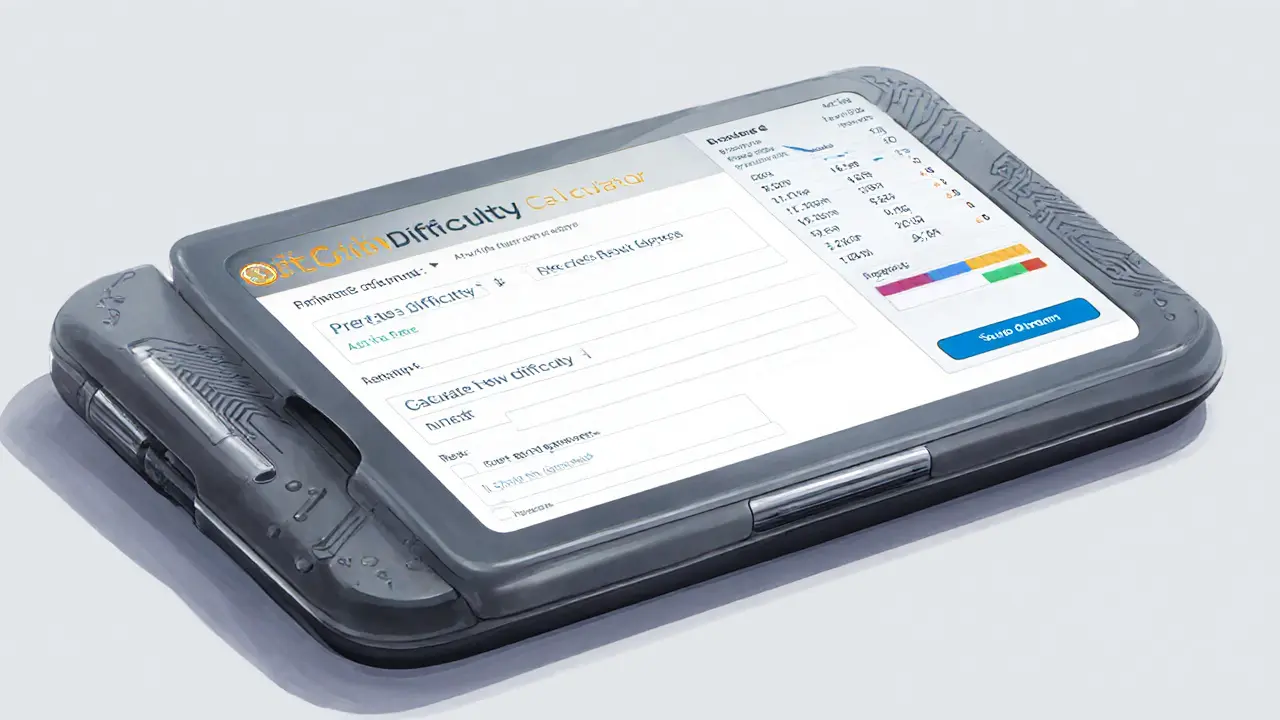
How to Calculate Mining Difficulty in Bitcoin (2025 Guide)
Learn how Bitcoin's mining difficulty is calculated, why it matters, and how to use the formula for better mining decisions in 2025.
VIEW MORE