
Serum Crypto Exchange Review
When working with Serum crypto exchange, a decentralized exchange built on the Solana blockchain that uses a central limit order book. Also known as Serum DEX, it offers fast, low‑cost trades and on‑chain order matching. If you’ve tried other DEXs, you’ll notice Serum’s order‑book model feels more like a traditional exchange, but with Solana’s speed behind it.
Solana the high‑throughput layer‑1 protocol that powers Serum gives the DEX sub‑second finality, which is why traders can place and cancel orders without feeling the lag you see on older chains. The cheap fees also let smaller investors dip their toes in without worrying about burning cash on gas.
The central limit order book a ledger that matches buy and sell orders at exact prices is Serum’s core advantage. Unlike automated market makers that rely on liquidity pools, this model lets you see the full depth of the market, set limit prices, and avoid slippage.
Key Features and How They Shape Your Trading
Because Serum runs on Solana, transaction fees are typically a fraction of a cent. That low cost structure lowers the barrier for day‑traders and high‑frequency bots, which can afford to send many small orders without eroding profit margins. In practice, the fee schedule looks like a flat 0.0005 SOL per trade, plus a tiny network charge.
Security-wise, Serum inherits Solana’s proof‑of‑history consensus, which provides strong finality and resistance to re‑org attacks. The DEX’s smart contracts are open‑source and have undergone multiple audits, so developers can verify the code themselves. For users, the default wallet integration is Phantom, but you can also connect Ledger, Sollet, or any Solana‑compatible wallet.
Liquidity on Serum is sourced from market makers that post orders directly to the order book. This differs from pool‑based DEXs where liquidity is locked in smart contracts. The result is tighter spreads, especially on high‑volume pairs like SOL/USDC or BTC/USDC. However, it also means you rely on active market makers to keep depth healthy.
If you compare Serum to other decentralized exchanges like Uniswap or PancakeSwap, the biggest contrast is the trading experience. Uniswap’s constant product formula can generate noticeable price impact on large orders, whereas Serum’s order‑book lets you set a limit and walk away, just like on a centralized platform. That control is why many professional traders favor Serum for spot trading.
On the UI side, the web portal mirrors familiar exchange layouts: you have a candlestick chart, order book depth, recent trades, and a trade box for market, limit, and stop orders. Advanced users can tap into the Serum API to pull real‑time order‑book data, which is useful for building bots or custom dashboards.
Another related entity worth mentioning is liquidity providers entities that place buy and sell orders on Serum’s order book. They earn fees from each matched trade, and their activity keeps the market fluid. Some projects run dedicated liquidity programs, offering incentives in the form of token grants to attract deeper order books.
When it comes to regulatory considerations, Serum is a non‑custodial platform—your private keys never leave your wallet. That design reduces compliance overhead but also means you’re fully responsible for security. Always enable hardware‑wallet signing for large withdrawals and double‑check contract addresses before approving any transaction.
For newcomers, the learning curve is short if you already know how traditional exchanges work. The main adjustment is getting comfortable with wallet connections and the idea that you’re interacting directly with on‑chain order books. The community runs regular AMAs and tutorial streams that walk through placing limit orders, setting stop‑losses, and reading depth charts.
Overall, Serum blends the speed of Solana with the precision of a central limit order book, creating a hybrid that feels both modern and familiar. Whether you’re a retail trader looking for low fees or a coder building a high‑frequency bot, the platform offers the tools you need without sacrificing security.
Below you’ll find a curated set of reviews, comparisons, and how‑to guides that dive deeper into each of these aspects. From fee breakdowns to security audits, the articles give you actionable insights to make the most of Serum’s unique model.
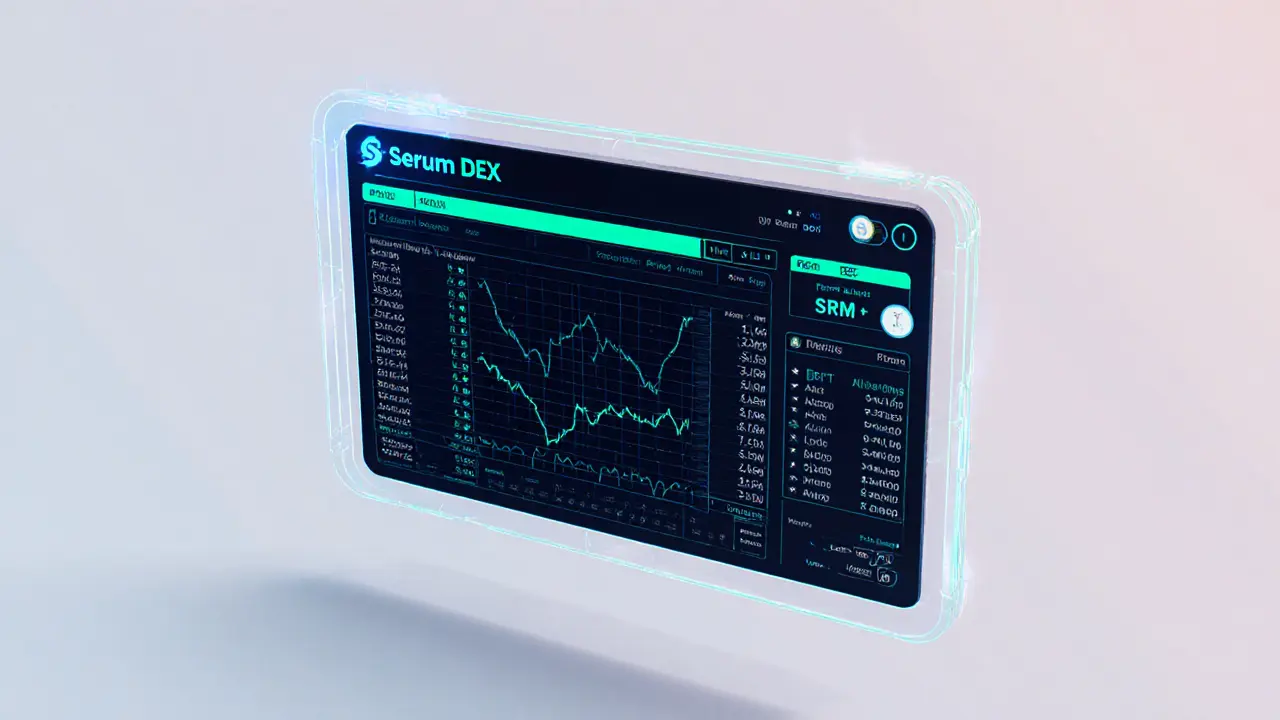
Serum Crypto Exchange Review 2025: Is the Solana DEX Still Alive?
A 2025 review of Serum crypto exchange covering its order‑book model, cross‑chain swaps, fees, SRM token status, and whether the Solana DEX is still functional.
VIEW MORE