
Arweave Permanent Storage Explained: How to Store Data Forever
Have you ever uploaded a photo or document to the cloud, only to find it gone years later? Maybe the service shut down, raised prices, or deleted your account. This is the problem of data impermanence. In our digital age, we assume our files are safe forever, but traditional cloud providers like AWS or Google Cloud rely on recurring payments and centralized control. If you stop paying, or if they decide to change their terms, your data disappears.
This is where Arweave comes in. It is not just another cloud drive; it is a protocol designed for one specific purpose: storing data permanently. Unlike renting space on a server, Arweave allows you to pay once and keep your information accessible for centuries. But how does it actually work? And is it really possible to store data forever without paying monthly fees?
The Core Problem: Why Traditional Storage Fails Long-Term
To understand why Arweave matters, you first need to look at how standard storage works. When you use Amazon S3 or Azure Blob Storage, you are essentially renting hard drive space. You pay a monthly fee based on how much data you hold. This model works fine for short-term needs, like hosting a website that changes daily or storing temporary backups.
However, this model breaks down for long-term preservation. Imagine you want to archive your family’s history, a scientific dataset, or a piece of art for your grandchildren. Over twenty years, those monthly fees add up significantly. More importantly, the provider holds the keys. They can censor content, lose data due to technical failures, or simply go out of business. There is no guarantee that your data will exist in ten, let alone fifty, years.
Decentralized storage solutions tried to fix this by spreading data across many computers. But most still required continuous payments. Arweave solved this by changing the economic question from "How do I pay for storage every month?" to "How do I pay enough now to cover storage costs for the next two hundred years?"
How Arweave Works: The Blockweave Structure
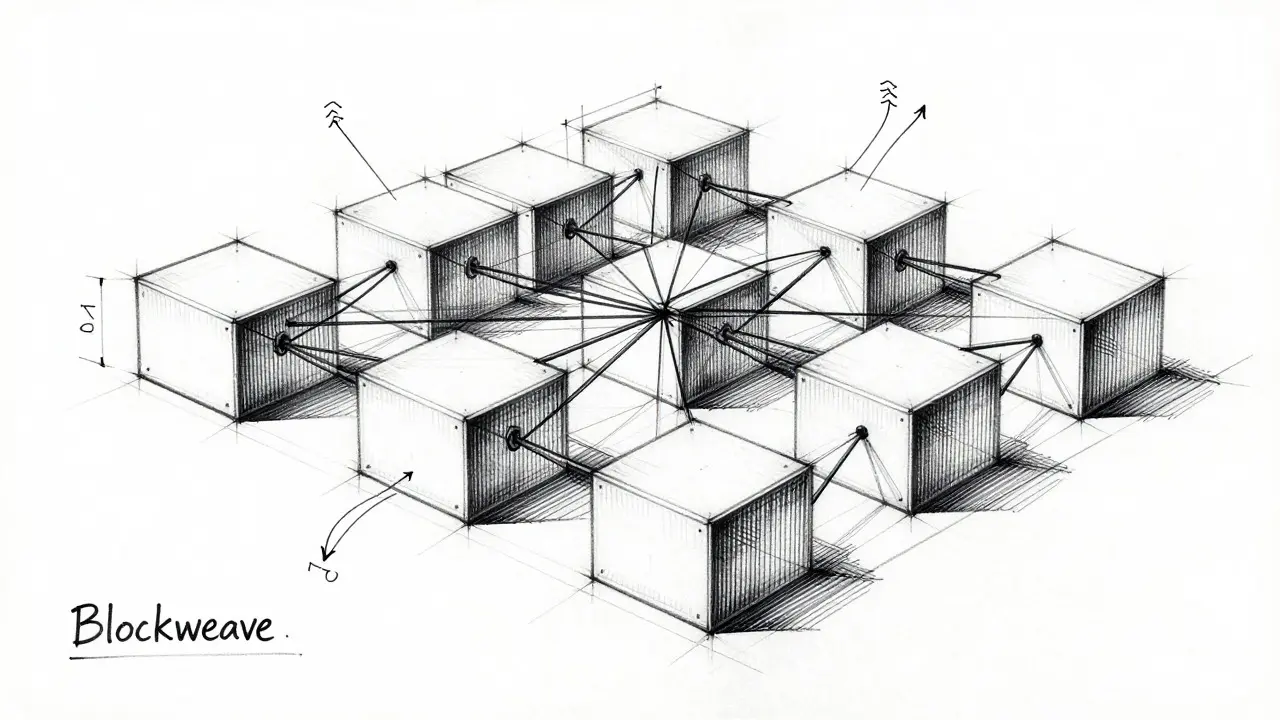
At the heart of Arweave is a unique technology called Blockweave. Most blockchains, like Bitcoin, link each new block only to the one immediately before it. This creates a single chain. Arweave is different. Each new block links to the previous block AND to a randomly selected older block, known as the "recall block."
Why does this matter? Because miners (the people running the hardware) must verify these links. To verify a link to an old block, they need access to the data stored in that block. This forces miners to keep copies of historical data on their drives. As new blocks are added, older data is constantly re-validated. This creates a self-sustaining loop where keeping old data is economically rewarding for miners because it helps them earn rewards for new transactions.
This structure ensures that data is not just stored once and forgotten. It is actively maintained by the network. The more time passes, the more valuable the historical data becomes to the mining process, ensuring its survival.
The Economic Model: Pay Once, Store Forever
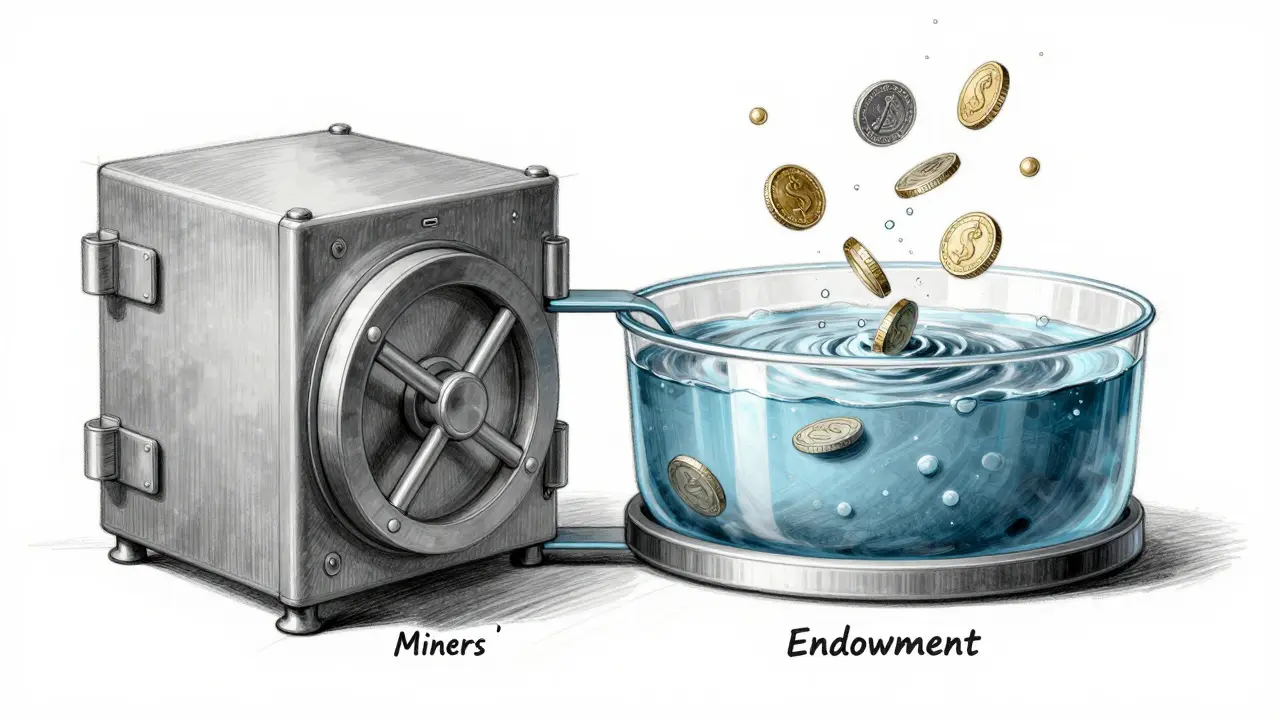
The magic of Arweave lies in its pricing strategy. When you upload data, you pay a single upfront fee in AR tokens. This fee is calculated using a formula that predicts the cost of storage over the next 200 years.
Here is how the money is split:
- 15% goes directly to miners: This covers the immediate cost of storing your data and incentivizes miners to keep it available today.
- 85% goes into an Endowment: This fund is invested in AR tokens. As the value of AR grows (or stays stable) and the cost of physical storage hardware drops, this endowment generates interest. This interest pays future miners to store your data indefinitely.
The assumption behind this model is that storage costs will decrease over time. Historically, the cost per gigabyte has dropped dramatically every decade. If storage costs fall faster than the inflation rate of the endowment, your data remains covered for far longer than 200 years-potentially thousands of years. This is a radical shift from the subscription models we are used to.
| Feature | Traditional Cloud (AWS/S3) | Rent-based Crypto (Filecoin) | Arweave |
|---|---|---|---|
| Payment Type | Monthly Subscription | Periodic Renewal | One-time Upfront Fee |
| Data Lifespan | As long as you pay | As long as contracts renew | Permanent (Target: 200+ years) |
| Censorship Resistance | Low (Centralized Control) | High (Decentralized) | Very High (Immutable) |
| Best Use Case | Frequent updates, apps | Short-to-medium term storage | Archives, NFTs, Historical Records |
What Can You Store on Arweave?
You might wonder what kind of data benefits from permanent storage. It isn’t just for hoarding old emails. Here are some real-world applications:
- NFT Metadata: Many Non-Fungible Tokens (NFTs) point to images hosted on central servers. If those servers go down, the NFT image breaks. Storing the metadata and image on Arweave ensures the asset remains intact forever.
- Decentralized Web Apps (dApps): Developers can host entire websites on Arweave. Since the code is immutable, users know they are interacting with the original, unaltered version of the app.
- Historical Archives: Organizations like the Internet Archive have partnered with Arweave to preserve web pages, books, and cultural artifacts. This protects against censorship and loss.
- Scientific Data: Researchers can publish datasets that need to remain unchanged and verifiable for peer review decades later.
The key constraint is that Arweave is optimized for "write-once" data. If you need to update a file frequently, Arweave is not the best tool. Instead, you would upload a new version each time, creating a permanent history of all versions.
Getting Started: A Practical Guide
If you want to try Arweave yourself, here is a simplified path to get your first file stored permanently.
- Set Up a Wallet: You need a crypto wallet that supports the AR token. Popular options include ArConnect or Drift Wallet. These are browser extensions similar to MetaMask.
- Buy AR Tokens: Purchase AR tokens from a cryptocurrency exchange. Keep in mind that the price fluctuates, so check current rates before buying.
- Choose a Gateway: Gateways are entry points to the Arweave network. Websites like arweave.net or drive.arweave.org allow you to upload files easily. For developers, tools like Drive or Bundlr simplify the process by batching small uploads.
- Upload Your Data: Connect your wallet to the gateway, select your file, and confirm the transaction. You will see the estimated cost in AR tokens. Once confirmed, your file gets a unique ID (hash).
- Access Your Data: You can retrieve your file anytime using the URL provided by the gateway. This URL will never change, and the file cannot be altered.
For developers, libraries like ArweaveJS make it easy to integrate permanent storage into applications. The learning curve is moderate if you already know blockchain basics, but straightforward for simple file uploads.

Limitations and Considerations
While Arweave is powerful, it is not a silver bullet. Understanding its limits helps you use it effectively.
Cost Calculation Complexity: The upfront cost depends on the size of your data and the current price of AR. For large datasets, estimating the exact cost can be tricky. If the price of AR spikes right before you upload, your bill increases. Planning ahead is essential.
Retrieval Speed: While data is always available, retrieving very large files might be slower than fetching them from a high-speed CDN (Content Delivery Network). However, improvements like Blockshadows aim to speed up retrieval significantly by caching data closer to users.
Immutability: Once data is on Arweave, it cannot be deleted or changed. If you accidentally upload sensitive information, it stays there forever. Always double-check your files before uploading. This is both a strength (for integrity) and a weakness (for privacy mistakes).
The Future of Permanent Storage
As the digital world grows, the need for permanent records increases. Governments, corporations, and individuals are realizing that relying on private companies for long-term storage is risky. Arweave provides a public good: a shared, neutral layer for humanity’s digital memory.
The ecosystem is expanding. Projects are building on top of Arweave to create user-friendly interfaces, better search engines, and faster retrieval networks. The goal is to make permanent storage as easy as sending an email, but with the durability of stone tablets.
Whether you are a developer building the next big dApp, an artist preserving your work, or just someone who wants to keep family photos safe from corporate shutdowns, Arweave offers a compelling alternative. It shifts the paradigm from renting the internet to owning your place in its history.
Is Arweave truly permanent?
Yes, technically. Arweave is designed to store data for at least 200 years through its endowment model. If storage costs continue to drop as predicted, data could be preserved for thousands of years. The incentive structure ensures miners always have a reason to keep the data.
How much does it cost to store 1 GB on Arweave?
The cost varies based on the price of AR tokens and the total amount of data already on the network. Generally, it costs a few dollars per gigabyte for permanent storage. This is often cheaper than paying monthly cloud fees over several years.
Can I delete my data from Arweave?
No. Arweave is immutable. Once data is written, it cannot be deleted or modified. This ensures integrity but means you should be careful about what you upload, especially personal or sensitive information.
How is Arweave different from IPFS?
IPFS (InterPlanetary File System) is a protocol for addressing and distributing data, but it doesn't inherently guarantee permanence unless you pin data to paid services. Arweave includes an economic layer that pays miners to keep data permanently, making it a complete solution for archival storage.
Is Arweave secure?
Yes. Arweave uses cryptographic hashing to ensure data integrity. The decentralized nature of the network means there is no single point of failure. Data is replicated across many nodes globally, making it highly resistant to attacks and censorship.