
Benefits and Risks of Crypto Restaking Explained

When you stake your Ethereum, you're helping secure the network and earning rewards in return. But what if you could do that and earn extra income by helping secure other protocols at the same time? That’s the promise of crypto restaking. It’s not just another yield farm-it’s a fundamental shift in how staked assets work. Instead of sitting idle after being locked up, your ETH can now power multiple layers of blockchain security. And yes, that means more rewards. But it also means more risk. Let’s break down exactly what restaking does, who it’s for, and why it’s one of the most talked-about moves in crypto right now.
What Is Crypto Restaking?
Restaking lets you use the same tokens you’ve already staked on Ethereum to also secure other services called Actively Validated Services (AVSs). Think of it like renting out your home security system to your neighbor so they can use it too. You’re still securing your own home (Ethereum), but now you’re also helping protect someone else’s-like a decentralized oracle network, a privacy layer, or a rollup chain-and you get paid for both.
This isn’t possible with regular staking. Normally, once you stake ETH, it’s locked into Ethereum’s consensus mechanism. You earn rewards, but your capital is stuck. Restaking changes that. It was pioneered by EigenLayer is a protocol on Ethereum that enables restaking by allowing users to opt-in their staked ETH to secure additional services. Since its mainnet launch in August 2023, EigenLayer has become the dominant platform, locking over $10 billion in ETH as of early 2026. Other projects like Renzo, Ether.Fi, and Puffer Finance have built on top of it to make restaking easier for everyday users.
How Restaking Works: Two Paths
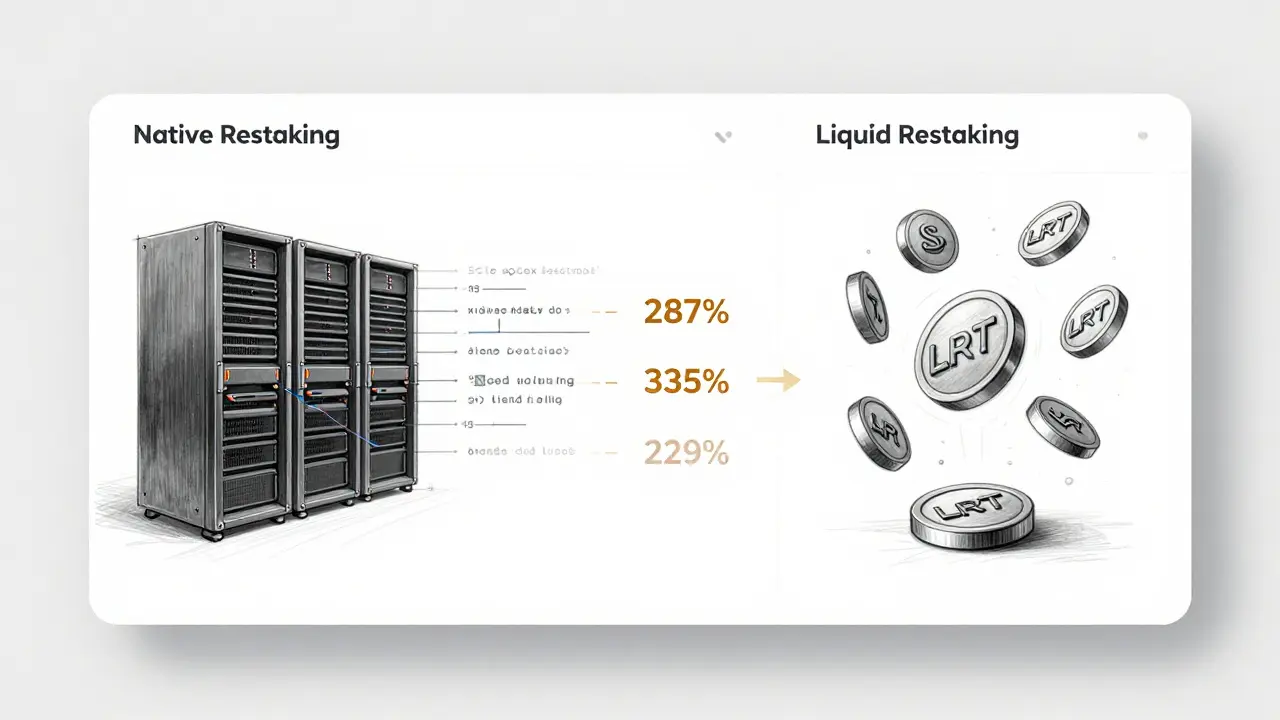
There are two main ways to restake: native and liquid.
Native restaking is for those who run their own Ethereum validator nodes. If you’re already running a node, you can install EigenLayer’s software and opt-in to secure AVSs. This gives you full control but requires technical know-how-think server setup, monitoring, and understanding slashing rules across multiple systems.
Liquid restaking is what most people use. You start by staking ETH through a liquid staking provider like Lido or Rocket Pool. In return, you get stETH or rETH-tokens that represent your staked ETH and can be traded or used in DeFi. Then, you deposit those tokens into a restaking protocol like EigenLayer. In return, you get LRTs (Liquid Restaking Tokens), which track your combined staked and restaked balance. The beauty? You still hold liquid tokens you can use elsewhere, while your ETH continues to earn rewards from multiple sources.
The Big Benefit: More Rewards, Less Idle Capital
The biggest draw of restaking is simple: you’re no longer leaving money on the table. Traditional staking on Ethereum might give you 3.5-4% APY. Restaking adds another 5-8% on top, depending on which AVSs you choose to support. That’s not a small bump-it’s nearly doubling your yield.
Why does this matter? Because crypto moves fast. If you’re only staking on Ethereum, you’re missing out on opportunities elsewhere. Maybe you want to earn from a decentralized AI data feed, or help secure a new zk-rollup. Restaking lets you do that without unstaking, selling, or moving your ETH. Your capital stays active, secure, and productive across multiple layers.
According to DAIC Capital’s Q2 2024 analysis, restaking creates “multi-layered rewards.” You’re not just earning from Ethereum anymore-you’re also getting paid for each AVS you help secure. And because these services are often new and need strong security, they offer higher incentives than Ethereum alone. Some users report earning 20-50% more than standard staking, especially when using high-demand AVSs.
The Hidden Risk: Slashing Across Multiple Protocols
Here’s where things get dangerous. With traditional staking, if your validator goes offline or misbehaves, you might lose a small portion of your ETH-usually between 0.1% and 5%. It’s a penalty, but it’s contained.
Restaking changes that. Now, you’re not just responsible for Ethereum’s rules. You’re also agreeing to the slashing conditions of every AVS you opt into. If one of those services gets hacked, misbehaves, or has a bug, your ETH can be slashed again. And it can happen multiple times.
This is called compounded slashing risk. Galaxy Research’s March 2024 report warned that this creates “single points of failure.” If a popular AVS gets exploited, thousands of restakers could lose part of their stake simultaneously. Imagine if 10% of restaked ETH was securing a flawed oracle-and that oracle got hacked. The fallout wouldn’t just hit one project. It could ripple across the entire restaking ecosystem.
And here’s the kicker: you might not even know what you’re securing. Many AVSs are experimental. Their code isn’t audited. Their operators aren’t well-known. Some users on Reddit’s r/ethstaker admit they don’t fully understand the risks of the AVSs they’re supporting. They just see the higher APY and click “Confirm.”
Concentration Risk: Too Much Power in One Place
Ethereum dominates restaking. Over 95% of all restaked assets are on EigenLayer. That’s not diversity-it’s centralization.
If something goes wrong with EigenLayer-or if its smart contracts have a flaw-it could affect billions of dollars worth of staked ETH. That’s not theoretical. In 2024, a bug in a minor AVS caused a temporary 2% loss for users who had restaked with it. While the loss was small, it exposed how fragile the system can be. Galaxy Research called this a “systemic risk” that could threaten Ethereum’s security if a major restaking failure occurred.
And unlike Ethereum’s native staking, which has been battle-tested for years, restaking protocols are still young. Their code hasn’t been through multiple market cycles. Smart contracts can have bugs. Oracles can be manipulated. Operators can go rogue. And if you’re restaking through a third-party app, you’re trusting their infrastructure too.
Who Should Restake-and Who Should Stay Away?
Restaking isn’t for everyone. Here’s who it works for:
- Experienced stakers who understand slashing, validator management, and DeFi risks.
- Long-term holders who aren’t planning to sell ETH and want to maximize passive income.
- Users who trust Ethereum and believe its security will remain strong even as it expands.
Here’s who should avoid it:
- Beginners who don’t know what a validator is or how slashing works.
- Those who can’t afford to lose even a small portion of their stake.
- People who want simplicity-restaking adds layers of complexity you can’t ignore.
Changelly’s beginner’s guide puts it bluntly: “Start small. Pick trusted platforms. Never commit more than you’re ready to lose.” That’s solid advice. Many users who lost money didn’t lose because of Ethereum-they lost because they restaked into an untested AVS they didn’t understand.

The Future: Modular Restaking and Broader Adoption
The next big update-EigenLayer v2, expected in late 2024-will let users choose which AVSs they want to support. Instead of opting into everything, you’ll be able to pick based on risk level: low, medium, or high. This could reduce exposure to dangerous protocols while still letting you earn from trusted ones.
There’s also talk of restaking expanding beyond Ethereum. Cosmos has begun testing similar models, and other PoS chains are watching closely. If this takes off, restaking could become a standard layer of blockchain infrastructure, potentially increasing Ethereum’s security budget by 3-5x, as Vitalik Buterin estimated in late 2023.
But adoption depends on solving two big problems: transparency and regulation. The U.S. SEC has hinted that restaking tokens might be considered securities. If that happens, platforms could be forced to shut down or restrict access. And without clear documentation on each AVS’s risk profile, users will keep flying blind.
Getting Started: A Real-World Example
If you’re ready to try it, here’s how one user did it:
- Staked 10 ETH through Lido and received 10 stETH.
- Connected their wallet to EigenLayer via the Renzo interface.
- Selected two low-risk AVSs: one for data availability and one for light client verification.
- Deposited 8 stETH into restaking and received 8 LRTs.
- Now earns 4% from Ethereum staking + 6% from AVSs = 10% total APY.
They kept 2 stETH outside restaking as a buffer. They monitor their position weekly. They never put more than 20% of their total ETH into restaking. That’s the smart way to do it.
Final Thoughts: Power With Responsibility
Restaking is one of the most powerful tools to emerge from Ethereum’s upgrade to proof-of-stake. It turns passive assets into active contributors to the entire crypto ecosystem. But it’s not a free lunch. Higher yields come with higher stakes-literally.
The best restakers aren’t the ones chasing the highest APY. They’re the ones who understand the risks, start small, and stay informed. They know that in crypto, the most valuable asset isn’t your ETH-it’s your ability to make smart choices.
Is restaking safe?
Restaking isn’t inherently unsafe, but it’s riskier than regular staking. You’re exposing your ETH to slashing conditions from multiple protocols, not just Ethereum. If one of those protocols gets hacked or has a bug, you could lose part of your stake. It’s only safe if you understand the risks, stick to well-audited platforms like EigenLayer, and never stake more than you can afford to lose.
Can I lose all my ETH with restaking?
You won’t lose all your ETH in a single event-slashing typically caps at 5-10% of your staked amount per incident. But if multiple AVSs fail at once, or if EigenLayer itself is compromised, the losses could add up. The risk isn’t total loss, but partial, repeated loss across different protocols. That’s why experts recommend limiting restaking to 20-30% of your total staked ETH.
Do I need to run a validator to restake?
No. Most users restake through liquid staking platforms like Lido, Rocket Pool, or Renzo. These services handle the technical side. You just deposit your stETH or rETH into a restaking protocol and receive LRTs in return. Running a validator is only necessary if you want to do native restaking, which is for advanced users with server experience.
How much extra yield can I earn from restaking?
On average, restaking adds 5-8% APY on top of Ethereum’s base staking yield of 3.5-4%. That means total returns can reach 8-12% APY. Some users report up to 15% by choosing high-reward AVSs, but those often come with higher risk. Yields change based on demand for security services, so they’re not guaranteed.
What happens if an AVS gets hacked?
If an AVS you’re securing gets hacked or misbehaves, your staked ETH can be slashed-meaning a portion of it gets permanently burned as a penalty. The amount depends on the severity of the offense. This is why some AVSs have lower rewards: they’re riskier. Always check the security audit status and operator reputation of any AVS before restaking into it.
Is restaking regulated?
Regulation is still unclear. The U.S. SEC has raised concerns that restaking tokens might be classified as securities, which could force platforms to restrict access or shut down. There’s no official rule yet, but the regulatory environment is shifting. If you’re in a jurisdiction with strict crypto rules, you should assume restaking could be treated as an investment product and prepare for potential restrictions.
Sahithi Reddy
March 21, 2026 AT 16:48Zachary N
March 22, 2026 AT 19:09Lauren J. Walter
March 24, 2026 AT 10:12Henrique Lyma
March 24, 2026 AT 10:47Anastasia Danavath
March 25, 2026 AT 01:22Prakash Patel
March 26, 2026 AT 02:50Elizabeth Kurtz
March 28, 2026 AT 00:50Marc Morgan
March 29, 2026 AT 06:59Graham Smith
March 29, 2026 AT 08:07Katrina Smith
March 31, 2026 AT 00:09Konakuze Christopher
March 31, 2026 AT 12:15Angelica Stovall
April 1, 2026 AT 05:23Taylor Holloman.
April 2, 2026 AT 02:56Bryan Roth
April 3, 2026 AT 08:10anshika garg
April 4, 2026 AT 11:33Gene Inoue
April 5, 2026 AT 23:32Ricky Fairlamb
April 6, 2026 AT 19:41Tony Weaver
April 8, 2026 AT 02:09Patty Atima
April 8, 2026 AT 18:37Lucy de Gruchy
April 10, 2026 AT 04:02Carol Lueneburg
April 11, 2026 AT 05:49Ernestine La Baronne Orange
April 11, 2026 AT 11:37Manali Sovani
April 13, 2026 AT 04:16john peter
April 14, 2026 AT 22:37Anastasia Thyroff
April 15, 2026 AT 11:37Kira Dreamland
April 16, 2026 AT 14:59sai nikhil
April 16, 2026 AT 22:29George Hutchings
April 17, 2026 AT 18:57Bruce Doucette
April 18, 2026 AT 11:14Ross McLeod
April 19, 2026 AT 04:49