Binopoly (BINO) Airdrop Guide: Details, Risks, and How to Participate
Chasing free money in the crypto world is a dangerous game. You see a ticker like BINO, you hear "airdrop," and your finger hovers over the claim button before your brain catches up. If you are looking for Binopoly airdrop details, here is the harsh truth right now: information is scarce, fragmented, and often confusing due to name clashes with other projects. As of September 2026, there is no massive, widely publicized snapshot event for Binopoly comparable to giants like Arbitrum or Optimism. Instead, what exists are niche promotional mechanics on specific exchanges and a lot of noise from look-alike tokens.
This guide cuts through the fog. We will look at what Binopoly actually is, how its distribution works via platforms like Bitget, why you need to be careful about the "BinoFi" confusion, and exactly what steps you should take if you want to hold this asset. No fluff, just the concrete data available today.
Key Takeaways
- Limited Official Data: There is no single, comprehensive official whitepaper detailing a fixed BINO airdrop schedule; most access comes through exchange-specific challenges.
- Name Confusion Risk: Do not confuse Binopoly (the prediction market project) with BinoFi (a hybrid exchange presale), as both use the BINO ticker.
- Exchange-Centric Distribution: The primary way to acquire BINO via airdrop mechanisms is through Bitget's "Learn & Earn" or challenge sections, not broad wallet snapshots.
- Liquidity Warning: Market data for BINO is currently inactive or showing placeholder values (--), indicating low trading volume and high volatility risk.
- Web3 Wallet Requirement: Since major centralized exchanges like Binance may not list BINO directly, users often need Web3 wallets to interact with decentralized exchanges (DEXs).
What Is Binopoly (BINO)?
To understand the airdrop, you first need to know what you are getting. Binopoly is a blockchain-based prediction market platform that allows users to bet on real-world events using cryptocurrency. Unlike traditional sportsbooks, it leverages smart contracts to ensure transparency and automated payouts. The native token, BINO, serves as the utility asset for staking, governance, and fee reduction within this ecosystem.
The project aims to solve the trust issues inherent in off-chain betting by moving everything on-chain. However, unlike established prediction markets such as Polymarket, Binopoly operates with a smaller footprint. This smaller scale directly impacts how they distribute their tokens. They cannot afford the multi-million dollar marketing budgets required for global viral campaigns, so their "airdrops" are often targeted rewards for early adopters and active traders on partner platforms.
The BINO Ticker Clash: Binopoly vs. BinoFi
Here is where most people get burned. In the crypto space, ticker symbols are not unique identifiers. Both Binopoly and BinoFi have used or plan to use the ticker BINO. This creates a significant semantic trap for anyone searching for "BINO airdrop."
BinoFi is a hybrid exchange model combining centralized liquidity with decentralized transparency, currently in a presale phase. Analysts have speculated on high ROI potential for BinoFi, citing figures like a $0.02 presale price targeting a $0.30 listing. This has generated buzz, but it is distinct from Binopoly.
| Feature | Binopoly | BinoFi |
|---|---|---|
| Primary Use Case | Prediction Markets / Betting | Hybrid Exchange / Trading |
| Airdrop Mechanism | Exchange Challenges (e.g., Bitget) | Presale Rewards / Early Investor Allocation |
| Market Status | Listed, Low Volume, Placeholder Data | Presale Phase / Upcoming Listing |
| Technology Focus | Smart Contract Betting | MPC Wallets & Cross-Chain Liquidity |
If you are researching an airdrop, check the contract address. Binopoly’s contract typically starts with 0xa2df... and ends in 05eb592 (note: always verify full addresses on Etherscan or BscScan). If the contract doesn't match, you might be looking at the wrong project entirely.

How to Participate in Binopoly Airdrops
Since there is no universal "connect wallet and claim" portal that everyone uses, participation is fragmented. The most reliable source for current BINO distributions appears to be Bitget, which hosts ongoing challenges and promotions where users can earn free Binopoly tokens.
Here is the practical workflow for catching these opportunities:
- Create a Bitget Account: Complete KYC verification. Most legitimate airdrops require identity checks to prevent Sybil attacks (where one person makes thousands of fake accounts).
- Navigate to the Promotions Hub: Look for the "Rewards Center" or "Learn & Earn" section. Search specifically for "Binopoly" or "BINO."
- Complete the Tasks: These usually involve simple actions like:
- Reading a short article about the project.
- Taking a quiz about prediction markets.
- Making a small trade (often $10-$50 equivalent) to prove activity.
- Claim Tokens: Once tasks are verified, the BINO tokens appear in your spot account. Note that withdrawal fees may apply if you move them to a personal wallet immediately.
Be aware that these campaigns are episodic. If you miss one, you don't lose eligibility forever, but you do miss the immediate reward window. There is no retroactive compensation for past months unless explicitly stated in a new campaign announcement.
Market Reality: Liquidity and Price Data
You might expect to see a vibrant green chart when you search for BINO. Instead, many trackers show -- for price, market cap, and volume. What does this mean?
It indicates thin liquidity. In crypto, price is determined by the last trade. If no one trades for days, the price looks static or disappears from aggregators. For Binopoly, this suggests that while the token exists, it is not heavily traded compared to top-tier assets. This has two implications for airdrop recipients:
- Slippage Risk: If you receive 1,000 BINO and try to sell them all at once, you might crash the local price because there aren't enough buyers on the other side.
- Valuation Uncertainty: Without consistent volume, it is hard to know the "fair" value of your airdrop. It could be worth $10 or $100 depending on who is buying at that exact second.
Some predictive models suggest a cumulative ROI of 0.00% for BINO in 2026, which sounds bleak. However, these models often rely on historical volume data. If a new feature launch drives usage, this can change overnight. But you must treat the current flatline as a warning sign, not a guarantee of future growth.
Alternative Acquisition: Web3 and DEXs
Not everyone wants to keep funds on an exchange like Bitget. If you prefer self-custody, you need to know that Binance does not currently list Binopoly on its central spot exchange. This means you cannot simply buy BINO with USDT on the main Binance interface.
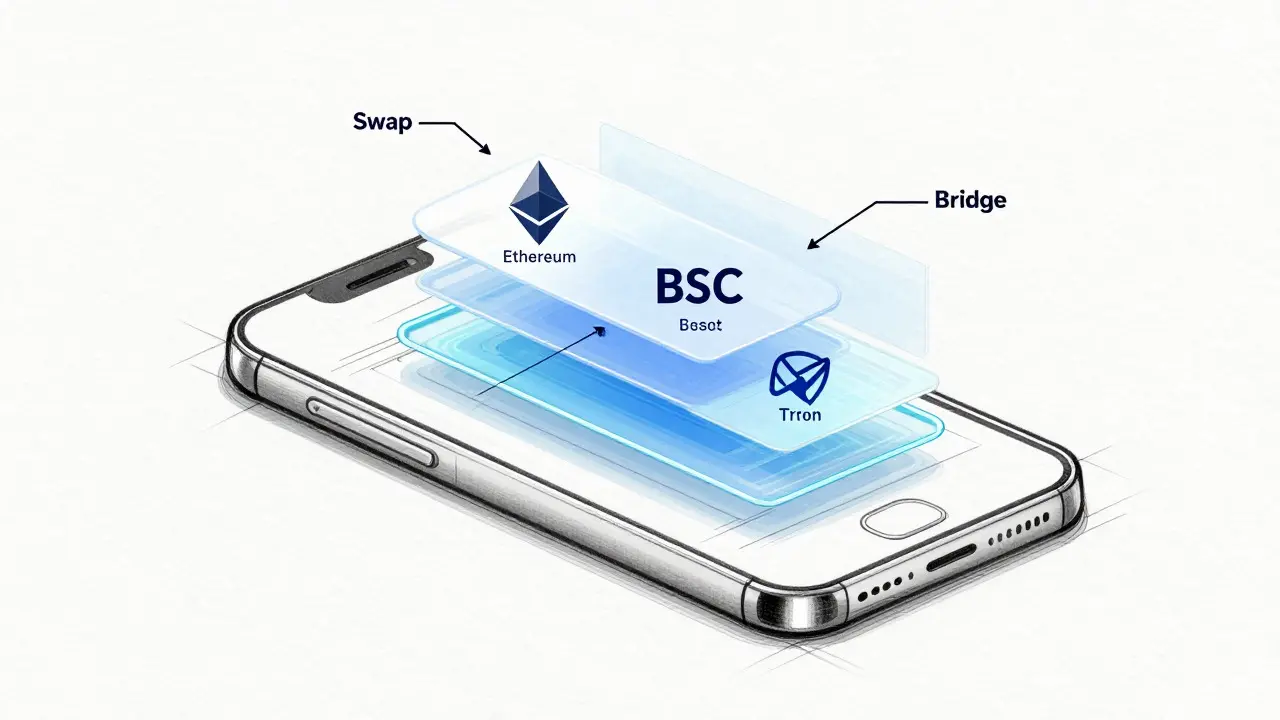
Instead, you must use the Binance Web3 Wallet or another compatible decentralized application (dApp) browser. From there, you connect to a Decentralized Exchange (DEX) like PancakeSwap (if on BSC) or Uniswap (if on Ethereum/Polygon, depending on the chain deployment).
Steps for DEX acquisition:
- Open your Web3 Wallet.
- Select the correct network (Check the official Binopoly docs for the chain ID).
- Go to the Swap tab.
- Paste the BINO contract address (do not search by name alone to avoid scams).
- Execute the swap.
This method gives you true ownership, but remember: if you send your tokens to the wrong address or network, they are gone forever. Always test with a small amount first.
Risks and Red Flags
When dealing with lesser-known airdrops, vigilance is key. Here are the specific risks associated with Binopoly:
- Phishing Scams: Because the official website traffic is lower, scammers create clone sites. If a site asks for your seed phrase to "claim" an airdrop, it is a scam. Legitimate airdrops never ask for private keys.
- Vesting Schedules: Check if the tokens you receive are fully liquid. Some projects lock airdropped tokens for 6-12 months. Read the fine print on the Bitget promotion page.
- Project Viability: Prediction markets are competitive. With giants like Polymarket dominating mindshare, Binopoly needs to innovate to survive. If user adoption stalls, the token utility diminishes.
Final Verdict: Is It Worth Your Time?
If you are already a user of Bitget and enjoy prediction markets, participating in Binopoly challenges is low-effort and potentially rewarding. The cost is time spent reading articles or making small trades. However, if you are hunting for a life-changing windfall, BINO might disappoint given the current low volume and lack of major tier-1 exchange listings.
Keep your expectations realistic. Treat any BINO tokens as speculative bonuses rather than core portfolio holdings. Monitor the official channels for updates on new partnerships, as a listing on a larger exchange would likely spike interest and volume, validating the earlier airdrop participants.
Is Binopoly the same as BinoFi?
No, they are different projects that share the same ticker symbol (BINO). Binopoly focuses on prediction markets, while BinoFi is a hybrid exchange project often in presale stages. Always verify the contract address to ensure you are interacting with the correct token.
Where can I find the official Binopoly airdrop link?
There is no single permanent URL for a general airdrop. Most distributions occur through specific campaigns on exchanges like Bitget under their "Promotions" or "Rewards" tabs. Check the official Binopoly social media channels (Twitter/X, Telegram) for links to current active campaigns.
Why does the BINO price show as '--' on some trackers?
This usually indicates low trading volume or a temporary data feed issue. If there are no recent trades, aggregators may fail to display a current price. It reflects limited liquidity rather than necessarily meaning the token is worthless.
Can I buy BINO on Binance?
As of late 2025/early 2026, BINO is not listed on Binance Centralized Exchange (CEX). You typically need to use the Binance Web3 Wallet to access decentralized exchanges (DEXs) or purchase it on platforms like Bitget.
Are Binopoly airdrops taxable?
In many jurisdictions, including New Zealand and the US, crypto airdrops received for services (like completing tasks) are considered taxable income at their fair market value upon receipt. Consult a local tax professional for advice specific to your location.