
Blockchain Health Records Interoperability: How It Works in 2026
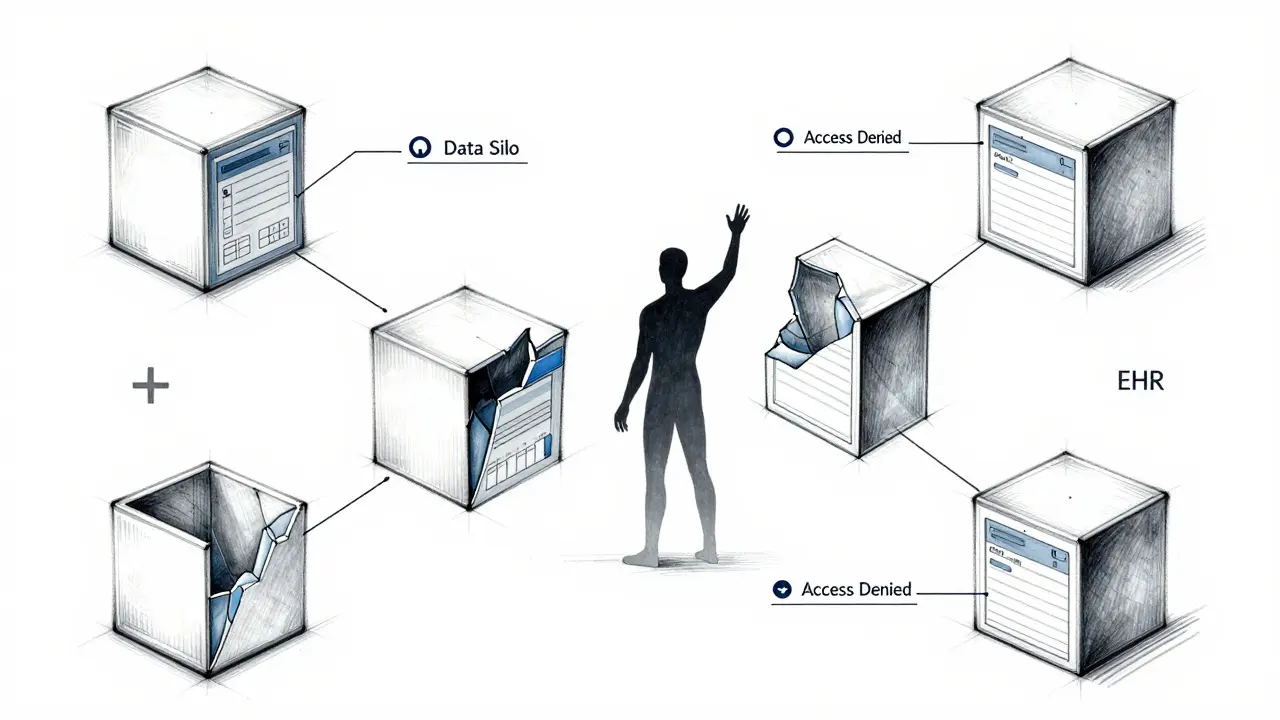
Imagine walking into a new hospital after an emergency, only to find that the doctors don't have your allergy history or past surgeries. You spend twenty minutes trying to remember details while they wait. This is the daily reality for millions of patients because healthcare data is trapped in silos. Blockchain health records are a decentralized system that uses immutable ledgers to create a unified, tamper-evident record of patient data across different providers. By solving the fragmentation problem, this technology allows patients to own their data and share it securely with any provider, anywhere.
The core issue isn't just about storage; it's about trust. Traditional Electronic Health Records (EHRs) were designed for single institutions, not for managing a person's lifetime of medical history across dozens of clinics, labs, and hospitals. When you switch providers, your data often stays behind. Blockchain changes the dynamic by creating a shared source of truth that no single entity controls entirely, yet everyone can verify.
Why Current Systems Fail at Sharing Data
Healthcare data is currently scattered across disparate organizations. Most hospital systems cannot easily or safely share data with each other. This leads to three major problems: inefficiencies, medical errors, and security risks. When a doctor in one city treats a patient who was hospitalized in another state, they are essentially flying blind unless the patient physically brings paper records or a USB drive.
The traditional model places stewardship of data with the provider, not the patient. If you leave a hospital, you lose easy access to your own file. Blockchain flips this script. It enables lifelong, patient-owned records stored in an interoperable system. This distribution of health information across a secure, peer-to-peer network means each transaction is immutable, timestamped, and transparent. For clinical decision-making, especially in telemedicine and precision medicine, this creates a collaborative environment where data flows as needed, rather than being locked away.
How Blockchain Solves Interoperability
Interoperability in this context doesn't just mean software talking to software; it means different healthcare entities trusting each other without a central middleman. A systematic review identified five necessary characteristics for successful implementation: governance, interoperability, privacy, scalability, and security. Blockchain addresses these by providing a decentralized trust mechanism.
Here is how the architecture typically works:
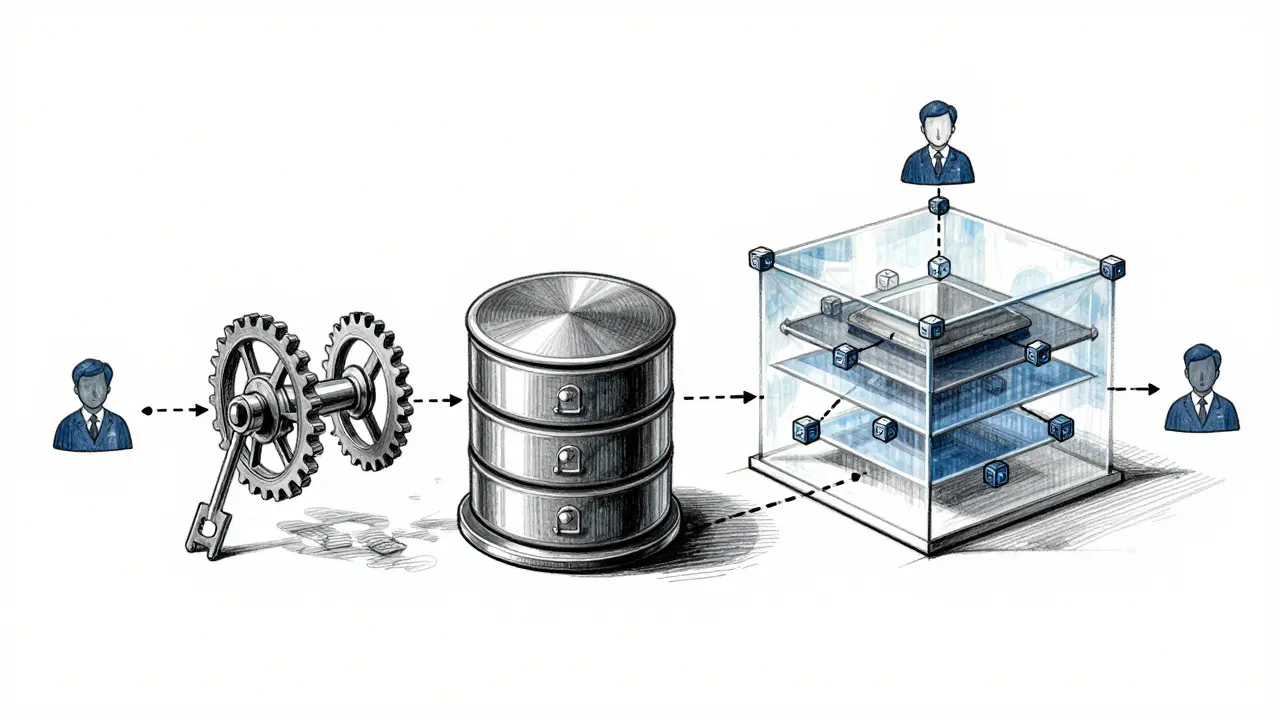
- Data Storage: Protected Health Information (PHI) is kept off-chain in encrypted databases within HIPAA-compliant cloud environments. Storing raw data on the public ledger would be inefficient and risky.
- Hashing: Only the cryptographic hash of the data and the transaction details are recorded on the blockchain. This creates an audit trail that proves when data was accessed or changed without revealing the content itself.
- Access Control: Smart contracts manage who can view the data. Patients grant temporary keys to specific doctors or researchers, revoking access when the treatment ends.
This hybrid approach preserves privacy while leveraging the blockchain’s strengths: strong encryption, immutable audit trails, and patient-centric control. It solves the "prominence" problems seen in 31.98% of recent studies, which focused specifically on fragmented EHRs and unauthorized access risks.
Key Technical Frameworks and Tools
Not all blockchains are created equal. In healthcare, permissioned networks are generally preferred over public ones like Bitcoin due to privacy and speed requirements. Two frameworks dominate the current landscape:
| Feature | Hyperledger Fabric | Ethereum |
|---|---|---|
| Network Type | Permissioned (Private) | Public / Hybrid |
| Consensus Mechanism | Pluggable (e.g., Raft) | Proof of Stake |
| Privacy Model | Channel-based isolation | Smart contract logic |
| Best For | Hospital consortiums, enterprise integration | Patient-facing apps, tokenized assets |
Hyperledger Fabric is an open-source distributed ledger platform designed for building solutions in multiple industries. It is particularly popular in healthcare because it allows participants to define their own privacy levels using channels. This makes it ideal for hospital groups that need to share data internally but keep it private from competitors.
Ethereum, on the other hand, offers a massive developer ecosystem. Its smart contract capabilities allow for complex logic, such as automatic insurance claims processing. However, its public nature requires careful handling of PHI, usually by keeping the actual data off-chain and only storing references on the chain.
Navigating Regulatory Compliance: HIPAA and GDPR
A common misconception is that blockchain automatically ensures compliance. In reality, the immutability of the ledger can conflict with regulations like the General Data Protection Regulation (GDPR), which grants patients the "right to be forgotten." If a record is permanently written to the chain, how do you delete it?
The solution lies in the hybrid architecture mentioned earlier. Since the actual patient data lives in a compliant database, you can delete or update the data there. The blockchain entry remains as a historical proof that a record existed at a certain time, but the sensitive content is removed or updated. For US-based implementations, HIPAA is a set of national standards to protect individuals' medical records and other personal health information. To comply, the off-chain storage must be in a HIPAA-compliant environment, and Business Associate Agreements (BAAs) must be signed between the blockchain node operators and the healthcare providers.
Emergency access is another regulatory hurdle. Doctors need immediate data during crises, but strict access controls can slow them down. Robust "break-glass" mechanisms are essential. These allow authorized personnel to bypass standard permissions in life-threatening situations, logging the action on the blockchain for later audit. Without this, the system becomes a liability rather than a tool.
Real-World Applications and Benefits
Theoretical benefits are great, but what does this look like in practice? Solutions like HealthChain utilize proxy re-encryption and smart contracts to allow patients to dynamically share data. Imagine a patient traveling abroad. They can grant access to a local clinic via a simple digital key, allowing the doctor to see relevant history without the patient needing to register again under a new system's controller.
Key benefits observed in pilots include:
- Reduced Redundancy: Labs don't repeat tests if previous results are verified on the chain.
- Supply Chain Transparency: Tracking pharmaceuticals from manufacturer to patient to prevent counterfeits.
- Automated Insurance: Smart contracts trigger payments when specific conditions are met, reducing administrative overhead.
- Better Clinical Decisions: AI models integrated with blockchain data can analyze large volumes of anonymized records to identify patterns for personalized care.
Market trends support this shift. Healthcare data is expected to grow by 36% in 2025, driven by digital health adoption. As cyberattacks against hospitals intensify, the resilience offered by a decentralized, tamper-evident system becomes a critical asset. It minimizes the risk of a single point of failure, which is a significant vulnerability in centralized server farms.

Challenges to Overcome in 2026
Despite the progress, hurdles remain. Cross-border mobility is still complex. If a patient moves countries, they may need to interact with different smart contract controllers, preventing a seamless global view of their records. The lack of integration across different blockchain deployments means that a record on Network A might not be instantly readable on Network B without bridging protocols.
Furthermore, blockchain does not inherently fix data format issues. If Hospital A uses XML and Hospital B uses JSON, the blockchain can verify the integrity of both files, but it doesn't automatically translate them. Standardization efforts, such as those by HL7 FHIR, must work in tandem with blockchain layers to ensure true semantic interoperability.
Culture change is perhaps the biggest barrier. Healthcare providers are accustomed to owning their data. Shifting to a model where the patient is the primary custodian requires education and trust-building. Successful integration involves more than just deploying code; it requires comprehensive change management strategies to ensure staff understand how to use these new tools effectively.
Frequently Asked Questions
Is blockchain health records data fully anonymous?
Not necessarily. While the data on the chain is hashed and linked to a pseudonymous identifier, the link between the identifier and the real patient identity exists in the off-chain database. True anonymity depends on how well the off-chain system is secured and whether zero-knowledge proofs are used to hide even the metadata.
Can I edit my health record on the blockchain?
You cannot directly edit the blockchain entries because they are immutable. However, you can add new entries that supersede old ones, or if the error is in the off-chain data, the provider can update the database. The blockchain will then record a new transaction pointing to the corrected version, maintaining a full audit trail of the correction.
What happens if a hospital goes bankrupt?
This is one of the main advantages of blockchain. Since the data is not solely owned by the hospital but distributed across the network, the records remain accessible to the patient and other authorized providers. The patient retains their digital keys, ensuring continuity of care regardless of the status of any single institution.
Does blockchain replace Electronic Health Records (EHR)?
No, it complements them. EHRs are still needed for day-to-day clinical workflow and detailed note-taking. Blockchain acts as the interoperability layer and the trust anchor, ensuring that data shared between different EHR systems is authentic and unaltered. It connects the silos rather than replacing the containers.
How fast are transactions on healthcare blockchains?
Speed varies by framework. Permissioned networks like Hyperledger Fabric can process hundreds to thousands of transactions per second, which is sufficient for most healthcare needs. Public chains like Ethereum may be slower depending on network congestion, but since heavy data is off-chain, the bottleneck is rarely the blockchain itself.