Drift Protocol Review: Is This Solana DEX Safe for Perpetual Trading in 2026?
Trading perpetual futures on Ethereum feels like trying to run a marathon in quicksand. You know where you want to go, but the gas fees and slow block times keep dragging you down. That is exactly why Drift Protocol was built. Launched in December 2022 by CEO Hyunwoo Kim and his team, Drift sits on the Solana blockchain, leveraging its high throughput to offer sub-600 millisecond trade execution. By late 2025, it had processed over $50 billion in cumulative volume, proving that decentralized derivatives don't have to be slow or expensive.
If you are looking for a platform that mimics the speed of centralized exchanges (CEXs) like Binance while keeping your keys private, Drift v2 is a serious contender. But does it actually work as well in practice as the specs suggest? Let’s break down the architecture, the risks, and whether it fits your trading style.
The Smart Margin Advantage
The biggest differentiator for Drift isn’t just speed; it is capital efficiency. Most decentralized exchanges force you into isolated margin accounts. This means if you want to trade Bitcoin and Ethereum simultaneously, you need separate collateral for each position. It is inefficient and clunky.
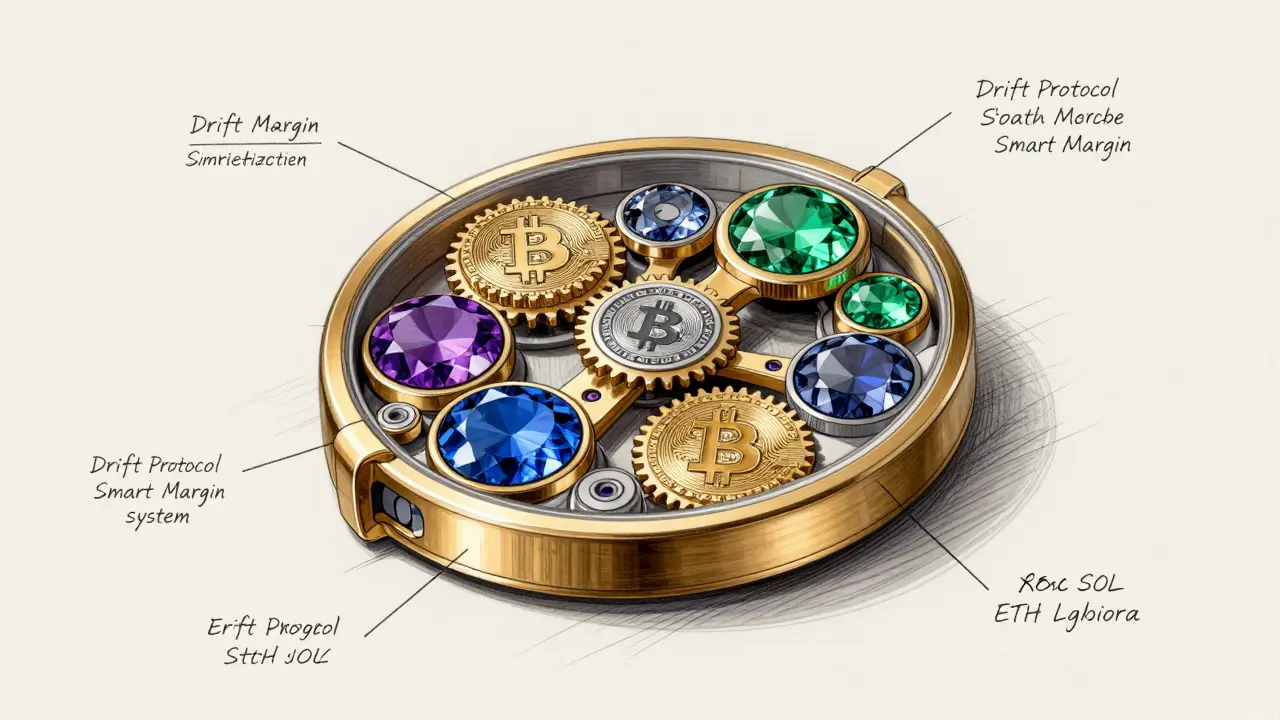
Drift uses a system called Smart Margin. Think of it as a unified wallet for all your positions. You deposit one type of collateral-say, USDC-and can open long or short positions across multiple markets like SOL, BTC, or ETH from that single pool. Internal testing showed this approach provides 37% higher capital efficiency compared to isolated margin systems. For professional traders who hedge across correlated assets, this feature alone saves significant time and reduces idle capital.
- Unified Collateral: Manage multiple positions with one deposit.
- Cross-Market Hedging: Offset losses in one asset with gains in another without moving funds.
- Simplified UX: No need to approve separate transactions for every new market entry.
This architecture mirrors the cross-margin systems seen on platforms like FTX before its collapse, but with the added security of being non-custodial and open-source. However, convenience comes with risk. If one position goes against you heavily, it draws from your entire collateral pool, potentially liquidating other healthy positions if you aren’t careful.
Speed, Liquidity, and The JIT Mechanism
On Solana, speed is expected. Drift delivers with a Just-In-Time (JIT) liquidity mechanism. When you place an order, the protocol pulls liquidity from providers instantly, ensuring minimal slippage. For retail traders executing orders under $100,000, this works beautifully. Gasless trading for order placement and cancellation means you don’t pay transaction fees for every click, which is a massive quality-of-life improvement over Ethereum-based competitors like dYdX or GMX.
However, liquidity depth remains the Achilles' heel of any DEX. As of August 2025, Drift’s average order book depth was 1.2 BTC at 0.1% slippage, compared to 8.7 BTC on Binance Futures. If you are an institutional trader trying to enter a $5 million position, you will move the market significantly on Drift. During the March 2025 BTC flash crash, Drift’s liquidation engine processed 78% of positions within safety parameters, whereas Hyperliquid managed 91%. While still respectable, it highlights that extreme volatility can expose gaps in decentralized liquidity pools.
| Feature | Drift Protocol | dYdX | Binance Futures |
|---|---|---|---|
| Blockchain | Solana | Avalanche/Starknet | Centralized |
| Execution Speed | <600ms | ~2-5 seconds | <100ms |
| Margin System | Smart (Unified) | Isolated/Cross | Cross/Isolated |
| Max Leverage | 50x | Up to 75x | Up to 125x |
| Gas Fees | Near Zero | Low/Medium | None |
Security: Audits and the Safety Module
In DeFi, code is law, but bad code loses money. Drift takes security seriously. The codebase is open-source under the Apache-2.0 license. Between January 2023 and August 2025, they underwent 14 comprehensive audits by firms including Trail of Bits, Neodyme, and OtterSec. All critical vulnerabilities were patched within 30 days of discovery.
But audits only catch static bugs. What happens when the market moves against the protocol? Drift relies on a Dynamic Risk Engine that monitors positions every 400 milliseconds. Prices are fed by Pyth Network oracles, updating every 15 seconds. To backstop potential losses, Drift uses a Debt Safety Module (DSM). Users stake DRIFT tokens to create an insurance fund. As of September 2025, this fund held $23.7 million and had covered 12 instances of bad debt totaling $867,000. This proves the system works, but remember: if the losses exceed the DSM, stakers lose their tokens. There is no external bailout.
User Experience and Common Pitfalls
Getting started requires a Solana wallet like Phantom or Backpack. The learning curve is moderate. New users typically spend 8-12 hours mastering features like cross-margin optimization. The documentation is rated 4.2/5 on GitHub, with plenty of video tutorials.
However, real-world usage reveals some friction points. Wallet connection failures are reported in 23% of user reviews. Price feed discrepancies during Solana network congestion happen too-about 18% of users noted issues during peak traffic. If Solana halts, Drift pauses. In Q2 2025, three protocol pauses caused $4.2 million in unrealized PnL discrepancies. It is rare, but it is a systemic risk you must accept when building on Solana.
Support is surprisingly robust for a DEX. Their Discord channel maintains a 92% satisfaction rating, with 24/7 active moderators. For those less technical, the September 2025 v2.3 upgrade introduced Social Trading, allowing you to copy the top 100 traders. Early adoption saw 12,000 followers allocating $47 million in copied positions, suggesting the platform is successfully lowering the barrier to entry for novice traders.
Tokenomics and Governance
The DRIFT token is more than just a governance tool. After the October 2025 overhaul, it serves multiple utilities: governing risk parameters, providing insurance coverage via the DSM, and earning fee shares. The price has been consolidating around $0.75 after 220 days of range-bound trading. Predictions vary wildly; TradingBeast forecasts a rise to $1.02 by December 2025, while WalletInvestor predicts a drop to $0.38 due to competition from Hyperliquid V3.
For traders, holding DRIFT doesn’t directly reduce fees, but participating in the DSM earns you a share of the protocol’s revenue. This aligns incentives: users who help secure the protocol benefit from its success.
Who Should Use Drift?
Drift is not for everyone. If you are a casual investor buying and holding Bitcoin, stick to a simple spot exchange. Drift is designed for active traders.
- Use Drift if: You trade frequently, want low fees, prefer self-custody, and understand the risks of smart contracts and oracle failures.
- Avoid Drift if: You are executing massive institutional-sized orders (liquidity depth is limited), you cannot tolerate occasional network pauses, or you are uncomfortable managing your own leverage ratios.
With daily fee revenues peaking at nearly $1 million in September 2025, Drift is clearly gaining traction. It holds 19% of Solana’s derivatives market share. As regulatory scrutiny increases-with the SEC targeting derivatives protocols in July 2025-Drift has implemented geo-blocking for 32 high-risk jurisdictions. This adds a layer of compliance that might appeal to cautious traders, though it limits accessibility.
Is Drift Protocol safe to use?
Drift is considered relatively safe due to its extensive audit history (14 audits by top firms) and the Debt Safety Module which covers bad debt. However, it carries standard DeFi risks including smart contract vulnerabilities, oracle manipulation, and Solana network instability. Always use cold wallets for large holdings and never trade with money you cannot afford to lose.
How does Drift compare to dYdX?
Drift offers faster execution (sub-second vs. seconds) and lower fees due to the Solana blockchain. It also features a superior Smart Margin system for capital efficiency. dYdX may have slightly higher overall liquidity depth and supports more varied chain environments, making it better for very large orders.
What is the maximum leverage on Drift?
Drift offers up to 50x leverage on major assets like SOL, BTC, and ETH. Higher leverage increases both potential profits and the risk of rapid liquidation.
Can I use Drift on mobile?
Yes, Drift is accessible via web browsers on mobile devices. Since it is a web-based interface connected to your Solana wallet (like Phantom), it works seamlessly on iOS and Android without needing a dedicated app download.
Does Drift charge gas fees?
No, Drift utilizes a gasless model for order placement and cancellation. Users do not pay transaction fees for these actions, making it significantly cheaper than Ethereum-based DEXs.