
E-CNY vs Bitcoin: How China’s Digital Currency Strategy Is Replacing Crypto

China isn’t trying to improve Bitcoin. It’s trying to erase it. While Bitcoin runs on a decentralized network where no single entity controls the money, China’s e-CNY - the digital yuan - is designed to put every transaction under the watch of the state. This isn’t a new experiment. It’s a full-scale replacement strategy, and it’s already working.
What Is the E-CNY, Really?
The e-CNY is not a cryptocurrency. It’s not even close. It’s the digital version of the Chinese yuan, issued and managed entirely by the People’s Bank of China. Think of it like cash, but tracked in real time. Every time someone uses it to buy coffee, pay rent, or take a bus, the government knows exactly who paid, who received, and when. There’s no anonymity. No pseudonymity. Just a direct line to the central bank.
By mid-2024, over 7.3 trillion yuan (about $1 trillion USD) had moved through the e-CNY system. That’s not a small number. It’s more than the entire market value of Bitcoin at its peak in 2021. The system works on smartphones, even without internet - using NFC chips like contactless payments. It doesn’t need a bank account. It doesn’t need a credit card. It just needs a government-approved digital wallet.
By 2025, the digital yuan was active in 26 major cities, including Beijing, Shanghai, and Shenzhen. Civil servants in some areas are paid in e-CNY. Public transport, grocery stores, and even McDonald’s accept it. The goal? Make cash obsolete - and replace private digital money with state-controlled money.
Why Bitcoin Can’t Survive in China
Bitcoin’s whole appeal is freedom. No government. No middleman. No tracking. That’s exactly why China banned it.
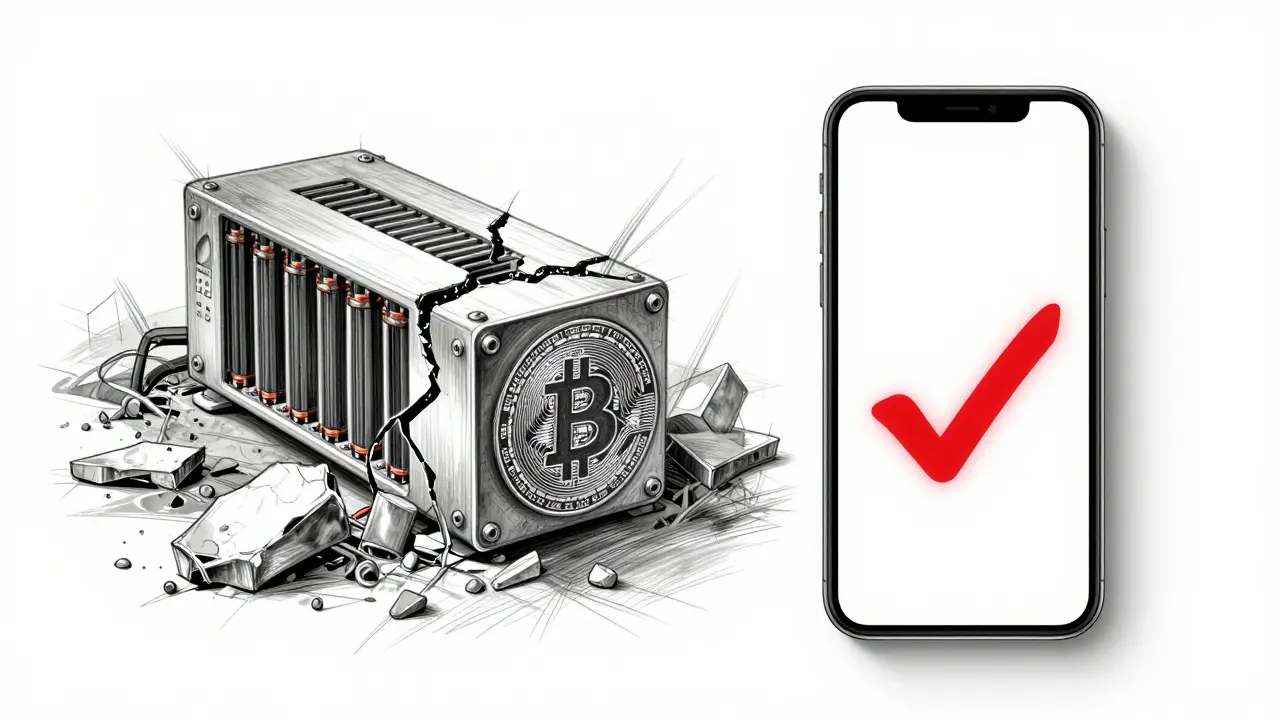
In 2021, China outlawed Bitcoin mining. All mining rigs were shut down. In 2023, trading platforms were forced to close. By 2025, it’s illegal to even hold Bitcoin as a speculative asset. The government doesn’t just block websites - it uses AI-powered tools to scan blockchain activity, track wallet addresses, and identify users who try to bypass restrictions using VPNs or peer-to-peer trades.
Here’s how strict it is: if you send Bitcoin from one wallet to another, Chinese authorities can see the transaction. They don’t need to know your name - but they can link your phone number, IP address, or payment history to that wallet. If you’re caught, your assets can be frozen. Your device can be seized. You can be fined. Or worse.
China also enforces the Financial Action Task Force’s Travel Rule - meaning every digital wallet must be registered with real-name information. No anonymous transfers. No privacy. No loopholes. That’s the opposite of Bitcoin’s design.
Technical Differences: Control vs. Chaos
Let’s compare them side by side.
| Feature | E-CNY (Digital Yuan) | Bitcoin |
|---|---|---|
| Issuer | People’s Bank of China | No central authority |
| Supply | Unlimited - can be printed anytime | Fixed at 21 million coins |
| Privacy | Zero anonymity - fully traceable | Pseudonymous - public ledger, hidden identities |
| Transaction Speed | Up to 100,000 transactions per second | 7 transactions per second |
| Energy Use | Minimal - runs on existing banking servers | High - requires massive mining power |
| Use Case | Domestic retail payments, government disbursements | Global store of value, speculative asset |
| Regulation | Strict KYC/AML - all users registered | No regulation - global, unregulated |
The e-CNY isn’t built for investment. It’s built for control. Bitcoin was designed to escape control. That’s why they can’t coexist in the same system.
How China Is Winning the Digital Currency War
China isn’t just banning Bitcoin - it’s building a global alternative.
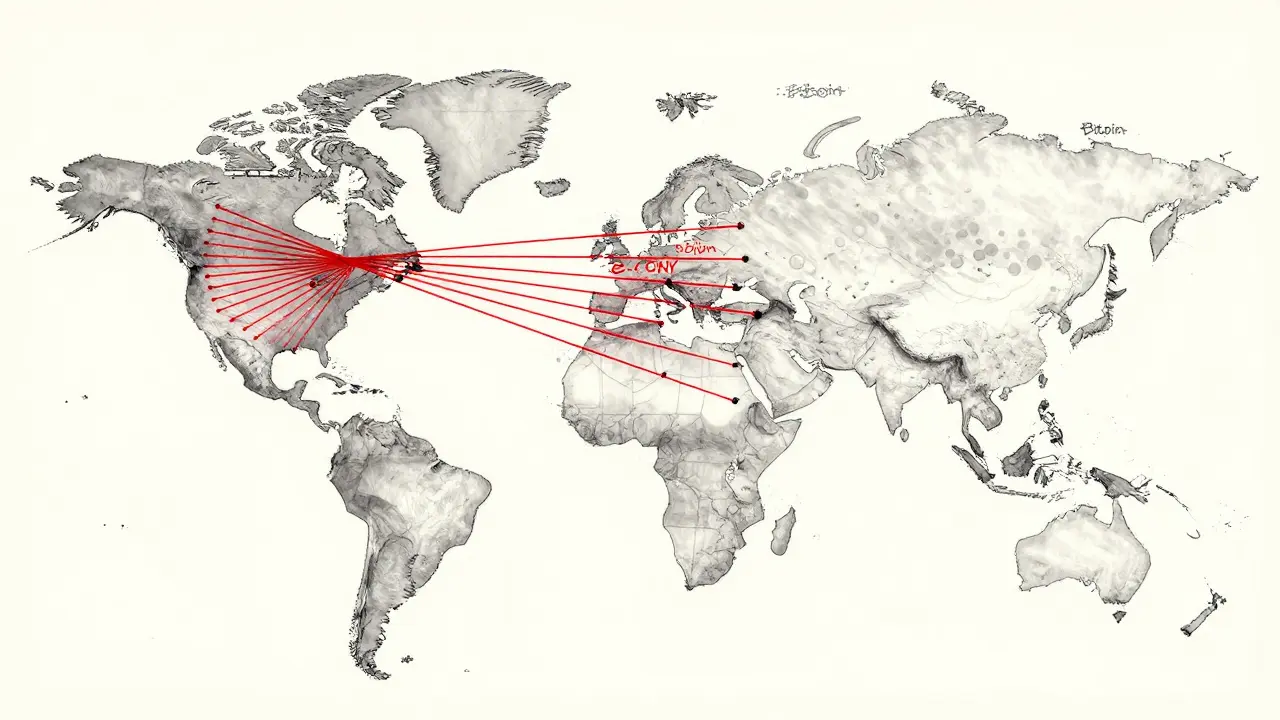
Through the mBridge project, China is working with central banks in Thailand, Hong Kong, the UAE, and Saudi Arabia to test cross-border payments using digital currencies. This isn’t about replacing the dollar overnight. It’s about creating a network of nations that can trade without using U.S. banking systems.
By integrating the e-CNY into the Belt and Road Initiative, China is pushing its digital currency into Africa, Southeast Asia, and Central Asia. Imagine a Pakistani truck driver paid in e-CNY for delivering goods to China. No USD. No SWIFT. No American oversight. Just a direct, state-controlled payment.
China’s investment in blockchain tech? Over 400 billion yuan per year through 2030. That’s more than $50 billion annually. This isn’t a pilot. It’s infrastructure.
Meanwhile, Bitcoin’s global user base grew to 580 million in 2025. But in China? Zero legal access. That’s the difference. One system is growing everywhere. The other is growing everywhere except where it matters most - the world’s second-largest economy.
Why People Still Use Crypto - Even in China
Despite the ban, 26% of ETF investors in Greater China plan to invest in crypto ETFs in 2025. Why? Because the desire for decentralized money doesn’t disappear just because the government says so.
People still trade Bitcoin over peer-to-peer apps. Some use offshore exchanges. Others hold it in hardware wallets tucked away in drawers. The underground market is quiet, but it’s there. The government tracks it. They arrest people for it. But they can’t stop it entirely.
There’s also a generational shift. Young Chinese users grew up with mobile payments. They’re comfortable with digital money. But they don’t want the government watching every coffee they buy. That’s why some still see Bitcoin as a symbol of financial freedom - even if they can’t legally own it.
What This Means for the Rest of the World
China’s move isn’t just about controlling its own citizens. It’s about rewriting the rules of global finance.
For decades, the U.S. dollar dominated international trade. Now, China is offering a new option: state-backed digital currency, with built-in surveillance and no reliance on Western banking networks. Countries tired of U.S. sanctions are paying attention.
When Hong Kong passed laws in August 2025 requiring stablecoins to be fully backed by reserves, it wasn’t just a local policy. It was a signal: China is setting the standards for digital money - and it’s not letting privacy or decentralization get in the way.
By 2030, over 20 countries may have their own CBDCs. But China’s is the most advanced. It’s the first to reach scale. And it’s the only one built to replace, not coexist with, private cryptocurrencies.
The Big Picture
The e-CNY isn’t about convenience. It’s about power. Bitcoin’s power comes from being unstoppable. China’s power comes from being unavoidable.
If you live in China, you don’t get to choose. You use the digital yuan - or you don’t pay your bills, ride the subway, or get paid. There’s no gray area.
For the rest of the world, this is a warning. If governments can control digital money, they will. Privacy won’t be a feature - it’ll be a bug. And Bitcoin? It might survive outside China. But inside? It’s already gone.
Is Bitcoin illegal in China?
Yes. Since 2021, Bitcoin mining has been banned. In 2023, all domestic cryptocurrency exchanges were shut down. By 2025, holding or trading Bitcoin for speculative purposes is illegal. The government actively monitors blockchain activity and enforces penalties on users who attempt to bypass restrictions.
Can I use Bitcoin in China if I have a VPN?
Technically, yes - but it’s risky. The Chinese government uses AI tools to detect VPN usage and track wallet activity. If you’re identified as trading Bitcoin, your bank account may be frozen, your device seized, or you could face fines or legal action. The system is designed to catch you - not prevent you.
Why does China hate Bitcoin but love the e-CNY?
Bitcoin threatens state control. The e-CNY enhances it. Bitcoin lets people move money without government oversight. The e-CNY lets the government track every dollar, control spending limits, freeze accounts instantly, and enforce capital controls. China doesn’t want financial innovation - it wants financial dominance.
Is the e-CNY a blockchain like Bitcoin?
No. The e-CNY uses a hybrid system with some blockchain elements, but it’s not decentralized. Transactions are processed through centralized servers controlled by the People’s Bank of China. Unlike Bitcoin’s public ledger, the e-CNY’s transaction history is not open to the public - only accessible to authorities.
Can the e-CNY be used outside China?
Limited use is being tested. Through the mBridge project, China is working with other central banks to enable cross-border payments using digital yuan. But it’s not open to the public yet. The goal is to bypass the U.S. dollar in trade deals - not to replace cash abroad.
How many people use the e-CNY?
As of July 2024, over 261 million users had registered digital yuan wallets. Transaction volume reached 7.3 trillion yuan ($1 trillion USD). Adoption is driven by government mandates, public sector payroll, and integration with Alipay and WeChat Pay.
Will other countries copy China’s model?
Some already are. Countries like Russia, Iran, and several African nations are exploring state-controlled digital currencies with strict surveillance features. But few have China’s scale, infrastructure, or enforcement power. The e-CNY is the most advanced CBDC in the world - and it’s being used as a blueprint.
What Comes Next?
The world is splitting into two digital money systems: one controlled by governments, the other by code. China chose control. The U.S. and Europe are still debating. Bitcoin? It’s still out there - but it’s not in China. And in today’s global economy, that’s a massive hole.
If you think digital money means freedom, think again. The future of money isn’t about technology. It’s about who owns it.