
Enterprise Distributed Ledger Technology Solutions: A Practical Guide for Business Leaders
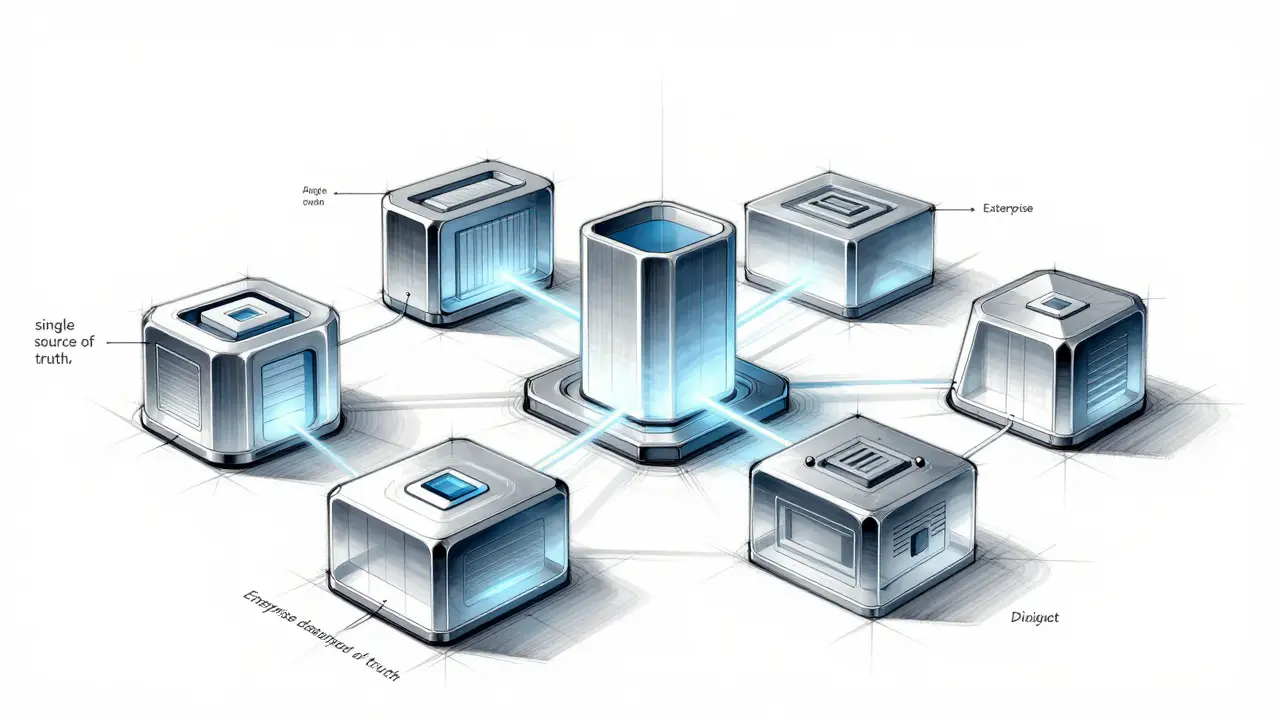
Imagine sharing a spreadsheet with five different departments. Every time someone updates a cell, everyone sees it instantly. No version control nightmares. No "who changed this?" emails. Now, imagine that spreadsheet is cryptographically sealed so no one can delete or alter past entries without everyone knowing. That is the core promise of Enterprise Distributed Ledger Technology (DLT). It is not about Bitcoin. It is not about trading crypto tokens on your phone. It is about building a single source of truth for business-critical data across organizations that do not fully trust each other.
In 2026, the hype cycle has settled. Gartner placed enterprise DLT firmly on the "Plateau of Productivity," meaning it is no longer an experimental toy but a mature tool for specific jobs. However, many companies still treat it like magic dust. They sprinkle it on legacy problems and wonder why nothing works. The reality is sharper. DLT solves coordination problems between untrusted parties. If you have a centralized database and trusted employees, you probably do not need it. But if you are coordinating supply chains, cross-border payments, or shared identity records, DLT might be your best option.
How Enterprise DLT Actually Works
To understand why enterprises choose DLT over traditional SQL databases, you need to look under the hood. At its heart, DLT is a network of computers (nodes) that maintain identical copies of a ledger. When a transaction occurs, it is broadcast to the network. Consensus protocols-like PBFT (Practical Byzantine Fault Tolerance) or Raft-ensure all nodes agree on the order and validity of that transaction before it is written permanently.
This creates two distinct advantages:
- Immutability: Once data is written, it cannot be altered retroactively. This provides an audit trail that is 100% verifiable, compared to only 68% in conventional systems where admin rights can quietly change history.
- Shared State: All participants see the same data at the same time. This eliminates the reconciliation process where Company A says they paid $10,000 and Company B says they received $9,500.
However, there is a trade-off. Traditional databases like Oracle Exadata can handle millions of transactions per second (TPS). Enterprise DLT platforms typically cap out between 3,500 and 10,000 TPS depending on the configuration. You also pay a storage premium. Because every node stores a copy of the ledger, you need roughly 37% more storage capacity than a centralized system. You are trading raw speed and efficiency for trust and transparency.
The Big Three: Choosing Your Platform
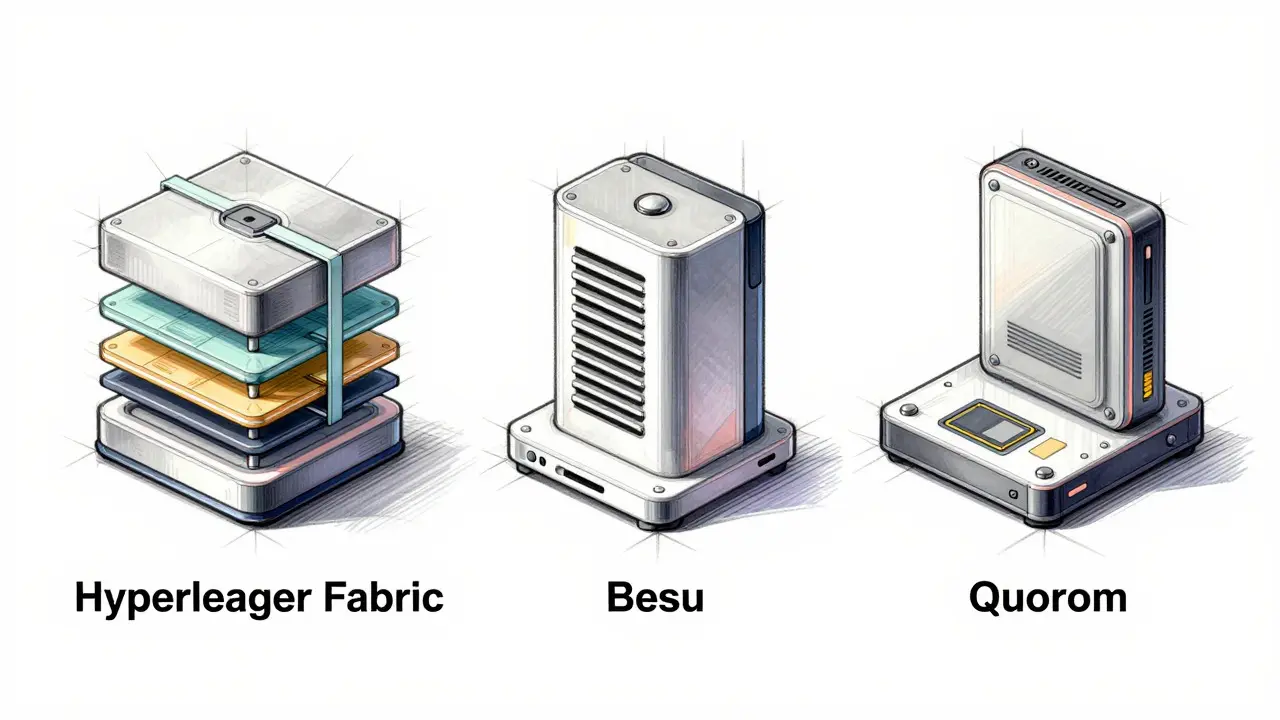
You do not build enterprise DLT from scratch. You choose a platform. In 2026, three ecosystems dominate the market. Each has a different philosophy and ideal use case.
| Platform | Best For | Key Technical Feature | Market Share (Production) |
|---|---|---|---|
| Hyperledger Fabric | Complex supply chains, multi-org networks | Modular architecture, private channels | 42% |
| Hyperledger Besu | Ethereum compatibility, DeFi integration | EVM support, Tessera privacy | Part of 31% Ethereum Ecosystem |
| Quorum | Financial services, high-speed payments | IBFT 2.0 consensus, 2-second finality | Part of 31% Ethereum Ecosystem |
Hyperledger Fabric is the heavyweight champion for modular design. It allows you to plug in different consensus mechanisms and identity management systems. Its "channels" feature lets subsets of participants share private data while keeping the rest of the network blind. This makes it perfect for industries like food safety (e.g., IBM Food Trust) where competitors need to collaborate on standards but hide their proprietary supplier lists.
Hyperledger Besu and Quorum sit in the Ethereum ecosystem. They speak the same language as public Ethereum (EVM), which means developers can reuse existing smart contract code. Besu focuses on privacy using Tessera, reducing gas costs by up to 87% compared to public chains. Quorum, backed by JPMorgan, dominates banking because it offers near-instant finality (2 seconds) and handles high throughput for interbank transfers.
Real-World Value: Speed, Fraud, and Cost
Why spend hundreds of thousands of dollars on this infrastructure? The numbers tell a clear story when applied correctly.
Fujitsu’s 2022 case studies showed that DLT increased decision-making speed by 47%. How? By removing manual verification steps. In a traditional supply chain, a shipment arrives, customs checks paperwork, the warehouse logs it, and finance updates the invoice. With DLT, the smart contract triggers automatically when IoT sensors confirm delivery. The invoice updates itself. Fraud risks dropped by 63% because the data path is transparent and immutable. Operational costs fell by 31% due to the elimination of intermediaries and reconciliation labor.
Consider Walmart’s mango traceability project. Before DLT, tracking the origin of a contaminated batch took seven days. After implementing DLT, it took 2.2 seconds. That is not just faster; it is life-saving. Similarly, Visa’s B2B Connect uses DLT to process cross-border transactions in 4-8 hours instead of the traditional 3-5 days. For businesses operating on thin margins, time is money.
The Hidden Costs and Implementation Pitfalls
Do not let the success stories fool you. Implementation is hard. Deloitte analyzed 147 case studies and found that most deployments take 6-9 months. The initial setup cost for open-source solutions like Hyperledger Fabric ranges from $150,000 to $500,000, mostly in engineering hours. Managed services like Kaleido start at $2,500 per month, but those fees add up quickly.
Here are the three biggest traps:
- The "Single Controller" Problem: Forrester reported that 55% of enterprise networks have one entity controlling over 51% of validator nodes. If one company holds the keys, is it really decentralized? Often, no. You get the complexity of blockchain with the centralization risk of a mainframe.
- Talent Shortage: Only 28% of enterprise developers have mastered distributed systems architecture. You will need specialized training. Expect an 8-12 week learning curve for your team. Integration with legacy ERP systems often adds another 35% to your timeline.
- Regulatory Friction: GDPR’s "right to be forgotten" clashes directly with DLT immutability. In 44% of EU implementations, legal teams struggled to map compliance requirements. You may need off-chain storage for personal data, linking only hashes to the ledger.
A major European bank canceled a $12 million DLT project after 18 months because it could not achieve the required 50,000 TPS for high-frequency trading. They settled at 8,200 TPS. Lesson learned: DLT is not for microsecond-latency trading. It is for coordination, not computation.

When Should You Use DLT?
Not every problem needs a blockchain. MIT’s Neha Narula argues that 63% of enterprise DLT projects solve problems more efficiently with traditional databases. Ask yourself these questions:
- Are there multiple independent parties involved?
- Do these parties lack full trust in each other?
- Is there a need for a shared, immutable record?
If the answer is yes to all three, DLT is likely appropriate. Examples include:
- Supply Chain Provenance: Tracking goods from raw material to retail.
- Cross-Border Payments: Reducing settlement times and intermediary fees.
- Digital Identity: Managing verifiable credentials (e.g., Sovrin Network handles 1.2 million daily).
If you are just storing customer orders internally, stick to SQL. If you need high-frequency analytics, use a data lake. DLT is a coordination layer, not a storage layer.
Future Outlook: Hybrid Architectures
By 2026, the trend is clear: pure blockchain is fading. Hybrid architectures are rising. 68% of new implementations combine DLT with traditional databases and AI/ML analytics. Fujitsu’s AI-powered Smart Document Management Solution is a prime example. The ledger ensures trust; the AI extracts insights.
Deloitte predicts that by 2027, 80% of enterprise DLT implementations will evolve into broader trusted data ecosystems. Pure blockchain use cases will drop to 25%. Interoperability remains the biggest hurdle. With 12+ major platforms, fragmentation threatens growth. Standards like EEA 3.0 aim to unify enterprise Ethereum, but progress is slow.
For now, the advice is simple. Start small. Pick a use case with clear ROI. Choose a platform that matches your technical stack. And remember: technology does not fix broken processes. It amplifies them. Fix the process first, then apply the ledger.
What is the difference between DLT and blockchain?
Blockchain is a type of DLT. All blockchains are distributed ledgers, but not all distributed ledgers are blockchains. Blockchain specifically refers to a linear chain of blocks. DLT is a broader term that includes other structures like Directed Acyclic Graphs (DAGs). In enterprise contexts, the terms are often used interchangeably, but DLT emphasizes the permissioned, private nature of the network.
Is Hyperledger Fabric free to use?
Yes, Hyperledger Fabric is open-source and free to download. However, the total cost of ownership is high. You must budget for infrastructure, developer salaries, security audits, and maintenance. Initial implementation costs typically range from $150,000 to $500,000.
Can DLT handle GDPR right-to-be-forgotten requests?
Directly, no. Data on a DLT is immutable. To comply with GDPR, enterprises store personal data off-chain in traditional databases and store only a cryptographic hash on the ledger. When deletion is requested, the off-chain data is removed, rendering the hash useless. This approach satisfies both immutability and privacy laws.
Which platform is best for financial services?
Quorum is currently dominant in financial services, with 72% adoption among top 50 banks. It offers high throughput (up to 20,000 TPS) and fast finality (2 seconds), which are critical for payments. Hyperledger Fabric is also used for complex trade finance scenarios requiring modular privacy.
How long does it take to implement an enterprise DLT solution?
Most deployments take 6 to 9 months. This includes requirements gathering, network setup, smart contract development, testing, and integration with legacy systems. Complex integrations with ERPs can extend timelines by 35%.