
Ethereum EIP-1559 Fee Burning Explained: How ETH Supply Is Reduced
Before EIP-1559, paying for Ethereum transactions felt like bidding in an auction you didn’t understand. You’d set a gas price, hope it was high enough, and watch as your transaction sat stuck for hours-or worse, got rejected because you underpaid. That changed in August 2021 with the London hard fork. EIP-1559 didn’t just tweak fees; it rewrote how Ethereum handles money. At its core is a simple but powerful idea: burn part of every transaction fee. This isn’t just a technical detail-it’s reshaping Ethereum’s entire economic model.
How EIP-1559 Changed the Fee Game
Before EIP-1559, Ethereum used a first-price auction. Users guessed how much to pay, and miners took the highest bids. This led to wild swings in fees. On busy days, fees spiked to $50 or more. On quiet ones, people overpaid by 300% just to be safe. Wallets had no clear baseline to work from.
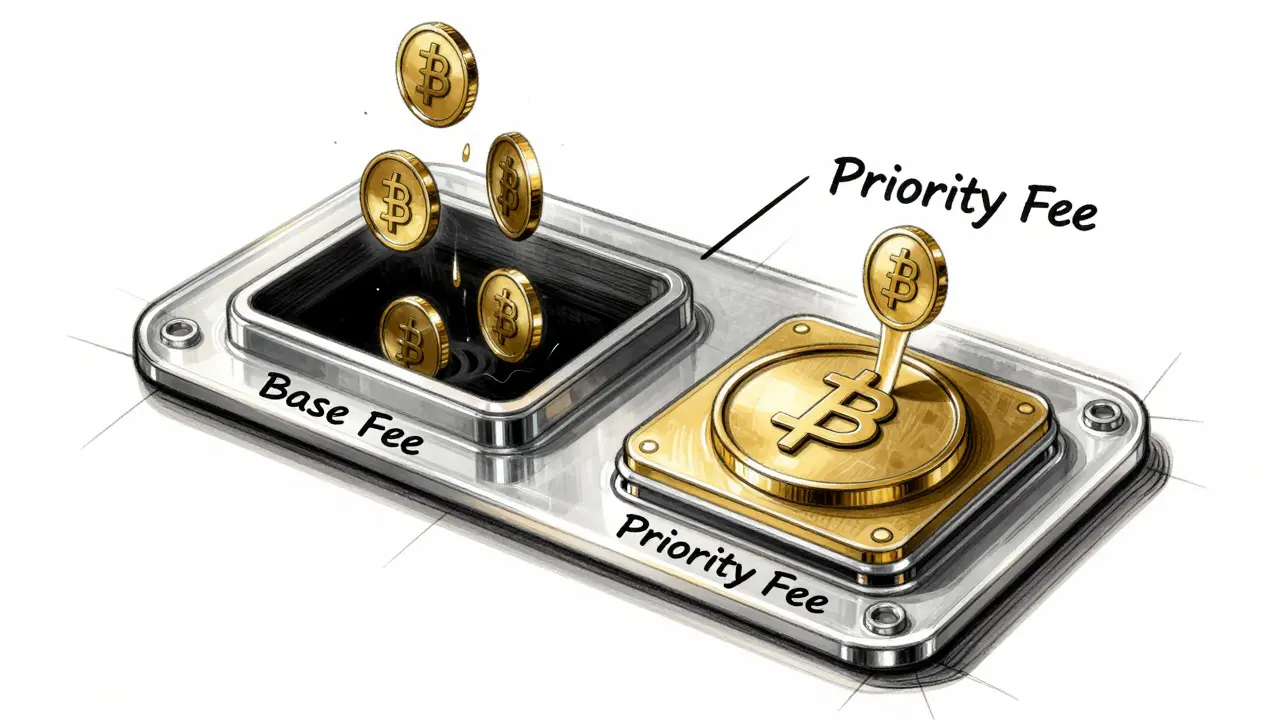
EIP-1559 introduced two new components: the base fee and the priority fee. The base fee is calculated automatically based on how full the last block was. If blocks are over 50% full, the base fee goes up. If they’re under, it drops. It adjusts by a maximum of 12.5% per block. This creates a predictable rhythm. You don’t guess anymore-you see what the network just charged and adjust slightly.
The priority fee? That’s your tip. It’s optional, but if you want your transaction processed faster during congestion, you add it. Think of it like giving a driver a bonus to get you there quicker. The base fee? It gets destroyed. Burned. Never seen again.
What Does ‘Burning’ Actually Mean?
Burning ETH isn’t sending it to a wallet you can’t access. It’s removing it from circulation permanently. When you pay a transaction, the base fee portion is sent to a public address that no one can spend from. It’s not stored. It’s not moved. It’s erased from the total supply.
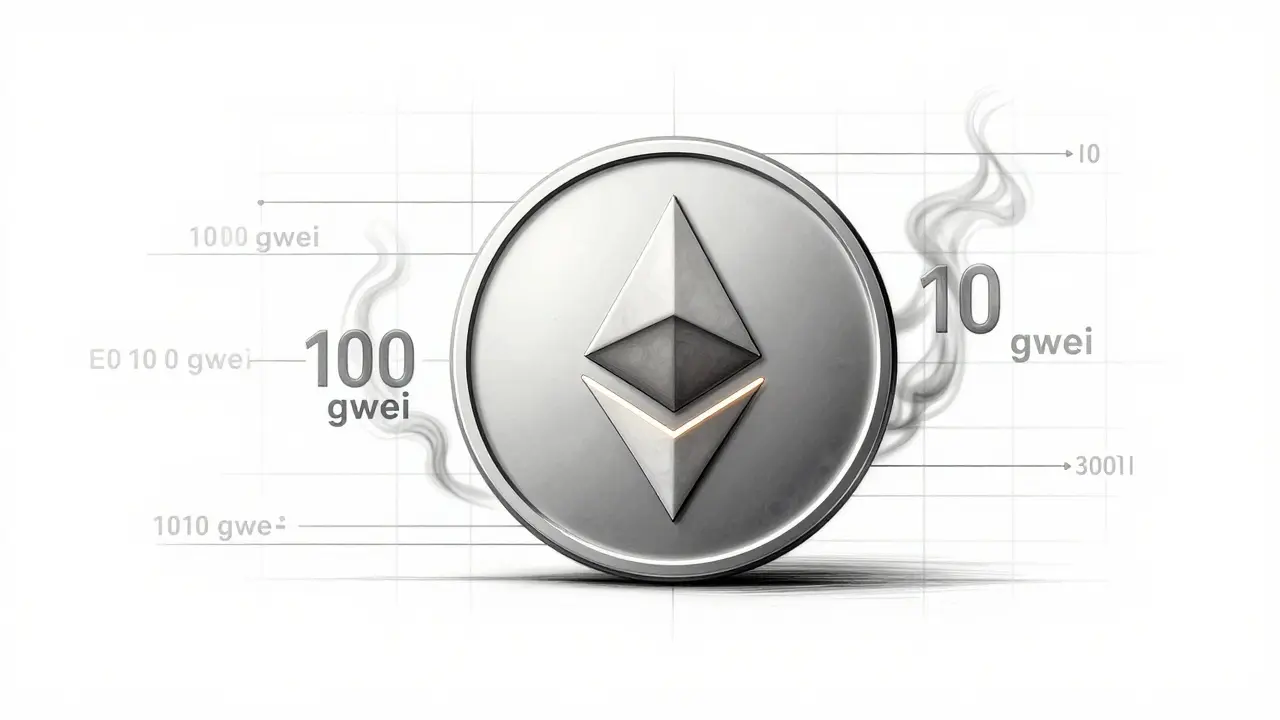
Let’s say you send a transaction with a base fee of 100 gwei and a priority fee of 10 gwei. You pay 110 gwei total. The 100 gwei vanishes. Only the 10 gwei goes to the validator (the new name for miners after the Merge). This is the big shift: Ethereum’s protocol now takes a cut of every transaction and removes it from the market.
Since EIP-1559 launched, over 2.5 million ETH have been burned. That’s more than $8 billion at 2022 prices. In peak congestion periods-like when NFTs exploded in 2021 or when DeFi protocols surged-over 1,500 ETH were burned in a single day. That’s not a trickle. That’s a steady drain on supply.
Why Burning Matters: Deflationary Pressure
Ethereum’s total supply used to grow slowly as new ETH was issued to validators. EIP-1559 flipped that. Now, ETH is being destroyed faster than it’s being created during high usage.
Here’s the math: Under normal conditions, Ethereum issues about 0.0002 ETH per second to validators. That’s roughly 1,728 ETH per day. But during busy periods, the network burns 1,500-2,000 ETH daily. That means, for stretches of time, more ETH is disappearing than being added. Ethereum becomes deflationary.
This isn’t theoretical. In 2022, ETH supply shrank by 0.23% annually due to burning. Delphi Digital’s models suggest that if Ethereum usage stays high, supply could contract by 0.15% to 0.30% every year. That’s not Bitcoin-level scarcity-but it’s real. And it’s growing as more people use DeFi, NFTs, and Layer 2 networks.
Impact on Miners and Validators
Before EIP-1559, miners made most of their money from transaction fees. After the Merge, they no longer mine. But the same logic applies to validators: they now earn only the priority fee. The base fee? Gone. That’s a major income shift.
Some critics, like Ethereum Classic’s 2024 analysis, argue this reduces validator revenue stability. If fees drop, validators get less. But the data tells another story. Since the Merge, ETH staking rewards have remained stable because block rewards (new ETH issuance) still cover most of validator income. The priority fee is a bonus-not the main paycheck.
What’s more, the burn mechanism has made Ethereum more attractive to long-term holders. If you believe Ethereum will keep growing in usage, then burning fees makes ETH scarcer over time. That’s a strong argument for holding, not selling.
User Experience: Less Stress, Fewer Failed Transactions
Widespread adoption of EIP-1559 didn’t just help the economy-it helped users. Wallets like MetaMask and Rainbow now auto-calculate fees based on the base fee from the last block. You don’t need to guess. You just click ‘Confirm’.
Liquity’s user data shows transaction success rates jumped 18% in the six months after EIP-1559. Failed transactions due to underpaid fees dropped sharply. Consensys reported a 37% drop in customer support tickets about gas fees. People stopped asking, “Why did my transaction fail?” because it stopped happening as often.
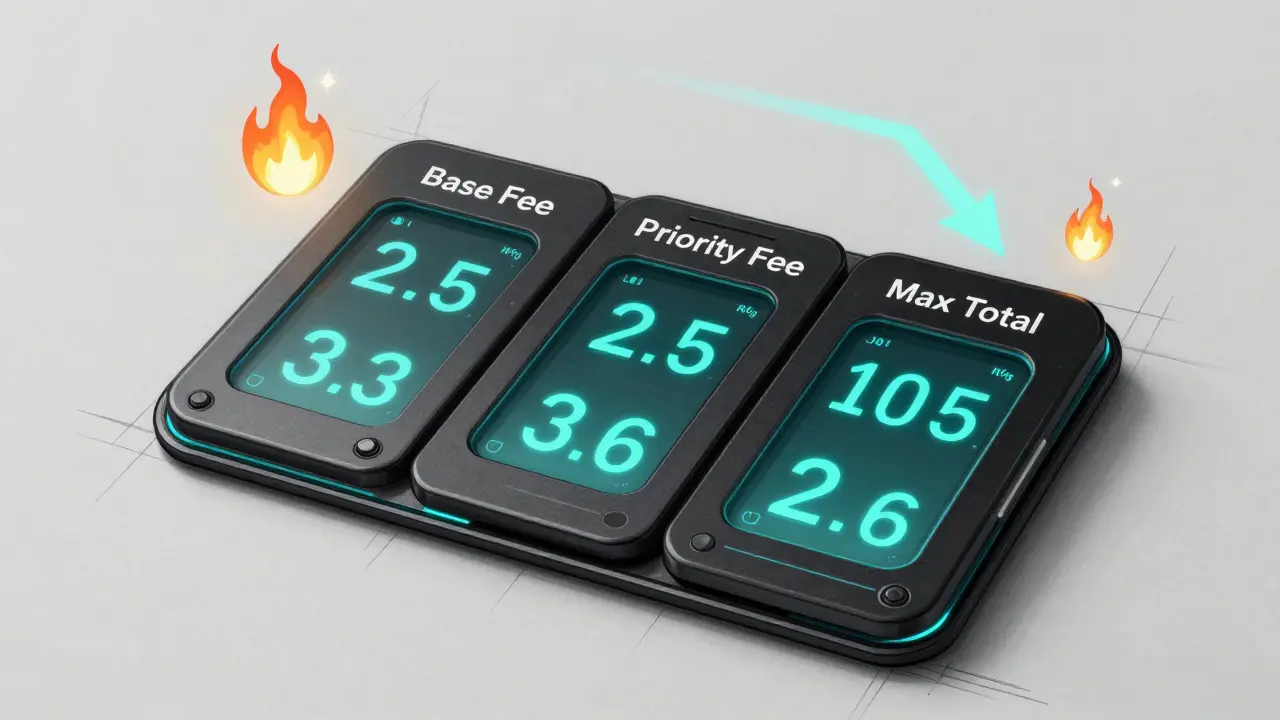
That doesn’t mean it’s perfect. During sudden spikes-like when a new token launches-users still set max fees too low. The system works best when users understand the difference between max fee and priority fee. Wallets now show clear labels: “Base Fee,” “Priority Fee,” and “Max Total.” Still, some users get confused. That’s why education matters more than ever.
How Other Chains Are Copying EIP-1559
EIP-1559 didn’t just fix Ethereum. It became a blueprint. Polygon adopted EIP-1559++ with a twist: part of the base fee goes to a treasury for development. BNB Chain uses a similar burn model. Arbitrum, Optimism, and other Layer 2s have implemented their own versions.
Why? Because it works. Users like predictable fees. Developers like stable systems. Investors like deflationary assets. Even Solana and Aptos have borrowed elements-like dynamic fee adjustments-though they don’t burn fees the same way.
EIP-1559’s influence proves one thing: Ethereum’s innovation isn’t just technical-it’s economic. It’s not just about speed or scalability. It’s about value.
What’s Next? EIP-4844 and Beyond
Ethereum’s roadmap doesn’t stop with EIP-1559. The Shanghai upgrade in 2023 let users withdraw staked ETH, which increased network activity-and thus, burning. Now, EIP-4844 (Proto-Danksharding) is on the horizon. It will introduce “blob transactions” for Layer 2s, with their own separate fee markets.
Here’s the twist: EIP-4844 will likely include its own burning mechanism. That means Ethereum won’t just burn fees from mainnet transactions. It’ll burn fees from thousands of Layer 2 transactions too. The total amount burned could jump tenfold.
There’s also talk of adjusting the 12.5% base fee change cap. Right now, during extreme congestion, fees can still spike. Some developers want to make adjustments faster. Others argue the current limit prevents chaos. The community is still debating it.
Final Thoughts: More Than Just a Fee Update
EIP-1559 wasn’t a patch. It was a revolution. It turned Ethereum from a network where fees were a gamble into one where they’re a predictable cost. It shifted value from miners to holders. It made ETH scarcer. And it gave the whole crypto world a new standard.
Today, if you use Ethereum, you’re part of a system that quietly destroys money every time you interact with it. That’s not a bug. It’s the design. And as usage grows, that destruction becomes more powerful. Ethereum isn’t just building apps. It’s building scarcity. And that’s what makes it different.
Does EIP-1559 mean ETH is deflationary?
ETH becomes deflationary only when the amount burned exceeds the amount issued as staking rewards. That happens during high network usage. In 2022, over 2.5 million ETH were burned, and supply shrank by 0.23% annually. But during low-usage periods, new ETH issuance still outpaces burning. So ETH is not always deflationary-it’s conditionally deflationary, depending on demand.
Do I lose money when ETH is burned?
No. You pay the base fee, but you don’t lose value. The base fee is part of the transaction cost, like a toll on a highway. You’re paying for processing, not giving money away. The burning affects the overall supply, not your wallet balance. Your ETH holdings don’t shrink because someone else paid a fee-you just helped reduce inflation across the network.
Can I choose not to pay the base fee?
No. The base fee is built into every transaction. It’s not optional. Even if you set your max fee to zero, the network will still require the base fee to be paid. Wallets handle this automatically. You can’t avoid it-nor should you. It’s the price of using the network.
Why does the base fee change so often?
The base fee adjusts every block (every 12 seconds) based on how full the previous block was. If blocks are over 15 million gas used, the fee goes up by up to 12.5%. If under, it drops. This keeps the network balanced. It’s not random-it’s math. The goal is to hit 15 million gas per block on average, avoiding congestion or wasted space.
What happens to the burned ETH? Is it gone forever?
Yes. Burned ETH is sent to a non-spendable address-often called a "burn address" or "zero address"-where no private key exists. It’s mathematically impossible to recover. Once burned, it’s removed from the total supply forever. Think of it like printing money and then setting it on fire. It no longer exists in the economy.
Is EIP-1559 good for long-term ETH holders?
Yes. By reducing supply through burning, EIP-1559 creates scarcity. If Ethereum usage keeps growing, more ETH will be burned than issued. This can increase value over time, especially if demand stays high. Many long-term holders see this as a core reason to believe in ETH’s value proposition-not just as a platform, but as a scarce digital asset.
George Suggs
February 25, 2026 AT 13:04Dianna Bethea
February 27, 2026 AT 08:27KingDesigners &Co
February 28, 2026 AT 09:35Felicia Eriksson
March 2, 2026 AT 08:20Tracy Whetsel
March 3, 2026 AT 20:09Alyssa Herndon
March 4, 2026 AT 16:26Ifeanyi Uche
March 4, 2026 AT 22:32Jeff French
March 5, 2026 AT 10:41Kenneth Genodiala
March 6, 2026 AT 03:56Michael Rozputniy
March 6, 2026 AT 04:01Brian Lemke
March 7, 2026 AT 18:11Michelle Mitchell
March 9, 2026 AT 00:24Kaitlyn Clark
March 9, 2026 AT 12:44christopher luke
March 10, 2026 AT 14:41Mary Scott
March 10, 2026 AT 17:58Shannon Holliday
March 12, 2026 AT 05:46Don B.
March 13, 2026 AT 11:47Arya Dev
March 13, 2026 AT 20:43Leslie Cox
March 15, 2026 AT 08:51Andrew Hadder
March 16, 2026 AT 16:59Derek Sasser
March 18, 2026 AT 03:21Neeti Sharma
March 19, 2026 AT 20:48Nadia Shalaby
March 20, 2026 AT 23:29Amita Pandey
March 21, 2026 AT 05:29Jan Czuchaj
March 22, 2026 AT 10:12