FATF Blacklist: Why Iran, North Korea, and Myanmar Are Banned from Global Crypto Markets

On any given day, billions of dollars flow through cryptocurrency networks - some legally, some not. But when the money comes from countries under international financial siege, it triggers alarms across banks, exchanges, and regulators. As of mid-2025, only three nations sit on the Financial Action Task Force’s (FATF) highest-risk blacklist: Iran, North Korea, and Myanmar. These aren’t just names on a list. They’re active hubs for crypto-enabled money laundering, sanctions evasion, and cybertheft that’s reshaping global finance.
What the FATF Blacklist Really Means
The FATF isn’t a police force. It doesn’t arrest anyone. But its word carries weight. When the FATF says a country is a high-risk jurisdiction, it tells every bank, exchange, and payment processor in the world: Proceed with extreme caution - or don’t proceed at all. Countries on this list have failed to meet basic standards for stopping money laundering and terrorist financing. For Iran and North Korea, the FATF has gone further: it’s asking member countries to apply countermeasures - essentially, cutting them off from the global financial system. Myanmar hasn’t reached that level yet, but regulators are watching closely.What does this look like in practice? If you’re a crypto exchange in Germany, Japan, or Canada, you’re legally required to block transactions to or from wallets linked to these countries. You must flag any transfer that even smells like it’s coming from there. Many exchanges go further - they ban all users from these regions outright. Why? Because the cost of getting it wrong - fines, reputational damage, even criminal charges - is too high.
North Korea: The World’s Most Active Crypto Thief
North Korea doesn’t just use crypto. It weaponizes it.According to Chainalysis, North Korean state-backed hackers stole over $1.5 billion from cryptocurrency platforms in 2024 alone. That’s more than the GDP of some small nations. Their favorite targets? Exchanges, DeFi protocols, and wallet services with weak security. In February 2025, they pulled off the biggest heist in crypto history: $1.5 billion from ByBit. The funds? Traced through mixers, converted into privacy coins, and laundered across dozens of chains. The U.S. Treasury called it “an act of economic warfare.”
It’s not random crime. It’s state policy. North Korea’s Lazarus Group operates like a military unit - with budgets, training, and targets. They fund missile programs, nuclear research, and elite military units through crypto theft. And they’re getting smarter. They now use blockchain analysis tools themselves to find vulnerabilities in exchanges. They exploit zero-day bugs in wallet software. They bribe insiders. They fake identities to register on platforms in other countries.
There’s no way to ignore this. The U.S. Treasury’s OFAC has designated over 200 crypto addresses linked to North Korea since 2020. FinCEN has issued multiple alerts. Even China has tightened controls on cross-border crypto flows to prevent North Korean funds from slipping through.
Iran: Crypto as a Survival Tool - and a Sanctions Evasion Scheme
Iran’s situation is more complicated. The people aren’t stealing crypto. They’re using it to survive.After years of U.S. and EU sanctions, Iran’s currency, the rial, lost over 80% of its value since 2018. Inflation hit 50% in 2024. Banks are closed to the world. People can’t pay for medicine, food, or internet services. So they turned to Bitcoin and stablecoins. Iranian exchanges like Bitget and LocalBitcoins saw transaction volumes jump 300% in 2024. Wallets filled with USDT became the new bank accounts.
But here’s the catch: while ordinary Iranians use crypto for food and medicine, the regime uses it to bypass sanctions. The Islamic Revolutionary Guard Corps (IRGC) runs crypto mining farms powered by subsidized electricity. They sell the coins on offshore exchanges. They use peer-to-peer platforms to trade for goods - from electronics to weapons components. In 2024, Iran accounted for nearly $6 billion in illicit crypto inflows - second only to North Korea.
The FATF doesn’t blame the people. It blames the system. Iran’s anti-money laundering laws are paper thin. Its regulators don’t require exchanges to verify users. There’s no reporting of suspicious transactions. That’s why the FATF keeps Iran on the blacklist - not because people are using Bitcoin, but because the state lets criminals and militants use it too.
Myanmar: A Country in Chaos, a Crypto Wild West
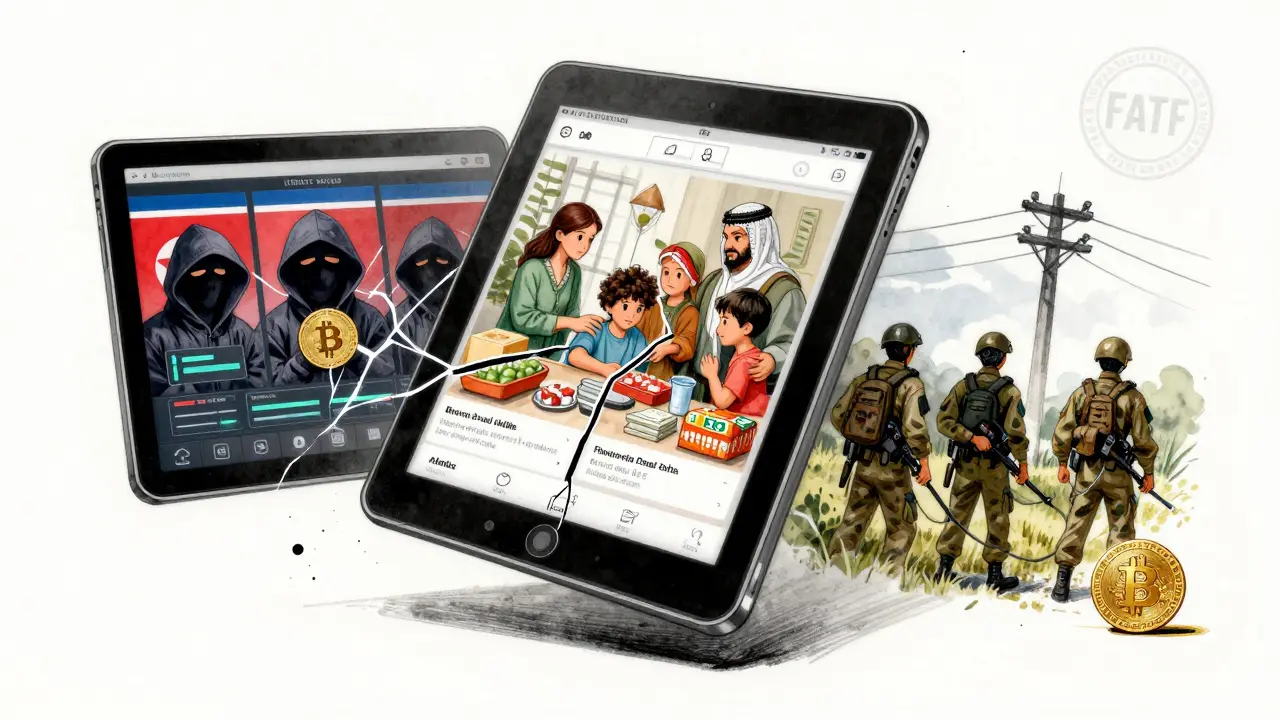
Myanmar’s story is one of collapse. After the 2021 military coup, the country’s banking system froze. International aid dried up. The economy shrank by 18% in 2023. With no access to banks, people turned to crypto. Mobile wallets, Telegram-based exchanges, and crypto-based remittances became lifelines.But the junta didn’t just sit back. It saw an opportunity. Military-linked groups now run crypto mining operations in remote regions. They use stolen electricity to mine Bitcoin and sell it overseas. They use crypto to pay mercenaries and buy weapons. In 2024, FinCEN flagged over 40 crypto addresses tied to Myanmar-based criminal networks. The FATF doesn’t yet call for full countermeasures - but it demands enhanced due diligence. That means any bank or exchange dealing with Myanmar must now prove every transaction is legitimate. Most just say no.
The result? A crypto black market thrives - but only for those with connections. Ordinary citizens can’t access international exchanges. They rely on unregulated peer-to-peer traders, who often disappear with their money. It’s survival - but it’s dangerous.
Why This Matters for Everyone Else
You might think: “I’m not in Iran, North Korea, or Myanmar. Why should I care?”Because these countries are poisoning the global crypto system.
When criminals use crypto to launder billions, regulators respond by tightening rules everywhere. Exchanges now require ID verification for every user. Withdrawals take days. You can’t send crypto to a wallet without a compliance check. Some platforms ban entire countries just to stay safe. Even if you’re honest, you’re caught in the net.
And it’s getting worse. In 2024, 75% of countries failed to meet FATF’s basic crypto rules. Many still don’t require exchanges to collect user data. Some still allow anonymous wallets. That creates loopholes - and criminals are exploiting them. Mixing services, privacy coins like Monero, and cross-chain bridges are now the go-to tools for laundering money from sanctioned states.
When a hacker steals $1 billion from a U.S. exchange, and the money flows through a mixer in a country with no rules, the whole system loses trust. Investors pull out. Regulators crack down harder. Innovation slows. The price of compliance rises. And the people who suffer most? The ones who just want to use crypto for good.
The Bigger Picture: Crypto as a Double-Edged Sword
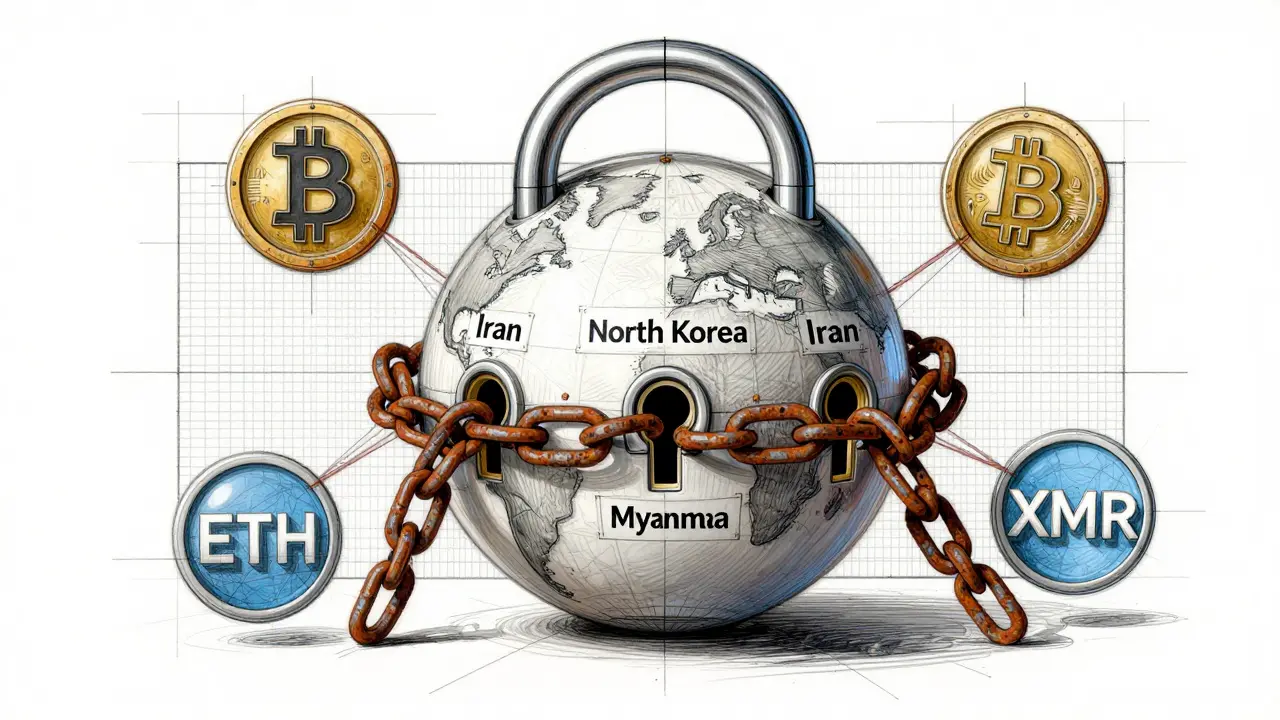
Bitcoin was meant to be free. Decentralized. Censorship-resistant. That’s why it’s so powerful in places like Iran and Myanmar - where governments control banks and silence dissent.But the same features that protect civilians also protect criminals. No KYC? No oversight? No borders? That’s a recipe for abuse. The FATF doesn’t want to ban crypto. It wants to clean it up. It wants exchanges to know who their customers are. It wants to trace dirty money. It wants to stop state-sponsored theft.
The challenge? Balancing freedom with safety. In North Korea, crypto is a weapon. In Iran, it’s a lifeline. In Myanmar, it’s a last resort. The world can’t ignore any of it. But it can’t let criminals hide behind humanitarian need either.
What’s Next? More Rules, More Pressure
The FATF updated its list in June 2025 - adding the British Virgin Islands and Bolivia to its “increased monitoring” list. It removed Croatia, Mali, and Tanzania. But Iran, North Korea, and Myanmar? Still there. No changes.That means pressure is rising. The U.S. is pushing for global sanctions on crypto mixers. The EU is preparing rules to freeze wallets linked to sanctioned entities. Japan and Singapore are requiring all exchanges to block traffic from these countries. Even crypto projects that claim to be “neutral” are now forced to choose sides.
And the numbers don’t lie. In 2024, sanctioned countries received 39% of all illicit crypto transactions - nearly 60% of the total value tied to global sanctions. That’s not a coincidence. It’s a strategy.
Until these three countries fix their systems - until they stop letting criminals run free - they’ll stay on the blacklist. And until then, every crypto user, everywhere, will feel the ripple effect.
Why are Iran, North Korea, and Myanmar still on the FATF blacklist?
They’ve failed to meet international standards for stopping money laundering and terrorist financing. Iran and North Korea have weak or nonexistent crypto regulations, allowing state-backed hackers and criminal networks to operate freely. Myanmar’s military regime uses crypto to fund armed groups and evade sanctions. Despite years of pressure, none have implemented meaningful reforms.
Can I use crypto if I live in one of these countries?
Technically, yes - but practically, it’s extremely difficult. Most global exchanges block users from these regions. Peer-to-peer trading exists, but it’s risky. You might get scammed, or your funds could be frozen. Even sending crypto to a friend abroad could trigger a compliance alert. Many people use VPNs and unregulated platforms, but that puts them at legal risk.
Does the FATF ban Bitcoin in these countries?
No. The FATF doesn’t ban any technology. It bans financial systems that enable crime. Bitcoin itself isn’t illegal - but the way it’s used by state actors in these countries is. The goal is to force governments to regulate exchanges, track transactions, and stop criminals - not to outlaw crypto.
Why does North Korea steal so much crypto?
North Korea lacks access to global banking and foreign currency. It can’t legally earn dollars or euros. So it steals them. Crypto theft is low-risk, high-reward. A single successful hack can fund missile tests or food imports. The Lazarus Group is a state-run cyber unit - not random hackers. Their operations are funded by the regime and reported directly to its leadership.
Are there any safe ways to send crypto to someone in Iran or Myanmar?
There’s no truly safe way. Even if you’re sending money to family, your transaction may be flagged and frozen. Some use decentralized exchanges or non-KYC platforms, but that violates most countries’ sanctions laws. If you’re trying to help someone in these regions, consider donating through verified NGOs that operate legally - not through crypto wallets.
Will these countries ever be removed from the FATF blacklist?
Only if they make sweeping changes: require all exchanges to verify users, report suspicious activity, freeze criminal wallets, and cooperate with international investigations. Iran would need to dismantle its IRGC’s crypto operations. North Korea would need to shut down Lazarus Group. Myanmar would need a democratic government that enforces the law. None of that is happening now - and without it, they’ll stay on the list.

Patricia Amarante
December 15, 2025 AT 09:14People in Iran are just trying to feed their kids. Stop acting like crypto is the problem-it’s the sanctions that are starving families.
Florence Maail
December 15, 2025 AT 15:04lol the FATF is just a CIA front. They don’t care about money laundering-they care about controlling who gets to use Bitcoin. 🤡
Timothy Slazyk
December 17, 2025 AT 10:22This isn’t about regulation-it’s about power. The FATF wants to decide who gets financial sovereignty. North Korea steals because it’s blockaded. Iran uses crypto because its banks are weaponized against its people. Myanmar? A dictatorship turned crypto into a war chest. The real crime isn’t the tech-it’s the global system that leaves no escape hatch for the oppressed. Crypto didn’t break finance. Finance broke itself, and now it’s blaming the tools people use to survive.
Emma Sherwood
December 18, 2025 AT 01:42It’s wild how we vilify entire populations for the crimes of their governments. I’ve talked to Iranian nurses who use USDT to buy insulin. Their kids aren’t funding missiles-they’re fighting to stay alive. We need to separate the people from the regime, not punish everyone under the same flag.
Madhavi Shyam
December 19, 2025 AT 19:42Let’s be clear: the FATF’s countermeasures are extraterritorial overreach. Sovereignty isn’t dead-it’s just being outsourced to private exchanges. KYC is the new border control.
SeTSUnA Kevin
December 20, 2025 AT 20:59North Korea’s $1.5B heist from ByBit is statistically improbable without insider collusion. Either the exchange was grossly negligent-or the FATF’s metrics are flawed.
Cheyenne Cotter
December 21, 2025 AT 09:23Look, I get that people in Iran are suffering, but you can’t just ignore the fact that the IRGC is mining Bitcoin with state electricity and selling it to buy drone parts. It’s not about punishing civilians-it’s about cutting off the funding pipeline. If you want to help, donate to NGOs that have compliance protocols. Don’t send crypto to a random wallet you found on Telegram. That’s not solidarity-that’s enabling.
And don’t even get me started on how Myanmar’s junta is using crypto to pay mercenaries. You think your $50 in USDT is helping a grandma buy rice? Odds are it’s buying bullets for a soldier who just burned down a village. The system is broken, but the solution isn’t to throw out all regulation-it’s to fix it so it doesn’t criminalize survival.
Also, the fact that 75% of countries still don’t require transaction reporting? That’s not a crypto problem. That’s a global governance failure. We need binding international standards, not just recommendations. The FATF’s a good start, but it’s toothless without enforcement. And until we have that, we’re just rearranging deck chairs on the Titanic while the money flows through the cracks.
And yes, I know some people are using crypto to survive. I’m not saying they’re bad. I’m saying the system is rigged. But we can’t let the worst actors destroy the entire ecosystem. We need smarter tools-not less oversight. Think of it like traffic laws. You don’t ban cars because some people speed. You build better cameras, stricter penalties, and better enforcement. Crypto’s the same. We need traceability without sacrificing access.
And if you think decentralized finance means no rules, you’ve been reading too much Reddit and not enough whitepapers. Decentralized doesn’t mean lawless. It means distributed responsibility. And right now, nobody’s taking responsibility. That’s the real crisis.
Bradley Cassidy
December 21, 2025 AT 21:21bro the whole thing is a mess 😭 like imagine being in iran and your only way to get meds is through some dude on telegram who takes your cash and sends you a wallet key… and then he ghosts you. or worse-your tx gets flagged and your whole family’s account gets frozen. this isn’t crypto freedom, this is digital survival horror. we need safe channels, not bans.
Mark Cook
December 23, 2025 AT 17:38Why is no one talking about how the US uses crypto to fund its own covert ops? 😏
Heather Turnbow
December 24, 2025 AT 06:46While I empathize with the plight of civilians in sanctioned nations, the structural integrity of the global financial system cannot be compromised by the absence of regulatory frameworks in rogue states. The FATF’s position, while imperfect, remains a necessary bulwark against systemic financial contagion. To relax standards under humanitarian pretenses would invite exploitation on a scale that would ultimately harm the very populations we seek to protect.
Samantha West
December 24, 2025 AT 12:31It’s ironic that we call Bitcoin censorship-resistant while the very institutions that claim to protect freedom are the ones censoring entire nations. The FATF isn’t fighting crime-it’s enforcing a financial caste system. Who gets to be human? Who gets to be a person with a bank account? The answer is written in the blockchain of power.
Dionne Wilkinson
December 25, 2025 AT 08:06Maybe the real question isn’t why they’re on the blacklist-but why we’re so quick to punish whole countries instead of targeting the actual criminals. The people aren’t the problem. The systems are.
Sean Kerr
December 25, 2025 AT 21:01imagine being a kid in myanmar and your mom uses crypto to buy you schoolbooks… but the exchange freezes it bc ‘sanctions’… and then the military takes your family’s land bc they think you’re rich? this system is broken on so many levels 😔
Amy Copeland
December 26, 2025 AT 03:16Oh wow, so now we’re supposed to feel bad for the IRGC because they mine Bitcoin? Next you’ll tell me the Lazarus Group is just ‘entrepreneurs’ trying to make ends meet. 🙄
Greg Knapp
December 27, 2025 AT 17:29you all think you’re so woke but you’re just using humanitarianism as a cover to launder your own crypto. i’ve seen it. you send 100 USDT to ‘help’ and it ends up buying AK-47s. stop pretending you’re saints
Rebecca Kotnik
December 28, 2025 AT 03:06It is imperative to acknowledge that the imposition of financial exclusion upon entire populations-regardless of the conduct of their governments-creates profound ethical dilemmas. The principle of individual accountability is foundational to justice, yet the current regulatory architecture enforces collective punishment under the guise of compliance. This paradox undermines the moral legitimacy of the very institutions tasked with preserving global financial integrity. A more nuanced approach, one that distinguishes between state actors and civil society, must be developed-not through blanket bans, but through targeted sanctions, enhanced due diligence protocols, and the establishment of humanitarian exemptions within the crypto ecosystem. To do otherwise is not to safeguard the system, but to entrench its inequities.
Tom Joyner
December 28, 2025 AT 09:34It’s fascinating how the same people who champion ‘decentralization’ suddenly become statist when it suits their moral convenience. Crypto was meant to bypass power structures-not become a new tool for them.
Jesse Messiah
December 29, 2025 AT 22:34hey just wanted to say i really appreciate how thoughtful this post was. it’s easy to get mad at crypto, but this breaks down why it’s so complicated. people are trying to survive, and the system’s not built for that. we need better solutions, not just more blocks.
Craig Nikonov
December 31, 2025 AT 17:01Anyone else think the FATF blacklist is just a way for the US/EU to control the global crypto market? They don’t want Iran or North Korea mining Bitcoin-they want to keep it in their own hands. The ‘money laundering’ excuse? Total BS. They’re scared of decentralized money that can’t be taxed or tracked.
Kelsey Stephens
January 1, 2026 AT 05:59I’ve worked with refugees who rely on crypto to get money from family abroad. They don’t know what a mixer is. They just know that without it, their kid won’t eat. This isn’t about crime-it’s about dignity. We can fix this without crushing people.
Shruti Sinha
January 3, 2026 AT 02:55Myanmar’s crypto use is a symptom of state collapse, not a cause. The solution isn’t to ban wallets-it’s to rebuild banks.
Donna Goines
January 4, 2026 AT 17:57Did you know the US Treasury has a crypto wallet that’s been used to pay private contractors who’ve hacked Iranian oil facilities? But we’re mad at North Korea for stealing? 😏
Chevy Guy
January 5, 2026 AT 01:51So the world’s biggest crypto thief is a country that can’t even buy food legally… and we’re surprised they steal? 🤦♂️
Abby Daguindal
January 6, 2026 AT 13:48It’s not about ‘helping people’-it’s about enabling criminals. You think you’re being noble sending crypto to Iran? You’re just moving money that funds terrorism. Wake up.
Jack Daniels
January 8, 2026 AT 12:15Every time I see someone say ‘it’s not the people, it’s the regime’ I feel sick. Because guess what? The people don’t vote. They don’t stop it. They benefit from it. They’re complicit. And now they want us to pay for their survival?