
Future of Cryptocurrency Taxation: What Changes in 2025 Mean for You
When you buy Bitcoin, sell Ethereum, or earn rewards from staking, you’re not just moving digital money-you’re creating a tax event. The future of cryptocurrency taxation isn’t about speculation anymore. It’s about compliance, tracking, and real consequences. Starting January 1, 2025, the rules changed. And if you’re still treating crypto like cash you can trade without a paper trail, you’re already behind.
Every Crypto Transaction Is a Taxable Event
The IRS doesn’t see cryptocurrency as money. It sees it as property. That means every time you swap one coin for another, spend Bitcoin on coffee, or receive crypto as payment, you trigger a taxable transaction. No exceptions. Not even if you didn’t cash out to fiat.Here’s how it breaks down:
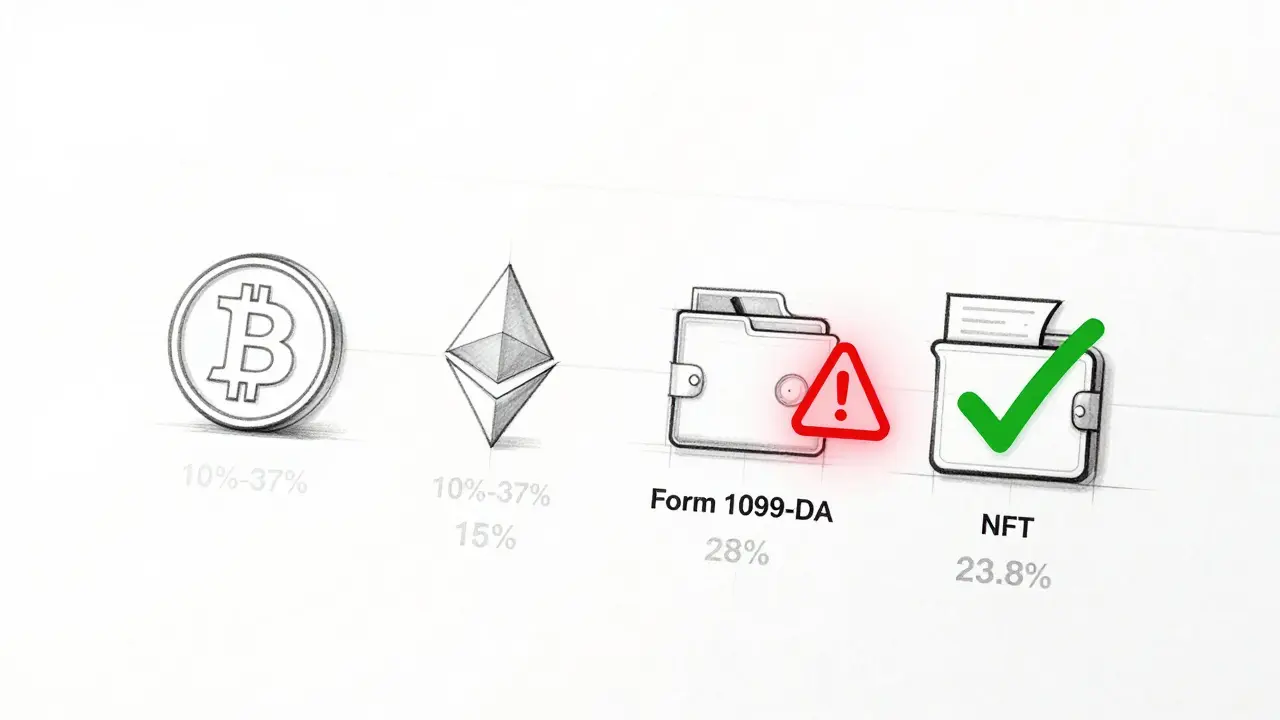
- Ordinary income: If you earn crypto from mining, staking, airdrops, or as salary, it’s taxed as income at your regular rate-between 10% and 37% depending on your total income.
- Short-term capital gains: Sell or trade crypto you’ve held less than a year? You pay your full income tax rate again.
- Long-term capital gains: Hold for over a year? Rates drop to 0%, 15%, or 20%, based on your income level. For 2025, single filers pay 15% if income is between $48,350 and $533,400.
Even swapping one crypto for another counts as a sale. That’s right-trading Bitcoin for Solana isn’t a simple swap. It’s a taxable event where you must calculate the gain or loss based on the fair market value at the time of the trade.
Form 1099-DA Is the Game Changer
Before 2025, crypto exchanges didn’t have to report your trades. Now they do. Form 1099-DA was created specifically for digital assets and went live January 1, 2025. Every U.S.-based exchange-Coinbase, Kraken, Binance.US, and others-must now report every sale, trade, or disposal you made during the year.This isn’t just paperwork. It’s a shift in enforcement. The IRS now has a direct line to your transaction history. If you didn’t report a trade last year, they’ll know. And they’ll match it with your tax return. No more guessing. No more hoping they won’t notice.
Think of it like how your stock broker sends you a 1099-B every year. Now crypto platforms do the same. The difference? Crypto transactions are far more frequent and complex. You might do 50 trades in a year. Each one needs to be tracked.
Wallet-by-Wallet Accounting Is Now Mandatory
The old days of averaging your cost basis across all wallets are gone. Starting in 2025, the IRS requires a wallet-by-wallet accounting method. That means you can’t just lump all your Bitcoin together. You have to track each purchase separately by wallet, timestamp, and cost.Why does this matter? Let’s say you bought 1 BTC in 2021 for $10,000 in Wallet A. Then you bought another 1 BTC in 2023 for $45,000 in Wallet B. If you sell 0.5 BTC from Wallet B, you can’t pretend you sold from Wallet A to claim a lower gain. The IRS now requires you to match each sale to the specific purchase it came from.
This creates a massive record-keeping burden. If you use multiple wallets-MetaMask, Ledger, Trust Wallet, exchange wallets-you now need a full transaction log for each. Missing even one transfer? You risk overpaying taxes or getting flagged.
The Wash Sale Rule Is Coming (Probably)
Right now, you can sell Bitcoin at a loss and buy it back the next day to claim a tax loss. It’s called tax loss harvesting. It’s legal. And it’s about to change.President Biden’s 2025 budget proposal includes applying the wash sale rule to cryptocurrency. That rule already exists for stocks: if you sell a stock at a loss and buy it back within 30 days, you can’t claim the loss. The same will likely apply to crypto.
If this passes, you’ll need to wait 30 days before repurchasing the same asset if you want to deduct the loss. This could change how traders manage their portfolios. No more quick swaps to lock in losses. Strategy shifts. Risk changes. And your tax bill could go up.
NFTs and Collectibles: A Higher Tax Rate
Not all crypto is treated the same. NFTs-non-fungible tokens-are classified as collectibles by the IRS. That means long-term gains on NFTs are taxed at 28%, not the usual 15% or 20%.So if you bought an NFT in 2022 for $5,000 and sold it in 2025 for $25,000, your $20,000 gain is taxed at 28%. That’s $5,600 in federal tax alone. Add state taxes, and you’re looking at over $7,000 in some states.
And it’s not just NFTs. Any digital asset that the IRS deems a collectible-like rare digital art, virtual land, or unique tokenized items-could fall under this rule. If you’re trading these, you need to know the difference.
Net Investment Income Tax Adds Another Layer
If you’re a high-income earner, there’s another tax waiting for you: the Net Investment Income Tax (NIIT). It’s an extra 3.8% applied to investment income-including crypto gains-if your modified adjusted gross income exceeds $200,000 (single) or $250,000 (married).So if you’re in the 20% long-term capital gains bracket and make $300,000 in crypto gains, you’re not just paying 20%. You’re paying 23.8%. That’s $71,400 in federal tax on $300,000 in gains.
And that’s before state taxes. In California, New York, or Hawaii, you could be paying 30% or more in total. This isn’t theoretical. This is real money leaving your wallet.

Charitable Donations Still Work-And They’re Powerful
Here’s one bright spot: donating crypto to charity still lets you avoid capital gains tax while claiming a deduction. If you donate Bitcoin you bought for $5,000 and it’s now worth $50,000, you get a $50,000 deduction. And you pay zero tax on the $45,000 gain.This is one of the most underused tools in crypto tax planning. Many people sell their crypto, pay taxes, then donate the cash. That’s double-taxed. Donating directly? You keep more.
Just make sure the charity is IRS-qualified. And keep proof of the donation date and value. The IRS is watching.
What Happens If You Don’t Catch Up?
The IRS isn’t going to wait. They’ve already started matching Form 1099-DA data with tax returns. If you didn’t report trades from 2023 or 2024, you’re at risk. Penalties for underreporting can hit 25% of the unpaid tax. Interest compounds. And audits are rising.Experts say: don’t wait. If you’ve held crypto since 2020 or earlier, organize your transaction history now. Use tools that import wallet data, track cost basis, and auto-generate reports. Don’t rely on exchange summaries-they’re incomplete without wallet transfers.
What’s Next? More Integration, More Clarity
The system in 2025 is still messy. Wallets don’t talk to each other. Exchanges don’t always share data. The IRS is still building the infrastructure to track transfers between platforms like they do with stocks.But the direction is clear: crypto is being folded into the traditional financial reporting system. Expect more automation. More mandatory reporting. More integration with banks and brokerages.
By 2027, you might see crypto transactions appearing on your W-2 or 1099-INT. The goal isn’t to punish users. It’s to bring crypto into the same regulatory fold as stocks, bonds, and real estate.
The future of cryptocurrency taxation isn’t about banning it. It’s about controlling it. And if you want to keep your gains, you need to control your records.
Do I have to pay taxes on crypto I haven’t sold?
Yes-if you earned it. If you received crypto as payment, from staking, mining, or an airdrop, it’s taxable as income the moment you receive it. You don’t need to sell it to owe tax. Selling it later triggers capital gains, but the initial receipt always creates a tax event.
Can I use FIFO, LIFO, or specific identification for crypto?
You can use specific identification, but only if you track each coin by wallet and timestamp. FIFO (first-in, first-out) is the default if you don’t specify. LIFO is not allowed for crypto under current rules. The wallet-by-wallet requirement means you must prove which specific coins you sold-so record every purchase and transfer.
What if I lost access to a wallet with crypto in it?
If you lost access to a wallet and can’t prove the cost basis, the IRS may assume the cost basis is $0. That means the full sale amount is taxable as a gain. Always back up wallet keys and keep records-even if you think you won’t need them.
Do I need to report crypto transfers between my own wallets?
Yes. Transfers between wallets you own aren’t taxable events, but they affect your cost basis tracking. You must record the date, amount, and original purchase details of the coins moved. Otherwise, you can’t accurately calculate gains when you later sell.
Are there any crypto tax exemptions?
No federal exemptions exist for individuals. Gifts under $18,000 (2025 limit) don’t trigger gift tax, but the recipient inherits your cost basis. Donating to charity avoids capital gains. Holding for over a year lowers rates. But there’s no blanket exemption for owning or trading crypto.
Prakash Patel
March 20, 2026 AT 03:41Elizabeth Kurtz
March 21, 2026 AT 10:21For anyone new to this, start using a tracker like Koinly or TokenTax. It saves hours and reduces stress.
john peter
March 22, 2026 AT 12:34By 2027, when crypto transactions appear on W-2s, we will witness the final collapse of fiat legitimacy. This is not taxation. This is subjugation.
Marc Morgan
March 23, 2026 AT 21:19Bro, I just wanted a latte. Not a tax audit.
Also, if I trade BTC for SOL and then SOL for ETH, am I now required to file three separate forms? Because if so, I’m just gonna keep my coins in a sock under my bed. Simpler. Safer. Less paperwork.
Kira Dreamland
March 24, 2026 AT 08:22Pro tip: screenshot every transaction in your wallet app. Even if it seems useless now. You’ll thank yourself later.
shreya gupta
March 24, 2026 AT 19:43Meanwhile, in the US, they're building blockchain-powered tax compliance systems. The irony is thick.
Derek Lynch
March 26, 2026 AT 19:08Start tracking your cost basis TODAY. Use a spreadsheet. Use an app. Use your grandma’s notebook. Just DO IT.
And yes, donating crypto to charity is one of the most powerful moves in personal finance. If you’ve got gains, give some away. It’s not just smart - it’s beautiful.
Dionne van Diepenbeek
March 27, 2026 AT 20:08Graham Smith
March 28, 2026 AT 14:52One must consider the ontological implications of treating non-fungible tokens as collectibles under IRC § 408(m). The commodification of digital artistry into a taxable asset class reflects a profound epistemological regression.
Katrina Smith
March 30, 2026 AT 00:09Lauren J. Walter
March 31, 2026 AT 12:30What if I just... disappear? Like, sell everything, move to Portugal, and never look back?
...I’m not joking. I’m seriously considering it.
Carol Lueneburg
April 1, 2026 AT 03:02Also, if you’re scared of tracking, just use Koinly. It’s magic. I used to hate taxes. Now I kinda look forward to them. 🤷♀️✨
Brenda White
April 2, 2026 AT 18:19Tobias Wriedt
April 4, 2026 AT 14:11Pay your damn taxes. It’s not a choice. It’s a moral obligation.
Ernestine La Baronne Orange
April 4, 2026 AT 17:46And yet - last year, I got audited anyway. They said my MetaMask transaction log didn’t match their algorithm. I had to hire a CPA who charges $400/hour. I lost $18,000 in legal fees.
They don’t want compliance. They want fear. And they’re winning.
Manali Sovani
April 6, 2026 AT 08:35Why make it harder than it needs to be? The complexity is intentional. It’s designed to confuse.
Konakuze Christopher
April 6, 2026 AT 16:21S F
April 7, 2026 AT 11:55Angelica Stovall
April 9, 2026 AT 02:53They’ll tax you into oblivion. Then they’ll say, 'See? Crypto doesn’t work.'
It’s a trap.
Taylor Holloman.
April 9, 2026 AT 03:33It’s like keeping a journal. You’re not just tracking money - you’re tracking your choices.
And yeah, the system’s messy. But it’s getting better. Slowly. And that’s worth something.
Bryan Roth
April 9, 2026 AT 04:32But here’s the good news: tools are getting better. Wallets are starting to auto-export logs. Exchanges are integrating with tax software. You don’t have to do it alone.
Start small. Track one wallet. One month. Then expand. You’ve got this.
sai nikhil
April 9, 2026 AT 07:11Also, I told my friends. They’re all confused. I’m the crypto tax guy now. 🤦♂️
Sahithi Reddy
April 10, 2026 AT 16:52George Hutchings
April 12, 2026 AT 03:26Change is coming. Not because the government loves crypto. But because crypto forced them to evolve.
Henrique Lyma
April 14, 2026 AT 02:44Meanwhile, the real players - the whales, the hedge funds - have teams of lawyers and accountants. They’re laughing all the way to the bank.
Steph Andrews
April 15, 2026 AT 15:20Simple. No drama. No fear. Just do the math.
Zachary N
April 17, 2026 AT 09:13The key? Documentation. Always. No exceptions.
And if you’re overwhelmed, hire a crypto-savvy CPA. It’s not a luxury - it’s insurance. You wouldn’t skip a car inspection. Don’t skip this.
Anastasia Thyroff
April 19, 2026 AT 02:45Then I saw the 28% rate.
I cried.
Then I deleted my wallet.
Never again.
Prakash Patel
April 19, 2026 AT 07:25Elizabeth Kurtz
April 19, 2026 AT 11:08Ernestine La Baronne Orange
April 20, 2026 AT 07:11