
How BFT Ensures Blockchain Network Reliability: A Deep Dive
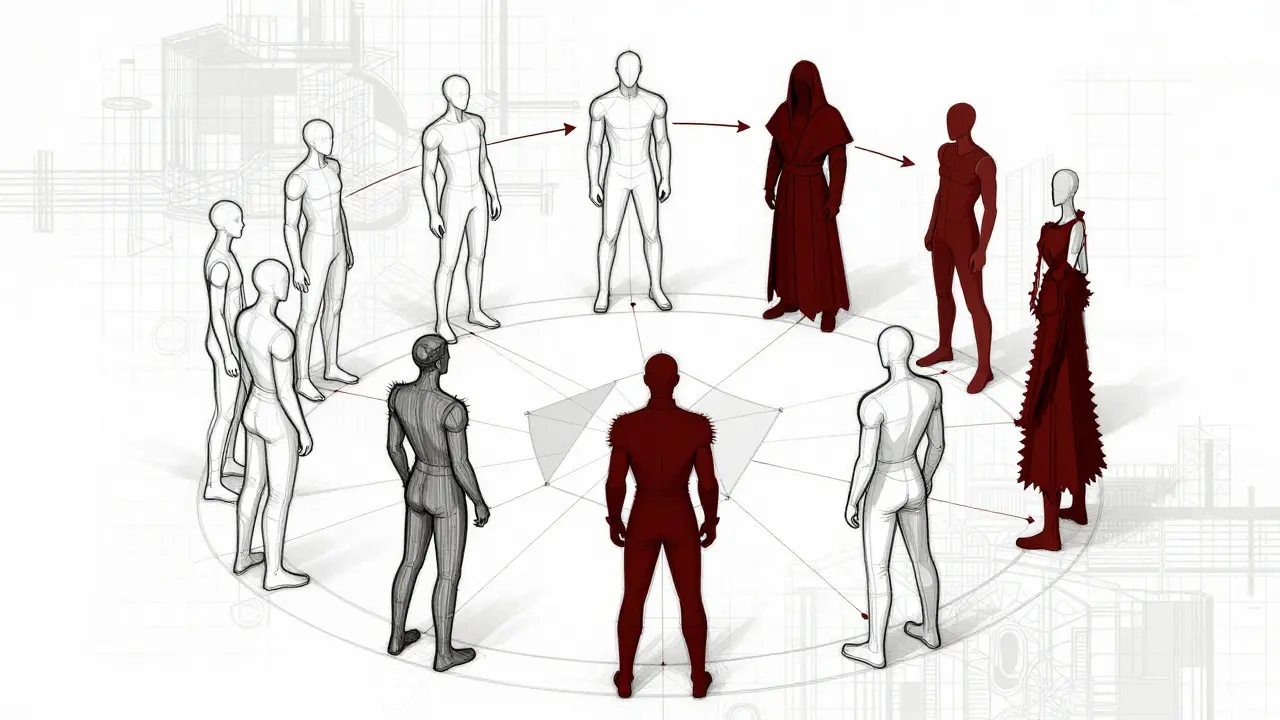
Imagine you are running a high-stakes financial settlement system. You need to know, with absolute certainty, that a payment has gone through. No "maybe," no "wait for six confirmations." Just done. This is the promise of Byzantine Fault Tolerance, or BFT. It is the mathematical backbone that allows decentralized networks to agree on truth even when some participants are lying, crashing, or acting maliciously.
Without BFT, blockchain networks would be fragile. A single bad actor could confuse the system, leading to double-spends or lost data. With it, systems like Hyperledger Fabric and Cosmos can process thousands of transactions per second with immediate finality. But how does it actually work? And why do public blockchains like Bitcoin largely ignore it in favor of Proof of Work?
What Is Byzantine Fault Tolerance (BFT)?
To understand BFT, we have to go back to 1982. Leslie Lamport, Robert Shostak, and Marshall Pease published a paper titled "The Byzantine Generals Problem." They used a military analogy to explain a computer science nightmare.
Imagine several generals commanding armies around a city. They must agree to attack at the same time to win. If they attack separately, they lose. The problem? Some generals might be traitors sending false messages to trick others into attacking alone. In computing terms, these "generals" are nodes in a network, and "traitors" are faulty or malicious servers.
Byzantine Fault Tolerance is a property of distributed systems that enables them to reach consensus despite the presence of faulty or malicious nodes. For a blockchain, this means the network stays reliable even if up to one-third of its nodes behave badly.
The math is strict. If you have $f$ faulty nodes, you need at least $3f + 1$ total nodes. So, if you want to tolerate 1 bad node, you need 4 nodes total. If you want to tolerate 3 bad nodes, you need 10. This ensures that honest nodes always form a majority capable of outvoting the liars.
How BFT Achieves Instant Transaction Finality
The biggest advantage of BFT over other consensus mechanisms is speed and certainty. Let’s compare it to Bitcoin.
Bitcoin uses Proof of Work (PoW). When you send Bitcoin, the network doesn’t say "it’s done" immediately. It says "it’s likely done." You wait for one block confirmation (about 10 minutes), then another, until you have six. Only then are you 99.99% sure the transaction won’t reverse. This is called probabilistic finality.
BFT offers deterministic finality. Once the consensus algorithm completes its steps, the transaction is permanent. There is no going back. This is crucial for enterprise applications where businesses cannot afford uncertainty.
Consider Hyperledger Fabric, an enterprise-grade permissioned blockchain platform. It uses a variant of BFT to process transactions with finality in under 2 seconds. JPMorgan’s Quorum implementation, which uses Istanbul BFT, reported 99.998% uptime over 18 months with zero consensus failures, even when simulated attacks compromised 30% of nodes. That kind of reliability is impossible with PoW.
The Mechanics: How PBFT Works
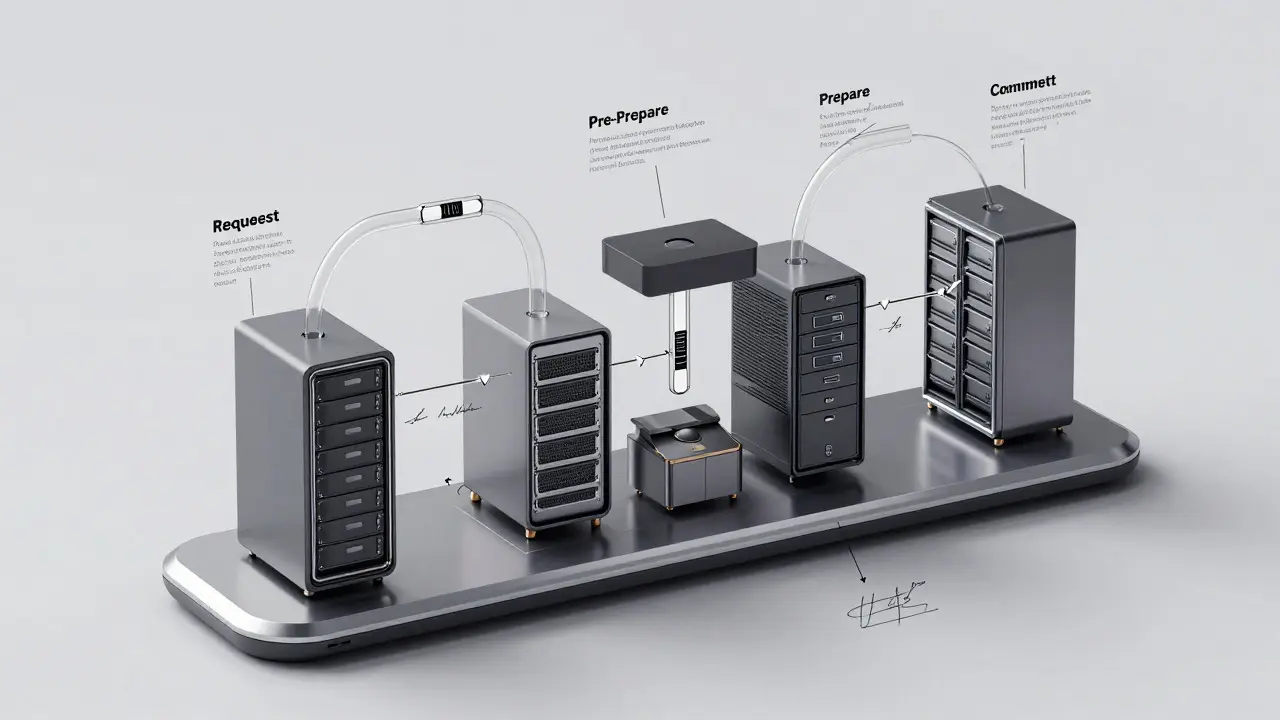
The most famous implementation of BFT is Practical Byzantine Fault Tolerance (PBFT), introduced by Miguel Castro and Barbara Liskov at MIT in 1999. PBFT operates in four distinct phases:
- Request: A client sends a request to the primary node.
- Pre-prepare: The primary node assigns a sequence number to the request and broadcasts it to all backup nodes.
- Prepare: Backup nodes check if the request is valid. If so, they broadcast a "prepare" message to all other nodes. Once a node receives $2f$ matching prepare messages, it enters the prepared state.
- Commit: Nodes broadcast a "commit" message. Once a node receives $2f+1$ commit messages, it executes the request and sends a reply to the client.
This multi-step voting process ensures that even if the primary node is corrupt, the backups can detect the lie and continue. Each step requires cryptographic signatures-Tendermint, for example, uses 64-byte Ed25519 signatures for every message-creating a verifiable audit trail.
BFT vs. Proof of Work and Proof of Stake
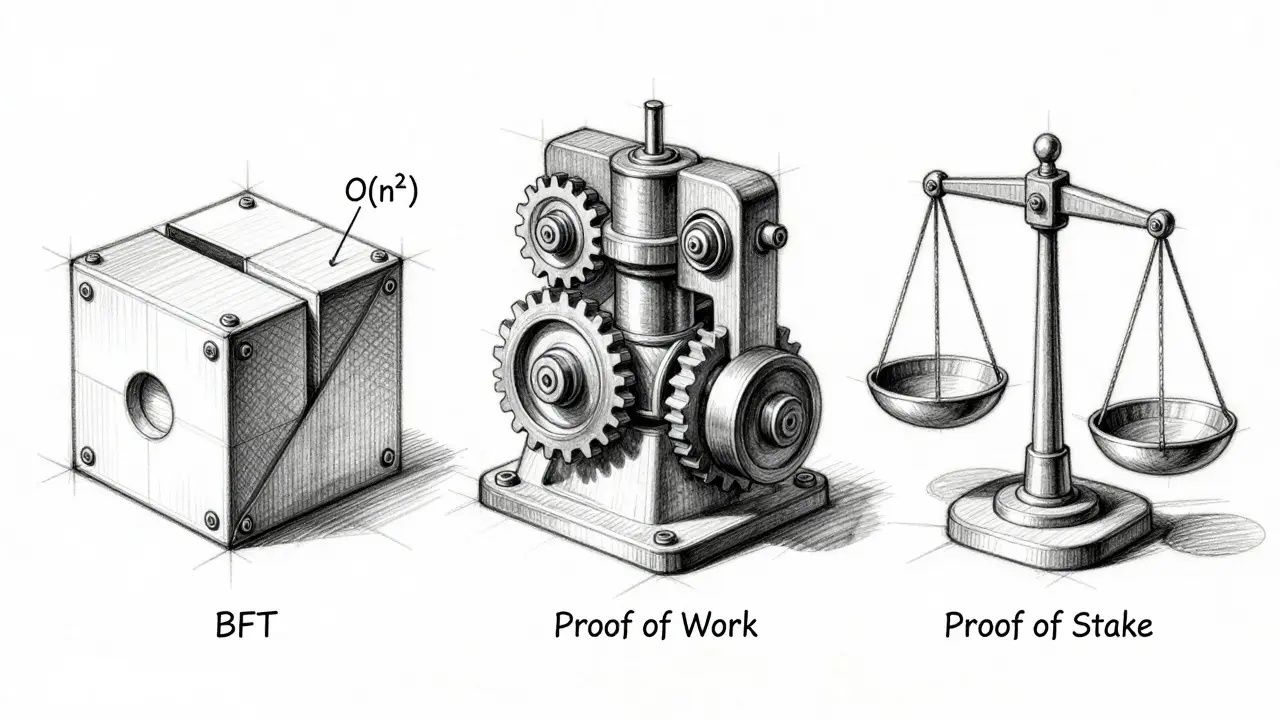
Not all blockchains use BFT. Why? Because there are trade-offs. Let’s look at how BFT compares to the dominant models in public blockchains.
| Feature | Byzantine Fault Tolerance (BFT) | Proof of Work (PoW) | Proof of Stake (PoS) |
|---|---|---|---|
| Finality Type | Deterministic (Instant) | Probabilistic (~60 mins) | Probabilistic/Deterministic hybrid (~6.4 mins) |
| Fault Tolerance Threshold | Up to 33% malicious nodes | Up to 50% hash power | Up to 33% staked value |
| Throughput (TPS) | High (1,000 - 10,000+) | Low (7 for Bitcoin) | Medium (15-30 for Ethereum pre-merge) |
| Energy Efficiency | Very High | Very Low | High |
| Decentralization Suitability | Permissioned/Private | Permissionless/Public | Permissionless/Public |
| Scalability Limit | O(n²) communication complexity | Hardware limited | Economic security limited |
As the table shows, BFT wins on speed and efficiency. However, it loses on scalability in open networks. The communication complexity grows quadratically ($O(n^2)$). This means as you add more nodes, the amount of data they must exchange explodes. Research from the Nervos Foundation indicates this makes traditional BFT unsuitable for networks with thousands of anonymous participants.
This is why Bitcoin uses PoW. It tolerates up to 50% malicious hash power (though securing 51% is economically difficult) and allows anyone to join without knowing who else is in the network. BFT typically requires a known set of validators, which introduces centralization risks.
Where BFT Dominates: Enterprise and CBDCs
Because of its instant finality and low energy cost, BFT is the king of enterprise blockchain. Gartner reported that 78% of enterprise blockchain implementations in 2022 utilized BFT-based consensus. Why? Businesses don’t care about ideological decentralization; they care about reliability and speed.
Take the European Central Bank’s Digital Euro project. Their wholesale CBDC prototype specifically required BFT-based consensus. As stated in their October 2022 report, financial market infrastructure demands "absolute transaction finality." You cannot settle interbank loans with a 10-minute window of doubt.
Other major players include:
- Cosmos Network: Uses Tendermint BFT to achieve 10,000 TPS with finality in 3-5 seconds.
- JPMorgan Quorum: Uses Istanbul BFT for private financial ledgers.
- Hyperledger Fabric: The standard for supply chain and corporate data sharing.
Challenges and Future Improvements
BFT isn’t perfect. The main criticism comes from developers like Pieter Wuille of Bitcoin Core, who noted that BFT protocols inherently require some level of trusted setup for node selection. This makes them less suitable for permissionless environments where anonymity is key.
There is also a steep learning curve. Chainstack’s 2022 developer survey showed it takes engineers an average of 83 hours to become proficient with BFT implementations, compared to 47 hours for Proof of Authority. Tuning network parameters to handle intermittent failures can take weeks, as one developer noted in a Reddit discussion about deploying PBFT in a supply chain network.
However, the technology is evolving. The Ethereum Foundation published research in January 2023 on "Linear Communication Cost BFT" protocols. These aim to reduce communication complexity from $O(n^2)$ to $O(n)$, potentially allowing BFT to scale to 1,000+ nodes. Additionally, the InterChain Foundation launched a $15 million grant program in March 2023 to improve BFT scalability, targeting a sharded variant called "Tendermint Core 2.0" by late 2024.
By 2026, IDC predicts 65% of enterprise blockchain implementations will use some form of BFT. While it may never replace PoW or PoS in public cryptocurrencies, its role in securing reliable, fast, and efficient private networks is undeniable.
What is the maximum percentage of faulty nodes BFT can tolerate?
BFT can tolerate up to 33.3% (one-third) of faulty or malicious nodes. Mathematically, if there are $f$ faulty nodes, the system needs at least $3f + 1$ total nodes to maintain consensus.
Why doesn't Bitcoin use Byzantine Fault Tolerance?
Bitcoin prioritizes decentralization and permissionless entry over speed. BFT requires a known set of validators, which creates centralization risks. Additionally, BFT's communication complexity grows quadratically, making it inefficient for large, anonymous public networks compared to Proof of Work.
What is the difference between probabilistic and deterministic finality?
Probabilistic finality (used by Bitcoin/Ethereum PoW) means a transaction becomes more secure over time as more blocks are added, but there is always a tiny chance of reversal. Deterministic finality (used by BFT) means once the consensus algorithm completes, the transaction is permanently recorded and cannot be reversed.
Which blockchains use BFT consensus?
Several prominent blockchains use BFT variants, including Cosmos (Tendermint BFT), JPMorgan Quorum (Istanbul BFT), and Hyperledger Fabric. These are primarily used in enterprise and permissioned settings where speed and finality are critical.
Is BFT energy-efficient?
Yes, BFT is highly energy-efficient. Unlike Proof of Work, which requires massive computational power to solve puzzles, BFT relies on digital signatures and message passing between nodes, consuming minimal electricity.

Heather Austin
July 26, 2026 AT 00:05hey so i was reading through this and honestly the part about O(n^2) complexity is super important but often glossed over in these enterprise pitches. basically if you have 100 validators its manageable but once you hit 1000 or more the network chatter just explodes. thats why cosmos uses a hub and spoke model to kind of mitigate it but even then scaling BFT to truly public levels is tough. i work with hyperledger fabric sometimes and the tuning required for PBFT variants is no joke. you gotta be really careful with your network latency settings because if nodes are too far apart geographically the consensus rounds take forever. also dont forget that tendermint isnt pure PBFT its a hotstuff variant which simplifies the view change process significantly. still requires known validators though which brings us back to the centralization debate.
Michelle Walker
July 27, 2026 AT 04:13You missed the elephant in the room. BFT is just a fancy word for 'we trust these specific computers.' It is not decentralized. It is permissioned. The article tries to spin it as reliable but reliability comes at the cost of censorship resistance. If you need absolute finality you are admitting that probabilistic security is insufficient for your use case which means you are building a database not a blockchain. Stop pretending enterprise chains are blockchains.
Lisa Chong
July 28, 2026 AT 00:29the whole concept of trusting nodes is terrifying when you consider who controls those nodes. big banks? governments? they will censor transactions without blinking an eye. the byzantine generals problem assumes traitors but what if the generals themselves are compromised by external forces like surveillance agencies. we are handing over our financial sovereignty to algorithms controlled by elites who want to track every penny. instant finality sounds nice until you realize it means instant control. wake up people. this is digital slavery disguised as efficiency. the math is rigged against the little guy.
Linda Hilliard
July 29, 2026 AT 20:39Typical layman misunderstanding. :P You fail to grasp that enterprise environments prioritize throughput and determinism over ideological purity. The term 'blockchain' describes the data structure, not necessarily the economic incentive layer. Hyperledger Fabric utilizes a ledger structure identical to Bitcoin's UTXO or account models, yet achieves sub-second finality via Raft or IBFT. To dismiss this as merely a 'database' ignores the cryptographic verification of state transitions inherent in the protocol. Furthermore, the notion that PoW is immune to censorship is naive given the regulatory pressure on mining pools. BFT offers auditable finality which is paramount for institutional adoption. Read some papers before posting.
Michelle Walker
July 31, 2026 AT 15:15Auditable finality is a buzzword for 'easier to subpoena.' If the validators are known entities they can be coerced. PoW miners are anonymous and distributed globally making coercion economically prohibitive. Your argument relies on the assumption that institutions care about decentralization which they do not. They care about control. Hence BFT fits their narrative perfectly. It is not a flaw in BFT it is a feature of centralization.
Linda Hilliard
August 1, 2026 AT 16:19Coercion exists in PoW via energy sanctions and hardware restrictions. The difference is one is explicit and contractual (BFT) while the other is implicit and geopolitical (PoW). Neither is purely free. But let us stick to technical merits. BFT allows for complex smart contract execution with guaranteed outcomes within a single epoch. This enables cross-chain interoperability protocols like IBC in Cosmos to function reliably. Without deterministic finality atomic swaps would require excessive locking periods increasing capital inefficiency. That is a tangible benefit beyond ideology.
Ran Tao
August 1, 2026 AT 16:45Oh please! 🙄 Everyone here acting like they understand distributed systems better than the inventors. The truth is BFT is the future and PoW is a dinosaur screaming into the void. 💥 Who cares about 'ideology' when you can process 10k TPS? 🚀 Enterprise doesn't care about your precious anonymity. They care about moving money fast. And guess what? Money talks and bullshit walks. BFT is winning hands down. Just look at the CBDC projects. Governments love BFT because it gives them exactly what they want: control and speed. So stop crying about decentralization and get with the program. 😂
Winston Lacewing
August 2, 2026 AT 09:40I feel like we are missing the human element here. Technology should serve people not the other way around. If BFT makes transactions faster and cheaper for everyday users why does it matter if it is slightly less decentralized? Most people just want to send money to family abroad without waiting hours and paying huge fees. The drama about 'traitors' and 'generals' is cool theory but real life needs practical solutions. Maybe we can have both? Layer 2s on top of BFT chains could offer privacy features. Let us not throw the baby out with the bathwater. 🌟
Shay Thomson
August 2, 2026 AT 19:59Actually that is a very fair point. The dichotomy between 'pure crypto' and 'enterprise tech' is artificial. We see hybrid models emerging where PoS provides security and BFT handles settlement layers. Ethereum's move to PoS already incorporates aspects of BFT logic in its consensus mechanism. The distinction blurs. What matters is whether the system achieves its goals efficiently. For supply chain tracking BFT is superior. For store of value PoW might still hold psychological weight. Both have their place.
Winston Lacewing
August 3, 2026 AT 12:35Exactly! It is not about picking a side. It is about using the right tool for the job. Using a sledgehammer to crack a nut is inefficient. Using a scalpel to chop wood is useless. BFT is the scalpel. PoW is the sledgehammer. We need both in our toolkit. The key is transparency so users know which one they are interacting with. Education is the real solution here. 🙏
DJ Maleko
August 4, 2026 AT 09:47Let me ask you something personal. How many of you actually run a node? 🤔 Probably none. You all read articles and parrot talking points. Meanwhile devs are struggling with the quadratic communication overhead. I deployed a testnet last week and my bandwidth bill was insane. BFT is great on paper but in practice it eats resources differently than PoW. It is not just CPU it is network I/O. People forget that. Also the signature aggregation in Tendermint helps but it adds complexity. Debugging those issues is a nightmare. 😩
Heather Austin
August 5, 2026 AT 15:20yeah the network IO is the killer. i noticed that too. when you have thousands of messages flying around per second your home internet connection chokes. most retail users cant handle that load. thats why validators tend to cluster in certain regions with good infrastructure leading to geographic centralization. it is a subtle form of bias. also the storage requirements grow linearly with blocks so pruning becomes essential but complicates light client verification. interesting tradeoffs.
DJ Maleko
August 6, 2026 AT 15:24Spot on. Geographic clustering is a huge risk factor. If all validators are in AWS us-east-1 you are vulnerable to regional outages. True decentralization requires physical distribution which increases latency which hurts BFT performance. It is a vicious cycle. 🔄
Jessie Smith
August 7, 2026 AT 06:42The philosophical underpinning of BFT is essentially a social contract encoded in mathematics. It presupposes a level of trust among participants that PoW deliberately avoids by relying on game theory and energy expenditure. One might argue that BFT represents a maturation of the technology towards pragmatic utility rather than radical experimentation. However, this pragmatism often masks a retreat from the original cypherpunk ideals of pseudonymous freedom. Is this evolution or devolution? Perhaps it is simply adaptation to market realities. The 'Byzantine' nature of humanity remains constant regardless of the consensus algorithm employed. We project our faults onto the machines.
Deep Rahman
August 8, 2026 AT 06:01When we think about the generals surrounding the city we must consider that history is filled with examples where communication breakdown led to disaster. The Byzantine Empire itself fell partly due to logistical and communication failures across vast distances. In modern terms this translates to latency and packet loss. BFT attempts to solve this logically but human factors remain. Operators make mistakes. Keys get lost. Networks go down. The algorithm is only as strong as its weakest operational link. Therefore education and robust monitoring tools are just as critical as the consensus code itself. We must nurture the ecosystem holistically.
Erika Pozzetto
August 9, 2026 AT 06:37It is indeed fascinating to observe how theoretical computer science concepts developed decades ago find practical application in contemporary financial infrastructure. The transition from academic curiosity to industrial standard demonstrates the enduring relevance of foundational research. Leslie Lamport's work continues to influence systems design profoundly. Moreover the integration of cryptographic primitives such as Ed25519 signatures enhances security posture significantly compared to older ECDSA implementations. This synergy between theory and practice exemplifies technological progress. Collaboration between academia and industry remains vital for continued innovation.
Kristine Lawson
August 10, 2026 AT 16:48One must acknowledge; however, that the reliance on pre-defined validator sets introduces significant governance challenges. Unlike permissionless networks where entry is open to all, BFT systems require rigorous vetting processes. This creates barriers to entry that may stifle competition and foster oligopolistic structures among validator operators. Furthermore, the slashing conditions in Proof-of-Stake variants of BFT must be carefully calibrated to penalize malfeasance without inadvertently punishing honest nodes experiencing transient network issues. Precision in parameter tuning is paramount.
Tawny Holmes
August 11, 2026 AT 02:48BFT is for apps. PoW is for money. Different use cases. Stop mixing them up.
Josephine Finlayson
August 12, 2026 AT 02:01That is a very succinct summary! It really highlights the distinct purposes each mechanism serves. Many newcomers struggle with this distinction so clear explanations are helpful. Thank you for clarifying!
Tawny Holmes
August 12, 2026 AT 11:27No problem. Simple truths often get buried in jargon.
Tuan Nguyen
August 13, 2026 AT 14:45The elitist perspective suggests that only those with sufficient technical acumen should participate in validator sets. Mass participation leads to mediocrity and security vulnerabilities. Professionalization of validation is inevitable. Amateurs should stick to holding tokens. The complexity of managing BFT nodes requires expertise that the average user lacks. This is not exclusionary; it is quality control.
Andrew Schneider
August 15, 2026 AT 12:14Oh wow, talk about gatekeeping! 🚪🙅♂️ Like the rest of us don't deserve to validate? Please. The 'expertise' barrier is just a smokescreen for profit margins. Anyone can learn. The tutorials are online. Stop acting like running a node requires a PhD. It requires patience and a decent SSD. The community thrives on diversity of participants, not just corporate farms. Shake off the snobbery and embrace the open spirit! ✨
Tuan Nguyen
August 17, 2026 AT 03:01Diversity does not equal security. A poorly configured node is a liability. Professional operators provide stability. Stability attracts value. It is basic economics.
Andrew Schneider
August 18, 2026 AT 16:22Economics of what? Exclusivity? That is not sustainability. That is fragility. When the pros sleep the amateurs keep the lights on. Don't forget that. 🌙💡