Is Crypto Regulated in Nigeria? The 2025 Legal Framework Explained
For years, if you asked a Nigerian whether cryptocurrency was legal, the answer was a confusing shrug. You could buy Bitcoin, but your bank might freeze your account for doing it. That era of ambiguity ended decisively in 2025. Today, crypto is regulated in Nigeria under a clear, comprehensive legal framework that recognizes digital assets as securities and establishes strict rules for exchanges and users alike.
The shift from restriction to regulation wasn't sudden; it was the result of intense pressure from a massive, resilient user base and a government realizing it couldn't ignore an industry moving billions of dollars. As of mid-2026, the landscape is defined by the Investments and Securities Act (ISA) 2025 and coordinated oversight between the Securities and Exchange Commission (SEC) and the Central Bank of Nigeria (CBN). This isn't just about permission-it's about compliance, taxation, and consumer protection.
From Ban to Blueprint: The Regulatory Turning Point
To understand where we are now, you have to look at how far we've come. Between 2017 and 2023, the Central Bank of Nigeria (CBN) issued circulars banning commercial banks from facilitating cryptocurrency transactions. For the average user, this meant navigating peer-to-peer (P2P) markets with high risk. In 2021, reports surfaced of bank accounts being frozen simply because they received crypto-related funds. It was a hostile environment that pushed activity underground rather than stopping it.
The tide began to turn in December 2023 when the CBN lifted its ban, issuing Virtual Asset Service Provider (VASP) Guidelines. These guidelines allowed banks to offer services to licensed crypto businesses, provided those businesses met strict anti-money laundering standards. But the real game-changer arrived in March 2025, when President Bola Ahmed Tinubu signed the Investments and Securities Act (ISA) 2025 into law.
This legislation replaced the outdated 2007 ISA and officially recognized cryptocurrencies as securities. By classifying digital assets this way, the government brought them under the direct jurisdiction of the SEC. This move didn't just legalize crypto; it structured it. It signaled to global investors that Nigeria was serious about building a compliant, transparent market rather than a wild west.
Who Controls What? The Multi-Agency Oversight Model
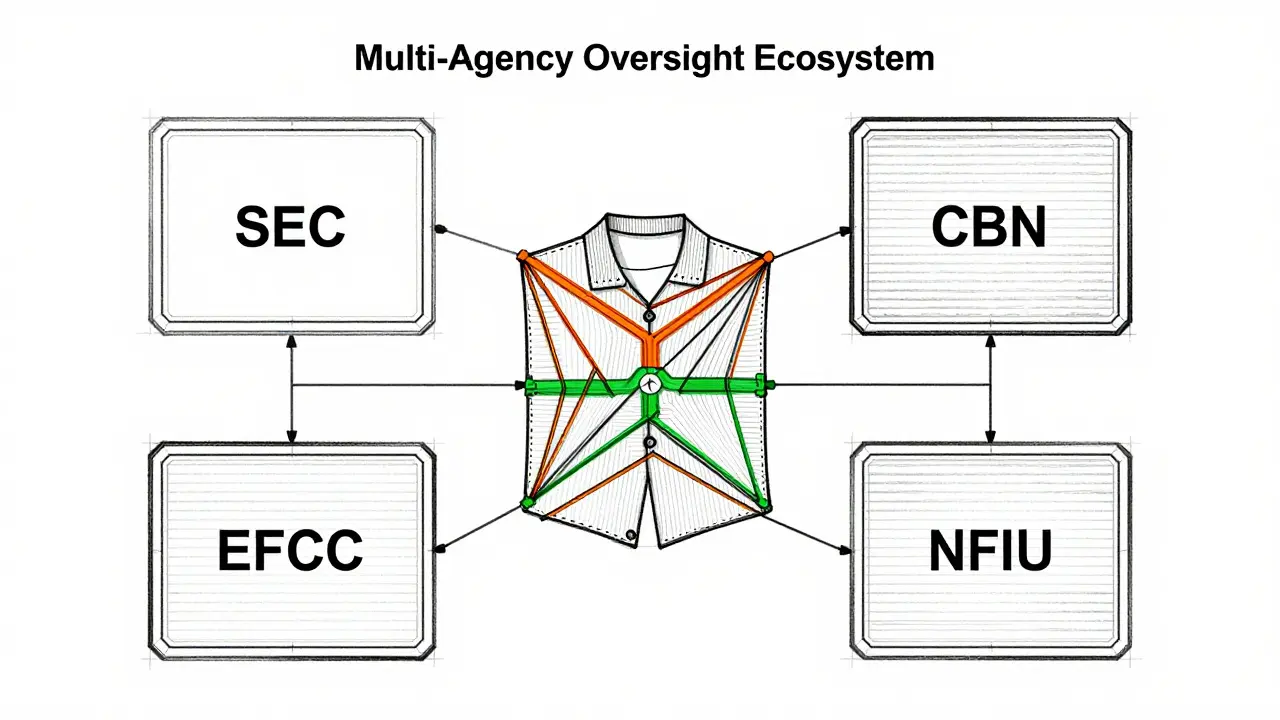
Nigeria’s approach to crypto regulation is unique because it doesn't rely on a single regulator. Instead, it uses a multi-agency model designed to cover every angle of the ecosystem. Understanding who does what is crucial for anyone operating in or using the Nigerian crypto space.
| Agency | Primary Role | Jurisdiction Focus |
|---|---|---|
| Securities and Exchange Commission (SEC) | Licensing and oversight of exchanges and token offerings | Digital assets as securities, investment-focused NFTs, forex platforms |
| Central Bank of Nigeria (CBN) | Banking relationships and payment systems | Currency conversion, fiat on/off ramps, VASP banking access |
| Economic and Financial Crimes Commission (EFCC) | Enforcement and fraud prevention | Anti-money laundering (AML), combating Ponzi schemes, telecom data access |
| Nigerian Financial Intelligence Unit (NFIU) | Financial intelligence and reporting | Monitoring suspicious transactions, integrating with global AML networks |
The SEC acts as the primary gatekeeper. If you want to run an exchange, list a token, or sell investment-grade NFTs, you go through the SEC. The CBN ensures that these entities can actually interact with the traditional banking system without triggering money laundering alerts. Meanwhile, the EFCC and NFIU provide the teeth, ensuring that bad actors don't exploit the new openness. This coordination is complex but necessary given the scale of Nigeria's market, which received an estimated $92.1 billion in crypto value between July 2024 and June 2025.
Licensing Requirements: How to Operate Legally
If you're a business looking to enter the Nigerian market, the days of launching a website and hoping for the best are over. The ISA 2025 and the SEC's Digital Assets Rules 2022 create a rigorous licensing regime. There is no "gray area" anymore; you are either licensed or you are illegal.
All Virtual Asset Service Providers (VASPs), including exchanges, must register with the SEC. The process involves several non-negotiable steps:
- Nigerian Corporate Registration: Your entity must be incorporated in Nigeria. Foreign companies cannot operate remotely without a local presence.
- Local Management: You must appoint Nigerian management personnel who understand both local law and digital asset mechanics.
- Paid-Up Capital: Specific capital requirements vary by license category but ensure the company has sufficient financial backing to handle operational risks.
- Fidelity Bonds: Companies must maintain fidelity bonds to protect against employee fraud or mismanagement.
- Physical Office: Maintaining a local office is mandatory, allowing regulators to conduct physical inspections if needed.
The SEC has already awarded provisional licenses to major players like Busha and Quidax. These platforms serve as benchmarks for compliance. Dozens of other companies are currently navigating the vetting process. The SEC is thorough, and delays are common as they scrutinize each application to prevent future scandals. This high barrier to entry protects consumers but challenges smaller startups.
Taxation and Penalties: The Cost of Non-Compliance
Regulation brings clarity, but it also brings costs. With the signing of the Nigeria Tax Administration Act (NTAA) 2025 in June 2025, the government has laid out specific tax obligations for crypto activities. Set to take full effect in 2026, this act introduces crypto-specific taxation, ending the previous uncertainty where many users assumed crypto gains were tax-free.
For businesses, the penalties for non-compliance are severe. The SEC has established a tiered penalty system for VASPs that fail to adhere to regulations:
- First Month Default: A fine of ₦10 million (approximately $6,693).
- Subsequent Months: An additional ₦1 million (approximately $669) for each month of continued non-compliance.
- License Revocation: Persistent violations lead to suspension or revocation of the operating license.
These fines are not symbolic. They are designed to force immediate compliance. For individual users, the focus is less on heavy fines and more on transparency. The amended National Anti-Money Laundering Act requires VASPs to report suspicious transactions, meaning your trading history is no longer private from regulatory eyes if it triggers certain thresholds.
Impact on Users: Freedom vs. Surveillance
How does this affect the everyday Nigerian crypto user? On one hand, the fear of having your bank account frozen is largely gone. Licensed platforms like Busha and Quidax can now integrate seamlessly with banks, making deposits and withdrawals smoother and safer. You no longer need to rely on risky P2P deals with strangers who might scam you.
However, this convenience comes with trade-offs. The enhanced oversight provisions give regulators access to telecom records for investigations. While this is aimed at stopping Ponzi schemes and fraud, it raises privacy concerns. Many users worry about government surveillance capabilities under the new framework. Social media discussions reveal a mixed sentiment: appreciation for legal certainty but anxiety about potential restrictions on P2P trading and data privacy.
Moreover, the learning curve for compliance is steep. Users must now verify their identities (KYC) rigorously on licensed platforms. Anonymous trading, once a hallmark of crypto culture, is effectively dead in the formal Nigerian market. If you want to use the banking system, you must be known to the regulator.
Nigeria vs. Africa: A Regional Leader?
When comparing Nigeria to its neighbors, it stands out for its comprehensive approach. Kenya and South Africa have introduced crypto-specific taxes, but Nigeria developed a full licensing framework first. This positions Nigeria as a potential hub for fintech innovation in Africa.
The country's market size-$92.1 billion in value received in late 2024/early 2025-is nearly double that of South Africa. This volume attracts foreign investment and encourages job creation in the tech sector. The National Blockchain Policy 2023 further supports this by driving broader technology adoption, even though it doesn't directly regulate crypto markets.
However, the complexity of the multi-agency model can be a double-edged sword. While it provides comprehensive coverage, it creates bureaucratic hurdles. Companies must navigate overlapping jurisdictions between the SEC and CBN, requiring significant legal expertise. This favors large, well-funded players over small innovators, potentially stifling some grassroots creativity.
Future Outlook: What Comes Next?
As we move through 2026, the focus shifts from implementation to refinement. The NTAA 2025 will fully impact tax reporting, forcing users and businesses to adapt their accounting practices. We expect to see more licensing approvals as the SEC processes the backlog of applications. This will increase competition among exchanges, potentially lowering fees for users.
Long-term viability depends on balancing innovation with consumer protection. If the government maintains this level of clarity while avoiding excessive bureaucracy, Nigeria could become the definitive fintech hub of Africa. But if enforcement becomes too aggressive or taxes too burdensome, activity may drift back to informal channels. For now, the signal is clear: crypto is here to stay, but it must play by the rules.
Is it legal to buy Bitcoin in Nigeria in 2026?
Yes, it is legal. Since the passage of the Investments and Securities Act (ISA) 2025, cryptocurrencies are recognized as securities. You can buy Bitcoin through licensed Virtual Asset Service Providers (VASPs) like Busha and Quidax, which are authorized by the SEC and allowed to work with commercial banks.
Do I need a license to trade crypto in Nigeria?
Individual users do not need a license to trade. However, any business acting as an exchange, wallet provider, or broker must obtain a license from the SEC. Operating without this license is illegal and subject to heavy fines and shutdowns.
Will my bank account be frozen for crypto transactions?
Not if you use licensed platforms. The CBN lifted its ban on crypto transactions in 2023, allowing banks to service licensed VASPs. Transactions with unlicensed or suspicious entities may still trigger freezes, so always use SEC-approved exchanges.
What are the penalties for non-compliant crypto businesses?
Under the current framework, VASPs face an initial fine of ₦10 million for the first month of default, plus ₦1 million for each subsequent month. The SEC can also suspend or revoke licenses for persistent non-compliance.
Are NFTs regulated in Nigeria?
It depends on the type. Investment-focused NFTs are regulated by the SEC as securities. Artistic or collectible NFTs that are not marketed as financial products remain largely unaffected, unless they involve significant fundraising or speculative trading patterns.
Which agencies regulate crypto in Nigeria?
The primary regulator is the Securities and Exchange Commission (SEC) for licensing and market conduct. The Central Bank of Nigeria (CBN) oversees banking interactions. The EFCC and NFIU handle enforcement, anti-money laundering, and financial intelligence.