
Isolated Margin vs Cross Margin: Which One Fits Your Crypto Trading Style?
When you trade crypto with leverage, your biggest question isn’t just how much you can make-it’s how much you can lose. Two systems control that: isolated margin and cross margin. They’re not just settings on your trading platform. They’re risk engines. Pick the wrong one, and you could lose your whole account. Pick the right one, and you protect yourself while still playing to win.
What Is Isolated Margin?
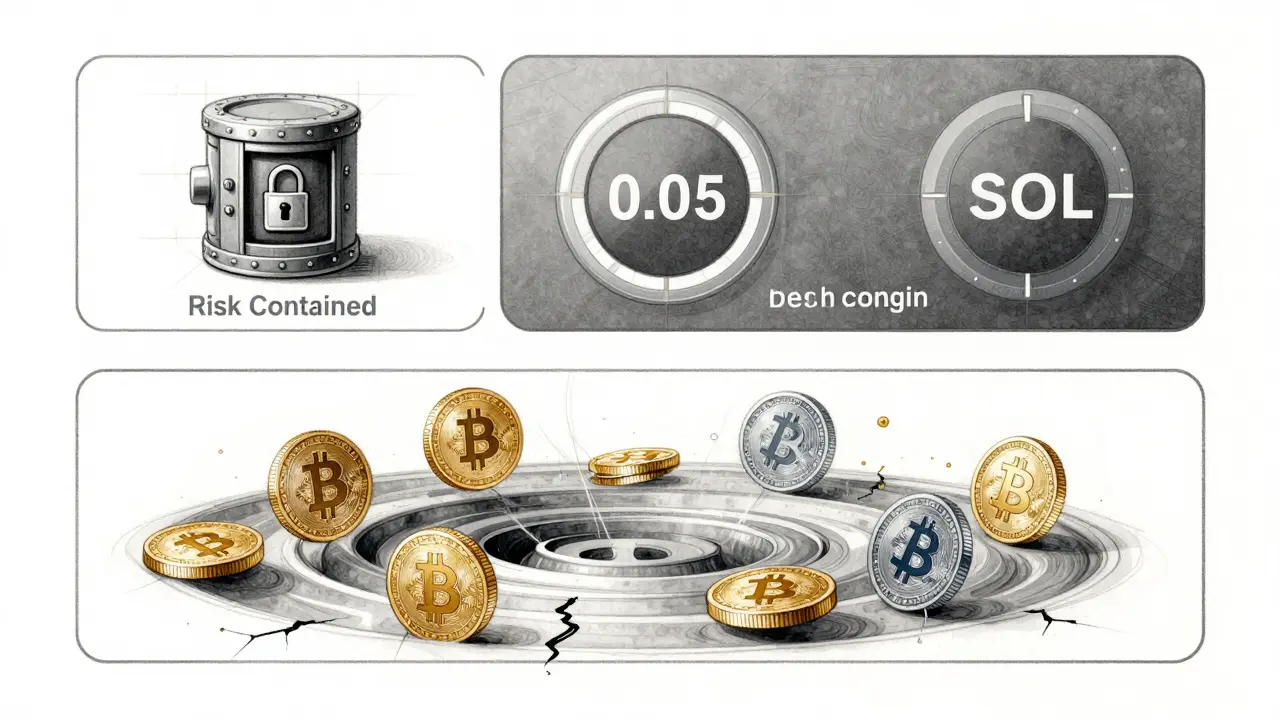
Isolated margin locks a fixed amount of your balance to a single trade. Think of it like a separate bank account just for that one position. If the trade goes bad, only that locked amount is at risk. The rest of your funds stay untouched.For example, say you have 1 BTC in your account and you open a 10x leveraged Ethereum position using 0.05 BTC as isolated margin. Even if that trade crashes, you only lose the 0.05 BTC. The other 0.95 BTC stays safe. No ripple effect. No surprise liquidations dragging down your other trades.
This is why professional traders and speculators love it. If you’re betting big on a single coin-like going long on Solana before a major upgrade-isolated margin lets you put up only what you’re willing to lose. It’s perfect for high-leverage plays where you know the risk but want to contain it.
Every exchange handles it the same way: you pick the position, set the margin amount, and the system calculates your liquidation price based on that fixed number. No more, no less. If the price hits that level, the trade closes. Done. No extra funds pulled from your wallet. You don’t get a safety net. But you also don’t get surprise losses.
What Is Cross Margin?
Cross margin uses your entire account balance as collateral for every open position. It’s like throwing all your chips into one pile and letting the system use any available funds to keep your trades alive.Let’s say you have 1 BTC and you open three positions: BTC/USDT, ETH/USDT, and SOL/USDT-all with cross margin enabled. If your ETH trade starts losing money, the system automatically pulls funds from your BTC or SOL positions to cover the margin. If you’re making profits on those other trades, those unrealized gains help prop up the losing one.
This means fewer liquidations. In a volatile market, that’s huge. You don’t have to constantly monitor each trade. The platform does the heavy lifting. That’s why beginners and passive traders often choose cross margin. It’s forgiving. It gives you breathing room.
But here’s the catch: if everything tanks at once-say, a crypto-wide crash-your entire account can be wiped out. Cross margin doesn’t protect you from systemic risk. It just delays the inevitable. One bad day, and your whole balance gets sucked into covering one losing trade.
Key Differences: Control vs. Convenience
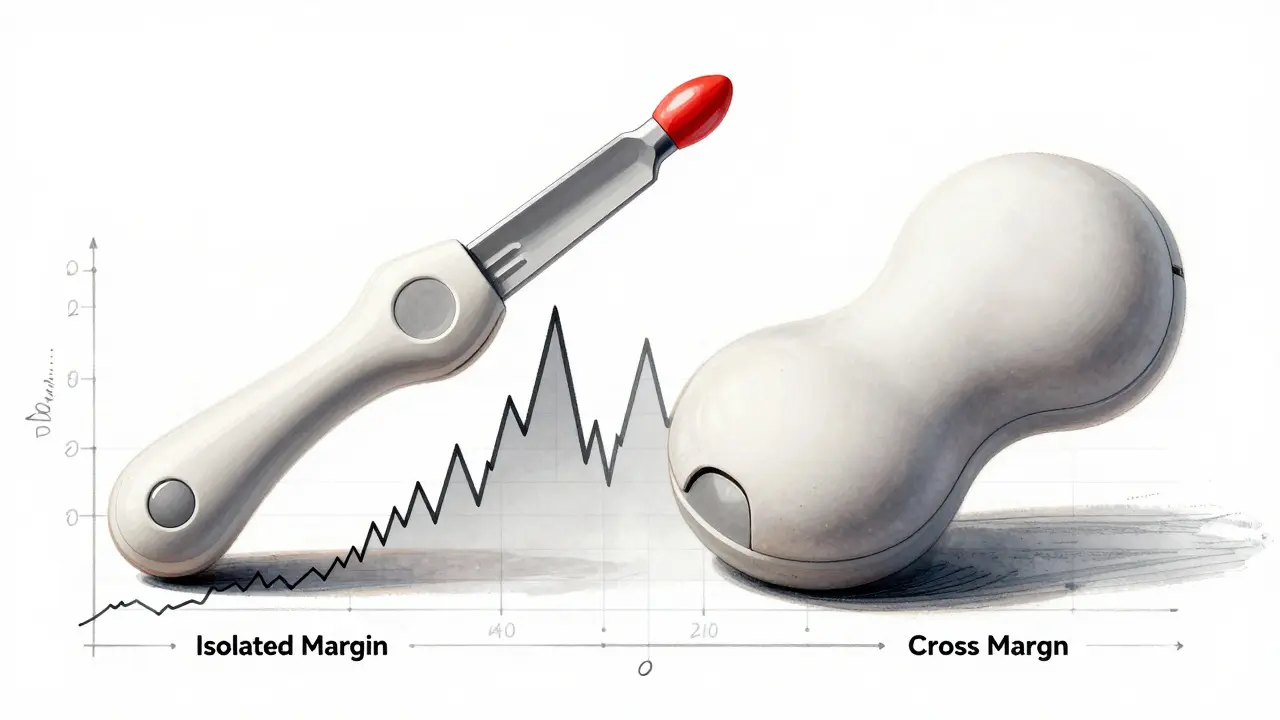
Isolated margin gives you control. Cross margin gives you convenience. That’s the core trade-off.
- Isolated margin: You decide exactly how much risk to take per trade. Liquidation only affects that one position. You must manually add more margin if you want to hold longer. No automatic support.
- Cross margin: Your whole balance backs every trade. The system auto-funds losing positions. You don’t need to micromanage. But one bad move can take out everything.
Platforms like Binance, BitMEX, and PrimeXBT let you switch between these modes in seconds. But once you’re live, changing your mind mid-trade can be risky. Most exchanges require you to close the position and reopen it under the new margin type.
When to Use Isolated Margin
Use isolated margin when:
- You’re making a high-risk, high-reward bet on a single asset.
- You’re testing a new strategy with limited capital.
- You’re trading with high leverage (50x, 100x, or more).
- You want to avoid emotional decisions-like adding more funds to a losing trade because your whole account is at risk.
Professional traders often use isolated margin for asymmetric trades: small bets with huge upside. A 0.01 BTC position at 100x leverage on a coin they believe will 10x? That’s isolated margin territory. If it works, they win big. If it fails, they lose only 0.01 BTC. Clean, calculated, controlled.
It’s also the go-to for traders who manage multiple unrelated positions. If you’re long on Bitcoin, short on Ethereum, and holding a stablecoin arbitrage-each trade should have its own risk bubble. Isolated margin keeps them separate.
When to Use Cross Margin
Use cross margin when:
- You’re running multiple correlated positions (like holding BTC, ETH, and SOL all long).
- You want to minimize active management and avoid constant monitoring.
- You’re a beginner and want to avoid accidental liquidations.
- You believe the market will recover and just need time to ride out volatility.
It’s the default setting on most exchanges for a reason. Retail traders-especially those who don’t trade full-time-find cross margin less stressful. You don’t have to calculate liquidation prices for every position. The system handles it.
But here’s the hidden danger: cross margin can make you feel safe when you’re not. If you open five leveraged positions and assume the system will protect you, you might ignore warning signs. Then, when the market turns, your entire balance gets consumed. No second chances.
Real-World Examples
Let’s say you’re trading on Binance Futures.
Scenario 1: Isolated Margin
You have $10,000. You open a 20x leveraged long on Cardano using $500 as isolated margin. The liquidation price is set at $0.25. Cardano drops to $0.24. Your position closes. You lose $500. Your remaining $9,500 is untouched. You sleep well.
Scenario 2: Cross Margin
You have $10,000. You open five positions: Cardano (20x), Solana (15x), Polygon (10x), Bitcoin (5x), and Ethereum (5x). All use cross margin. Cardano crashes. The system pulls $300 from your Bitcoin profits to keep it alive. Then Solana drops. It pulls another $400 from your Polygon position. Now your Bitcoin trade is under pressure. You didn’t touch it, but now it’s at risk too. Within hours, your whole $10,000 is gone.
Same market, same trader, same leverage. Different margin modes. Totally different outcomes.
Which One Do Most Traders Use?
Most retail traders use cross margin. It’s the default. It feels safer. Platforms promote it because it keeps users trading longer.
But professional traders? They use isolated margin for speculative plays and cross margin for portfolio exposure. Some even use both at the same time: isolated for high-risk bets, cross for core holdings.
During market crashes, isolated margin usage spikes. Traders who survived the 2022 Terra collapse or the 2023 FTX fallout often credit isolated margin for saving their accounts. They didn’t lose everything because they’d limited each trade’s damage.
Common Mistakes to Avoid
Here’s what goes wrong:
- Using cross margin for high-leverage bets: You think the system will save you. It won’t. It’ll just take everything.
- Assuming isolated margin is “safe”: It’s not. You can still lose 100% of your allocated margin. It just won’t hurt your other trades.
- Not checking liquidation prices: Both modes show them, but many traders ignore them until it’s too late.
- Switching modes mid-trade: You can’t. You have to close and reopen. That’s a costly mistake during fast moves.
Always test both modes in demo mode first. Every major exchange offers a paper trading environment. Use it. See how your positions behave under stress.
Final Decision: What’s Right for You?
There’s no “best” margin type. Only the one that matches your style.
If you’re:
- Aggressive, focused, and disciplined → Isolated margin. You want to control your risk down to the dollar.
- Passive, diversified, and risk-averse → Cross margin. You want the system to help you hold through volatility.
- Learning → Start with isolated margin. It teaches you discipline. You’ll learn what real risk looks like without losing your whole account.
Most traders who survive long-term in crypto derivatives don’t rely on luck. They rely on structure. Isolated margin gives you that structure. Cross margin gives you comfort. Choose based on what you need-not what feels easier.
Can I use both isolated and cross margin at the same time?
Yes. Most exchanges let you set different margin modes for each open position. You can have one trade using isolated margin and another using cross margin. This is common among professional traders who want to isolate high-risk bets while keeping core positions protected with cross margin.
Does cross margin increase my chances of getting liquidated?
No-it actually reduces the chance of liquidation on any single trade. But it increases the risk of total account loss. If multiple positions drop at once, cross margin uses your entire balance to cover losses, which can drain your account faster than isolated margin would.
Is isolated margin better for beginners?
Yes, if you’re serious about learning risk management. Isolated margin forces you to think about how much you’re risking per trade. It’s harder to ignore losses when they’re contained. Cross margin can be dangerous for beginners because it hides the true cost of a losing trade.
Can I change my margin mode after opening a trade?
No. You must close the position first, then reopen it under the new margin setting. This is why planning ahead matters. Always decide your margin mode before opening a trade.
Which margin type is more common on exchanges?
Cross margin is the default on most platforms like Binance, Bybit, and OKX because it keeps users trading longer. But isolated margin is the preferred choice among experienced traders and institutions for its precision and risk control.

Harshal Parmar
January 24, 2026 AT 22:10Man, I love how this breaks it down so clearly. I started with cross margin because it felt like a safety net, but after losing a chunk of my portfolio during that Solana dump last year, I switched everything to isolated. Now I treat each trade like its own little experiment-set the risk, walk away, and let the market decide. No sleepless nights wondering if my BTC position is gonna drag down my ETH trade. It’s not sexy, but it’s sustainable. And honestly? I sleep better now. 🌙
Adam Lewkovitz
January 24, 2026 AT 22:15The premise is fundamentally flawed. Cross margin is not a crutch it is a feature of modern risk aggregation. Your assertion that isolated margin provides control is statistically irrelevant when market-wide liquidations occur. The system does not fail the trader the trader fails the system by misallocating capital. You are confusing risk management with risk avoidance. This article reads like a beginner’s guide written by someone who has never held a position through a black swan event.
Clark Dilworth
January 25, 2026 AT 06:39From a portfolio optimization standpoint, cross margin aligns with mean-variance efficiency under correlated asset regimes. Isolated margin introduces unnecessary friction in rebalancing and increases the probability of suboptimal exposure due to siloed risk allocation. The behavioral economics here are fascinating-traders perceive isolated as ‘control’ but in reality they’re just avoiding dynamic hedging. Also, liquidation thresholds are non-linear under cross margin due to collateral elasticity. This article misses the math entirely.
Brenda Platt
January 26, 2026 AT 11:43Y’all need to try this: start with isolated margin for your first 3 trades. Just 3. Then come back and tell me you didn’t learn more in those 3 trades than in 3 months of cross margin. 💪 I used to be the person who thought cross margin was ‘easier’… until I lost 70% of my account in one night because I forgot I had 5 leveraged positions all tied together. Now I’m a total isolated convert. And yes, I use emojis. Deal with it. 😘
Barbara Rousseau-Osborn
January 27, 2026 AT 21:49Anyone using cross margin on anything above 10x is asking for it. You think the platform cares about you? They make money when you blow up. That’s why they make it the default. If you’re not using isolated margin, you’re not a trader-you’re a gambler who got lucky once. And if you’re a beginner, you shouldn’t even be on leverage. Period.
steven sun
January 28, 2026 AT 03:30bro i just use cross bc i forget what i even traded lmao. one time i had 3 positions open and i was like wait did i go long or short on doge? then i checked and i was up 200% so i just left it. isolated? nah man i cant keep track of all that. i just want to chill and watch my portfolio grow. if it goes down i just wait. the market always comes back right? 😅
Catherine Hays
January 29, 2026 AT 09:29Isolated margin is for people who don’t trust the market. Cross margin is for people who trust the system. If you’re trading crypto and you’re scared of losing your margin, you shouldn’t be here. This whole article is fearmongering dressed up as advice. You don’t get rich by playing it safe. You get rich by going all in. Period.
Chidimma Catherine
January 30, 2026 AT 09:32Thank you for this detailed breakdown. In Nigeria, many young traders are drawn to cross margin because they believe it protects them, but they do not understand the systemic risk involved. I have seen too many lose everything in a single market crash. Isolated margin is not just safer-it is more educational. It teaches discipline. I recommend every new trader begin with isolated, even if only for practice. Knowledge is power, and power is control. 🙏
Nathan Drake
February 1, 2026 AT 06:24It’s interesting how we frame this as a binary choice-control versus convenience. But isn’t that just a projection of our own anxieties? Isolated margin gives us the illusion of control over an inherently uncontrollable system. Cross margin forces us to confront the reality that we are part of a network, not an isolated actor. Maybe the real question isn’t which margin to use-but which version of ourselves we want to be when the market turns against us.
Melissa Contreras López
February 1, 2026 AT 21:35Okay real talk-this is the most helpful thing I’ve read all week. I was using cross margin like it was a magic shield. Then I lost a third of my account because one trade went south and dragged everything with it. I cried. Then I switched to isolated. Now I feel like I’m actually in charge. I’m not ‘safe’-but I’m accountable. And that’s the difference between being a trader and being a victim. You got this. 💛
Mike Stay
February 2, 2026 AT 11:26The institutional adoption curve is telling. Hedge funds, family offices, and algorithmic traders overwhelmingly use isolated margin for directional bets and cross margin only for delta-neutral or hedged portfolios. The reason? Isolated margin allows for precise exposure targeting and capital efficiency. Cross margin introduces systemic contagion risk-something no professional portfolio manager would tolerate at scale. Retail traders mimic the default setting because it’s easy. Professionals design systems because they understand complexity. The gap isn’t in tools-it’s in mindset.
Taylor Mills
February 3, 2026 AT 18:56isolate margin is for retards who cant handle leverage. if you cant handle losing 5% of your account on one trade you dont belong here. cross margin is for real men. i went 50x on shiba with cross and got liquidated but i made 12x on my other trades so i broke even. thats how you play. isolated is for people who want to be bankers not traders.
Arielle Hernandez
February 5, 2026 AT 02:41One critical point missing from this analysis: liquidation price calculation differs significantly between modes under funding rate volatility. In cross margin, the effective liquidation threshold is dynamically recalculated based on total equity and unrealized PnL across positions. This creates a non-linear risk profile that is rarely understood by retail traders. Additionally, exchanges often apply higher margin requirements for cross margin positions during periods of high volatility-further reducing the perceived safety net. Always check your exchange’s whitepaper on margin mechanics.
HARSHA NAVALKAR
February 6, 2026 AT 17:20Same. I used cross margin for 6 months. Lost 80%. Switched to isolated. Now I only risk 2% per trade. I don’t make huge wins, but I don’t lose everything either. I’m still here. That’s the win.
Ryan Depew
February 7, 2026 AT 00:25Bro I just use isolated for my moonshots and cross for my HODLs. Like I’ll do 100x on some random memecoin with isolated-max 0.01 BTC-and then use cross for my BTC and ETH positions so I don’t have to babysit them. Works like a charm. You don’t have to pick one. Use both. It’s not rocket science.
Mathew Finch
February 7, 2026 AT 18:29Of course isolated margin is better. Anyone who uses cross margin is just a retail sheep following the default setting because they’re too lazy to learn. You think the platform cares if you lose? They charge fees whether you win or lose. This article is just marketing fluff disguised as education. Real traders know better.
Jessica Boling
February 8, 2026 AT 01:05So isolated margin is for people who like spreadsheets and cross margin is for people who like surprises? Cool. I’ll take the surprise. At least it’s exciting. Also I think the whole ‘risk management’ thing is overrated. If you’re not losing money sometimes you’re not trying hard enough. Just saying.
Tammy Goodwin
February 8, 2026 AT 08:22I use isolated for everything. Even my stablecoin arb positions. I know it’s overkill but I sleep better. And honestly? I don’t care what anyone else does. This is my money, my rules. No one else is going to protect it for me.
Jen Allanson
February 9, 2026 AT 16:38The article fails to address the regulatory implications of margin configuration under MiCA and CFTC guidelines. Cross margin may constitute a form of collateral rehypothecation under certain jurisdictions, potentially exposing traders to counterparty risk beyond the exchange’s insolvency. Isolated margin, by contrast, complies with segregation requirements in most compliant frameworks. This is not a trading preference-it is a legal consideration.
Adam Fularz
February 10, 2026 AT 22:21why do people overthink this so much. just use whatever the app says. i dont even know what margin means. i just tap the button and hope for the best. sometimes i win sometimes i lose. its all good. 🤷♂️
Harshal Parmar
February 12, 2026 AT 20:53Just read your comment, Harsha. I feel you. I used to think the same way. Then I lost a month’s rent in one night because I didn’t know what cross margin really did. Now I don’t just ‘tap the button’-I think about it. And honestly? It’s made me a better trader, even if I’m not making millions. I’m still here. That’s what matters.