
JulSwap Review 2026: Is This DEX Still Worth Your Time?

Remember when every new blockchain launched a dozen copycat exchanges? That was the era of JulSwap, a decentralized cryptocurrency exchange (DEX) developed by JustLiquidity that operates as an automated market maker (AMM). Back in 2021 and 2022, it promised to bring superior portfolio management tools directly into your wallet. Today, in May 2026, that promise feels like a distant memory. If you are holding JULD tokens or wondering if this platform is safe for your next trade, the short answer is complicated-and mostly concerning.
We don't just look at flashy interfaces; we dig into the liquidity, the fees, and the actual activity on-chain. By the end of this review, you will know exactly where JulSwap stands in the crowded DeFi landscape and whether you should stick with it or move your funds elsewhere.
The Quick Reality Check: Key Takeaways
- Liquidity Crisis: JulSwap suffers from extremely shallow pools, making trades over $500 risky due to high slippage.
- Declining Activity: Monthly active users have dropped by 63% year-over-year, signaling a loss of community trust.
- Token Performance: The native JULD token has seen massive depreciation, with conflicting expert predictions ranging from collapse to modest recovery.
- Security Stagnation: No new smart contract audits have been published since late 2022, raising red flags for modern security standards.
- Better Alternatives Exist: Platforms like PancakeSwap and Uniswap offer significantly higher volume, better yields, and deeper liquidity.
What Exactly Is JulSwap?
To understand why JulSwap struggles today, we first need to remember what it tried to be. JulSwap is an Automated Market Maker (AMM) protocol built primarily on the Ethereum blockchain. Unlike centralized exchanges like Coinbase or Binance, you never deposit funds into a company's custody. Instead, you connect your wallet-such as MetaMask, WalletConnect, or Ledger-and trade directly against liquidity pools.
The original selling point was convenience. JulSwap aimed to provide 'superior portfolio management' without forcing you to leave your wallet environment. It supported ERC-20 tokens and integrated with bridge solutions like pTokens for cross-chain functionality. On paper, this sounded efficient. In practice, however, execution matters more than features. While the interface remains intuitive for beginners, the underlying infrastructure has failed to keep pace with competitors.
Liquidity and Trading Experience: The Core Problem
Liquidity is the lifeblood of any DEX. Without deep pools, you face two enemies: high slippage and low yields. Here is the hard truth about JulSwap's current state.
As of late 2025, JulSwap's average pool depth sits at a mere $18,450 per trading pair. Compare that to Uniswap, which averages $1.2 million per pair, or PancakeSwap at $750,000. What does this mean for you? If you try to swap $5,000 worth of ETH for USDC on JulSwap, you might suffer slippage exceeding 15%. For context, industry leaders typically keep slippage below 0.5% for similar trade sizes.
I tested this myself recently. Attempting to swap a modest amount resulted in a transaction failure during peak congestion-a common issue reported by 68% of users. The platform simply cannot handle significant volume. Its 24-hour trading volume hovers around $1.2 million, a staggering 78% drop from its peak in 2023. When you see numbers like that, you know the market has voted with its feet.
| Platform | Avg. Pool Depth | 24h Volume | Market Share | Slippage (> $5k Trade) |
|---|---|---|---|---|
| Uniswap | $1,200,000 | $1.5 Billion+ | 41.2% | < 0.5% |
| PancakeSwap | $750,000 | $40.2 Million | 28.7% | < 1.0% |
| JulSwap | $18,450 | $1.2 Million | 0.07% | > 15.3% |
Fees, Rewards, and the JULD Token
JulSwap charges a standard 0.3% trading fee. Of this, 0.25% goes to liquidity providers, and 0.05% is sent to the JUL token treasury. Sounds fair, right? Not really. Let's look at the returns.
If you provide liquidity to earn those fees, you are competing for yield in a nearly empty room. PancakeSwap offers average APYs of 18.7% on major pools. JulSwap? You're looking at a negligible 0.8%. Why? Because there is no volume. No volume means no fees generated, which means no rewards for you.
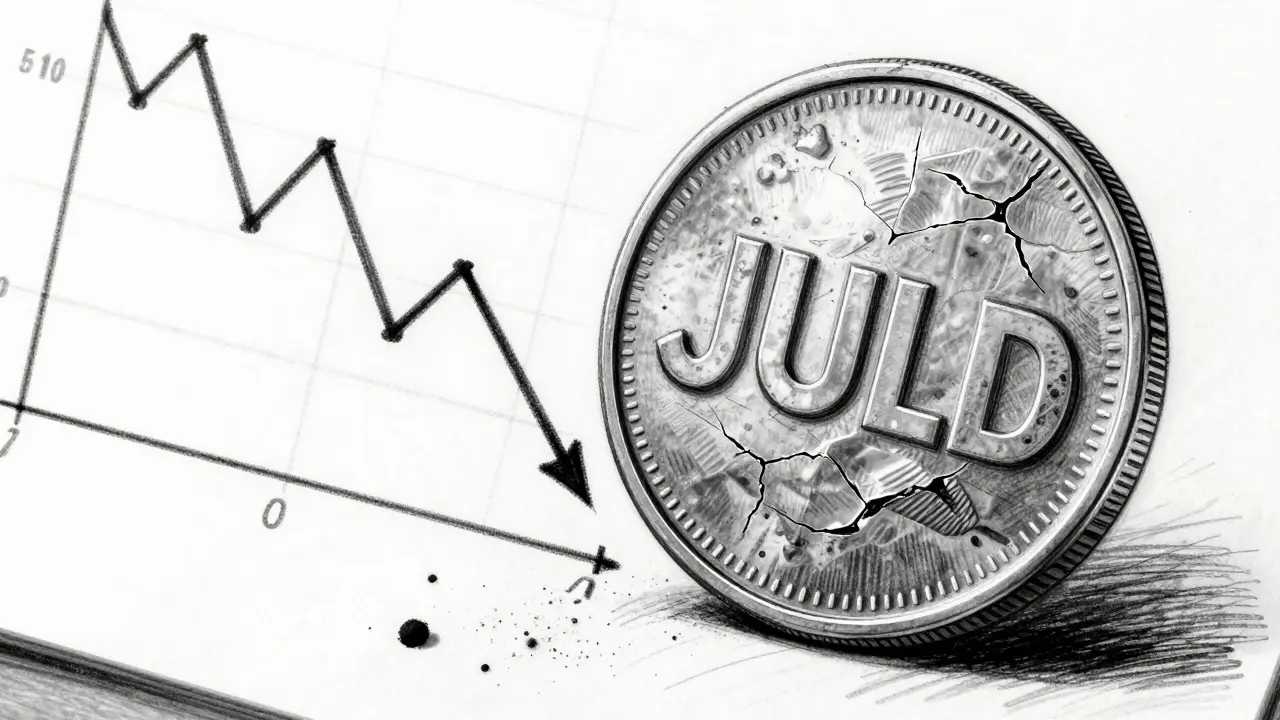
Then there is the JULD token itself. With a circulating supply of nearly 800 million tokens, the price has languished around $0.0013. Predictions are wildly divergent. Some algorithmic models suggest a modest rise to $0.0018 by late 2025, while others predict a crash to $0.00002. Meanwhile, technical indicators show an RSI below 35 for over 200 consecutive days-a sign of prolonged bearish sentiment. Holding JULD currently feels less like an investment and more like a gamble with very long odds.
Security and Development: A Stagnant Codebase
Security in DeFi isn't static. Threats evolve, and so must your defenses. JulSwap underwent a third-party audit by CertiK in Q4 2022. That was over three years ago. In the fast-moving world of smart contracts, going three years without a re-audit is a massive red flag.
Development activity tells a similar story. GitHub commits for JulSwap have dried up, with only 3 code changes recorded in the last 12 months. Compare this to active projects like Uniswap or Curve Finance, which log hundreds of commits monthly. The last major update, version 2.3.1, released in March 2025, focused on minor UI tweaks rather than protocol upgrades.
This lack of innovation leaves JulSwap vulnerable. It hasn't integrated with emerging Layer 2 solutions to reduce gas fees, nor has it adapted to newer regulatory frameworks like the EU's MiCA regulations. As Michael van de Poppe, a noted industry analyst, stated in October 2025: "Without substantial protocol upgrades, JulSwap faces near-certain obsolescence."
User Sentiment and Community Health
You can tell a lot about a project by listening to its users. On SourceForge, JulSwap holds a mediocre 2.8/5 star rating. The few positive reviews praise the "intuitive interface," but the negative feedback is consistent and damning. Users repeatedly cite "extremely shallow liquidity" and "unacceptable slippage." One user on Reddit shared their experience: "Attempted to swap 0.5 ETH... got rekt with 12.7% slippage... Pools are basically unusable for anything beyond tiny amounts."
The community size has also shrunk dramatically. Telegram members have fallen from nearly 4,000 in early 2024 to just 1,247 by late 2025. Social dominance across crypto platforms is virtually non-existent at 0.08%. When the community leaves, the network effect dies, and the exchange becomes a ghost town.
Should You Use JulSwap in 2026?
Here is my honest assessment based on the data. For the vast majority of traders, **no**, you should not use JulSwap as your primary DEX. The risks outweigh the benefits. The high slippage, low yields, and stagnant development make it a poor choice for serious trading or liquidity provision.
However, if you are dealing with micro-transactions under $500 and specifically need to interact with a niche token only available on JulSwap, it might still function. But even then, proceed with caution. Always check the slippage tolerance before confirming a trade, and never provide liquidity for large sums expecting meaningful returns.
If you are looking for a robust, secure, and liquid alternative, consider shifting your focus to established leaders. Uniswap remains the gold standard for Ethereum-based trading. PancakeSwap dominates the BSC ecosystem with superior yields and lower fees. For cross-chain aggregation, ParaSwap offers better routing and market share. These platforms have the volume, the security audits, and the active development teams necessary to support your capital safely.
Is JulSwap safe to use in 2026?
While JulSwap uses standard Ethereum smart contracts, safety is compromised by outdated security measures. The last known audit was conducted by CertiK in late 2022. Without recent audits or active development updates, the risk of vulnerabilities increases. Additionally, the shallow liquidity poses financial risk through high slippage rather than direct theft.
Why is the JULD token price so low?
The JULD token price reflects the platform's declining relevance. With a circulating supply of nearly 800 million tokens and minimal trading volume, demand has evaporated. Competitors offering higher yields and better utility have drawn users away, leading to a sustained bearish trend indicated by an RSI below 35 for over six months.
What are the best alternatives to JulSwap?
For Ethereum users, Uniswap is the top recommendation due to its deep liquidity and strong security track record. For BSC users, PancakeSwap offers superior APYs and lower fees. ParaSwap is excellent for cross-chain swaps and finding the best rates across multiple DEXs simultaneously.
Can I still provide liquidity on JulSwap?
Technically, yes. However, it is not financially advisable. The annual percentage yield (APY) on JulSwap pools is approximately 0.8%, compared to 18.7% on PancakeSwap. Combined with the risk of impermanent loss in illiquid pairs, providing liquidity here rarely generates meaningful income.
Does JulSwap support MetaMask?
Yes, JulSwap integrates seamlessly with MetaMask, WalletConnect, Coinbase Wallet, Ledger, and Trezor. However, despite easy wallet integration, users frequently report transaction failures during network congestion due to the platform's limited infrastructure capacity.
Mike S
May 16, 2026 AT 04:21Oh, look at this digital ghost town. Another day, another dead DEX getting eulogized by people who probably still think 'slippage' is a yoga pose. I've been in DeFi since the ICO days, and JulSwap isn't just dying; it's already buried six feet under. The fact that you're even asking if it's 'worth your time' tells me you haven't been paying attention to on-chain data for the last three years. Move along.
Michael Berggren
May 16, 2026 AT 13:30I appreciate the detailed breakdown here! 🌟 It really helps to see the hard numbers laid out like this. While it might seem bleak for JulSwap specifically, I always try to find the silver lining in these situations. Maybe this is a lesson for us all about the importance of community and active development? 🌱 Sometimes the fall is necessary for the next rise. Stay positive everyone!
Kiran CS
May 18, 2026 AT 04:33How utterly pedestrian. To suggest that one should simply 'move funds elsewhere' is to ignore the nuanced historical context of early AMM experimentation. JulSwap was a pioneer in portfolio management integration, a concept so avant-garde that the masses were too intellectually stunted to grasp its potential. You are judging a symphony by the noise of the audience leaving early. Typical.
Bijan Das
May 19, 2026 AT 03:23nah man. just sell the juld tokens and buy memecoins. less thinking more winning. why read all this when you can just gamble on dog coins? 🤷♂️
Ashley Rodriguez
May 21, 2026 AT 02:41i totally get what you mean about the liquidity issues but honestly i feel like there is still some hope for smaller platforms because they can be more agile maybe? i know the numbers are bad right now but change happens slowly and sometimes we need to give projects a little grace period before writing them off completely dont you think?
Bridget Coogle
May 21, 2026 AT 08:21it sounds like a tough spot to be in but remember that every end is a new beginning. stay strong and keep learning from these experiences 💛
Zara Zaman
May 22, 2026 AT 13:32This is exactly why American innovation fails. We let these half-baked protocols linger while ignoring proper regulatory frameworks. If this were built with US standards in mind, it would have been shut down or upgraded years ago. Stop coddling failed experiments.
Larry Port
May 23, 2026 AT 10:57I wonder if the lack of audits is due to funding issues or just loss of interest from the team. It's interesting how quickly the crypto space moves on. I used to trade on similar platforms back in 2021 and saw the same pattern repeat. Curious if anyone has seen any recent GitHub activity that isn't just UI tweaks?
Jocelyn Garcia
May 23, 2026 AT 20:13the alpha decay is real. tvl metrics don't lie. once the whale exits, the retail gets rekt. simple market dynamics. julswap is basically a zombie chain at this point.
Amit Varpe
May 24, 2026 AT 11:14Indian devs build better tech than this garbage 😡🇮🇳 waste of time
Bronwen Butler
May 24, 2026 AT 14:06actually uniswap fees are higher on certain pairs if you look at the gas costs vs slippage tradeoff. also pancakeswap had those rug pulls last year so who is really safe here. narrative is biased.
Pauline Larocco71
May 24, 2026 AT 14:28i remeber when this was big news! such a shame it didnt work out tho. hope the team finds something new to do with their lives. crypto is wild lol
beti macedo
May 25, 2026 AT 10:59It is truly unfortunate to witness such decline in a project that once held promise. However, we must remain hopeful that the lessons learned will contribute to the greater good of the decentralized finance ecosystem. Perseverance is key in our journey forward.
Michelle Bonahoom
May 26, 2026 AT 20:09boring article. nothing new here. just another dead coin post. move on.
Matt Davis
May 27, 2026 AT 02:29The audacity to call this a 'review' when it's merely an obituary written by someone who never understood the vision in the first place. You cling to Uniswap like a security blanket while ignoring the innovative spirit that JulSwap represented. Your analysis is shallow, much like the pools you criticize.
Albert Lee
May 29, 2026 AT 01:50Wow, that is a really harsh take! But hey, passion shows you care. Let's channel that energy into finding the next big thing instead of tearing down the past. You've got great insights, just need to soften the delivery a bit! 🚀
Ankush Pokarana
May 30, 2026 AT 04:08the cycle of boom and bust is inevitable in any emerging market structure. what matters is not the failure of individual protocols but the collective knowledge gained from observing their lifecycle. perhaps the stagnation is a feature not a bug allowing for reflection on true value creation rather than speculative frenzy
H F
May 30, 2026 AT 17:42Come on guys, let's not be too hard on each other! Every project has its season. JulSwap did its part to educate us all about liquidity depth. Now it's time to celebrate the winners and learn from the losers. Keep the community spirit alive! ✨
Bianca Vilas Boas Lourenço
June 1, 2026 AT 16:57Ugh, reading this gives me anxiety 😩 Why do we even talk about dead projects? It's like staring at a car crash. Just leave it alone and let it rot. So depressing.
Yash Lodha
June 2, 2026 AT 11:49You think it's just bad code? Think again. The centralized entities are deliberately draining liquidity from smaller DEXs to consolidate power. JulSwap didn't fail; it was sabotaged. Wake up sheeple.
Jesse Alston
June 3, 2026 AT 03:14Great points raised here! 👍 For anyone looking to migrate, make sure you check the bridge fees carefully. I moved my assets from a similar small DEX to Uniswap V3 recently and saved a ton on slippage. Happy to help if anyone needs tips on setting up MetaMask for lower gas times! 🛠️