
ko.one crypto exchange review: What You Need to Know Before Trading
There’s no verified information about a crypto exchange called ko.one. No official website, no user reviews on trusted platforms like Trustpilot or Reddit, no press coverage from major crypto news outlets like CoinDesk or Cointelegraph. Even search engines show nothing substantial-just empty results or dead links. If you’re being pushed to sign up for ko.one, you should pause. Hard.
Cryptocurrency exchanges are not all created equal. Some are trusted giants with billions in assets under management. Others are shadowy operations that vanish overnight after stealing user funds. The difference? Transparency. And ko.one has none of it.
Why ko.one Raises Red Flags
Legitimate crypto exchanges don’t hide. They list their headquarters, regulatory licenses, team members, and security protocols. They publish audit reports from firms like CertiK or Hacken. They have customer support teams that answer emails within hours, not days.
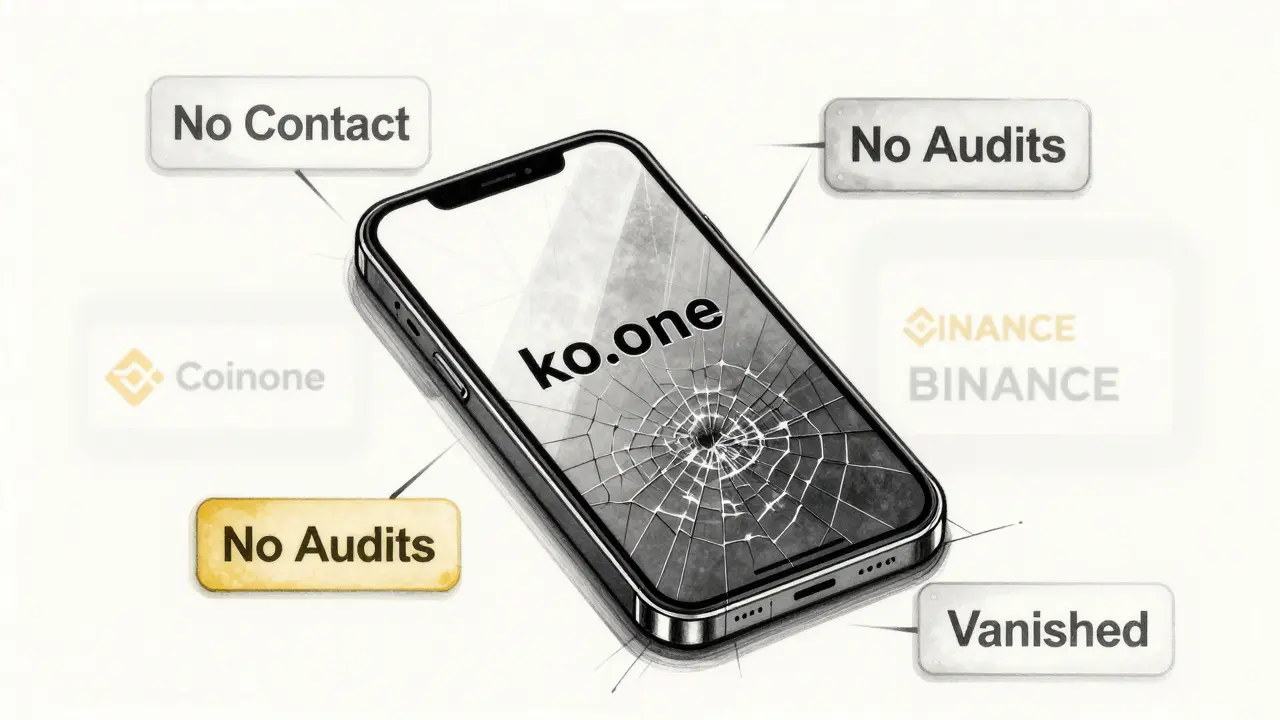
ko.one does none of this. No domain registration details. No contact page. No terms of service. No privacy policy. If you can’t find where a company is legally registered, you can’t hold them accountable. And in crypto, accountability is everything.
There’s one name that sometimes gets confused with ko.one: Coinone. It’s a real, South Korean exchange founded in 2014. It’s regulated by the Financial Services Commission (FSC) and has partnered with CertiK for code audits. But Coinone is not ko.one. The similarity in name is likely intentional-a tactic used by scam platforms to trick users into thinking they’re signing up for a trusted brand.
What a Real Crypto Exchange Should Offer
If you’re looking for a safe place to trade crypto, here’s what you should demand:
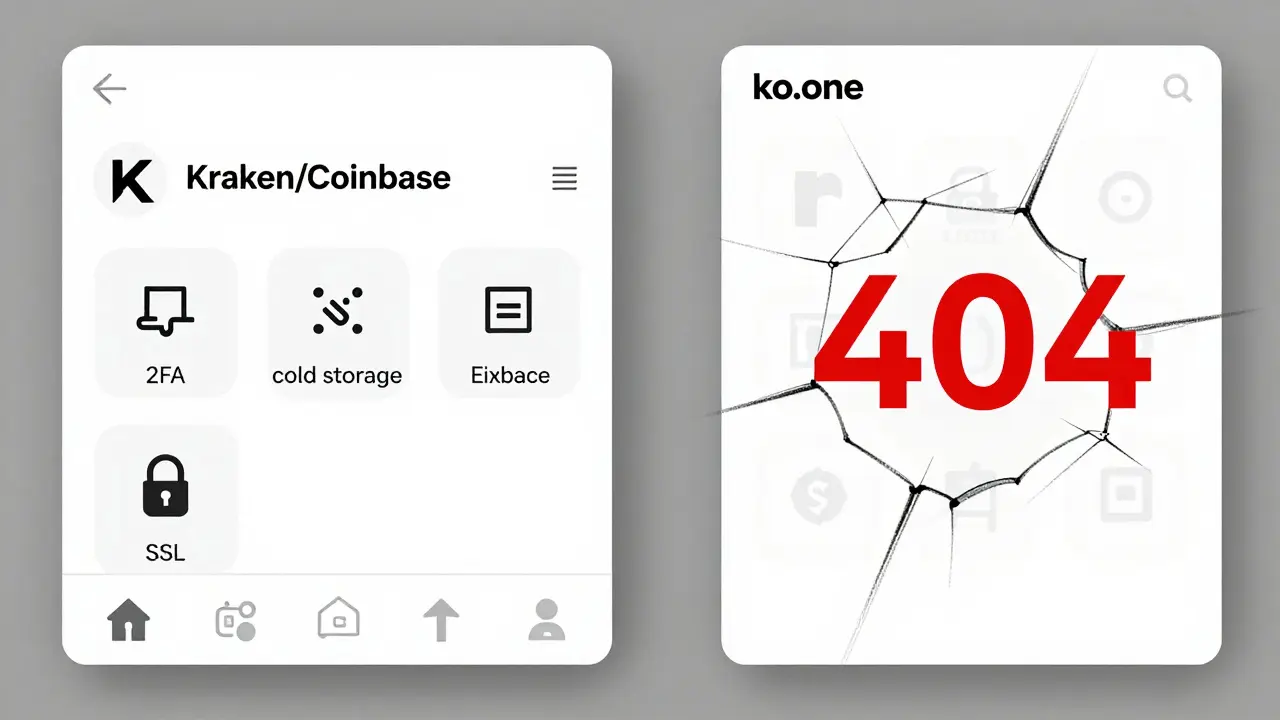
- Two-Factor Authentication (2FA) - Not just SMS. Use FIDO2 or TOTP apps like Authy or Google Authenticator. SMS can be hijacked.
- Cold Storage - At least 90% of user funds stored offline. Exchanges that keep most coins online are asking to get hacked.
- SSL Encryption - Check the URL. It must start with https:// and show a valid certificate.
- Withdrawal Whitelisting - You should be able to lock withdrawal addresses so funds can’t be sent anywhere without your approval.
- Public Audits - Look for reports from independent firms. If they’re not published, assume nothing is secure.
- Regulatory Compliance - Exchanges operating legally in the EU, US, Japan, or South Korea must follow strict rules. ko.one shows no such registration.
Take Binance, Kraken, or Coinbase. They all publish their proof-of-reserves monthly. They all have bug bounty programs offering six-figure rewards for security flaws. They all list their legal entities and licensed jurisdictions. ko.one? Nothing.
How Scams Like This Operate
These fake exchanges follow a predictable pattern:
- They create a website that looks professional-often copied from real platforms.
- They run ads on YouTube or TikTok promising high returns or free crypto giveaways.
- They lure you in with low trading fees or fake “limited-time bonuses.”
- Once you deposit funds, withdrawals get delayed, then denied.
- The site disappears. The domain expires. The operators vanish.
There’s a reason why DMM Bitcoin shut down in December 2024. A North Korean hacking group stole over $300 million in Bitcoin. The exchange didn’t have proper cold storage or intrusion detection. It wasn’t audited. It wasn’t transparent. And when the breach happened, they had no way to recover the funds.
ko.one could be following the same path. Without security infrastructure, user funds are just sitting ducks.
What to Do If You Already Used ko.one
If you’ve deposited crypto into ko.one:
- Stop depositing more. No amount of “one more transaction” will get your money back.
- Check your wallet history. If you sent funds to an unknown address, recovery is nearly impossible.
- Report the platform to your country’s financial crime unit. In New Zealand, that’s the New Zealand Police Financial Crimes Unit. In the US, file with the FTC. In the EU, contact Europol.
- Use tools like Have I Been Pwned to check if your email or wallet address was leaked.
- Change passwords on every account you used with the same credentials.
There’s no magic tool to recover stolen crypto. Blockchain transactions are irreversible. The only way to avoid loss is prevention.
Alternatives to ko.one
If you need a safe, reliable exchange, here are real options:
- Kraken - Based in the US, regulated, offers staking, futures, and institutional-grade security.
- Coinbase - Publicly traded, audited, insured custodial wallets, easy for beginners.
- Binance - Largest by volume, supports 300+ coins, but check local regulations.
- Coinone - If you’re in Asia, this is a legitimate Korean exchange with full regulatory compliance.
All of these platforms have public audit reports, clear KYC procedures, and active customer support. None of them hide behind vague domain names.
Final Warning
There is no such thing as a “secret” or “exclusive” crypto exchange that outperforms the big names. If someone tells you ko.one is better than Coinbase or Kraken, they’re either misinformed or trying to scam you.
Crypto is risky enough without adding fake platforms into the mix. Don’t gamble with your savings. If you can’t verify it, don’t trust it.
Is ko.one a real crypto exchange?
No, ko.one is not a verified or legitimate cryptocurrency exchange. There is no official website, regulatory registration, user reviews, or security documentation tied to this name. All available evidence suggests it either doesn’t exist or is a scam platform designed to mimic real exchanges like Coinone.
Can I trust ko.one with my crypto?
Absolutely not. Legitimate exchanges publish their security practices, undergo third-party audits, and are regulated by financial authorities. ko.one provides none of this. Depositing funds into ko.one puts your assets at extreme risk of permanent loss.
Why do people search for ko.one?
Many users confuse ko.one with Coinone, a real South Korean exchange. Scammers register similar domain names to exploit this confusion. Always double-check URLs-Coinone is coinone.com, not ko.one. Typo scams like this are common in crypto.
What should I look for in a crypto exchange?
Look for: FIDO2-compliant 2FA, cold storage for 90%+ of funds, public audit reports, clear regulatory status, withdrawal whitelisting, and responsive customer support. Platforms like Kraken, Coinbase, and Coinone meet these standards. If a platform doesn’t list these, avoid it.
What happened to DMM Bitcoin?
DMM Bitcoin, a Japanese exchange, suffered a $305 million hack in 2024 by North Korean hackers. The breach occurred because of weak infrastructure and lack of proper security audits. By December 2024, the exchange shut down, and customer assets were transferred to SBI VC Trade. This shows how quickly unsecured platforms collapse.
How can I protect myself from fake crypto exchanges?
Never trust a platform you can’t verify. Check the domain name carefully. Search for reviews on Reddit or CryptoCompare. Look for regulatory licenses on official government websites. Avoid platforms that promise high returns or pressure you to deposit quickly. Use only exchanges with public track records and transparent operations.
If you’re new to crypto, start with well-known exchanges. Don’t chase unknown platforms. Your money isn’t a gamble-it’s your life savings. Protect it like it matters.

Patty Atima
March 20, 2026 AT 09:47Just saw this and thought I'd chime in - ko.one? Never heard of it. Glad someone called this out. Stick to Kraken or Coinbase. Easy.
Lucy de Gruchy
March 20, 2026 AT 21:19Of course it's a scam. Every 'new' exchange that pops up with zero footprint is a honeypot. The fact that people still fall for this is why crypto is still the Wild West. And yes, Coinone is real - but ko.one? That's not even a typo. It's a trap.
Lauren J. Walter
March 21, 2026 AT 02:22Wow. Just... wow. Someone actually made a website called ko.one? I mean, did they not even try? Like, I could've named mine 'k0.one' and it'd be more convincing. This is almost cute. In a 'please-don't-lose-your-life-savings' kind of way.
Carol Lueneburg
March 21, 2026 AT 07:34Thank you for this. 🙏 I've seen so many people get burned by these copycat sites. You're right - if you can't find the team, the license, or even a phone number... walk away. I'm sending this to my crypto group. You're a lifesaver. 💖
Brenda White
March 21, 2026 AT 07:36wait so ko.one is fake?? but i just deposited like 2 btc?? is it too late?? i thought it was coinone lol
Tobias Wriedt
March 22, 2026 AT 14:59People who use fake exchanges deserve to lose everything. No one's forcing you to use some sketchy site with no domain records. This isn't rocket science. If you can't verify it, don't touch it. Simple.
Ernestine La Baronne Orange
March 22, 2026 AT 19:51Oh my GOD. I just found out my friend lost $18k to this exact thing last week. She thought 'ko.one' was 'Coinone' because the logo was almost identical. She's in therapy now. I'm not even joking. The emotional toll? The sleepless nights? The way she keeps checking her wallet like it's gonna magically refill?? I'm not okay. I'm not okay. I'm not okay.
Manali Sovani
March 23, 2026 AT 03:47While the intent of this post is commendable, the tone lacks scholarly rigor. One cannot base regulatory legitimacy solely on domain registration. A more comprehensive methodology would involve cross-referencing with FINTRAC, FATF guidelines, and the South Korean Financial Services Commission's official registry. This is amateurish analysis.
Konakuze Christopher
March 24, 2026 AT 08:02They're all connected. Same group behind ko.one, Coinex, and that 'Binance Lite' site last month. They use the same hosting, same template, same fake 'support' emails. This isn't random. It's a factory.
S F
March 25, 2026 AT 00:02US has the best exchanges. Why are people even looking at Asian sites? If it's not on Coinbase or Kraken, it's not worth your time. America built this. Don't let some foreign typo scam take your money.
Angelica Stovall
March 26, 2026 AT 03:12So let me get this straight - you're telling me there's no way to 'verify' a crypto exchange except by checking if it's on a list of 5 big names? What about smaller ones? What about innovation? What about decentralization? This is censorship disguised as safety. I'm done.
Taylor Holloman.
March 26, 2026 AT 09:19I appreciate the clarity here. Honestly, it's heartbreaking how many people get lured in by tiny design differences. I used to work in UX - I can tell you these fake sites are copied with terrifying precision. But the lack of transparency? That's the giveaway. If they're hiding their legal entity, they're hiding their intent. Stay safe, everyone.
Sarah Zakareckis
March 27, 2026 AT 00:07TL;DR: If it doesn't have proof-of-reserves, 2FA via TOTP, and a public audit - it's not a real exchange. Period. Use this as a checklist. Save your assets. You're worth more than a 24-hour 'bonus'.
Sarah Hammon
March 27, 2026 AT 01:55just wanted to say thanks for the coinone tip - i was about to deposit into ko.one because i typed it wrong on my phone. saved me. also i think u meant 'https://' not 'https//:' lol
iam jacob
March 27, 2026 AT 21:39i just lost everything. i'm not mad. i'm just... empty. i thought it was real. i trusted it. i believed in it. i don't even know why anymore.
Jesse Pals
March 28, 2026 AT 18:56Man I've seen so many of these. I just tell people: if it looks too good to be true, it is. And if you can't find a phone number or a physical address? Run. Don't walk. I use Kraken and sleep like a baby. Peace out.
Diane Overwise
March 30, 2026 AT 05:17How quaint. A blog post with bullet points. Truly, the pinnacle of crypto education. I'm sure the author has a LinkedIn profile with 'blockchain evangelist' in the title. Meanwhile, real traders are building on-chain. But by all means - keep preaching to the choir.
Ann Liu
March 30, 2026 AT 22:53Correction: DMM Bitcoin's assets were transferred to SBI VC Trade in early 2024, not December. The hack occurred in November 2023. The shutdown was announced in January 2024. Accuracy matters - especially in crypto.