
Large-Cap vs Small-Cap Crypto: How Market Size Dictates Risk and Reward

Imagine buying a ticket on a massive cruise ship versus hopping into a small speedboat. The cruise ship is stable, predictable, and unlikely to flip over in rough waters, but it won’t go anywhere fast or turn on a dime. The speedboat? It can zip across the ocean, reach hidden coves, and deliver an adrenaline rush-but one big wave could send you into the drink. This is exactly how market capitalization works in cryptocurrency.
When you hear traders talk about "large-cap" or "small-cap" coins, they aren't just discussing price tags. They are talking about risk profiles, liquidity, and potential returns. Understanding these categories is the difference between blindly gambling on a meme coin and building a structured portfolio that balances safety with growth. Let’s break down what these terms actually mean, why the numbers matter, and how you can use this knowledge to make smarter moves in the crypto market.
The Math Behind the Hype: What Is Market Cap?
A lot of beginners get tripped up by price alone. You might see a coin trading at $0.01 and think, "Wow, if this goes to $1, I’ll be rich!" But that ignores the most critical metric in any asset class: market capitalization.
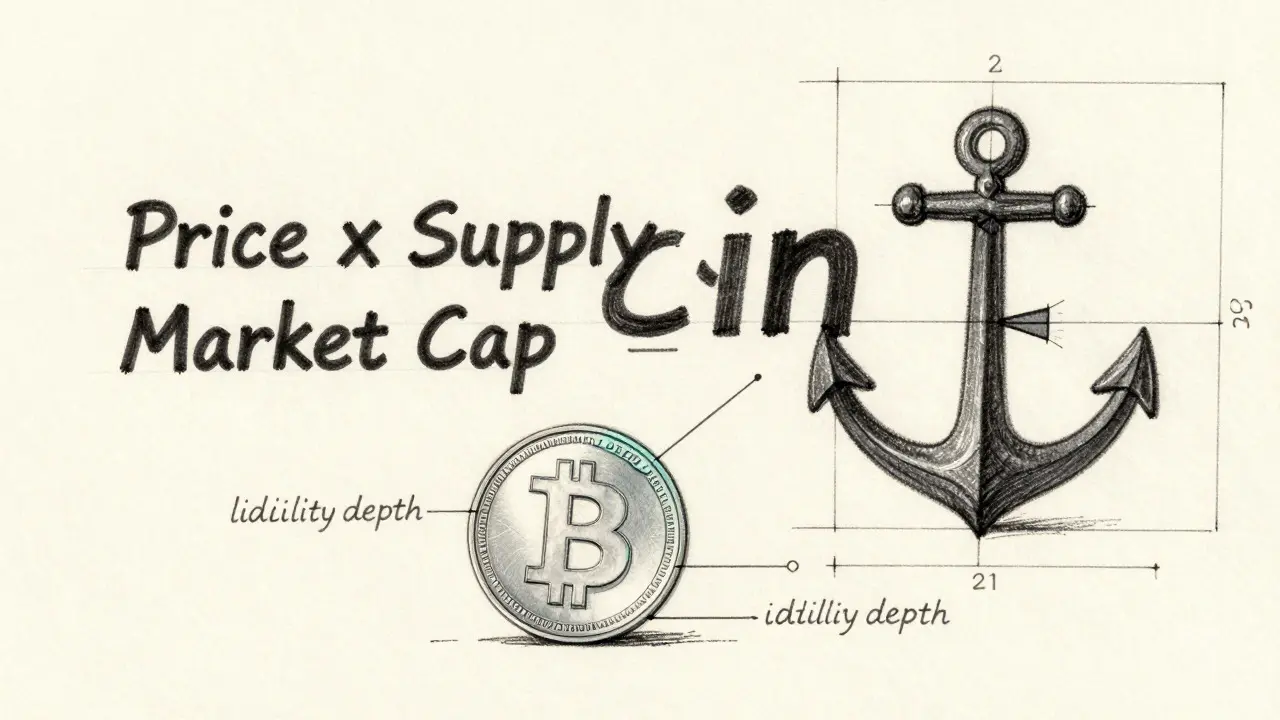
Market cap is calculated by multiplying the current price of a single token by the number of tokens currently in circulation. It’s the same formula used for stocks: Price × Circulating Supply = Market Cap.
Let’s look at a real-world example. If Bitcoin (BTC) is trading at $70,000 and there are 19.6 million BTC in circulation, the math looks like this:
- $70,000 × 19,600,000 = ~$1.37 Trillion
That $1.37 trillion figure tells you the total value investors have placed on the entire Bitcoin network. Now compare that to a new altcoin trading at $1.00 but with 1 billion tokens in circulation. Its market cap is only $1 billion. Even though the individual token prices are close ($70k vs $1), the sheer scale of Bitcoin makes it fundamentally different from the smaller project.
This distinction matters because moving a $1 billion market cap requires far less money than moving a $1.37 trillion one. A whale dumping $10 million worth of Bitcoin will barely ripple the chart. That same $10 million dump on a small-cap coin could crash its price by 50% or more overnight.
Defining the Tiers: Large-Cap vs Small-Cap
Unlike traditional stock markets, where definitions are somewhat standardized by regulators like the SEC, crypto is a wild west. However, major exchanges like Binance and educational platforms like Gemini have established general consensus ranges that most analysts follow.
| Category | Approximate Market Cap Range | Risk Profile | Typical Investor Goal |
|---|---|---|---|
| Large-Cap | > $1 Billion | Lower relative risk, high stability | Capital preservation, steady growth |
| Mid-Cap | $50 Million - $1 Billion | Moderate risk, balanced volatility | Growth with manageable downside |
| Small-Cap / Low-Cap | $1 Million - $50 Million | High risk, extreme volatility | Speculative gains, "moonshot" potential |
Large-Cap Cryptocurrencies are the "blue-chips" of the digital world. Think Bitcoin, Ethereum, Solana, and BNB. These projects have survived multiple bear markets, have deep liquidity (meaning you can buy or sell large amounts without crashing the price), and are listed on virtually every major exchange. They are considered safer bets within the volatile crypto ecosystem, though "safer" here still means significantly riskier than government bonds.
Small-Cap Cryptocurrencies, on the other hand, are the speculative frontier. These are often newer projects, niche DeFi tokens, or meme coins that haven’t yet proven their long-term viability. Their market caps range from $1 million to $50 million. Because their float is small, it doesn’t take much capital to move their price-which is why you see those insane 100x gains on social media. But it also takes very little to wipe them out completely.
The Liquidity Trap: Why Price Isn’t Everything
Here is a trap that catches many new investors: confusing low price with affordability. A coin might cost pennies, but if it has a massive supply, its market cap might already be huge, leaving little room for growth. Conversely, a small-cap coin might have a high price per token but a tiny circulating supply, making it vulnerable to manipulation.
Liquidity is the lifeblood of trading. Large-cap coins have deep order books. If you want to sell $10,000 worth of Ethereum, you can do it instantly with minimal slippage (the difference between the expected price and the executed price). Try doing that with a small-cap token, and you might find there isn’t enough buyer demand to absorb your sale. Your price gets hammered, and you exit for much less than you planned.
This is why Bitnovo and other analysts stress that market cap is just the starting point. You must cross-reference it with trading volume. A healthy ratio suggests genuine interest. A low volume relative to market cap indicates a "liquidity trap," where the price looks good on paper, but you can’t actually get your money out.
Fully Diluted Valuation: The Hidden Danger
There is another metric you need to watch closely, especially with small and mid-cap coins: Fully Diluted Valuation (FDV).
Most market caps are based on circulating supply-the tokens currently available to trade. But many projects have millions more tokens locked in vesting schedules, reserved for the team, or allocated for future development. FDV calculates what the market cap would be if all tokens were in circulation today.
Why does this matter? Imagine a new token launches with a market cap of $10 million. Sounds cheap, right? But if its max supply is 10 billion tokens and only 1% is circulating, the FDV is $1 billion. As those locked tokens unlock over the next few years, they enter the market, creating massive selling pressure. This dilutes the value of the coins you hold.
Large-cap coins like Bitcoin have transparent, hard-capped supplies (21 million BTC max). You know exactly when new coins enter circulation (every four years, roughly, via halving events). Small-cap projects often lack this transparency. Always check the FDV-to-Market-Cap ratio. If the FDV is significantly higher than the current market cap, expect inflationary pressure as more tokens hit the market.
Risk vs. Reward: Building Your Strategy
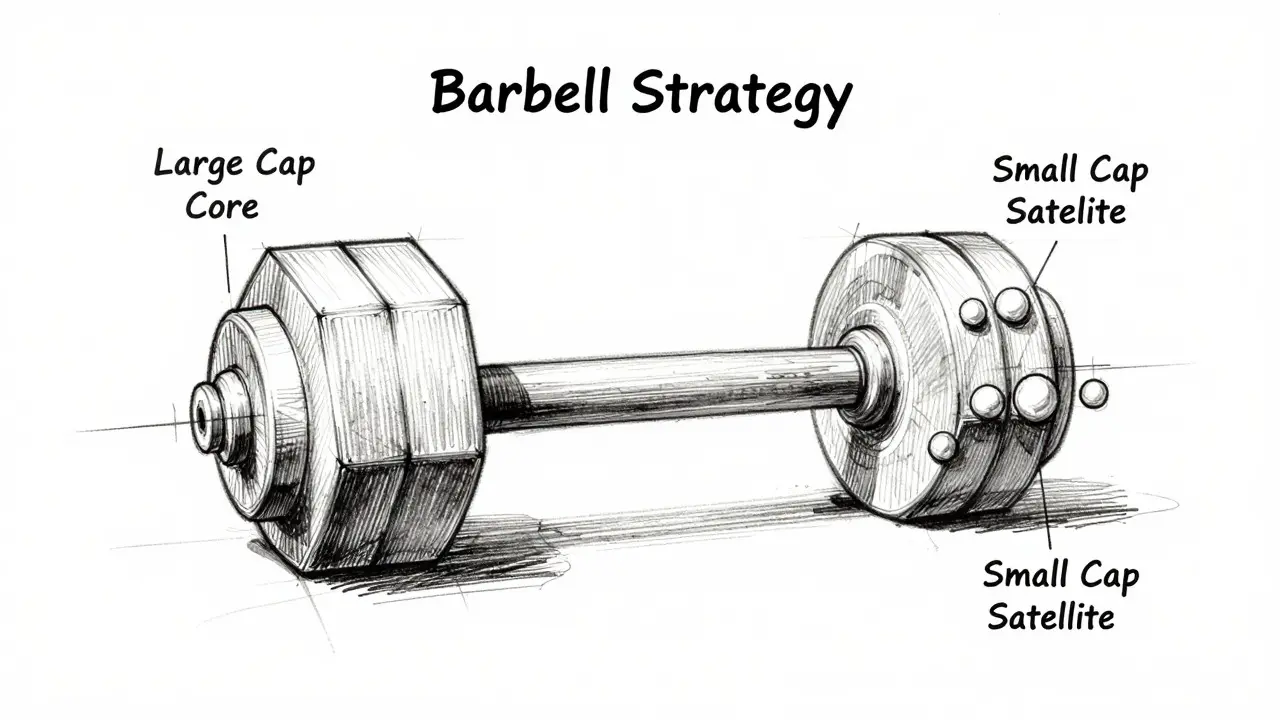
So, which should you invest in? The answer isn’t one or the other-it’s about allocation. Professional portfolio managers often use a "barbell strategy."
The Core (70-80%): Large Caps
Allocate the majority of your crypto portfolio to large-cap assets. These provide exposure to the broader adoption of blockchain technology without the existential risk of a project failing entirely. They act as your anchor. In a bull market, they may not give you 100x returns, but they are likely to double or triple while preserving capital better than smaller peers during downturns.
The Satellite (20-30%): Small & Mid Caps
Use a smaller portion of your funds to hunt for gems. This is where you research emerging narratives-AI tokens, Layer-2 solutions, or new gaming ecosystems. Here, you are betting on specific teams and technologies. Yes, many will fail. But one winner can offset several losses and drive significant overall portfolio growth.
Remember, small-cap investing requires homework. You need to evaluate the team, the code audits, the community engagement, and the utility. With large caps, you’re largely betting on the macro trend of crypto adoption. With small caps, you’re betting on a specific startup’s ability to survive.
Common Pitfalls to Avoid
Even seasoned investors make mistakes when navigating cap categories. Here are three common errors:
- Chasing Past Performance: Just because a small-cap coin pumped 500% last month doesn’t mean it’s a good buy now. Often, the easy money has already been made, and early adopters are looking to exit.
- Ignoring Macro Trends: Large-cap coins tend to lead market cycles. When Bitcoin starts rallying, liquidity eventually flows down to mid-caps, then small-caps. Buying small caps before Bitcoin shows strength is often premature.
- Confusing Market Cap with Revenue: Unlike stocks, most crypto projects don’t generate profit in the traditional sense. Don’t judge a coin’s health solely by its market cap. Look at active users, transaction fees, and developer activity.
Final Thoughts on Sizing Up Crypto
Market capitalization is your compass in the chaotic crypto landscape. It doesn’t tell you which way is north, but it tells you how rough the terrain is. Large caps offer a smoother ride with modest rewards. Small caps offer a thrilling, dangerous trek with the possibility of striking gold-or getting lost in the woods.
By understanding the mechanics of circulating supply, liquidity, and fully diluted valuation, you stop reacting to hype and start making calculated decisions. Whether you prefer the stability of blue-chip digital assets or the high-stakes game of small-cap speculation, knowing where each asset fits in the hierarchy is the first step toward mastering your portfolio.
What is the safest crypto category to invest in?
Within the cryptocurrency space, large-cap cryptocurrencies (those with a market cap over $1 billion) are generally considered the safest. Coins like Bitcoin and Ethereum have established track records, high liquidity, and widespread institutional adoption, making them less susceptible to extreme manipulation or sudden collapse compared to smaller projects.
Can small-cap crypto coins go to zero?
Yes, it is very common for small-cap cryptocurrencies to lose most or all of their value. Due to low liquidity, lack of established utility, or project failure, many small-cap tokens become worthless. Investors should only allocate money they can afford to lose entirely to this category.
Why is Fully Diluted Valuation (FDV) important?
FDV reveals the true potential size of a project if all tokens were released. A low market cap with a high FDV indicates that many tokens are yet to enter circulation, which can cause significant price drops (inflation) as those tokens are unlocked and sold by early holders or the team.
How does liquidity affect my ability to sell crypto?
Liquidity determines how easily you can buy or sell an asset without affecting its price. Large-cap coins have high liquidity, allowing instant sales at fair prices. Small-cap coins often have low liquidity, meaning large sell orders can crash the price, resulting in significant losses (slippage) when you try to exit.
Is it better to invest in one large-cap coin or many small-cap coins?
It depends on your risk tolerance. Investing in one large-cap coin offers stability but lower percentage gains. Spreading funds across many small-cap coins diversifies risk but requires extensive research. A balanced approach often involves a core holding of large caps supplemented by a diversified satellite portfolio of small caps.
Heather Austin
July 18, 2026 AT 12:23the fdv section is where most people get wrecked honestly. you see a $10m market cap and think its cheap but if the fully diluted valuation is $1b you are buying into a massive sell wall that will open up in like 6 months. always check the vesting schedule before you ape in.
Lisa Chong
July 19, 2026 AT 11:00I suspect the entire concept of market capitalization is a fabricated narrative designed to keep the masses compliant with centralized banking interests. The 'large caps' are merely state-approved digital fiat, while the small caps represent the only true resistance against the globalist agenda. They want you to feel safe in your cruise ship so they can control the speedboat. Do not trust the numbers. The system is rigged by design. We must reject this false dichotomy imposed upon us by the elite financial institutions who profit from our ignorance.
Ran Tao
July 19, 2026 AT 19:37Oh look another generic article telling people to buy Bitcoin because it's 'safe'. How boring 🙄. I made my millions on meme coins when they were trading at fractions of a cent. You guys are too scared to take real risks. Life is short why settle for 2x returns when you could be doing 100x or losing everything? It’s all about the thrill anyway 😂🚀
Ruth Williams
July 20, 2026 AT 01:19It is quite amusing to observe the sheer lack of sophistication displayed by those who chase small-cap tokens without understanding basic economic principles. True wealth preservation requires an appreciation for liquidity depth and institutional adoption metrics which are inherently tied to large-cap assets. One must cultivate a refined palate for value rather than indulging in the vulgar spectacle of speculative mania.
Sophie Nakasako
July 20, 2026 AT 09:41I find myself wondering if we are defining risk correctly here. Is risk truly just volatility or is it the permanent loss of capital? When we look at small caps aren't we ignoring the human element of team integrity and community resilience? Perhaps the barbell strategy is sound but maybe we need to add a third leg to the stool: governance participation. What do you all think about active ownership as a risk mitigator?
Kristy Morrow
July 20, 2026 AT 23:38you think you know risk but you dont. the real risk is trusting anyone. big caps are just bigger traps. small caps are honest traps. at least they tell you upfront its gambling. i prefer the honesty of chaos over the lie of stability. wake up sheeple.
John Harman
July 22, 2026 AT 07:29Let me save you some time reading this fluff. Market cap is price times supply. If you don't understand that you shouldn't be touching crypto. Liquidity is king. If you can't sell it you don't own it. Simple as that. Stop listening to influencers and start looking at order books.
Antony Lopez
July 22, 2026 AT 14:43This analysis ignores the geopolitical reality of crypto adoption. American investors should focus on assets that align with our national interests and regulatory frameworks. Foreign stablecoins and obscure altcoins are often vectors for illicit finance. Stick to what is transparent and domestically relevant. The SEC exists for a reason and large caps generally comply better than these sketchy offshore projects.
Kat Barr
July 23, 2026 AT 09:39I love how this breaks down the cruise ship vs speedboat analogy!! It really helps visualize the difference in stability 🌊⛵. I’ve been feeling so overwhelmed trying to decide where to put my savings but this makes it seem much more manageable! Just remember everyone has different comfort levels and that’s totally okay 💖✨
Logan Edmison
July 25, 2026 AT 01:04the universe doesn't care about your market cap. entropy eats everything eventually. bitcoin might be stable today but tomorrow it could be dust. small caps are just faster decay. we are all just holding sand in our hands waiting for the wind to blow it away. nihilism is the only true hedge.
Michelle Walker
July 26, 2026 AT 05:24You are missing the point entirely. Small caps are not investments; they are lotteries. Large caps are commodities. Treating them as equivalent asset classes is intellectual laziness. Check the FDV. Check the volume. If you can’t read a balance sheet, stay out of crypto. It’s that simple. No excuses.
Shay Thomson
July 26, 2026 AT 22:15Oh my gosh this is such a dramatic way to look at investing! But seriously the fear of missing out on those 100x gains is real isn't it? I just want everyone to feel heard whether they are conservative or wild. Let's create a space where both the cruise ship captains and the speedboat racers can coexist peacefully! 🕊️
DJ Maleko
July 27, 2026 AT 16:57I noticed you didn't mention your personal portfolio allocation. Are you hiding something? Why are you afraid to share your exact holdings? Transparency builds trust. I’m putting 90% in small caps because I know where the bodies are buried. You’re too scared to ask the right questions. Keep digging deeper into the dark web gems 🕵️♂️💎
Erika Pozzetto
July 29, 2026 AT 00:46In light of the aforementioned discussion regarding market capitalization tiers, it is imperative to consider the long-term implications of tokenomics on sustainable growth trajectories. While large-cap assets provide a certain degree of predictability which is undoubtedly beneficial for risk-averse individuals, one must also acknowledge the transformative potential inherent in smaller, more agile ecosystems that may disrupt existing paradigms through innovative technological solutions and decentralized governance models thereby offering substantial rewards for those willing to endure short-term volatility.
Russ Fincham
July 29, 2026 AT 16:13The data speaks for itself. Volatility is a feature not a bug. However most retail traders lack the discipline to handle the swings. Formal analysis suggests a correlation between market cap size and beta coefficients. Use this knowledge or remain mediocre.
Linda Hilliard
July 30, 2026 AT 07:10Let’s be clear about alpha generation here. You cannot generate meaningful alpha solely through large-cap exposure unless you are leveraging derivatives which introduces counterparty risk. The smart money rotates into mid-caps during liquidity surges. Understanding the flow of capital from BTC -> ETH -> Alts is critical for timing entries. Don’t be a bagholder. 📉🧠
Winston Lacewing
July 31, 2026 AT 14:42This whole debate is making me sick to my stomach! How can people sleep at night knowing their money is tied to such arbitrary numbers? I lost my shirt on a rug pull last year and I still dream about it 😭. We need to talk about the moral responsibility of developers who launch these toxic small caps. It’s predatory behavior plain and simple! 🤮💔
Kristine Lawson
August 2, 2026 AT 14:18I fundamentally disagree with the notion that small caps offer 'moonshot' potential without acknowledging the ethical implications of such speculation. To encourage reckless investment in unproven technologies is to endorse a culture of greed that undermines the very principles of decentralization. We must demand higher standards of accountability from project creators regardless of their market capitalization tier. Precision in language matters; let us not confuse gambling with investing.
Tawny Holmes
August 3, 2026 AT 04:39Market cap determines liquidity. Liquidity determines slippage. Slippage kills profits. Buy large caps or learn to code. That is the only advice you need.
Jessie Smith
August 4, 2026 AT 01:50the aristocracy of blockchain understands that true power lies not in the size of the vessel but in the quality of the crew. large caps are bloated bureaucracies slow to innovate and ripe for disruption. small caps are the guerrilla fighters of the digital age swift unpredictable and dangerous. i prefer the danger. safety is for the weak minded. embrace the chaos and let the strong survive.
Kim Kay
August 5, 2026 AT 22:28i think its important to remember that everyone starts somewhere. dont let the jargon intimidate you. market cap is just a number. what matters is do you believe in the project? take your time and research. its okay to make mistakes. we are all learning together.
Jackie D
August 7, 2026 AT 20:46this post is a kaleidoscope of truth and hype swirling together like oil on water. i wonder if the real treasure is hidden in the cracks between the large and small caps? maybe there is a middle ground where the wise merchants dwell. i find myself pondering the texture of liquidity. is it smooth like silk or rough like sandpaper? lets explore the nooks and crannies of this digital landscape together.