
Nonce vs Other Mining Variables: The Core of Bitcoin Proof-of-Work
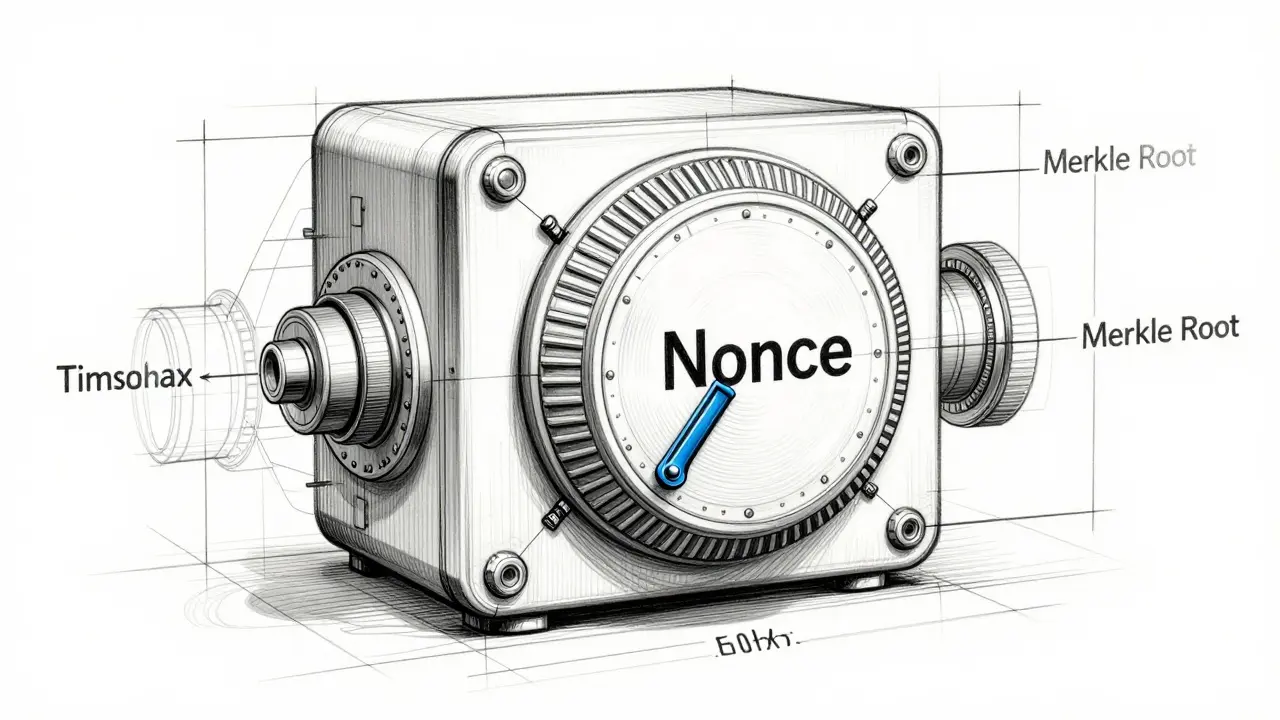
Imagine you are trying to pick a safe combination by turning the dials randomly. You spin them billions of times a second, hoping one specific sequence clicks open. In Bitcoin mining, that spinning dial is called the nonce. It is the single most important variable miners manipulate to win the race for block rewards. But it doesn't work in isolation. The nonce interacts with several other fixed or semi-fixed values in the block header to create a unique cryptographic puzzle.
Understanding the difference between the nonce and other mining variables is crucial for grasping how blockchain security actually works. Most people think mining is just "computing power," but it is really about manipulating specific data points within a strict mathematical framework. This article breaks down exactly what the nonce is, how it differs from variables like difficulty targets and timestamps, and why this distinction matters for the network's integrity.
What Is the Nonce?
The nonce is a 32-bit number used once in the Bitcoin block header to satisfy the proof-of-work requirement. Technically, it stands for "number used once." Its job is simple: change the input to the hashing algorithm until the output hash meets the network's difficulty target. Since the SHA-256 algorithm is deterministic, changing even one bit of the input completely changes the output. Miners rely on the nonce as their primary lever to find that winning hash.
The nonce provides approximately 4.3 billion possible values ($2^{32}$). When a miner starts working on a block, they begin incrementing the nonce from zero upward. Modern ASIC miners can test billions of nonces per second. If they exhaust all 4.3 billion combinations without finding a valid hash, they must change another variable in the block header to reset the nonce counter and start again.
The Block Header: Where Variables Live
To understand the nonce's role, you need to look at the entire block header. The header is an 80-byte structure that contains six key components. Five of these are either fixed by previous blocks or determined by transaction data. Only one-the nonce-is freely adjustable by the miner in real-time.
| Variable | Size (Bytes) | Controlled By | Role in Mining |
|---|---|---|---|
| Version | 4 | Network Protocol | Indicates software version; rarely changed during mining. |
| Previous Block Hash | 32 | Network History | Links to the prior block; immutable for current mining attempt. |
| Merkle Root | 32 | Miner (Transaction Selection) | Summarizes all transactions; changes if transaction set changes. |
| Timestamp | 4 | Miner (with constraints) | Current time; can be adjusted slightly to extend nonce space. |
| Bits (Difficulty Target) | 4 | Network Algorithm | Target hash value; adjusts every 2,016 blocks. |
| Nonce | 4 | Miner Hardware | Primary variable incremented to find valid hash. |
The previous block hash ensures the chain remains unbroken. You cannot change it because it represents historical truth. The Merkle root summarizes the transactions included in the block. While miners can choose which transactions to include, doing so requires recalculating the entire Merkle tree, which is computationally expensive compared to simply incrementing a nonce. Therefore, the nonce remains the fastest way to search for a solution.
Nonce vs. Difficulty Target
A common misconception is that miners adjust the difficulty to make mining easier. They do not. The difficulty target is a network-wide parameter that adjusts automatically every 2,016 blocks (roughly every two weeks). Its purpose is to keep the average block time at 10 minutes, regardless of how much total computational power joins or leaves the network.
If more miners join, the network increases the difficulty, making the target hash smaller and harder to find. If miners leave, the difficulty drops. Individual miners have zero control over this variable. They must accept the current difficulty and use their nonce to try to meet it. This distinction is vital: the nonce is the tool; the difficulty is the goalpost.
Nonce vs. Timestamp
When the 4.3 billion nonce values are exhausted, miners don't give up. They tweak the timestamp. The timestamp records when the block was created. Network rules allow some flexibility here-typically a few hours deviation from the actual time-as long as it isn't too far in the past or future. By changing the timestamp by just one second, the entire block header changes, resetting the nonce to zero and opening up another 4.3 billion possibilities.
This creates a larger search space. However, manipulating the timestamp is less efficient than using the nonce because it involves updating the header and re-hashing. It is a fallback strategy, not the primary method. Miners prefer to stick to the nonce unless absolutely necessary.
Nonce vs. Extra Nonce
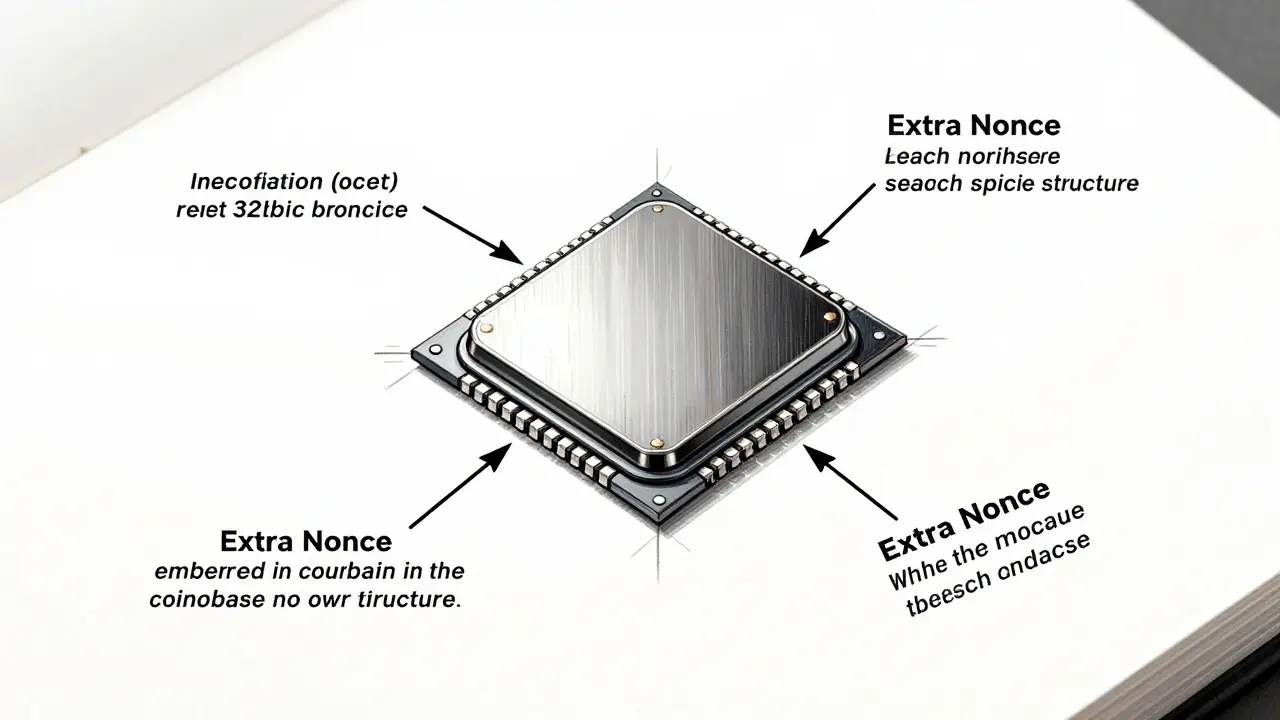
In modern mining, especially with high-difficulty networks like Bitcoin, 4.3 billion attempts are often insufficient for a single miner to find a block. To solve this, mining pools and sophisticated software use a concept called the extra nonce. This isn't part of the standard block header. Instead, it is embedded within the coinbase transaction (the first transaction in the block).
By changing the extra nonce in the coinbase data, miners alter the Merkle root. A new Merkle root means a new block header, which resets the standard nonce. This effectively gives miners a near-infinite search space. While the standard nonce is the final step in the hash calculation, the extra nonce allows miners to generate unique jobs for each worker in a pool, preventing duplicate work.
Why the Nonce Matters for Security
The reliance on the nonce is what makes Bitcoin secure. Because finding the correct nonce requires brute-force computation, it is economically expensive to attack the network. An attacker would need to control more than 51% of the global hash rate to rewrite history, which would require massive investment in hardware and electricity.
The nonce acts as a "proof of work" engine. It proves that significant energy was expended to validate the block. Unlike other variables that might be manipulated strategically (like transaction selection), the nonce discovery is purely probabilistic. It is a guessing game where luck and speed determine the winner. This randomness ensures no single entity can predict or guarantee block production, maintaining decentralization.
Practical Implications for Miners
For individual miners or small operations, understanding these variables helps in optimizing setup. You cannot influence the difficulty or the previous block hash. Your focus should be on maximizing your hash rate (nonce testing speed) and ensuring your mining software efficiently handles extra nonces if you are in a pool.
Transaction fees are another variable. While not part of the header's cryptographic puzzle directly, they affect the Merkle root. Miners select transactions based on fee rates to maximize revenue. However, this selection happens before the nonce hunting begins. Once the block template is built, the nonce becomes the sole focus.
Frequently Asked Questions
Can a miner change the difficulty target?
No. The difficulty target is adjusted automatically by the Bitcoin protocol every 2,016 blocks to maintain a 10-minute block interval. Individual miners have no control over this variable.
What happens when the nonce runs out of values?
When all 4.3 billion nonce values are tested without success, the miner changes another variable in the block header, typically the timestamp or the extra nonce in the coinbase transaction, to reset the search space.
Is the nonce part of the transaction data?
No. The nonce is part of the block header, not the individual transactions. It is used to secure the entire block, not specific transactions within it.
How does the extra nonce differ from the standard nonce?
The standard nonce is in the block header and has a 32-bit limit. The extra nonce is stored in the coinbase transaction and allows miners to create unique block templates, effectively expanding the search space beyond the 32-bit limit.
Why is the nonce called "number used once"?
It is called "used once" because each valid nonce is unique to a specific block. Once a block is mined, that nonce is permanently recorded on the blockchain and cannot be reused for another block.