
Paradex Crypto Exchange Review: Is This Zero-Fee DEX Better Than a CEX?
Quick Takeaways
- Cost: 0% maker and taker fees for retail UI traders.
- Speed: Sub-second execution (often 100-200ms) thanks to the DimeVM architecture.
- Privacy: Unique zk-style masking that hides your positions and PnL from public view.
- Assets: Support for 115+ assets across perpetuals, options, and spot markets.
- Risk: Self-custodial, though it currently relies on a centralized operator for block proposals.
The Tech Under the Hood: DimeVM and Starknet
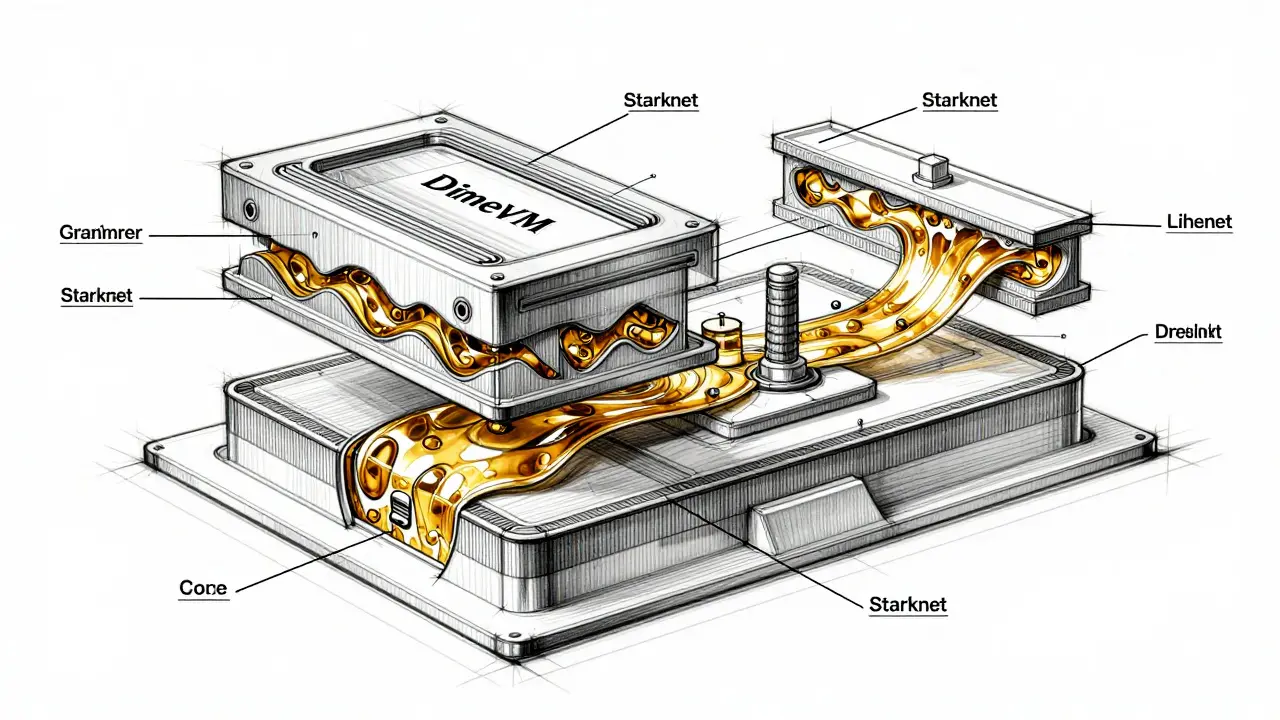
Most decentralized exchanges (DEXs) feel sluggish because they fight for space on a crowded mainnet. Paradex takes a different route. It operates on its own proprietary Layer 2 blockchain called DimeVM is the specialized virtual machine and appchain that powers Paradex, enabling over 10,000 transactions per second (TPS) . By leveraging Starknet, a zk-Rollup L2 that scales Ethereum by processing transactions off-chain and submitting proofs to the mainnet , Paradex ensures that while the trading happens at lightning speed, the final security is anchored to Ethereum. This architecture is why you don't see the typical 'lag' associated with DeFi. While a standard DEX might handle 100 to 500 TPS, DimeVM pushes past 10,000. For a trader, this means your market orders fill instantly. In real-world tests, users have reported BTC perpetual positions filling in as little as 127ms. If you're doing high-frequency trading or scalping, this difference is everything.Trading Options and the Zero-Fee Model
The biggest draw for most people is the cost. In a world where platforms like GMX or Kwenta charge between 0.1% and 0.15% per trade, Paradex has disrupted the model by offering 0% fees for retail users. This isn't just a promotional gimmick; it's a core part of their strategy to capture market share from centralized exchanges (CEXs). Beyond the cost, the variety of markets is impressive. You can access over 250 markets, including:- Perpetual Futures: Trade the price movement of 115+ assets with up to 50x leverage.
- Perpetual Options: A more flexible way to hedge or speculate, recently expanded to 25 assets.
- Spot Trading: Direct asset exchange (rolling out fully in 2026).
Comparing Paradex to the Competition
When you put Paradex side-by-side with other leading derivatives platforms, the trade-offs become clear. While it beats almost everyone on speed and cost, it's a newer player compared to veterans like dYdX.| Feature | Paradex | Hyperliquid | GMX |
|---|---|---|---|
| Trading Fees | 0% (Retail) | Low | ~0.1% |
| Execution Speed | <200ms | Fast | Variable |
| Privacy Features | zk-Account Masking | Public | Public |
| Max Leverage | 50x | Variable | Variable |
| 30-Day Vol (Approx) | $5.98 Billion | $4.21 Billion | Lower |
The Learning Curve and Potential Pitfalls
It's not all smooth sailing. If you've never traded derivatives, Paradex can feel like stepping into the cockpit of a fighter jet. The platform uses a unified margin system. Instead of having separate pots of money for different trades, all your collateral is pooled. While this is great for capital efficiency, it's a double-edged sword. If one position goes south and you've over-leveraged, it can drag down your other positions and lead to a cascade of liquidations. New users have reported accidentally over-leveraging because they didn't fully grasp how the unified margin interacts with their total balance. To avoid this, I recommend using their interactive margin calculator before opening a position. It gives you a real-time look at your liquidation price, which is essential for survival in a volatile market.
Is It Truly Decentralized?
This is where the critics, like those at CoinDesk, bring up a valid point. While your funds are self-custodial (you hold the keys), the current 'Phase 1' implementation relies on a centralized operator for block proposals. This means the network isn't fully autonomous yet. However, they've mitigated this risk by undergoing regular audits from OpenZeppelin, a leading security firm that audits smart contracts to ensure they are free from vulnerabilities and bugs . The goal is to move toward full decentralization as the project matures. For now, you're trusting the system's design and the audits rather than a fully distributed set of validators.How to Get Started on Paradex
Getting your first trade live takes about 15 minutes if you have your wallet ready. Here is the general path:- Connect Your Wallet: Use a compatible Web3 wallet to connect to the interface.
- Bridge Assets: Move your funds (like USDC) from Ethereum or other supported chains (Solana, Arbitrum, Base) into the Paradex ecosystem.
- Deposit Collateral: Move your funds into the exchange's trading account.
- Set Your Margin: Decide between cross-margin or isolated-margin depending on your risk appetite.
- Execute Trade: Use the limit or market order book to open your first position.
Does Paradex really have zero fees?
Yes, Paradex offers 0% maker and taker fees for traders using the retail user interface. This is one of its biggest competitive advantages over other decentralized exchanges like GMX or Kwenta.
Is my money safe on Paradex?
Your funds are self-custodial, meaning you maintain control of your private keys. The platform's smart contracts are audited by OpenZeppelin to reduce the risk of exploits, although all leveraged trading carries inherent market risk.
What is the maximum leverage available?
Paradex supports a maximum leverage of 50x. However, higher leverage significantly increases the risk of liquidation, especially within a unified margin system.
Which blockchains does Paradex support?
Paradex connects to over 20 chains, including Ethereum, Solana, Arbitrum, Avalanche, Base, and Binance Smart Chain, making it very easy to move assets in and out of the platform.
What is DimeVM?
DimeVM is the proprietary Layer 2 appchain and virtual machine that allows Paradex to process over 10,000 transactions per second, providing the speed needed for professional-grade trading.
John and Lauren Busch
April 15, 2026 AT 09:04Zero fees. Truly a miracle in this dystopia.
Abhinav Chaubey
April 16, 2026 AT 03:05Everyone knows that L2 appchains are the only viable path forward for scalability, but people still cling to their archaic CEX habits. It is frankly embarrassing that some of you still don't understand the efficiency of zk-rollups over traditional order books. If you actually bothered to read a whitepaper, you would see that Paradex is simply executing the inevitable evolution of trading infrastructure. Most of these discussions are just noise from people who can't distinguish between a bridge and a smart contract. Get on the right side of history or stay poor.
Michael Harms
April 16, 2026 AT 17:45This looks like a great way for new folks to get into DeFi without getting wrecked by fees right out of the gate! Just remember to take it slow with the leverage guys!
Robert Preston
April 17, 2026 AT 04:09Regarding the unified margin system, you have to be extremely careful with your collateral ratios. It is very easy to think you're hedged when you're actually just exposing your entire account to a single volatility spike. I highly suggest keeping a reserve in a separate wallet to top up if things get hairy, rather than relying on the internal pool alone.
Keri Pommerenk
April 17, 2026 AT 13:52thanks for the tip on the margin calculator definitely gonna use that before i try any 50x trades haha
nikki krinkin
April 18, 2026 AT 09:21I like the idea of masking the PnL. It's nice to trade without everyone watching every single move on-chain.
Thomas Jewett
April 19, 2026 AT 01:38Typical corporate trash trying to hide the fact that they still have a centralized operator runing the show. Give me a real decentralized system and not some half-baked L2 that claims to be the future while holding the keys in a vault somewhere in some fancy office in california probably. Its just another way to trick the american public into thinking they have control while the elites just move the goalposts whenever they feel like it. Completely fraudulent if you actually look at the architecture properly!
Luke George
April 20, 2026 AT 21:40The centralized operator is the real red flag here. They say it's Phase 1, but Phase 2 never comes because they want the kill-switch for when the regulators come knocking.
Kim Smith
April 22, 2026 AT 13:27it is just so fascinatin how we try to recreate the stock market but with more magic internet money and the weirdest logic about how we trust code over people even though the code is written by people who are’ probably just as messy as the rest of us in this great cosmic dance of capital and risk and i wonder if the speed of 200ms even matters when the actual philosophical value of the asset is basically a collective hallucination based on hype cycles and memes’
Mark Pfeifer
April 23, 2026 AT 23:44The trade-off between the centralized operator and the execution speed is a necessary evil for now. We can't expect 10k TPS on a fully decentralized set of validators with current consensus mechanisms.
Alex Long
April 24, 2026 AT 20:52Mid. Still feels like a ghost town compared to Binance. Total joke.
Yuhan Mo
April 26, 2026 AT 05:02The integration of the DimeVM is quite an elegant solution for reducing latency. From a quantitative perspective, the reduction in slippage for high-frequency strategies is the primary value proposition here.
siddharth narula
April 28, 2026 AT 03:23One must ponder if the pursuit of zero fees is merely a siren song leading the naive into the abyss of over-leveraging. 🧐 True wealth is not found in the velocity of trades, but in the discipline of the soul. 🌟
Anna Grealis
April 28, 2026 AT 19:59Bridge is a scam. My funds just disappeared into the void. dont use it.
Tracy Sperandio
April 30, 2026 AT 08:43Absolute game-changer! The speed on this thing is electric and I'm loving the vibe of the UI. Let's get those gains!
Karen Mogollon Gutierrez
May 1, 2026 AT 17:06I find it utterly preposterous that we are expected to trust a unified margin system that can essentially incinerate one's entire portfolio due to a single erroneous calculation! It is a tragedy of the highest order!
nathan jones
May 3, 2026 AT 12:51Pretty decent experience so far. Just a regular DEX with better speeds.
Kaitlyn Wu
May 5, 2026 AT 09:46For those of you complaining about the learning curve, just read the docs. It's not the platform's fault if you can't handle basic margin concepts. Be professional about your risk management or leave the market.
Sean Mitchell
May 6, 2026 AT 04:30I'm honestly exhausted just looking at this list of features. The sheer audacity of claiming a DEX can replace a CEX while still having a 'centralized operator' is just peak comedy. It's a total disaster waiting to happen and I can't wait to watch it crash and burn in a spectacular fireball of liquidations. Truly, the height of irony.