
Position Sizing in Cryptocurrency Trading: A Guide to Risk Management

Quick Summary
- The Goal: Prevent a single bad trade from wiping out your account.
- Core Methods: Range from simple fixed dollar amounts to complex mathematical formulas like the Kelly Criterion.
- The Golden Rule: Never risk more than 1-3% of your total account on a single trade.
- Key Tool: Stop-loss orders are mandatory to define your "risk per share."
- Scaling: Percentage-based sizing allows your positions to grow as your account grows.
Why Position Sizing is Your Only Real Safety Net
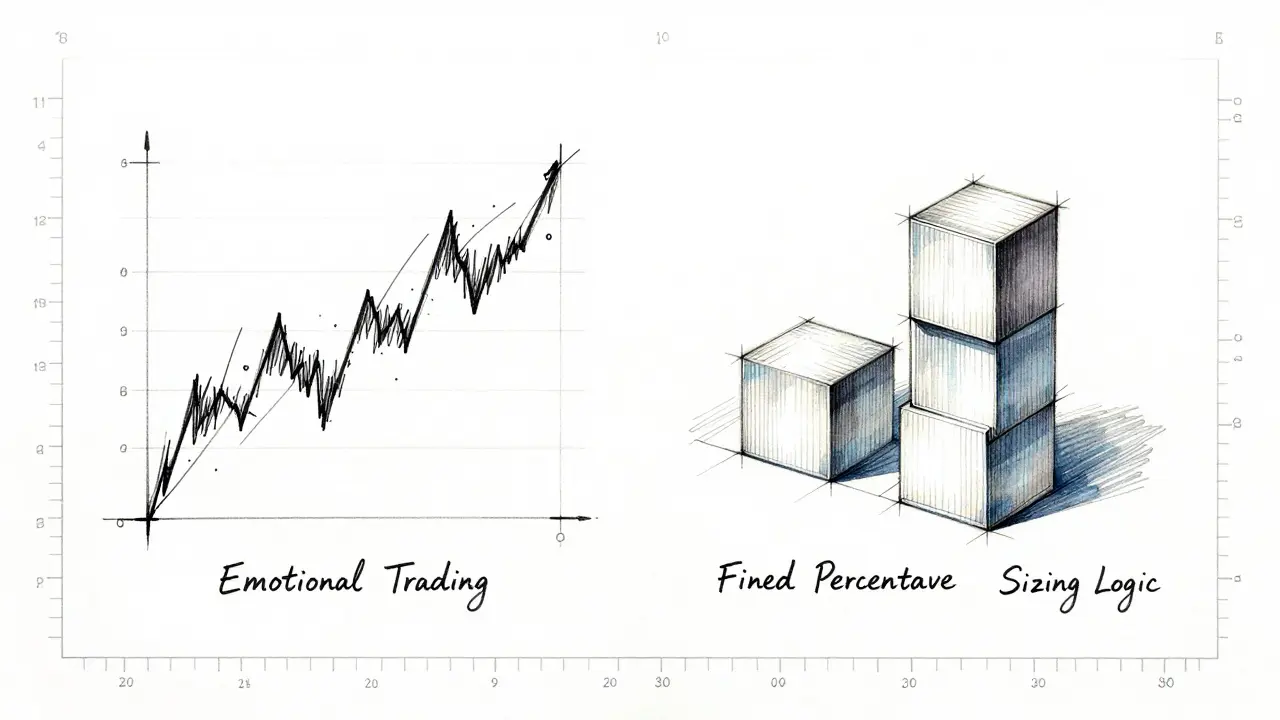
In the wild west of Cryptocurrency, volatility is the only constant. A coin can jump 20% in an hour and crash 30% the next. Without a strict sizing plan, emotional trading takes over. When you're winning, you feel invincible and oversize your next trade. When you're losing, you "revenge trade" by doubling down to win it all back quickly. This is a one-way ticket to a zero balance.
Systematic sizing removes the guesswork. Instead of saying "I'll put $1,000 into this," a professional asks, "How much am I willing to lose if this trade goes wrong?" By focusing on the loss rather than the potential gain, you ensure that no matter how many times you are wrong, you still have enough capital to keep playing. This psychological shift from "winning" to "surviving" is what separates long-term profitable traders from the crowd.
Common Strategies for Allocating Capital
Depending on your experience level and the size of your portfolio, different methods will work better. You don't need a PhD in math to start, but you do need consistency.
The Fixed Dollar Value Approach
This is the simplest method. You decide on a flat amount for every trade. For example, if you have a $10,000 account and decide every trade gets $500, you're done. If Bitcoin is at $30,000, you buy 0.0167 BTC. If Ethereum is at $2,000, you buy 0.25 ETH. It's great for beginners because it's easy to track, but it has a major flaw: it doesn't account for volatility. A 10% move in a stablecoin is very different from a 10% move in a micro-cap meme coin.
The Fixed Percentage Method
This is where things get smarter. Instead of a dollar amount, you use a percentage of your current account balance. Let's say you use a 60% allocation. If your account is $10,000, you invest $6,000. If your account grows to $12,000, your next trade size automatically bumps up to $7,200. Conversely, if you hit a losing streak and your balance drops to $8,000, you only invest $4,800. This naturally scales your risk based on your actual wealth.
The Fixed Fraction and Kelly Criterion
For the math-heavy traders, the Kelly Criterion is a formula used to maximize long-term growth by considering your win rate and the ratio of your average win to your average loss. While powerful, it can be overly aggressive for the crypto market. Most pros prefer a "Fractional Kelly" approach, where they use only a small portion of the recommended size to avoid the extreme swings that come with the full formula.
| Method | Complexity | Best For | Main Advantage | Main Weakness |
|---|---|---|---|---|
| Fixed Dollar | Very Low | Beginners | Simple to execute | Doesn't scale with growth |
| Fixed Percentage | Low | Growth Accounts | Automatic scaling | Requires constant balance tracking |
| Fixed Fraction | Medium | Risk Managers | Accounts for volatility | More calculations per trade |
| Kelly Criterion | High | Quantitative Traders | Mathematically optimized | Can be too aggressive/risky |
The 3-Step Calculation Process
If you want to trade like a professional, stop guessing. Use this workflow for every single trade you open. Let's use a real-world scenario: you have a $50,000 portfolio and you want to buy a token currently priced at $50.
- Determine Your Total Risk: Decide what percentage of your total capital you are okay with losing on one trade. Most pros use 1%. In this case, 1% of $50,000 is $500. This is your "Risk Amount."
- Define Your Invalidation Point: This is where your Stop-Loss Order goes. If you buy at $50 and decide the trade is a failure if it hits $45, your risk per unit is $5 ($50 - $45).
- Calculate Position Size: Divide your total risk by the risk per unit. $500 divided by $5 equals 100 units. You buy exactly 100 tokens.
Why does this work? Because regardless of whether the token goes to $100 or crashes to $0, your maximum loss is capped at $500 (1% of your account). You can lose 10 trades in a row and still have 90% of your capital left.
Avoiding the Common "Degenerate" Pitfalls
In the crypto community, you'll often see people talking about "going all in" or using 100x leverage. This is a recipe for disaster. The most common mistake is oversizing. When a trader sees a promising chart, they ignore the math and put 20% of their account into one asset. If that asset drops 5%-which is a normal Tuesday in crypto-they've lost 1% of their entire portfolio on a tiny fluctuation.
Another trap is ignoring correlation. If you have five different positions in five different "AI coins," you might think you're diversified. But since those coins usually move together, you've actually just created one giant, oversized position in the AI sector. True risk management requires you to look at your total exposure across the whole market, not just individual trades.

The Future of Sizing: Algorithms and AI
As the market matures, we're seeing a shift toward automated risk management. Modern platforms are integrating tools that automatically adjust your position size based on the Average True Range (ATR)-a measure of volatility. If the market becomes more volatile, the system automatically shrinks your position to keep your dollar-risk constant.
We are also seeing the rise of Risk Parity models in the DeFi (Decentralized Finance) space. Instead of allocating by dollar amount, these systems allocate based on the risk contribution of each asset. This ensures that a volatile asset like a small-cap altcoin doesn't dominate the risk profile of your entire portfolio compared to something more stable like Bitcoin.
What is the best risk percentage per trade for a beginner?
For most beginners, risking 1% of the total account balance per trade is the gold standard. This allows you to endure a long string of losses without significantly impacting your capital. Very conservative traders may drop this to 0.5%, while experienced pros might push it to 2-3% for high-conviction setups.
Can I use position sizing with leverage?
Yes, but leverage is simply a tool to achieve your desired position size with less capital. Your risk should still be calculated based on your total account equity, not the leverage amount. If your math says you need a $1,000 position and you only have $100, 10x leverage gets you there, but your stop-loss must still be based on the $1,000 exposure.
What happens if I don't use a stop-loss?
Without a stop-loss, you cannot accurately calculate your position size because your "risk per share" is technically the entire price of the asset. This makes the math impossible and forces you to rely on intuition, which often leads to catastrophic losses during flash crashes.
Is the Kelly Criterion too risky for crypto?
The full Kelly Criterion can be extremely volatile and may suggest position sizes that are too large for the liquid nature of some crypto markets. Using a "Half-Kelly" or "Quarter-Kelly" approach-where you only take a fraction of the suggested size-is generally recommended to provide a safety buffer.
How often should I review my sizing strategy?
You should review your strategy at the end of every trading month. Check your drawdown (the peak-to-trough decline) and your win rate. If your drawdown is deeper than you're comfortable with, lower your risk percentage per trade. If your win rate is high but your profits are low, you might consider slightly increasing your sizing.
Next Steps for Your Trading Journey
If you're just starting, don't jump into the complex formulas. Start with a **Fixed Dollar** approach for two weeks to get used to the rhythm of the market. Once you're comfortable, move to a **Fixed Percentage** model to start scaling your growth.
If you find yourself struggling with the math, look for a "Position Size Calculator" online. You just plug in your account balance, your risk percentage, and your stop-loss price, and it gives you the exact amount of crypto to buy. The goal isn't to be a human calculator; the goal is to protect your money so you can stay in the game long enough to get lucky and skilled.
Artavius Edmond
April 11, 2026 AT 06:48This is a super chill way to look at things and honestly helps a lot of people get their head around the basics. Love seeing the focus on survival over quick wins.
william manes
April 13, 2026 AT 06:34Stop gambling and start winning 🇺🇸. Most of yall are just lazy 🤡
Heather Warren
April 14, 2026 AT 13:54I can definitely help everyone implement the fixed percentage method if you're struggling. It is much more sustainable for long-term growth!
daniella davis
April 15, 2026 AT 15:08Ugh please, anyne with a real brain already knows the Kelly Criterion is way too aggresive for this market. Its like, duh, obviously you use fractional kelly or you're basically just begging to be liquidated lol.
7stargee Emmanuel Obani
April 15, 2026 AT 18:391% risk is for cowards lol :-)
Kelly Cantrell
April 17, 2026 AT 12:36They want us using these "calculators" so we stay predictable. The markets are rigged by the elites anyway, and these formulas are just a way to keep the retail traders in a nice little box while the big banks drain the liquidity.
Rima Dinar
April 18, 2026 AT 23:15It is so important to remember that every single person's journey is different, and while the 1% rule is a wonderful baseline, you should really take the time to reflect on your own emotional tolerance for loss because if you are staring at the screen in a panic, no amount of math will save your mental health in the long run.
Hope Johnson
April 19, 2026 AT 06:13Risk management is essentially a philosophy of humility in the face of an unpredictable universe. By acknowledging that we cannot possibly predict the future of a volatile asset, we shift our focus from the ego-driven desire for a massive win to a more inclusive understanding of capital preservation, which allows us to remain participants in the market for years rather than days. This disciplined approach doesn't just protect the wallet; it protects the spirit from the devastating swings of greed and despair that often characterize the cryptocurrency space.
aletheia wittman
April 21, 2026 AT 02:32omg i literally lost half my port doing the opposite of this last week and i am actually spiraling right now!!
Prasanna Shembekar
April 21, 2026 AT 11:51totally relate to that feelz bad man
Amanda Faust
April 23, 2026 AT 02:12stop-losses are basic common sense and the fact that people need a guide for this is honestly embarrassing
Rebecca Violette
April 23, 2026 AT 14:18i just cant stop myself from buying the dip even tho i know its a trap i feel so alone in this
Emily H
April 24, 2026 AT 17:29The inclusion of the Average True Range (ATR) for automated sizing is an excellent point. It provides a quantitative basis for adjusting exposure in real-time.
Swati Sharma
April 25, 2026 AT 14:14Using a Delta-neutral strategy alongside this sizing can really mitigate the systemic risk of a market-wide drawdown.
Jonathan Chamma
April 27, 2026 AT 08:37Just take it slow and be kind to yourselves while learning. It's a wild ride but we're all just trying to find our footing in this crazy digital gold rush.
Scott Fenton
April 27, 2026 AT 17:09One must strictly adhere to the invalidation point. Many traders move their stop-loss lower as the price drops, which fundamentally invalidates the original risk calculation and exposes the account to undue hazard.
Lauren Abrams
April 29, 2026 AT 08:26Interesting approach to the risk per unit calculation.
Samson Selleck
April 30, 2026 AT 11:19The sheer lack of sophistication in the fixed dollar approach is staggering. Any serious actor would utilize a variance-weighted allocation to optimize the Sharpe ratio, yet here we are discussing the equivalent of a piggy bank strategy for the masses.
Lela Singh
April 30, 2026 AT 18:59Get that bread safely! 🚀
Terrance Hausmann
May 1, 2026 AT 00:12I've found that combining the fixed percentage method with a bit of intuition for high-conviction plays works best, though you have to be careful not to let your emotions drive the bus when you're on a losing streak since that's exactly when the math becomes the most important part of the entire operation.
Will Dixon
May 1, 2026 AT 13:08just use a calc online like the post says its way easyer
Jason Davis
May 3, 2026 AT 00:17The ATR based systems are realy the way to go if you dont want to manualy adjust every hour. Its a lifesaver for those of us with full time jobs.
Agnessa Dale
May 4, 2026 AT 15:57This is such a helpful guide for anyone starting out! Stay positive!
7stargee Emmanuel Obani
May 5, 2026 AT 00:59Imagine actually following a rule book in crypto lol