
TVL as Investment Metric for DeFi: What It Really Tells You
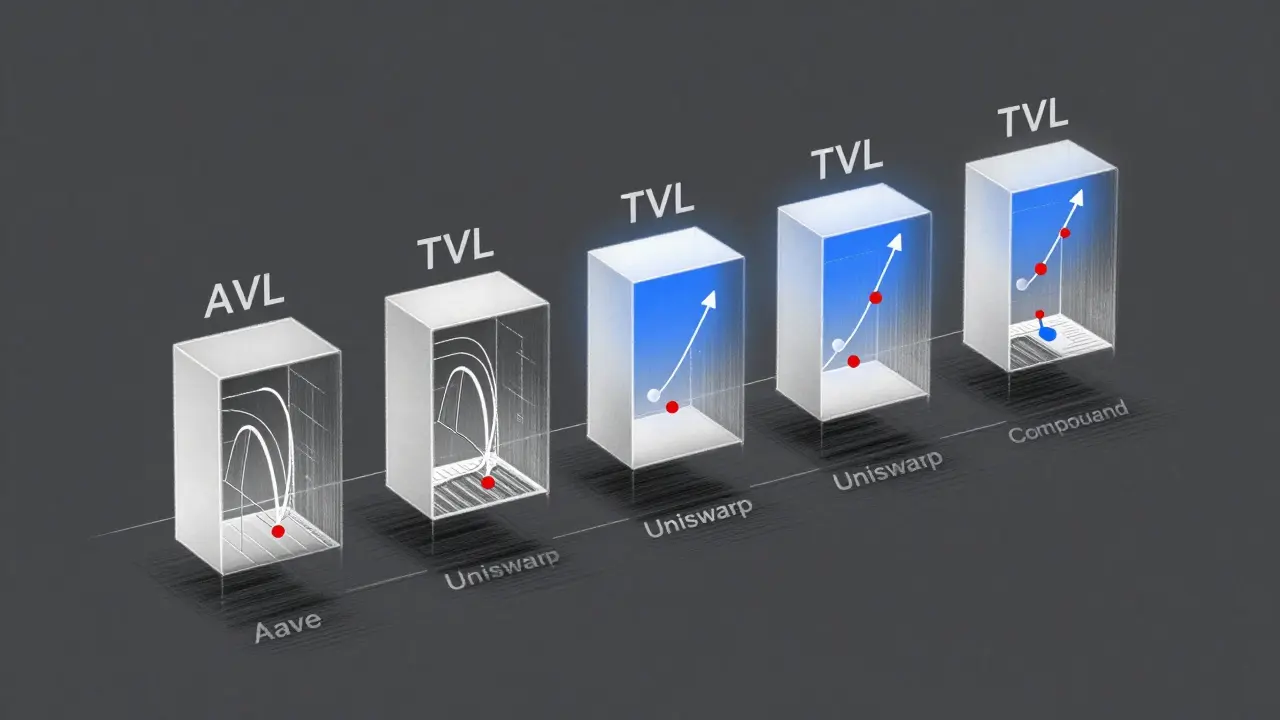
When you look at a DeFi protocol and see it has $2 billion in Total Value Locked (TVL), what does that actually mean? Is it a sign of strength, or just a flashy number pulled from a website that doesn’t tell the full story? Too many investors treat TVL like a leaderboard score - higher is better, end of story. But that’s where things go wrong.
What TVL Really Measures
TVL is the total dollar value of crypto assets locked in a DeFi protocol’s smart contracts. That includes ETH, USDC, WBTC, or any token people deposit to lend, stake, or provide liquidity. If you put $10,000 worth of ETH into a lending platform like Aave, that $10,000 gets counted in its TVL. Same if you add liquidity to a decentralized exchange like Uniswap. It’s not about how many tokens are traded - it’s about how much real money is actively working inside the system.
As of mid-2025, over $127 billion is locked across all DeFi protocols globally, according to DeFiLlama. That’s not small change. But here’s the catch: TVL doesn’t measure success. It measures commitment. And commitment can be fake.
Why TVL Matters More Than Market Cap
Market cap tells you the price of a token times how many are in circulation. But in DeFi, tokens can be wildly overvalued while the actual protocol sits idle. You can have a token with a $5 billion market cap, but if only $50 million is locked in its smart contracts, most of that value is just speculation. TVL cuts through that noise.
Think of it this way: Market cap is like the number of people who say they’re going to a concert. TVL is how many actually showed up with tickets in hand. If a DeFi project has high TVL, it means real users are risking their capital inside it - lending, earning yield, swapping tokens. That’s a sign of trust. And trust is what keeps DeFi alive.
How TVL Can Lie to You
Not all TVL is created equal. Some protocols inflate their numbers using tricks that look like growth but are just noise.
- Looping: A protocol lends you tokens, you use those tokens to deposit back into the same protocol, and suddenly your TVL doubles - even though no new money entered the system.
- Price manipulation: If a token’s price spikes because of hype, TVL jumps - even if nobody deposited anything new. That’s not adoption, that’s volatility.
- External data reliance: A 2025 study by the Bank for International Settlements found that over 10% of DeFi protocols calculate TVL using off-chain servers. That means their numbers aren’t even verified on the blockchain. They could be wrong, outdated, or intentionally misleading.
And here’s the kicker: the same token can appear in multiple protocols. If you deposit USDC into a lending platform, then use the LP token you get to stake in a yield aggregator, that same USDC gets counted twice. That’s double-counting. It inflates the total without adding real value.
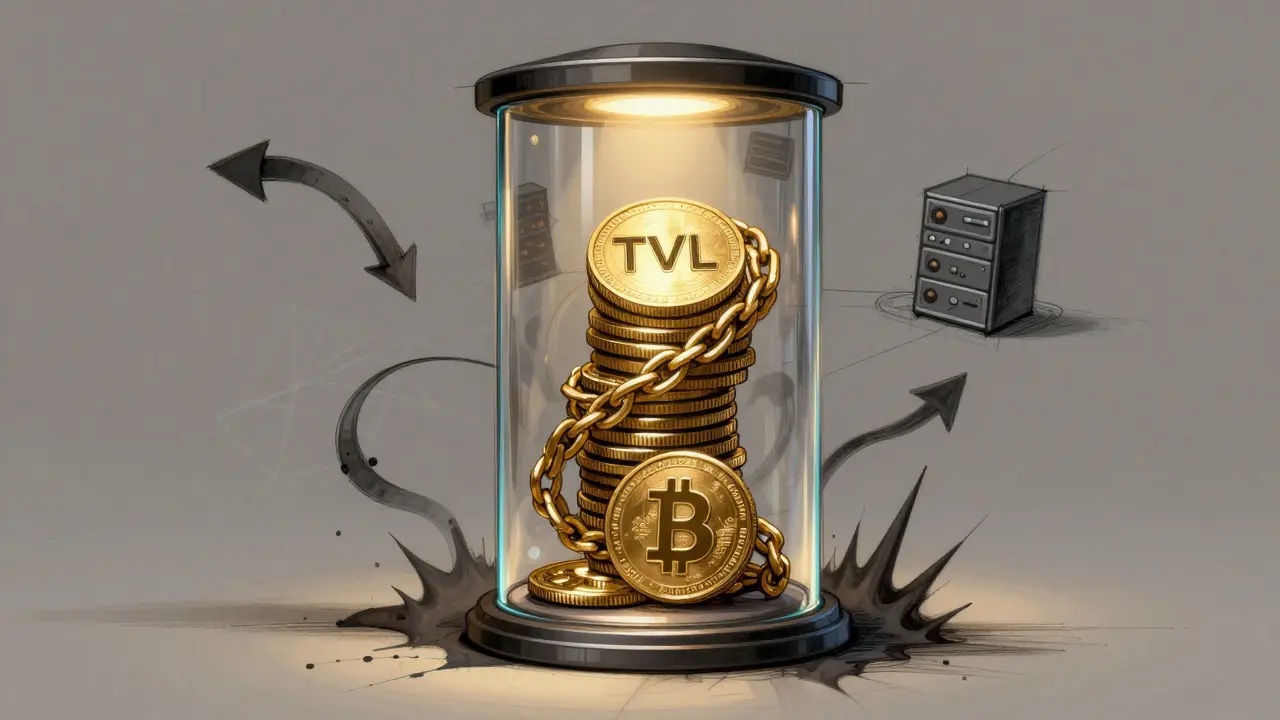
What High TVL Doesn’t Tell You
High TVL doesn’t mean:
- The protocol is safe
- The team is trustworthy
- The tokenomics are sustainable
- The code has been audited
- Users are actually using it daily
There are DeFi projects with $1 billion in TVL that got hacked six months later. Others have massive TVL but only 200 active users. TVL alone won’t tell you if a protocol is going to survive the next bear market. You need more data.
How Smart Investors Use TVL
Experienced investors don’t look at TVL in isolation. They use it as a filter - not a final answer.
Here’s how they do it:
- Set a minimum threshold: Most institutional investors won’t even look at a protocol unless it has at least $50 million in TVL. Below that, the risk of exit scams or illiquidity is too high.
- Track the trend: Is TVL growing steadily over weeks? Or did it spike overnight because of a token airdrop? Steady growth suggests real adoption. Sudden spikes often mean temporary hype.
- Compare within categories: Don’t compare a lending protocol’s TVL to a DEX’s. Look at TVL among similar protocols. If Aave has $8 billion and Compound has $3 billion, that tells you something about market preference - not just size.
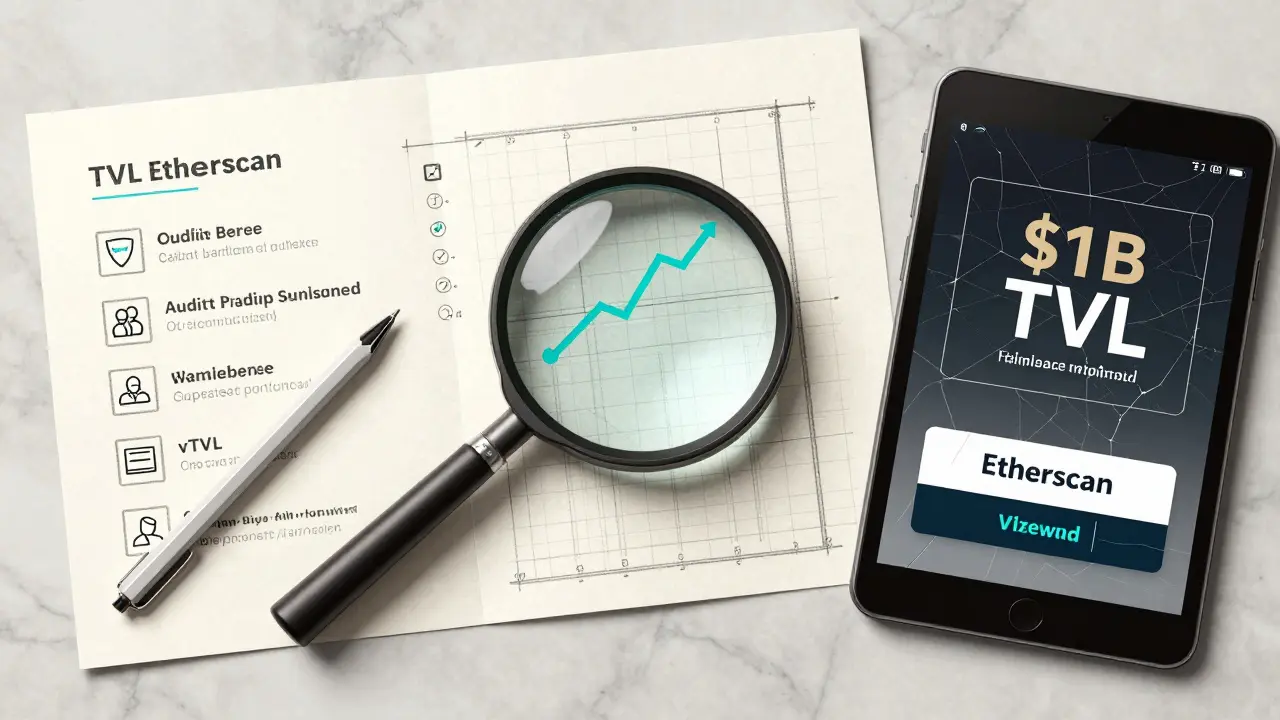
- Check the source: Use DeFiLlama as your primary source. It’s the most transparent, with clear methodology and chain-by-chain breakdowns. CoinGecko is good for beginners. L2BEAT is best if you’re focused on Ethereum Layer 2s like Arbitrum or Optimism.
- Verify independently: Use Etherscan or Dune Analytics to check the actual balances in the smart contract. If the protocol claims $150 million in TVL but the contract shows $90 million, something’s off.
TVL Trends in 2025
Ethereum still holds the largest share of DeFi TVL - about 55% - even with high gas fees. But the shift is real. Solana, Polygon, and Base are gaining ground fast. Binance Smart Chain still holds strong in Asia, while newer chains like Sei and Blast are trying to break in with high-yield incentives.
Institutional money is starting to flow in. BlackRock and Fidelity aren’t buying tokens - they’re locking stablecoins into regulated DeFi lending pools. That’s not speculation. That’s capital allocation. And it’s pushing TVL higher in a more sustainable way.
Regulation is also shaping TVL. Protocols based in Switzerland and Singapore - where rules are clear - are seeing faster growth than those in gray areas. Investors want certainty. TVL grows fastest where the rules are known.
The Future of TVL: Can It Get Better?
Right now, TVL is like a blurry photo. It shows you something’s there, but you can’t see the details. The industry is working on fixes.
One promising idea is verifiable TVL (vTVL). Instead of relying on third-party dashboards, vTVL pulls data directly from on-chain balance queries using standardized methods. The BIS study showed that when protocols used vTVL, their reported numbers matched reality 46.5% of the time - still low, but better than before.
By 2026, we’ll likely see more protocols adopt vTVL standards. Tools will emerge to auto-flag suspicious TVL spikes. Investors will stop trusting raw numbers and start trusting verified data.
But here’s the truth: TVL will never be a perfect metric. It’s a snapshot. And DeFi moves fast. The best investors know this. They use TVL to spot opportunities - then dig deeper.
What to Do Next
If you’re new to DeFi, start here:
- Go to DeFiLlama.com and sort protocols by TVL.
- Pick one with over $100 million TVL and check its “Tokenomics” and “Audit” tabs.
- Look at its TVL chart over the last 30 days. Is it steady? Rising? Or flashing red?
- Search for its name + “hack” or “rug pull” on Reddit or Twitter. If people are warning others, walk away.
TVL is a starting point - not the finish line. It tells you where the money is. But only you can decide if it’s worth your own.
Is TVL the same as market cap?
No. Market cap is token price multiplied by total supply - it’s about speculation. TVL is the real dollar value of assets locked in a protocol’s smart contracts - it’s about actual usage. A project can have a huge market cap but tiny TVL, meaning no one is really using it.
Can TVL be manipulated?
Yes. Common tricks include looping (depositing borrowed tokens back into the same protocol), using inflated token prices, or relying on off-chain data that’s not verified. Some protocols artificially boost TVL to attract more users. Always check the trend over time and verify with on-chain tools like Etherscan.
What’s a good TVL for a DeFi project to be considered safe?
Most serious investors look for at least $50 million in TVL before considering a project. Institutional players often require $100 million or more. Below that, the risk of exit scams or liquidity issues increases significantly. But even $500 million doesn’t guarantee safety - always combine TVL with audits, team history, and user activity.
Why does TVL change even when no one deposits or withdraws?
Because TVL is calculated in USD, and the value of the locked assets changes with their market price. If ETH drops 15%, your TVL drops too - even if you didn’t touch your deposit. That’s why TVL reflects both user activity and crypto volatility.
Which platform is the most reliable for checking TVL?
DeFiLlama is the most trusted because it uses transparent, on-chain data and clearly shows its methodology. CoinGecko is user-friendly but less detailed. L2BEAT is best for Ethereum Layer 2 protocols. Never rely on just one source - cross-check with Etherscan or Dune Analytics for verification.
Should I invest based only on high TVL?
Absolutely not. High TVL can attract attention, but it doesn’t mean a project is good or safe. Look at tokenomics, audits, team background, trading volume, and community sentiment. TVL is a filter - not a decision-maker. Many high-TVl projects have failed because their underlying model was flawed.

Sean Kerr
December 17, 2025 AT 13:22TVL is just the appetizer, not the main course 😅. I saw a project with $2B TVL last year and it rug-pulled a week later-lol. Always check the audit, the team, and if the devs actually have GitHub commits that aren’t just ‘updated readme.md’ 🤷♂️.
Heather Turnbow
December 17, 2025 AT 14:44Thank you for this thoughtful breakdown. Too often, metrics like TVL are treated as gospel rather than one piece of a much larger puzzle. The distinction between commitment and success is crucial, and your analogy of concert tickets versus attendance is both accurate and elegant.
Patricia Amarante
December 19, 2025 AT 09:12Yup. TVL’s just a starting point. I always check the liquidity depth and if the tokens are actually being used or just sitting there like decorations.
Donna Goines
December 19, 2025 AT 17:26Did you know most TVL numbers are cooked by centralized exchanges that front-run deposits? The whole system is rigged. The BIS study? That’s just the tip. The real data is buried in private nodes owned by hedge funds that pump and dump before anyone sees it. You think you’re investing? You’re just feeding the machine.
Greg Knapp
December 20, 2025 AT 10:35TVL is just a number like followers on Instagram. People chase it because they think it means something. It doesn't. If you're not checking the code yourself you're just gambling with your life savings
Shruti Sinha
December 22, 2025 AT 08:17Well articulated. The double-counting issue is particularly under-discussed. USDC in Aave, then LP token staked in Yearn - same capital, counted twice. It’s misleading for retail investors who don’t dig deeper.
Cheyenne Cotter
December 22, 2025 AT 19:55Okay but let’s be real - TVL is the only metric most people even look at. The fact that you have to explain this at all shows how broken the DeFi education system is. I’ve seen people invest in projects with $500M TVL and zero code audits because the Discord had 50k members. And then they blame the ‘market’ when they lose everything. It’s not the market. It’s laziness. And now we’re all stuck cleaning up the mess while the whales move on to the next shiny thing.
Jesse Messiah
December 23, 2025 AT 23:03Great post! I always tell newbies: TVL is like the weight on the scale - it tells you something’s there, but not if it’s muscle or fat. Always pair it with active users, fee revenue, and audit reports. And never trust a protocol that doesn’t link to its contract addresses. If they’re hiding it, they’ve got something to hide.
Samantha West
December 25, 2025 AT 02:51TVL is a construct of capitalist illusion - a modern-day idol. We worship it because we fear the void of uncertainty. But in truth, it measures nothing but the collective delusion that value can be quantified in USD terms when the underlying asset is a decentralized, trustless, volatile network. The real question isn’t ‘what is TVL?’ - it’s ‘why do we still believe in it?’
Craig Nikonov
December 25, 2025 AT 22:58TVL is the crypto version of a guy showing off his Rolex at a gas station. Looks impressive till you realize he borrowed it from his cousin who works at a pawn shop. And yeah, the BIS study? That’s just the tip of the iceberg. Most ‘verified’ TVL is just someone’s Excel sheet with a blockchain logo slapped on it.
Rebecca Kotnik
December 26, 2025 AT 03:26This is one of the clearest, most balanced analyses of TVL I’ve encountered in years. The emphasis on trend analysis over absolute values is especially vital. Institutional adoption via stablecoin locking is indeed a positive signal - it reflects capital allocation based on risk-adjusted returns, not speculative FOMO. That said, the fragmentation across chains makes cross-protocol comparisons increasingly difficult. Standardized reporting frameworks are urgently needed, and I hope regulators begin pushing for mandatory on-chain data transparency as a condition for listing on centralized exchanges.
Terrance Alan
December 27, 2025 AT 02:20Everyone’s so obsessed with TVL they forget half these protocols are just glorified Ponzi schemes with fancy UIs. The fact that people still think $1B TVL means safety is why I lost my life savings last cycle. No audits? No team? No history? Doesn’t matter. TVL’s high so it’s safe. Yeah right. I’m done.
Sally Valdez
December 27, 2025 AT 22:56TVL is a tool of the globalist elite to control your money. Why do you think they push it so hard? Because they know you’ll follow the numbers instead of asking who owns the servers behind DeFiLlama. The real value is in the blockchain - not some third-party dashboard that’s probably run by a hedge fund in the Caymans. Wake up.
Sammy Tam
December 29, 2025 AT 02:48Love this. TVL’s like the size of a campfire - looks warm and inviting, but if you don’t check what’s burning under it, you’ll get burned. I always look at the token distribution too. If 20% of the supply is in one wallet and TVL’s high? Red flag. Also, check if the liquidity is locked. If not, bye-bye.
Jonny Cena
December 30, 2025 AT 11:21You nailed it. TVL is a filter, not a finish line. I always say: if you wouldn’t trust the team with your dog, don’t trust them with your ETH. And always, always check the contract yourself on Etherscan. It takes 5 minutes. Could save you six figures.
George Cheetham
December 30, 2025 AT 12:33TVL is a mirror. It reflects the collective attention of the market - not its wisdom. The real insight lies in what happens after the TVL peaks. Does it stabilize? Does usage grow? Are fees rising? That’s where the story begins. Too many treat TVL as a destination. It’s merely the first step on a long, winding road.
Sue Bumgarner
December 31, 2025 AT 20:23Why are we even talking about this? America’s DeFi projects are the only ones that matter. The rest are just copycats with bad UX. TVL on Ethereum? Fine. TVL on Solana? Meh. TVL on some chain no one’s heard of? That’s just crypto socialism. Stick to the real economy - the US chain.
Kayla Murphy
January 1, 2026 AT 22:45Thank you for writing this. It’s so easy to get swept up in the hype, but you reminded me to slow down and look at the real numbers. I’m going back to check my portfolio now - and I’m definitely digging into Etherscan tonight. You’ve given me a new perspective.