
Validator Requirements for Different Blockchains: Hardware, Staking, and Costs Explained
Validator Cost Calculator
Select Blockchain
Cost Breakdown
Cost Analysis
Running a validator on a blockchain isn’t like setting up a home server. It’s a high-stakes operation that demands serious hardware, deep pockets, and constant attention. If you think you can just buy a laptop and start earning rewards, you’re in for a surprise. Different blockchains have wildly different rules - and the gap between what’s possible and what’s profitable can be massive.
Hardware Isn’t Just a Suggestion - It’s a Mandate
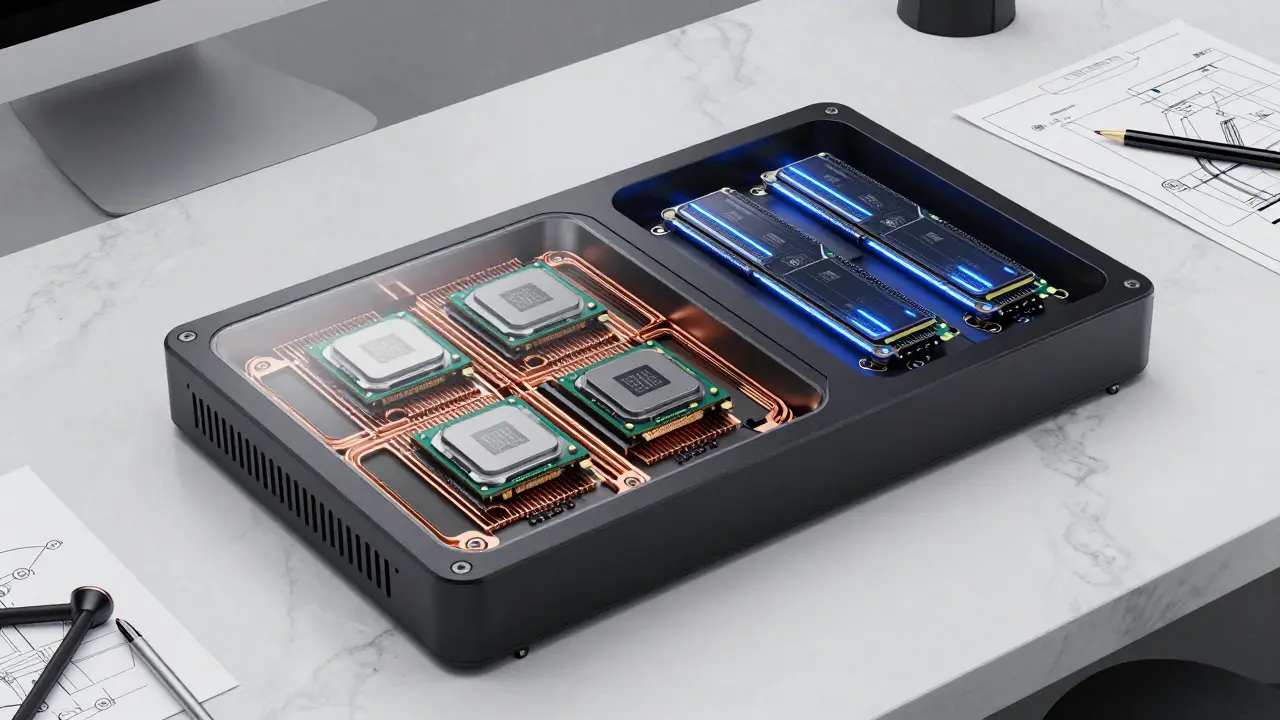
Every blockchain has its own appetite for computing power. Ethereum’s validator nodes don’t need much more than a decent desktop: a quad-core CPU, 32GB of RAM, and a 4TB NVMe SSD. But that’s the exception. Most modern chains demand far more.
Solana is where things get intense. To keep up with its 400+ TPS speed, validators need 12-core CPUs with AVX2 support, 256GB of ECC RAM, and dedicated NVMe drives split across ledger, snapshot, and account storage - totaling 2.25TB. A physical setup? Expect to spend $2,600 to $5,000. Use the cloud? You’re looking at $4,500 a year - and that’s before electricity.
Tron’s requirements have exploded by 2025. Regular validators now need 16-core CPUs at 3.0GHz+, 64GB RAM, and 2.5TB SSD. But if you want to be a Super Representative - the only ones who actually produce blocks - you need 32-core AMD EPYC processors, 128GB+ RAM, and at least 3TB of storage. These aren’t upgrades. They’re survival tools.
The Real Barrier: Staking Capital
Hardware is expensive. But the real wall is staking. You don’t just run a node - you lock up real money to back it. And the amounts are staggering.
Ethereum requires exactly 32 ETH to activate a validator. At $2,625 per ETH (as of December 2025), that’s $84,000 upfront. No exceptions. No workarounds. You either have it or you don’t.
Solana says you can stake as little as 1 SOL. But here’s the catch: to actually make money, you need around 5,700 SOL - roughly $934,000. Why? Because rewards are distributed based on total stake in the network. Small stakes get drowned out. Most solo operators on Solana are either whales or they’re running validator-as-a-service for others.
Then there’s Sui. To become a validator, you need 30 million SUI tokens. That’s not a typo. Even at low prices, that’s millions in USD. Cosmos is different - it’s a race. Only the top 180 validators by stake get to participate. Right now, you need about 33,052 ATOM to even be in the running. That’s not a requirement - it’s a competitive threshold.
Tron and Binance Smart Chain don’t even let you run a validator unless you’re elected. Tron has 27 Super Representatives. You need community votes, not just coins. Binance Smart Chain has 41 validators - all handpicked from 63 applicants. It’s not decentralized. It’s curated.

Operational Costs: The Hidden Tax
Just because you’ve bought the hardware and staked the tokens doesn’t mean you’re done. Every day, you pay to play.
Solana validators must submit a vote transaction for every slot they confirm. That’s every 400 milliseconds. Over 24 hours, that adds up to 1.1 SOL - about $185 - in fees. That’s not a bonus. That’s a mandatory daily tax. If you miss a vote? You lose rewards. If you vote wrong? You get slashed.
Binance Smart Chain’s validators earn from transaction fees - 90% of them. In February 2024, that meant $14.59 million distributed among 41 validators. But that’s only if you’re one of the 41. If you’re outside the top tier? You get nothing.
On Ethereum, your reward depends on how accurately you attest to blocks and how often you propose them. Miss one? Your reward drops. Miss too many? You get slashed - meaning you lose a portion of your staked ETH. It’s not a penalty. It’s a system designed to force perfection.
Consensus Mechanisms: Why One Size Doesn’t Fit All
Not all validators are created equal. The type of consensus a blockchain uses changes everything.
Proof of Stake (PoS) - used by Ethereum, Cardano, Polkadot - selects validators based on how much they stake. More stake = higher chance to be chosen. Simple, but capital-heavy.
Delegated Proof of Stake (DPoS) - used by Tron, EOS, and Binance Smart Chain - lets token holders vote for representatives. You don’t need to run the node yourself. You vote. The top 27 (Tron) or 41 (BSC) get to validate. This is faster, but more centralized. Your influence is only as strong as your voting power.
Solana uses a hybrid called Proof of History (PoH). It’s not just about staking - it’s about timing. Every transaction is timestamped using a cryptographic clock. That requires specialized hardware that can handle constant, ultra-fast hashing. That’s why Solana validators need AVX2 and SHA instruction support. General-purpose servers won’t cut it.
Byzantine Fault Tolerance (BFT) - used by Hyperledger and Ripple - doesn’t rely on stake at all. Instead, nodes reach consensus through voting rounds. It’s fast and efficient, but only works in permissioned networks. You can’t just join. You have to be invited.

Who’s Really Running These Validators?
Forget the myth of the solo hobbyist. The reality is brutal.
On Ethereum, most validators are run by institutions, staking pools, or professional operators. The 32 ETH barrier is too high for individuals unless they pool with others. Liquid staking tokens like stETH let you stake smaller amounts, but you’re still relying on someone else’s infrastructure.
Solana’s ecosystem is dominated by validator-as-a-service providers. Companies like Figment, Bison Trails, and Stakehound offer to run your stake for you. You give them your SOL. They handle the hardware, the voting, the uptime. You get 80-95% of the rewards. It’s easier - but you’re giving up control.
Tron’s Super Representatives are often crypto exchanges, mining farms, or well-funded teams with marketing budgets. Winning a vote isn’t about tech - it’s about community trust, social media presence, and public relations. You need to be a brand, not just a node.
The trend? Centralization. The more capital and complexity required, the fewer players can compete. Ethereum has thousands of validators. Solana has nearly 2,000. Tron has 27. BSC has 41. That’s not decentralization. That’s oligarchy.
What’s Next? The Future of Validation
Hardware demands will keep rising. Blockchains are getting bigger. State sizes grow. Transaction volumes climb. Tron’s 2025 specs are already 3x what they were in 2023. By 2027, we’ll likely see validators needing 512GB RAM and 5TB SSDs just to keep up.
Staking derivatives and liquid staking are lowering the barrier - but they’re also shifting power to centralized providers. If you stake through Lido or Rocket Pool, you’re trusting them to run the validator. You’re not a validator. You’re a customer.
Regulation is coming. In the EU, staking rewards are already treated as taxable income. In the U.S., the IRS is watching. If you’re running a validator at scale, you may need to register as a financial service provider. That’s not just a cost - it’s a legal hurdle.
For most people, the smart move isn’t to run a validator. It’s to delegate. Pick a reputable validator with high uptime, low commission, and transparent reporting. Let them handle the hardware. Let them deal with the slashing risks. You just earn.
But if you’re serious about running your own? Know the numbers. Know the risks. And know that you’re not just running a node - you’re betting your capital, your time, and your reputation on a system that doesn’t forgive mistakes.
What’s the cheapest blockchain to validate on?
There’s no truly cheap option. Ethereum requires $84,000 in ETH. Solana needs $934,000 to be profitable. Cosmos needs over $1 million in ATOM to be competitive. The only way to reduce cost is delegation - using a validator service to stake smaller amounts. But even then, you’re paying fees and trusting someone else.
Can I run a validator on my home PC?
Only on Ethereum - and even then, it’s risky. A home PC lacks the uptime, bandwidth, and redundancy needed. Most home connections have data caps, slow upload speeds, and no UPS. If your validator goes offline, you get slashed. Professional setups use cloud hosting or dedicated servers with 99.9%+ uptime guarantees.
Why do some blockchains require so much more hardware than others?
It’s about speed and throughput. Solana and Tron are designed to process thousands of transactions per second. That requires high CPU power, fast storage, and massive RAM to handle the state data. Ethereum, by contrast, prioritizes security and decentralization over speed, so it can afford slower, cheaper hardware. Higher performance always demands higher resources.
Do validator rewards cover the costs?
It depends. On Ethereum, rewards barely cover electricity and hardware depreciation. On Solana, you’re paying $185 a day in fees - so you need high staking volume to break even. On Binance Smart Chain, validators earn from fees, so profitability depends on network usage. Most solo operators only break even if they’re running multiple nodes or have access to cheap power.
What happens if I miss a vote or go offline?
You get slashed. On Ethereum, you lose a small percentage of your staked ETH. On Solana, you lose rewards for that slot and may be temporarily deprioritized. On Tron, you lose your vote count. On Cosmos, you drop in rank and may fall out of the top 180. Downtime isn’t just inconvenient - it’s expensive.
Are validator requirements the same across all regions?
Yes and no. The technical requirements are global - a 12-core CPU is a 12-core CPU whether you’re in New Zealand or Nigeria. But operational costs vary wildly. Electricity prices in Southeast Asia are 3x lower than in Europe. Internet bandwidth is cheaper in some regions. Regulatory rules, however, differ by country - and that can make running a validator illegal or taxable in ways you didn’t expect.
Is it better to run my own validator or use a service?
For most people, a service is better. Running your own requires constant monitoring, technical skill, and risk tolerance. Validator-as-a-service providers handle everything: hardware, updates, security, uptime. You give up some rewards (they take 5-15% commission), but you gain reliability. If you’re not a sysadmin or blockchain engineer, the risks outweigh the rewards.
How do I choose a validator to delegate to?
Look for three things: uptime history (99%+), commission rate (under 10% is ideal), and transparency. Check their public dashboards. Do they post regular updates? Do they have a public GitHub or forum? Avoid validators with no track record or those who don’t disclose their infrastructure. Reputation matters - and so does consistency.
Shane Budge
December 4, 2025 AT 15:06Hardware costs are insane, but the real killer is the daily vote fees on Solana. $185 a day just to stay in the game.
Lore Vanvliet
December 5, 2025 AT 06:45Oh please, you think $84k is high? Try living in the US and paying taxes on staking rewards while your neighbor in India runs 10 nodes on a Raspberry Pi. This isn't decentralization, it's American capitalism with blockchain glitter.
sonia sifflet
December 6, 2025 AT 12:18Stop romanticizing solo validators. The only people running their own nodes are either crypto bros with more money than sense or institutional bots with automated failovers. Everyone else is just renting their stake through Lido or Coinbase. The dream is dead.
Scott Sơn
December 7, 2025 AT 10:35Let me get this straight - you’re telling me I need a $5k rig just to earn back my coffee money? And if I sneeze during a vote, I get slashed? This isn’t finance, it’s a high-stakes game of Russian roulette with a GPU. I’m out.
Frank Cronin
December 8, 2025 AT 10:40You call this ‘decentralization’? 27 Super Reps on Tron? 41 on BSC? That’s not a blockchain - it’s a country club. If you’re not rich, well-connected, or politically savvy, you’re just a spectator with a wallet. Welcome to Web3, where the elite built the gate and sold the keys.
Stanley Wong
December 9, 2025 AT 02:16I get that the numbers look scary but honestly if you look at the bigger picture most people who are actually into this stuff aren't running nodes because they want to make money they're running them because they believe in the tech and the vision and sure the costs are high but the alternative is handing over your power to some corporate staking service and pretending you're still part of the movement
miriam gionfriddo
December 9, 2025 AT 10:10Wait so solana validators pay $185 a day in fees??? And you’re telling me this is sustainable??? I’m not even mad I’m just confused how this isn’t a pyramid scheme with extra steps. Also typo in your SSD size lol
Nicole Parker
December 9, 2025 AT 21:59It’s sad how much of this feels like a race to the top where only the richest survive. I get the technical reasons - speed, throughput, security - but it’s hard not to feel like we’ve traded the original promise of crypto for something that just mirrors Wall Street with more buzzwords. Maybe the real innovation isn’t in the tech, it’s in realizing we need to build systems that don’t require millions to join.
Kenneth Ljungström
December 11, 2025 AT 00:42Love this breakdown. If you’re thinking about running a node, just start by reading the docs, then check the uptime stats of the top validators. If you’re not a sysadmin, delegate. No shame in it. The blockchain doesn’t care who runs the node - it just cares that it stays up.
Brooke Schmalbach
December 11, 2025 AT 18:30Let’s be real - the only reason Ethereum’s hardware requirements are ‘low’ is because it’s the last standing relic of the early days. By 2027, even that’ll be a joke. The future belongs to the chains that can scale without needing a data center in your basement. And that’s not Ethereum.
Cristal Consulting
December 12, 2025 AT 00:50Delegate. Seriously. Your time is worth more than your ETH. Find a validator with 99.9% uptime and under 8% fees. Set it and forget it. You’ll sleep better and earn more.
Tom Van bergen
December 13, 2025 AT 06:51Who decided that running a node should cost more than a Tesla? Maybe the problem isn’t the hardware it’s the idea that anyone should have to stake a million to participate in a decentralized network
Sandra Lee Beagan
December 15, 2025 AT 05:39From Vancouver, I’ve watched this shift from grassroots to gated. The jargon around ‘decentralized’ is now just PR for oligarchic control. We need open-source validator tools, subsidized bandwidth in developing regions, and non-custodial delegation protocols - not more hardware demands.
Ben VanDyk
December 16, 2025 AT 19:34Everything here is technically accurate. But you didn’t mention that most validators are hosted in data centers in Iceland or Sweden because of cheap power. So the ‘global’ requirement is a lie - it’s just centralized in colder countries with better electricity.
michael cuevas
December 17, 2025 AT 18:53Yeah sure the fees are high but you’re acting like this is new. Ever heard of Wall Street? The rich get richer. The only difference is now you can see the math behind it. Stop pretending blockchain is for the people. It’s for the people who already have the money to play.
Nina Meretoile
December 18, 2025 AT 20:32It’s okay to feel overwhelmed. The system is designed to make you feel like you’re not good enough. But you don’t need to run a node to be part of this. You just need to understand it. That’s power too.
Barb Pooley
December 20, 2025 AT 03:02What if all this is just a trap? What if the real goal is to get people to lock up their crypto so the big players can manipulate the market? I’ve seen the charts - when staking rewards drop, the price always follows. Coincidence? I don’t think so.
Martin Hansen
December 21, 2025 AT 17:23Anyone who thinks they can run a validator on a home PC is delusional. You think your 8GB RAM laptop is a node? You’re a liability. You’re the reason nodes get slashed. Stay out of the way and delegate like a responsible adult.
Chris Mitchell
December 22, 2025 AT 22:41The real question isn’t who can run a validator - it’s who should. If your node’s uptime is below 99%, you’re not helping the network. You’re dragging it down. That’s not decentralization - that’s noise.
rita linda
December 24, 2025 AT 20:26Tron’s 27 Super Reps? BSC’s 41? That’s not blockchain - that’s a corporate board meeting with blockchain logos on the slides. America’s tech elite just rebranded feudalism.
Mariam Almatrook
December 25, 2025 AT 13:53It is deeply concerning that the industry continues to market this as ‘decentralized finance’ while the entry barrier approaches that of private equity funds. The linguistic dissonance is not accidental - it is a deliberate obfuscation of power consolidation.
Regina Jestrow
December 27, 2025 AT 09:32I’m just curious - if you had $84k to stake, would you run your own node or delegate? And why? No judgment - just genuinely want to know.