
What is ALIAS (ALIAS) crypto coin? Privacy claims vs real-world reality
The ALIAS cryptocurrency was built to be one of the most private digital currencies ever created. It promises ring signatures, Tor network integration, and something called "Stealth Staking" - all designed to hide who you are, what you’re buying, and how much you own. Sounds powerful, right? But here’s the truth: ALIAS is a ghost in the crypto world. It exists on paper, but almost nowhere else.
What ALIAS claims to do
ALIAS says it’s not just another altcoin. It’s a privacy-first blockchain. Unlike Bitcoin, where every transaction is public, ALIAS uses ring signatures to mix your transaction with others, making it nearly impossible to trace where the money came from or where it went. It also hides your IP address by routing all traffic through Tor and OBFS4 - tools normally used by journalists and activists in repressive regimes. Then there’s "Proof-of-Anonymous-Stake" (PoAS), or "Stealth Staking," which lets you earn rewards just by holding coins - without ever revealing your balance or identity to the network.
The idea was solid. When ALIAS launched, privacy coins like Monero and Zcash were gaining attention. ALIAS tried to outdo them by stacking multiple privacy layers into one system. It even built an Android wallet that lets you stake directly from your phone, something few other privacy coins offered at the time. The whitepaper from 2020 laid out a clear roadmap: faster blocks, better anonymity, mobile accessibility.
The numbers don’t lie
But none of that matters if no one uses it.
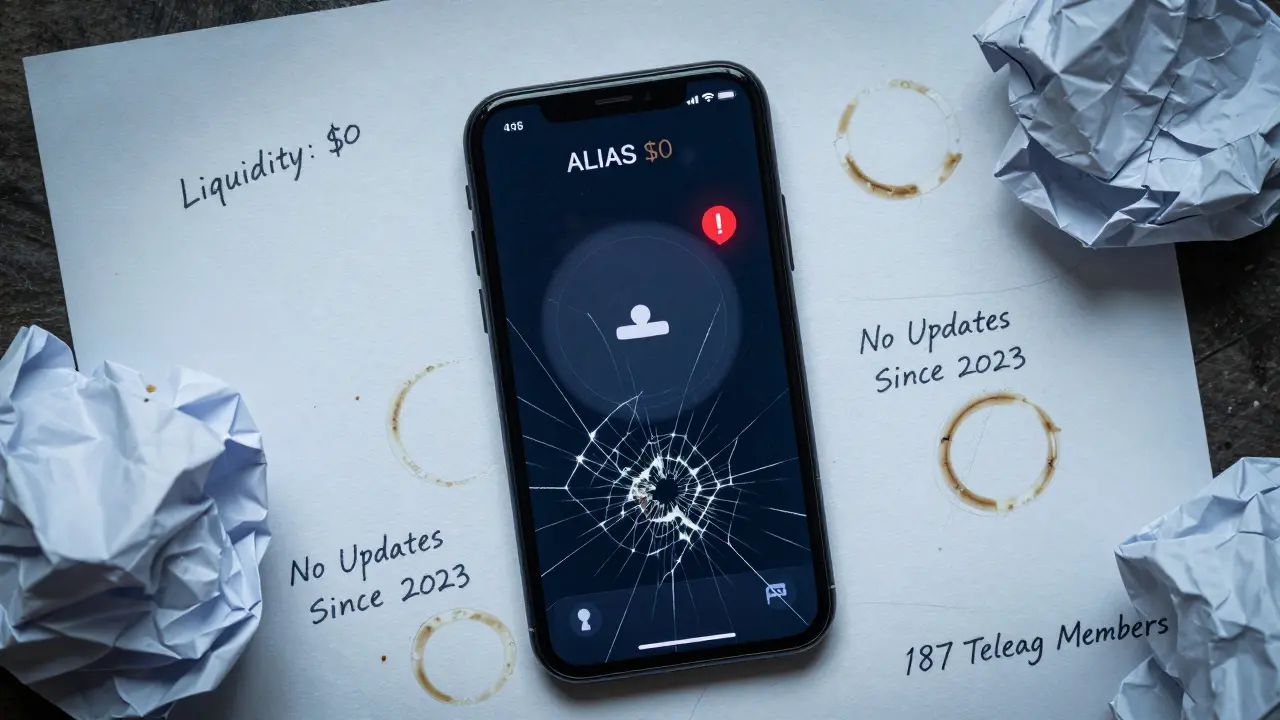
As of November 2025, ALIAS has a market cap of just $2.41 million. That’s less than 0.001% of Bitcoin’s value. For comparison, Monero - a single competitor - is worth over $2.8 billion. ALIAS trades on only six exchanges. On Coinbase, its 24-hour volume is $388.88. On Binance, it’s $1,035. On Liquidity Finder, it’s $289. That’s not trading. That’s a few people buying a few coins. One user on Bitget wrote: "I tried to buy $50 worth. Slippage was 15%. I gave up."
Price data is all over the place. CoinMarketCap says $0.058. Binance says $0.067. Coinbase says $0.075. Liquidity Finder says $0.083. Why? Because there’s no real market. Each price reflects a single trade, not supply and demand. When liquidity is this thin, a single person can move the price 20% with one click.
The total supply is around 31 million coins. But here’s the weird part: some sites say 30.7 million are circulating. Others say 31 million are in circulation - but zero are actually being traded. That’s not a typo. That’s data chaos. It means no one knows how many coins are out there - or who owns them.
Who’s using ALIAS?
No one.
There are no major merchants accepting ALIAS. No payment processors list it. No DeFi protocols support it. No wallets beyond the official Android app even bother to integrate it. The official website, alias.cash, offers a wallet download - but no tutorials, no FAQs, no troubleshooting guides. If your wallet freezes? Good luck.
The community? Nonexistent. The Telegram group has 187 members. The Twitter account has 2,147 followers and gets 2 likes on posts. The GitHub repo hasn’t had a meaningful update since March 2023. Three commits in the last year. That’s not development. That’s maintenance. The last major upgrade? May 2019 - over five years ago.
Reddit has no threads about ALIAS. Trustpilot has no reviews. CoinMarketCap gives it a 2.8 out of 5 - below average. Bitget admits: "The value of ALIAS is not widely recognized by the market."
Why does ALIAS still exist?
It’s still running. The blockchain hasn’t crashed. The wallet still syncs - sometimes. You can still stake coins. But it’s a zombie coin. A digital ghost.
Most coins die because they’re scams. ALIAS isn’t a scam. It was built with real tech. But it failed because no one cared. No developers. No users. No liquidity. No exchange support. No media attention. No roadmap updates. No community growth.
It’s like building a luxury sports car… and parking it in a garage with no keys. The engine works. The lights turn on. But no one can drive it.
What happens if you try to use it?
If you’re thinking of buying ALIAS, here’s what you’ll face:
- You’ll have to go to obscure decentralized exchanges (DEXs) with high fees.
- Your transaction might take hours to confirm - or fail entirely.
- The Android wallet drains your battery and freezes randomly.
- You won’t find help. No forums. No Reddit. No Discord.
- Even if you buy it, you won’t be able to sell it without losing 10-20% in slippage.
And here’s the kicker: the coin’s all-time high was $6.74 in January 2018. Today? Around $0.06. That’s a 98.85% drop. Not a correction. Not a market dip. A total collapse.

Is ALIAS worth anything?
Technically? Maybe. The code works. The privacy features are real. But value isn’t about technology. It’s about adoption. And ALIAS has none.
Compare it to Monero. Both use ring signatures. Both hide IPs. But Monero has:
- A $2.8 billion market cap
- 120+ exchange listings
- Active developers, forums, and research teams
- Real-world use cases - from privacy advocates to underground markets
ALIAS has none of that.
There’s no future here. No growth. No momentum. No reason to believe this will change. Even if you bought ALIAS at its lowest point - $0.00067 in February 2024 - you’re still holding a coin with no buyers, no sellers, and no future.
The bottom line
ALIAS is a privacy coin that was built with ambition but abandoned by reality. It has the tech. It lacks the people.
If you’re looking for a private cryptocurrency to use - or invest in - ALIAS is not it. It’s a relic. A footnote. A cautionary tale.
There are better privacy coins out there. Monero. Zcash. Dash. Even newer ones like Pirate Chain. They have volume. They have users. They have teams that show up.
ALIAS? It’s still running. But no one’s home.
Is ALIAS a scam?
No, ALIAS is not a scam in the traditional sense. It was launched with real code, a whitepaper, and working privacy features. There’s no evidence the team stole funds or lied about the tech. But it’s a failed project. It has no users, no development, and no liquidity. That doesn’t make it fraudulent - it makes it irrelevant.
Can I stake ALIAS coins safely?
Technically, yes - the Android wallet allows stealth staking without revealing your balance. But the wallet is buggy. Many users report crashes, sync failures, and excessive battery drain. Even if staking works, there’s no guarantee you’ll ever be able to withdraw your coins later due to lack of liquidity. Staking ALIAS is like earning interest in a bank that might shut down tomorrow.
Where can I buy ALIAS?
ALIAS is listed on only six exchanges as of late 2025, including Binance, Coinbase, and a few obscure DEXs. You won’t find it on major platforms like Kraken or KuCoin. Buying it requires navigating low-liquidity markets, where even small trades can cause 10-20% price swings. It’s not practical for anyone except speculators willing to risk total loss.
Why did ALIAS crash so hard?
ALIAS peaked at $6.74 in January 2018, then lost 98.85% of its value. The crash happened because the team stopped developing. No updates. No marketing. No partnerships. No community building. While competitors like Monero grew, ALIAS sat still. When crypto markets shifted toward real utility, ALIAS had none. It became a speculative bubble that popped - and never recovered.
Is ALIAS better than Monero?
No. Monero has stronger privacy tools, a larger community, active development, and real trading volume. ALIAS added Tor and OBFS4 to its stack - but Monero has proven itself over 10+ years. ALIAS’s features are theoretical. Monero’s are battle-tested. If privacy is your goal, Monero is the only real choice.
orville matibag
February 4, 2026 AT 00:26Been watching ALIAS for years. It's like that one friend who used to be cool but now just sits in the corner staring at their phone. The tech is legit, but nobody shows up. I mean, I respect the effort, but crypto isn't a garage project - it needs bodies. And traffic. And memes.
Josh Flohre
February 4, 2026 AT 04:28This is why amateur devs shouldn’t touch blockchain. You don’t just ‘build privacy’ and call it a day. You need liquidity, community, marketing, and constant iteration. ALIAS had all the ingredients but forgot to cook. It’s not a ghost - it’s a corpse with a wallet.
Jesse Pasichnyk
February 5, 2026 AT 07:19ALIAS is proof that Americans can’t build anything anymore. In my day, if you had a good idea, you hustled. Now? You write a whitepaper, slap on Tor, and wait for the magic. Newsflash: magic doesn’t exist. We need grit, not cryptography.
Jordan Axtell
February 6, 2026 AT 01:32It’s not about the tech. It’s about the soul. ALIAS had soul. It believed in anonymity as a human right. But the world? It wants to be watched. It wants to be tracked. It wants to be monetized. So ALIAS died not because it failed - but because humanity chose surveillance over privacy. And that’s the real tragedy.
Also, the wallet crashes. I’ve lost 3 staking rewards to it. Still wouldn’t sell. It’s symbolic.
James Harris
February 6, 2026 AT 11:46Hey, don’t give up on ALIAS just yet! I know it’s quiet, but sometimes the best things start small. I bought $20 worth last month. It’s not going anywhere, sure - but I’m holding it like a seed. Maybe one day someone will wake up and say, ‘Hey, privacy matters.’ And when they do, ALIAS will be ready.
aryan danial
February 8, 2026 AT 08:00One must question the ontological foundations of ALIAS’s existence: if a blockchain operates in a vacuum with no participants, does it truly possess value, or is it merely a metaphysical construct, a Platonic ideal of privacy rendered inert by the materialist hegemony of centralized exchanges? The absence of liquidity is not merely economic - it is epistemological. The coin is not dead; it is unperceived.
Matthew Ryan
February 10, 2026 AT 07:46Interesting breakdown. I’ve got a few ALIAS coins from 2021. Never sold. Never staked. Just… there. Kinda like a fossil. I like that it’s still running. Feels like a quiet rebellion.
Molly Andrejko
February 11, 2026 AT 20:45Thank you for writing this. It’s so easy to just write off projects like this as ‘dead.’ But I think we owe it to the builders to acknowledge what they tried. Even if it didn’t work - the attempt mattered. And maybe one day, someone will pick it up again.
Alisha Arora
February 13, 2026 AT 10:00LOL. This is why I don’t trust crypto anymore. You think you’re buying privacy, but you’re just buying a ghost. And now you’re stuck with a wallet that eats your battery. I bought ALIAS because I thought it was ‘underrated.’ Turns out it’s just underrated because it’s trash.
Michael Sullivan
February 13, 2026 AT 23:12ALIAS = crypto ghost story. 🕯️💸
Staking it is like sending letters to a house with no mailbox. The coin’s still there. But no one’s home. And the power’s off.
Reda Adaou
February 15, 2026 AT 18:28My friend staked ALIAS for 6 months. Got 0.0003 ALIAS in rewards. Then the wallet crashed. He still hasn’t recovered his coins. But he says he believes in the vision. I just believe in liquidity.
Paul Gariepy
February 17, 2026 AT 06:23I’ve been trying to help people use ALIAS for years. The wallet’s buggy, yeah, but the privacy features are real. I made a video guide last year - 120 views. 3 comments. One guy said ‘thanks.’ That’s it. I still believe in this. It’s just… really hard to get people to care.
Sharon Lois
February 18, 2026 AT 10:29ALIAS isn’t dead. It’s being buried by the NSA. You think they want privacy coins to thrive? Nah. They want you buying Bitcoin on Coinbase so they can track your coffee purchases. ALIAS is the real threat. And that’s why it’s dead.
Oliver James Scarth
February 20, 2026 AT 00:47One cannot help but observe that ALIAS represents a fascinating case study in the intersection of cryptographic ambition and sociological neglect. The technical architecture, while not revolutionary, is commendably coherent. The fatal flaw, however, resides not in the protocol - but in the absence of collective will. A blockchain without a community is merely an elegant monument to hubris.
Kieren Hagan
February 21, 2026 AT 08:31While the market data presented is accurate, it is incomplete. ALIAS’s value proposition lies not in trading volume, but in its potential as a decentralized privacy layer. The lack of adoption is a systemic failure of the broader crypto ecosystem - not ALIAS itself. Until regulators stop crushing privacy coins, projects like this will remain marginalized.
sachin bunny
February 21, 2026 AT 18:09ALIAS is the real crypto. Everyone else is fake. The government hates it. The banks hate it. That’s why it’s worth something. I bought 10,000 ALIAS at $0.0001. One day they’ll wake up and realize privacy is the future. Then it’ll be $100. I’m not rich. But I’m patient.
Olivette Petersen
February 22, 2026 AT 17:29It’s sad, but also kind of beautiful. ALIAS is like that indie band no one heard - but the few who did? They still listen. I don’t trade it. I don’t stake it. I just check the block explorer sometimes. It’s still syncing. Still alive. That’s enough.
Michelle Anderson
February 23, 2026 AT 15:21Wow. A coin with 0 liquidity and a 98% drop. Congrats, ALIAS. You’ve achieved peak crypto irony: a privacy coin so obscure, even the scammers ignore it.
Danica Cheney
February 23, 2026 AT 20:30alais? is that the one with the weird wallet? i tried it once. my phone got hot. gave up. lol
Kyle Pearce-O'Brien
February 25, 2026 AT 05:51ALIAS is the last true anarchist project in crypto. While everyone else is chasing DeFi yields and NFTs, ALIAS whispered: ‘What if we just… didn’t?’ It’s not a failure - it’s a philosophy. And philosophies don’t need volume. They need resonance.
Shruti Sharma
February 26, 2026 AT 01:01why do people still talk about this? i bought 5000 alais in 2020. its worth less than my coffee. i just use it to pay my dog walker. he doesnt even know what it is. he just takes the coins. i think he thinks its digital candy.
Robin Ødis
February 26, 2026 AT 23:15Let’s be honest - ALIAS was doomed from day one. You can’t build privacy on a team of three devs who haven’t pushed code in years. You need structure. You need funding. You need a CEO who doesn’t vanish after the ICO. This wasn’t a vision. It was a nap.
Jacque Istok
February 28, 2026 AT 13:27Here’s the thing: Monero works because it’s messy. It’s ugly. It’s loud. ALIAS is quiet. And quiet things get ignored. The real lesson? If you want to be heard - you gotta scream. Even if you’re right.
Mendy H
March 1, 2026 AT 02:50ALIAS: the cryptocurrency equivalent of a handwritten letter in the age of email. Adorable. Nostalgic. Completely impractical.
sabeer ibrahim
March 2, 2026 AT 14:50ALIAS is a trap. I know because I’m from India. We’ve seen this before. Fake privacy. Fake team. Fake roadmap. They take your money, then disappear. This isn’t a ghost - it’s a honeypot.
orville matibag
March 2, 2026 AT 21:15Just checked the ALIAS blockchain. One transaction today. Sent 0.0001 ALIAS from wallet A to wallet B. No one knows why. No one cares. But it happened. I think that’s the most honest thing about this coin.