
What is Bitcat (BTCAT)? A Deep Dive into the Solana Meme Coin
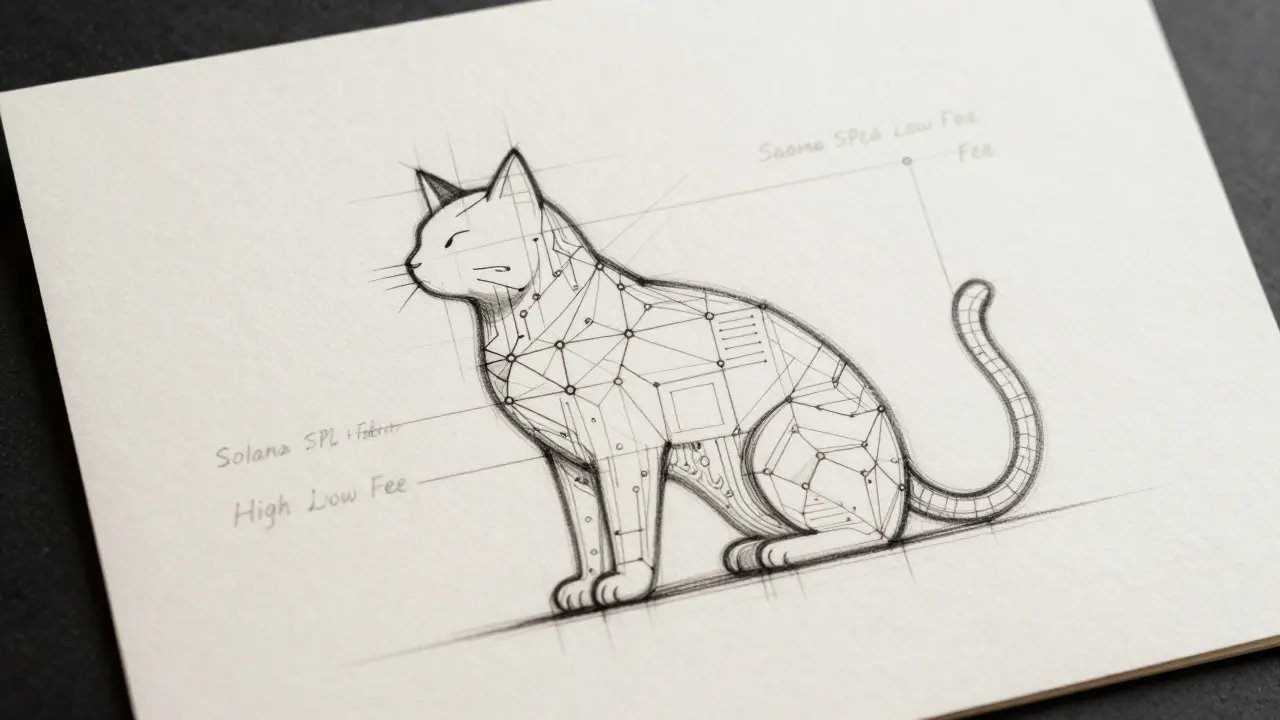
You’ve probably seen it flash across your screen on a decentralized exchange or mentioned in a chaotic Telegram group: Bitcat. It’s one of those tokens that seems to pop up out of nowhere, rides a brief wave of hype, and then settles into the quiet hum of the broader crypto market. But what exactly is Bitcat (BTCAT), and why should you care?
At its core, Bitcat is a speculative meme cryptocurrency built on the Solana blockchain. It doesn’t have a complex utility roadmap, a revolutionary technology stack, or a famous venture capital backing. Instead, it relies on community sentiment, branding, and the sheer volatility inherent to the meme coin sector. If you are looking at BTCAT today, you aren’t investing in a protocol; you are betting on attention.
The Basics: What Drives Bitcat?
To understand Bitcat, you first need to understand where it lives. Unlike Bitcoin or Ethereum, which run their own blockchains, BTCAT exists as a token on top of an existing network. Specifically, it is an SPL token on the Solana blockchain.
This distinction matters for two reasons. First, Solana is known for high speed and low transaction fees. This makes trading small-cap tokens like BTCAT affordable compared to networks with higher gas costs. Second, being an SPL token means BTCAT follows standard fungible token rules unless customized otherwise. There is no hidden staking mechanism or governance voting right attached to holding BTCAT-at least, not according to any public documentation.
The project lacks a traditional whitepaper, a doxxed founding team, or a corporate entity behind it. In the world of crypto, this anonymity is common for meme coins but signals high risk. You are trusting code and community momentum rather than a legal contract or a product roadmap.
Tokenomics and Supply: The Numbers Behind the Name
When evaluating any crypto asset, supply dynamics are crucial. For Bitcat, the numbers are relatively straightforward but tell a story of limited inflation potential.
| Metric | Value |
|---|---|
| Maximum Supply | 955,360,000 BTCAT |
| Circulating Supply | ~955,080,000 BTCAT |
| Inflation Rate | Negligible (~0.03% remaining) |
| Blockchain | Solana (SPL Standard) |
With nearly 99.97% of the total supply already in circulation, there is very little room for new tokens to be minted and dumped onto the market. This can be seen as a stability factor-there’s no hidden team wallet waiting to unlock millions of tokens next month. However, it also means the price movement depends entirely on demand shifts within that fixed pool.
Market Performance: From Hype to Reality
If you look at the chart for Bitcat, you’ll see a classic meme coin trajectory. It launched, gained traction, hit a peak, and then settled into a much lower valuation range.
The all-time high for BTCAT was recorded on November 12, 2024, at approximately $0.00926. Since then, the price has dropped significantly. As of mid-2026, trading data from platforms like Bybit and Binance shows BTCAT hovering around $0.000013 to $0.000022. That represents a drawdown of roughly 99.75% from its peak.
This isn’t unique to Bitcat. Most meme coins experience extreme volatility followed by long periods of consolidation or decline. The current market cap sits around $21,700, ranking it outside the top 10,000 cryptocurrencies globally. This places it firmly in the "micro-cap" category, where liquidity is thin and prices can swing wildly on small trades.
How to Buy and Store Bitcat
Because BTCAT is not listed on major centralized exchanges like Coinbase or Kraken, buying it requires interacting with the Solana ecosystem directly. Here is how most users acquire it:
- Get a Solana Wallet: You’ll need a wallet that supports SPL tokens. Popular options include Phantom, Solflare, or the integrated Web3 wallet on Binance.
- Fund with SOL: You cannot buy BTCAT with USD directly on most decentralized exchanges. You need Solana’s native currency, SOL, to pay for transaction fees and to swap for BTCAT.
- Use a DEX: Connect your wallet to a Solana-based decentralized exchange like Raydium or Orca. Search for the BTCAT contract address (always verify this on trusted aggregators like CoinGecko to avoid scams).
- Swap: Exchange your SOL for BTCAT. Be aware of slippage settings; due to low liquidity, you may need to set higher slippage tolerance to complete the trade.
Storing BTCAT is simple since it’s an SPL token. Any secure Solana-compatible hardware wallet, such as Ledger or Trezor, can hold it safely. Never share your seed phrase, and consider using a separate "hot" wallet for trading while keeping larger amounts in cold storage.
Risks and Considerations
Before you allocate funds to Bitcat, it’s critical to understand the risks. This is not a blue-chip investment.
- Liquidity Risk: With daily trading volumes sometimes dipping below $40, selling large positions can be difficult without crashing the price.
- No Utility: BTCAT does not generate revenue, offer staking rewards, or provide access to services. Its value is purely speculative.
- Regulatory Uncertainty: Meme coins often fall into regulatory gray areas. Agencies like the SEC and FCA have issued warnings about high-risk crypto assets, and meme coins are frequently cited as examples of speculative bubbles.
- Smart Contract Risks: While Solana’s infrastructure is robust, individual token contracts can have vulnerabilities. Always check if the mint authority and freeze authority have been revoked for any token you hold.
Why Do People Still Trade It?
If the fundamentals seem weak, why does Bitcat still exist? The answer lies in the psychology of meme coins. Traders are drawn to the possibility of asymmetric returns-the idea that a tiny investment could multiply many times over if the community rallies again. Additionally, the low entry cost (fractions of a cent per token) appeals to newcomers who want to own "many" tokens, even if the actual value remains negligible.
For experienced traders, micro-caps like BTCAT offer opportunities for short-term speculation based on social media trends or broader Solana ecosystem movements. But for the average investor, it serves as a reminder: in crypto, popularity is fleeting, and liquidity is king.
Is Bitcat (BTCAT) a scam?
There is no evidence that Bitcat is a deliberate scam in the sense of a rug pull where developers stole funds immediately. However, it is a high-risk speculative asset with no utility, anonymous creators, and significant price depreciation. Investing in it carries substantial financial risk.
Where can I buy Bitcat?
You can buy Bitcat on decentralized exchanges (DEXs) like Raydium or Orca via the Solana blockchain. You will need a Solana-compatible wallet and SOL to perform the swap. Some centralized platforms like Binance may list it for tracking or through their Web3 wallet interface, but direct spot trading pairs are rare.
What is the maximum supply of BTCAT?
The maximum supply of Bitcat is capped at 955,360,000 tokens. Currently, nearly all of these tokens are in circulation, meaning there is very little inflationary pressure from new token issuance.
Does Bitcat have any real-world use cases?
No. Bitcat is classified as a meme coin. It does not offer staking, governance rights, or integration with other applications. Its primary function is as a speculative trading asset driven by community interest.
How volatile is Bitcat?
Bitcat is extremely volatile. It has dropped over 99% from its all-time high. Daily price swings of 10-30% are common due to low liquidity and thin trading volumes. It is not suitable for risk-averse investors.
Shay Thomson
July 11, 2026 AT 08:54Oh my god, reading this feels like watching a car crash in slow motion but the car is made of pure hype and broken dreams 😱 I mean, really? A 99.75% drop? That’s not just a dip, that’s a complete obliteration of value! It’s absolutely tragic how people throw their savings into these digital ghosts hoping for a miracle that never comes. The sheer drama of it all is exhausting to witness. We are living in such a chaotic era where attention is the only currency that matters, and once the spotlight moves on, you’re left with nothing but dust and regret. It makes me want to scream at the screen because why do we keep doing this to ourselves?! The volatility is insane and frankly terrifying for anyone who isn’t prepared to lose everything overnight.
DJ Maleko
July 11, 2026 AT 14:02Let’s cut through the noise 🧵 Most of you don’t understand basic market mechanics. This isn’t about 'hype' or 'drama', it’s about liquidity traps and predatory smart contract designs. Look at the tokenomics: nearly 100% circulating supply means no inflation, sure, but also no mechanism for organic growth unless external capital floods in. The real issue? Thin order books on DEXs allow whales to manipulate price action with minimal capital expenditure. You think you’re trading a coin; you’re actually providing exit liquidity for insiders who bought at $0.000001. Stop romanticizing your losses and start analyzing the on-chain data. 📉🔍
Erika Pozzetto
July 13, 2026 AT 13:25I have been observing the cryptocurrency sector for quite some time now and I must say that the situation with Bitcat is rather concerning from an analytical perspective. It appears that there is a significant lack of fundamental utility which serves as the bedrock for any sustainable financial instrument. When one examines the historical performance of similar assets it becomes evident that speculative fervor tends to dissipate rapidly leaving investors in a precarious position. Furthermore the absence of a transparent development team raises questions regarding accountability and long-term viability. One should perhaps consider more traditional investment avenues that offer greater stability and regulatory oversight rather than engaging in such high-risk ventures that seem to defy logical economic principles entirely.
Russ Fincham
July 13, 2026 AT 15:08The article is technically accurate but misses the bigger picture. Solana's ecosystem is becoming saturated with low-effort meme coins that serve no purpose other than to extract wealth from retail traders. The fact that BTCAT has no governance rights or staking rewards makes it functionally identical to air. Why would anyone allocate capital to an asset that generates zero yield? It’s inefficient. The market is correcting itself by pricing these assets toward zero. Smart money is moving to protocols with actual revenue streams, not digital cat pictures. If you’re holding this, you’re not investing; you’re donating to early adopters.
Linda Hilliard
July 15, 2026 AT 12:14Sigh. Another thread filled with amateurs discussing 'meme potential' as if it were a legitimate metric for valuation 🙄 Let us be clear: BTCAT is a textbook example of a failed speculative bubble. The notion that 'community sentiment' can sustain a token without underlying utility is laughable. True alpha lies in understanding token distribution models and smart contract security audits, neither of which appear to have been rigorously applied here. Those who continue to trade this asset based on social media trends are essentially participating in a sophisticated Ponzi scheme disguised as decentralized finance. Educate yourselves before risking capital on such trivialities. :/
Winston Lacewing
July 16, 2026 AT 02:55This whole thing is a moral disaster! 🚨 How can we sleep at night knowing that people are losing their life savings on something as absurd as a cat token? It’s disgusting! The greed is palpable and it sickens me to see so many innocent souls being manipulated by anonymous scammers hiding behind pseudonyms. We need stricter regulations NOW to protect the vulnerable from these predatory practices. Every time someone buys BTCAT they are enabling a system that preys on hope and desperation. It’s evil! Pure evil! And yet here we are, still talking about it instead of demanding justice for the victims of this crypto plague! 😡💔
Kristine Lawson
July 17, 2026 AT 18:10I find myself compelled to disagree with the prevailing narrative presented herein. While the author suggests that Bitcat lacks utility, one might argue that the very act of communal speculation constitutes a form of social utility, albeit ephemeral. Furthermore, the assertion that anonymity equates to risk is somewhat reductive; after all, Bitcoin’s creator remains anonymous, yet the network thrives. To dismiss BTCAT solely based on its current price trajectory ignores the potential for future catalysts, such as integration into broader metaverse ecosystems or adoption by niche communities. One must remain open to the possibility that what appears to be failure today may well be innovation tomorrow. ;)
Tawny Holmes
July 18, 2026 AT 22:46BTCAT is dead. Move on.
Jessie Smith
July 19, 2026 AT 16:09look, i get the hate train rolling but lets not forget the art of the gamble. btcat ain't about numbers, its about vibes. the vibe right now is... quiet. too quiet. but hey, maybe thats the setup for the next pump? nobody knows. its all just energy flowing through the blockchain. dont overthink it, just feel the flow. or don't. whatever. im outta here. 🌊
Drew M
July 20, 2026 AT 11:14Absolutely fascinating read! 🌟 I’ve been tracking BTCAT since its inception and while the price action has been brutal, the community resilience is undeniable. There’s something poetic about holding onto a dream even when the charts look grim. I believe that with the right marketing push and strategic partnerships, this could still see a resurgence. Don’t give up on the underdogs! They often surprise us. 💖✨
Deep Rahman
July 21, 2026 AT 04:38When we look at the nature of value itself we must ask ourselves what gives something worth. Is it the gold in the ground or the belief in the gold? Bitcat represents a pure expression of collective human desire for gain without labor. It is a mirror reflecting our own greed and hope back at us. In this sense it is more valuable than most because it teaches us about ourselves. Perhaps the loss of money is small compared to the gain in self-knowledge that comes from participating in such experiments. We are all students of the market whether we like it or not.
Melissa Beckwith
July 21, 2026 AT 16:44I tend to stay away from these discussions because they rarely lead anywhere productive, but I felt compelled to point out that the technical analysis provided here is superficial at best. Anyone who claims to understand the future price movement of a micro-cap meme coin is either lying or deluded. The variables are too numerous and the manipulation too prevalent. I prefer to observe from the sidelines and let others make the mistakes. History shows that those who chase pumps usually end up holding the bag. It is better to preserve capital than to chase glory in a graveyard of tokens.
Josephine Finlayson
July 22, 2026 AT 06:33I understand that this can be a frustrating experience for many investors, and I want to offer some words of encouragement. It is important to remember that every loss is a learning opportunity. Please take care of your mental health during these turbulent times. Maybe it is time to step back and reflect on your investment strategy. There is no shame in cutting losses and trying again later with more information. You are not alone in this journey, and support is always available if you need it. ❤️
Tuan Nguyen
July 23, 2026 AT 16:39The discourse here is painfully naive. The concept of 'community' in meme coins is a fabrication designed to keep retail holders engaged while developers slowly drain liquidity. BTCAT is a perfect case study in how easily trust can be manufactured and then destroyed. The lack of transparency is not a feature; it is a fatal flaw. Anyone suggesting otherwise is either willfully ignorant or complicit in the deception. The market does not care about your feelings or your memes. It cares about supply and demand, and currently, demand is non-existent.
Hazel Fruitman
July 23, 2026 AT 19:12im so tired of seeing ppl get played by these scams. its literally criminal how easy it is to rug pull now. u guys r walking into traps with ur eyes wide open. wake up sheeple! stop buying garbage just cuz its trending. ur money deserves better than to go into a black hole. seriously tho, check the contract before u buy anything. dont be stupid.
Autumn Story
July 24, 2026 AT 09:41Oh dear! 😟 I know it looks scary right now but maybe there is a silver lining? Sometimes things bounce back unexpectedly! I tried buying a little bit and oh my gosh the slippage was crazy but hey, at least I learned something new about Raydium settings! Don't give up hope everyone! We can all learn from this together! Just be careful ok? Safety first! 🙏💕
Mark Tuason
July 25, 2026 AT 15:26It is important to approach this topic with a balanced perspective. While the risks are substantial, it is also true that decentralized finance offers unprecedented opportunities for innovation. However, caution is advised. Investors should conduct thorough due diligence and never invest more than they can afford to lose. The information provided in the post is useful for educational purposes, but it should not be construed as financial advice. Prudence is key in this volatile landscape.
Ella Collinson
July 27, 2026 AT 09:06The alpha here is obvious to anyone with a basic understanding of DeFi metrics. Low liquidity + high concentration = death spiral. The burn rate is negligible, meaning there is no deflationary pressure to offset sell-offs. The team has renounced ownership, which sounds good until you realize there is no roadmap for development. It’s a zombie project. Stay away unless you enjoy watching your portfolio bleed out in real-time. 📉
Ray Arney
July 28, 2026 AT 09:35Yeah, it’s pretty rough. I got in late last year and yeah, didn’t expect it to tank this hard. But honestly, I’m just chillin’. If it goes to zero, fine. If it moons, bonus. No stress. Just gotta have fun with it, ya know?
Andrew Schneider
July 29, 2026 AT 11:17BOOM! 💥 You guys are missing the plot! This isn’t a dump, it’s a consolidation phase! The bears are weak and the bulls are sleeping! Wait until the next cycle hits and BTCAT flies to the moon! 🚀🌕 All you haters can keep your boring stablecoins while I sit on bags of potential millions! Drama is good for business! Keep the faith! 🔥😎
Eric Braddock
July 31, 2026 AT 00:11Wake up! 🛑 This is part of the grand plan. The SEC is watching. The Feds are manipulating the markets. BTCAT is a testnet for social engineering. They want you to think it’s worthless so you sell low while the elites accumulate. It’s all connected. The cat is a symbol of surveillance. Do your research. Trust no one. The matrix is feeding on your fear. 👁️🗨️
Nick G
August 1, 2026 AT 13:44I appreciate the diverse viewpoints shared here. It is fascinating to see how different cultures and backgrounds influence our perception of risk and reward. As someone who values harmony and understanding, I believe that dialogue is essential. Even if we disagree on the merits of BTCAT, we can respect each other’s experiences. Let us strive to create a supportive environment where everyone feels heard. Crypto can be divisive, but we can choose to connect rather than conflict. 🌍🤝
Nick Wengel
August 1, 2026 AT 16:37Just another day in crypto. Some win, some lose. BTCAT is just a token. Nothing more. Nothing less. People make it complicated. Keep it simple. Buy low, sell high. Or don’t. Whatever.
Alicia Hull
August 3, 2026 AT 05:41I have a question! Why exactly is the liquidity so low? Is it because the team pulled it or is it just natural decay? I need to know the facts before I decide anything. Don’t give me vague answers! I want specifics! 😠
Johan Otto
August 3, 2026 AT 10:38Boring. 😴
Anuj Kashyap
August 4, 2026 AT 09:18Interesting read. 🧐 The irony is that the more you analyze it, the less it makes sense. And the less you analyze it, the more dangerous it becomes. Balance is key. Or maybe chaos is the only constant. Who knows? 🤷♂️