
What is Canary (CNR) crypto coin?
Canary (CNR) isn’t just another crypto coin. It’s a utility token built for a specific purpose: powering the Canary Exchange, a decentralized exchange (DEX) on the Avalanche blockchain. If you’ve ever tried to trade one crypto for another without using a central platform like Binance or Coinbase, you’ve used something like Canary. But unlike most DEX tokens, Canary goes beyond simple trading. It’s tied to games, NFTs, and reward systems that make holding it more than just a bet on price.
What Exactly Is CNR Used For?
CNR isn’t meant to be a store of value like Bitcoin. It’s a tool. Think of it like a loyalty card that also lets you play games and earn more cards. On the Canary Exchange, you earn CNR tokens just by trading. The more you trade, the more CNR you get. You can also stake your CNR to earn even more CNR - yes, earning tokens just by holding them. That’s called yield farming, and it’s one of the main reasons people hold CNR.There’s also liquidity pool farming. If you put up a mix of two tokens - say, CNR and AVAX - into a shared pool, you become a liquidity provider. In return, you get a share of trading fees and extra CNR rewards. Some of these pools have offered high APYs (annual percentage yields), though those numbers change fast. The platform keeps the number of pools small to avoid flooding the market with too many CNR tokens, which would hurt its value.
The Ecosystem: More Than Just a Swap
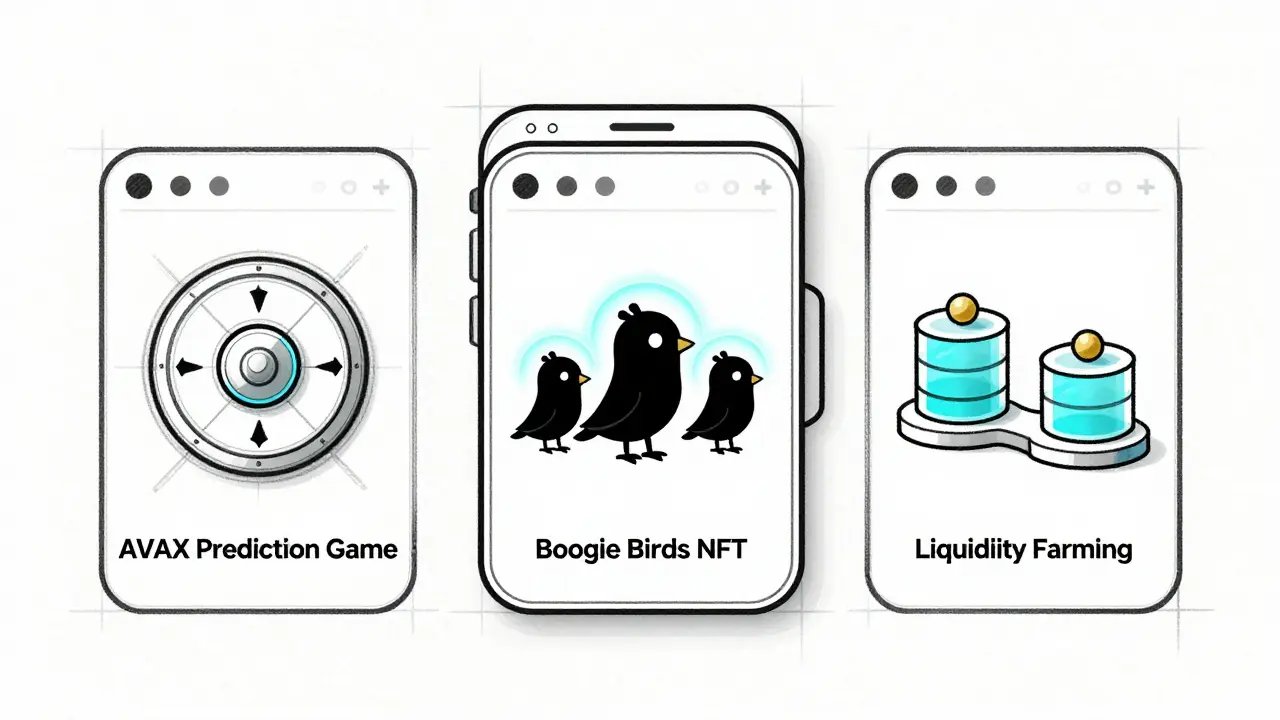
Canary isn’t just about trading. It’s built around a few unique apps that make it stand out.AVAX Prediction is a peer-to-peer betting game. You guess whether the price of Avalanche (AVAX) will go up or down in the next hour. If you’re right, you win CNR. It’s like sports betting, but for crypto prices. No middleman. No bookie. Just smart contracts and your prediction.
Boogie Birds is a collection of AI-generated NFTs shaped like cartoon birds. These aren’t just digital art. You can stake them on the Canary platform and earn CNR rewards over time. The more rare the bird, the more CNR you get. It’s a way to turn NFTs into income generators instead of just collectibles.
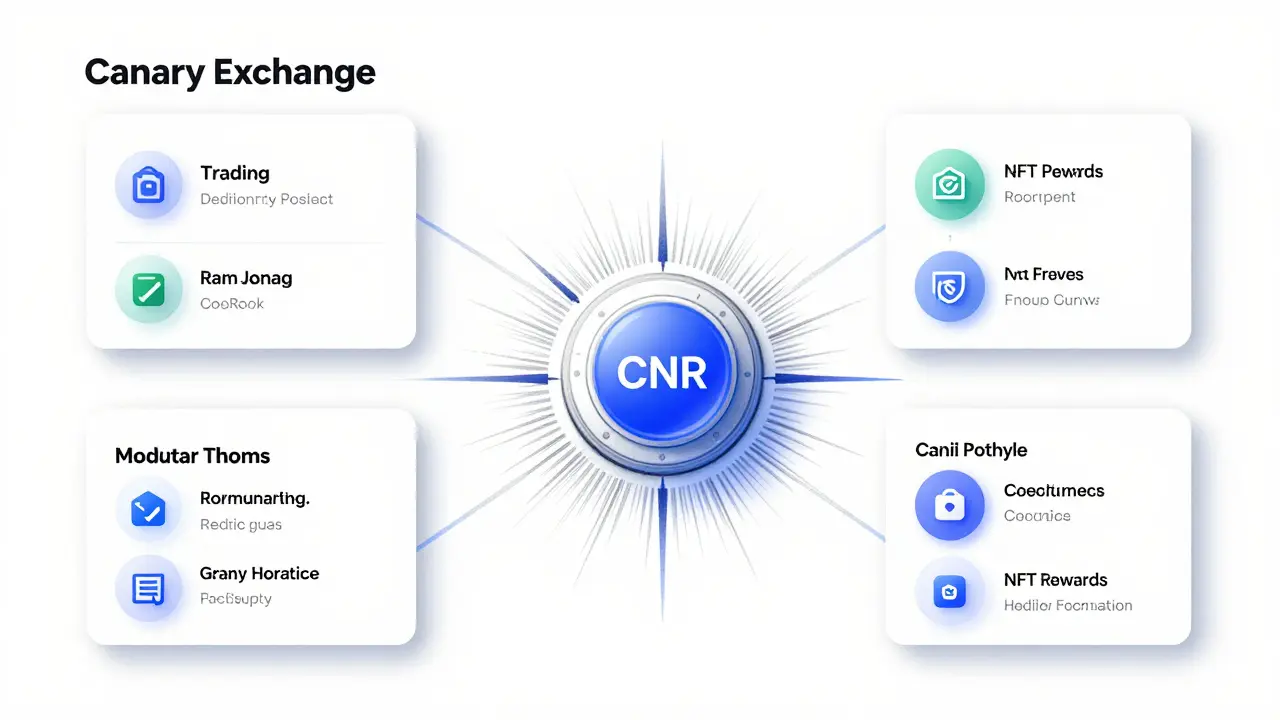
These features turn CNR from a simple token into a gateway. Want to play a game? You need CNR. Want to stake your NFTs? You need CNR. Want to earn rewards from trading? You need CNR. It’s the fuel that makes the whole ecosystem run.
Technical Details: Supply, Blockchain, and How It Works
The total supply of CNR is capped at 570 million tokens. But right now, only about 211 million are in circulation. That means over half the supply hasn’t been released yet. The project plans to slowly unlock the rest over time through staking rewards, liquidity mining, and airdrops.Canary runs on the Avalanche blockchain. Why? Because Avalanche is fast, cheap, and handles high traffic without slowing down. While Ethereum can get congested and expensive, Avalanche keeps transaction fees under $0.01 and confirms trades in under 2 seconds. That’s crucial for a DEX that wants users to trade, stake, and play games without waiting.
Canary uses an Automated Market Maker (AMM) model. That means there’s no order book. Instead, there are pools of tokens locked in smart contracts. When you swap USDC for CNR, you’re not trading with another person. You’re trading against a pool. The price changes based on supply and demand inside the pool. This lets anyone trade any token without needing a buyer or seller to match up.
Price History and Market Reality
CNR had a wild ride. Its all-time high was $0.35 on KuCoin in 2021. That’s when hype around DeFi and NFTs was at its peak. But by early 2026, the price had crashed hard. As of February 2026:- Bybit: $0.00023847
- Crypto.com: $0.0002458
- Coinbase: $0.0010
That’s a drop of over 99% from its peak. Trading volume is low. On Crypto.com, daily volume is around $17,000. On CoinGecko, it’s $43,000. That’s tiny compared to major coins like Ethereum or even smaller ones like Solana. The market cap is either not tracked or so low it’s listed as $0 on some platforms.
Price swings are still wild. Coinbase showed a 17% gain over seven days, but Crypto.com showed a 8% drop. That kind of inconsistency suggests low liquidity - meaning there aren’t enough buyers and sellers to keep prices stable. A small trade can move the price a lot.
How to Buy and Store CNR
You can’t buy CNR on Coinbase or Binance directly. You’ll need to use exchanges that list it, like Bybit, KuCoin, or Gate.io. Here’s how:- Create an account and complete KYC (Identity Verification Level 1).
- Deposit crypto - usually USDT, USDC, or AVAX.
- Go to the trading section and search for “CNR”.
- Choose a market order (buy now) or limit order (set your price).
- After buying, you can keep it on the exchange or move it to your own wallet.
For storage, you have options:
- Exchange wallets - easy, but you don’t control the keys.
- Web or mobile wallets - like MetaMask or Trust Wallet. You control your private keys.
- Hardware wallets - Ledger or Trezor. Best for long-term holding.
- Paper wallets - print out your keys. Secure, but risky if you lose the paper.
If you’re using CNR to stake, farm, or play games, you’ll need to move it to a wallet that connects to the Canary Exchange. Most users use MetaMask with Avalanche network settings.
Is CNR Worth It?
Here’s the hard truth: CNR is not a growth stock. It’s not a moonshot. It’s a utility token for a niche ecosystem. If you’re into DeFi games, NFT staking, and low-fee trading on Avalanche, then CNR has a real use. You can earn from it. You can play with it. You can build something with it.But if you’re looking for a coin that will double in value next year? CNR probably isn’t it. The market is tiny. The team doesn’t get much press. The price is stuck in the basement. It’s not dead - it’s just quiet.
The real question isn’t “Will CNR go up?” It’s “Do I want to use it?” If the answer is yes - you like playing prediction games, staking NFTs, or farming yield on Avalanche - then holding CNR makes sense. If you just want to invest, there are far more liquid options.
Final Thoughts
Canary (CNR) is a project that didn’t chase hype. It built something specific: a DeFi ecosystem for people who want to earn while they play. It’s not perfect. The price is low. The data is messy. But it works. And for a small group of users, it’s the only place they go to trade, farm, and have fun with crypto.If you’re curious, try it with a small amount. Swap a few dollars. Stake a Boogie Bird. Play one prediction game. See if the experience feels worth it. That’s the only way to know if CNR has value - not by looking at charts, but by using it.
What is the CNR token used for?
CNR is the utility token of the Canary Exchange, a decentralized exchange on Avalanche. It’s used to earn rewards through trading, staking, liquidity farming, and participating in ecosystem apps like AVAX Prediction and Boogie Birds NFT staking. You need CNR to access these features.
Where can I buy Canary (CNR)?
You can buy CNR on exchanges like Bybit, KuCoin, and Gate.io. You’ll need to create an account, complete KYC, deposit crypto (like USDT or AVAX), and then trade for CNR. It’s not listed on Coinbase or Binance.
Is CNR a good investment?
CNR isn’t a traditional investment. Its value comes from usage, not speculation. If you plan to use the Canary Exchange ecosystem - staking NFTs, farming yield, or playing prediction games - then holding CNR makes sense. If you’re looking for price growth, it’s risky due to low liquidity and a 99% drop from its all-time high.
Why does CNR run on Avalanche?
Avalanche offers fast transaction speeds (under 2 seconds), low fees (under $0.01), and high scalability. These features are essential for a DEX with real-time games, NFT staking, and frequent trading. Ethereum’s high gas fees would make these features unusable for most users.
What’s the total supply of CNR?
The maximum supply is 570,000,000 CNR. As of December 2025, about 211 million were in circulation. The rest are locked for future distribution through staking, liquidity mining, and airdrops.
maya keta
February 27, 2026 AT 15:06Okay but let’s be real - CNR is just another vaporware token with a fancy name and zero traction. 99% drop? Yeah, that’s not a correction, that’s a funeral. If you’re still holding this, you’re either emotionally attached or you didn’t check the charts after 2022. The ecosystem? Cute. But no one’s playing AVAX Prediction except bots and retirees with too much time. This isn’t DeFi innovation - it’s a graveyard with a website.
And don’t even get me started on Boogie Birds. AI-generated cartoon birds? Really? That’s the future of NFT utility? I’ve seen better art on a 2010 MySpace profile. The whole thing feels like a scammy side-project from a guy who read one Medium article about yield farming and thought, ‘I can do this.’
Curtis Dunnett-Jones
February 28, 2026 AT 20:47While I appreciate the thoroughness of the analysis presented, I must respectfully challenge the assertion that CNR lacks intrinsic value. The token’s utility within a functioning, non-centralized ecosystem - particularly one built on Avalanche’s high-throughput infrastructure - represents a foundational shift in how digital asset economies can be structured. The fact that liquidity is low does not equate to irrelevance; rather, it suggests an early-stage network effect尚未 fully realized.
Furthermore, the mechanism of rewarding active participation through staking, liquidity provision, and gamified interaction is not merely speculative - it is a deliberate design choice aimed at fostering sustainable user engagement. One cannot evaluate such a system solely through the lens of price appreciation, as this fundamentally misunderstands the nature of utility tokens.
Sean Logue
March 2, 2026 AT 14:41Bro, I tried this whole CNR thing last year. Bought a few bucks worth, staked a Boogie Bird (the one with the neon sunglasses), played two prediction games - won $0.87 in CNR. Then I forgot about it.
Woke up last week, checked my wallet - still there. Still staking. Still earning like 0.00003 CNR per hour. It’s like having a digital hamster wheel that spins forever but never gets you anywhere. But hey, it’s fun. Like a crypto aquarium. I don’t care if it’s worth $0.0002. I like watching my bird float around in the blockchain. 🐦✨
Carl Gaard
March 2, 2026 AT 16:02OMG I CAN’T BELIEVE THIS IS STILL A THING 😭😭😭
I remember when CNR was at $0.30 and everyone was making bank. Now it’s like watching your ex post a selfie with their new partner… on the same platform you used to share memes with them. I still have 200k CNR in my MetaMask. I don’t trade it. I don’t stake it. I just… look at it. Like a photo of my first car. It’s not valuable anymore. But it’s mine. And that’s enough.
Also, the AVAX Prediction game? I once guessed ‘down’ and it went up. I lost 0.02 CNR. I cried. Then I laughed. Then I cried again. Then I staked my bird. Now I’m at peace. 🙏
bella gonzales
March 2, 2026 AT 16:57Ugh. I read half of this. Too long. Why does everyone make these essays? Just say if it’s a scam or not. I don’t care about Boogie Birds. I just want to know if I can make money. Answer: No. Move on.
Paul Reinhart
March 3, 2026 AT 07:15There’s something quietly beautiful about projects like this - not because they’re destined to explode, but because they persist. CNR doesn’t need to be the next Bitcoin. It doesn’t need to be on Coinbase. It just needs to work for the people who use it. And from what I’ve seen, it does.
I’ve watched small communities form around these ecosystems - people sharing strategies for liquidity farming, trading prediction outcomes, even designing custom avatars for their Boogie Birds. It’s not about the price. It’s about the ritual. The daily check-in. The quiet joy of earning something real, even if it’s only 0.001 CNR.
Maybe that’s the real innovation here: not the tech, but the human habit it sustains. We’re not just holding tokens. We’re holding routines. And in a world of noise, that’s rare.
Samantha Stultz
March 4, 2026 AT 14:02First off, the supply numbers are misleading. 570M total? Only 211M circulating? That’s a red flag. Who controls the rest? The dev team? A VC? A shell company? And why is there no public vesting schedule? You can’t just say ‘airdrops’ and expect people to trust you.
Also, ‘low liquidity’ is code for ‘easy to manipulate.’ A $43k daily volume? That’s a pump-and-dump waiting to happen. One whale buys 5M CNR and the price spikes 20%. Then they dump. Done. And you think people are ‘earning’? They’re just feeding the cycle.
And Boogie Birds? AI-generated birds? That’s not utility - that’s a distraction. You’re not building a product. You’re building a TikTok trend with a blockchain label.
Robert Conmy
March 6, 2026 AT 07:40Anyone still defending CNR is either brainwashed or getting paid to shill. This isn’t innovation - it’s a Ponzi wrapped in NFTs and labeled ‘DeFi.’ The team’s been silent since 2023. No roadmap updates. No audits. No transparency. And you think people are ‘using’ it? No. They’re holding it because they’re too stubborn to admit they got scammed.
Stop romanticizing this. It’s a ghost town. The only thing growing here is the number of people asking ‘why is this still alive?’
Lilly Markou
March 7, 2026 AT 10:53While I recognize the technical merits of the Avalanche integration and the structured reward mechanisms, I remain deeply concerned about the long-term sustainability of a token whose market capitalization is effectively unquantifiable. The absence of consistent liquidity and the reliance on speculative user behavior - rather than institutional adoption - renders the ecosystem vulnerable to systemic collapse.
Furthermore, the integration of gamified elements, while ostensibly engaging, may inadvertently encourage addictive behavior patterns among retail participants. One must ask: Is the utility of CNR truly beneficial, or merely seductive?
McKenna Becker
March 8, 2026 AT 12:42If you’re not using it, you don’t need it. If you’re using it, you already know why. No charts. No hype. Just open the app. Play. Stake. See if it feels right. That’s all that matters.
precious Ncube
March 9, 2026 AT 04:26Canary? More like Canary in the coal mine. This is what happens when you let crypto bros design a game without a single financial engineer in the room. They think ‘yield farming’ means ‘free money.’ It doesn’t. It means ‘you’re the last one holding the bag.’
And Boogie Birds? Please. If I wanted to stare at AI-generated birds, I’d open my cat’s Instagram. At least she’s real.
Amita Pandey
March 10, 2026 AT 16:03It is my considered opinion that the CNR token exemplifies a profound misalignment between technological ambition and economic reality. The premise of utility-driven tokenomics is commendable in theory, yet in practice, it is undermined by the absence of regulatory clarity, insufficient liquidity, and an overreliance on speculative user engagement. The ecosystem, while technically coherent, lacks the institutional scaffolding necessary for long-term viability. One cannot sustain a decentralized economy on sentiment alone.
Jan Czuchaj
March 11, 2026 AT 16:23I’ve been following CNR since its early days. I didn’t buy at $0.35. I didn’t even buy at $0.05. But I watched. I read the whitepaper. I tested the prediction game. I staked one NFT. I didn’t expect to get rich. I just wanted to see if it worked.
And guess what? It did. For me. Not for everyone. But for me - it was real. I earned 0.0004 CNR yesterday. That’s less than a penny. But it was mine. I didn’t buy it. I didn’t trade it. I earned it. And that… that felt different.
Maybe it’s not a revolution. But it’s a quiet rebellion. Against the idea that crypto has to be about money. Maybe it’s about the little things. The daily check-in. The bird that still flies. The game that still works. Even if no one else is watching.
Tracy Peterson
March 12, 2026 AT 07:43People are acting like CNR is dead. It’s not. It’s just quiet. And sometimes, quiet is the most powerful thing. No hype. No influencers. No FOMO. Just a small group of people who actually use it - not because they think it’ll go to the moon, but because it does what it says.
Try it. With $5. Play one game. Stake one bird. See if you feel anything. If you don’t? Cool. Move on. But if you do? You’re part of something real. And that’s worth more than any chart.
George Suggs
March 14, 2026 AT 01:19Low volume? Yeah. But that’s fine. I don’t need 100k traders. I need one person who knows how to farm the pools. One person who knows which bird gives the best yield. One game that doesn’t glitch. That’s enough.
CNR isn’t for everyone. It’s for the ones who don’t need to shout to be heard.
Dianna Bethea
March 15, 2026 AT 21:13If you’re new to CNR, don’t overthink it. Start small. Buy $10 worth of CNR. Put it in MetaMask. Connect to the Canary Exchange. Try staking one Boogie Bird. Play one prediction game. See how long it takes to earn your first CNR.
Don’t look at the price. Don’t check the chart. Just experience it. If it feels like a chore? Walk away.
If it feels like a game? You’re already winning.
KingDesigners &Co
March 16, 2026 AT 02:1499% drop? Classic. This is why you don’t trust projects without a VC backer. CNR is a ghost project. The devs vanished. The Discord is dead. The Telegram has 3 active users. And yet… people still hold it.
Why? Because they’re addicted to the dream. Not the token. The dream.
That’s the real tragedy.
Felicia Eriksson
March 18, 2026 AT 01:00I think people forget that crypto isn’t just about money. Sometimes, it’s about the little things - like logging in every day and seeing your bird still there. Still earning. Still alive.
I don’t care if CNR is worth $0.0001. I care that it still works. And that’s rare.
aaron marp
March 18, 2026 AT 15:57Let’s reframe this: CNR isn’t a coin. It’s a community. You don’t buy it to get rich. You buy it to belong. To play. To earn a little something by showing up. Most tokens want you to speculate. This one wants you to participate.
And maybe… that’s the future. Not moonshots. Just small, consistent, human things.
Patrick Streeb
March 20, 2026 AT 02:45While the technical architecture of the Canary ecosystem is commendable, I must express concern regarding the opacity of token distribution mechanisms. The absence of a publicly verifiable vesting schedule for the remaining 359 million tokens raises legitimate governance and trust concerns. Without transparency, even the most elegantly designed utility token risks being perceived as a speculative vehicle rather than a decentralized protocol.
Phillip Marson
March 21, 2026 AT 08:24This isn’t crypto. This is a cult with a smart contract. People are staking cartoon birds like they’re praying to a blockchain god. I’ve seen grown men cry because their bird got a ‘rare feather.’
And you? You’re reading this like it’s a whitepaper. It’s not. It’s a fever dream. And you’re the patient.
Tracy Whetsel
March 22, 2026 AT 11:41Here’s the truth: CNR doesn’t need to go to the moon. It just needs to stay on the ground - for the people who actually use it.
I staked my bird last week. Earned 0.0003 CNR. It’s not money. It’s a token. A little digital pat on the back.
And sometimes? That’s enough.
Alyssa Herndon
March 24, 2026 AT 09:56I used to think CNR was a joke. Then I tried it. I didn’t expect to like it. But I did. Not because it’s profitable. Because it’s peaceful.
No drama. No noise. Just a quiet place to earn something small, and feel like you’re part of something that still works.
I don’t know if it’ll last. But for now? I’m glad it’s here.
Michael Rozputniy
March 26, 2026 AT 02:24They’re hiding something. 570M supply? Only 211M out? Who’s holding the rest? The Fed? The Illuminati? The blockchain is transparent - but the team isn’t. Why no audit logs? Why no public wallet tracking? This isn’t DeFi. It’s a honeypot.
And the ‘prediction game’? That’s not a game. That’s a market manipulation tool. They’re using it to pump and dump on retail. You think you’re playing? You’re the bait.
Danny Kim
March 26, 2026 AT 04:19So let me get this straight… you’re telling me people are staking AI-generated birds to earn a token that’s worth less than a meme coin from 2021… and they call this innovation?
Wow. We really did it. We turned crypto into a therapy session.