
What is UNI (UNI) crypto coin? A clear guide to Uniswap's governance token
UNI Governance Voting Simulator
How UNI Voting Works
Each UNI token equals one vote in Uniswap's governance system. This calculator shows how your UNI holdings affect your voting influence.
Your vote could influence proposals if you hold over 0.5% of the total supply.
UNI is the governance token for Uniswap, the largest decentralized exchange (DEX) on Ethereum. Unlike traditional cryptocurrencies that are mined or staked for rewards, UNI doesn’t pay interest or generate passive income on its own. Instead, it gives holders the power to vote on changes to the Uniswap protocol - things like fee structures, new features, and how treasury funds are spent. If you’ve ever traded tokens like ETH, USDC, or even obscure altcoins without using a centralized exchange like Coinbase, you’ve likely used Uniswap - and maybe even held UNI without realizing it.
How UNI came to be
Uniswap launched in November 2018 as an open-source automated market maker (AMM). It didn’t need order books or middlemen. Instead, it used smart contracts to let users swap tokens directly from their wallets by pooling liquidity. For the first two years, no one owned UNI. The protocol ran purely on code. Then, on September 16, 2020, the team dropped 400 UNI tokens into the wallets of every Ethereum address that had ever traded on Uniswap. That was a surprise gift - over 10,000 people got tokens just for using the platform. No sale. No premine. Just a reward for early adopters.
Today, UNI has a fixed supply of 1 billion tokens. About 753 million are already in circulation. That means roughly 25% are still locked up for future distribution - mostly to team members, investors, and long-term protocol incentives. The annual inflation rate is around 27.6%, which sounds high, but most of it goes toward rewarding liquidity providers and funding development, not just handing out free tokens.
What UNI actually does
UNI isn’t a currency you spend on coffee. It’s a voting key. Every UNI token equals one vote in Uniswap’s decentralized governance system. Proposals get submitted by anyone - developers, users, even random Reddit posters. If a proposal gets enough support, it goes to a vote. If it passes, the code changes automatically. In the last few years, UNI holders have voted to:
- Redirect a portion of protocol fees to UNI stakers
- Allocate $15 million to build Unichain, a new Layer 2 solution
- Change how liquidity mining rewards are distributed
- Launch new token listing procedures
There’s no CEO. No board. No corporate office. The community decides. That’s what makes UNI different from tokens like Bitcoin or Ethereum - it’s not just a store of value or a medium of exchange. It’s a tool for collective control.
How Uniswap works (and why UNI matters)
Uniswap runs on Ethereum and lets you swap any two ERC-20 tokens without needing someone to buy or sell on the other side. How? Liquidity pools. If you want to trade ETH for DAI, you’re not trading with another person. You’re trading against a pool of ETH and DAI that other users deposited. The price is set by a mathematical formula - not by market makers or order books.
Uniswap V3, launched in 2021, made this even smarter. Liquidity providers can now choose specific price ranges where they want their funds to work. Instead of spreading $10,000 across all possible prices, you can focus it between $1,800 and $2,200 for ETH. That increases capital efficiency by up to 4,000 times. More trades get processed. More fees get earned. And UNI holders benefit because the protocol becomes more valuable.
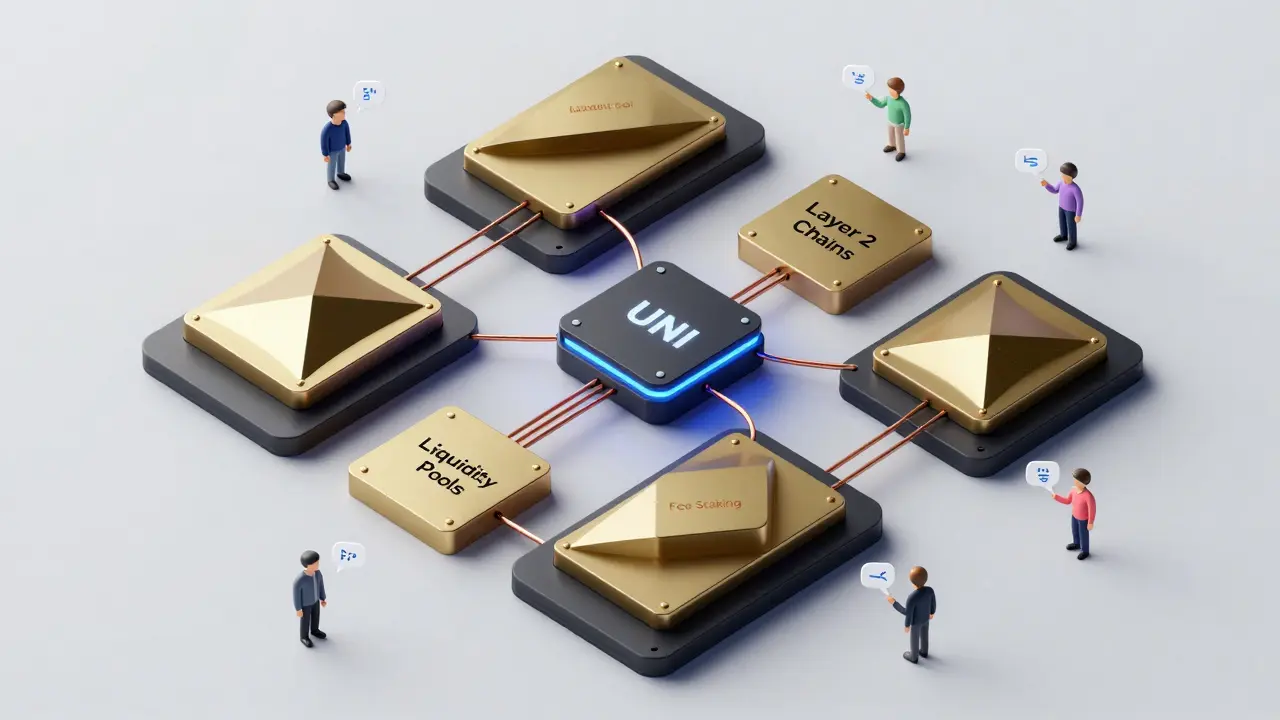
Uniswap isn’t just on Ethereum anymore. It’s live on Polygon, Arbitrum, Optimism, ZKsync, and more. But this creates a problem: liquidity is spread thin. That’s why Unichain - a new Layer 2 built on the OP Stack - is coming. It’s designed to bring all those chains together under one roof. If it works, Uniswap could dominate DeFi even more.
Who uses UNI and why
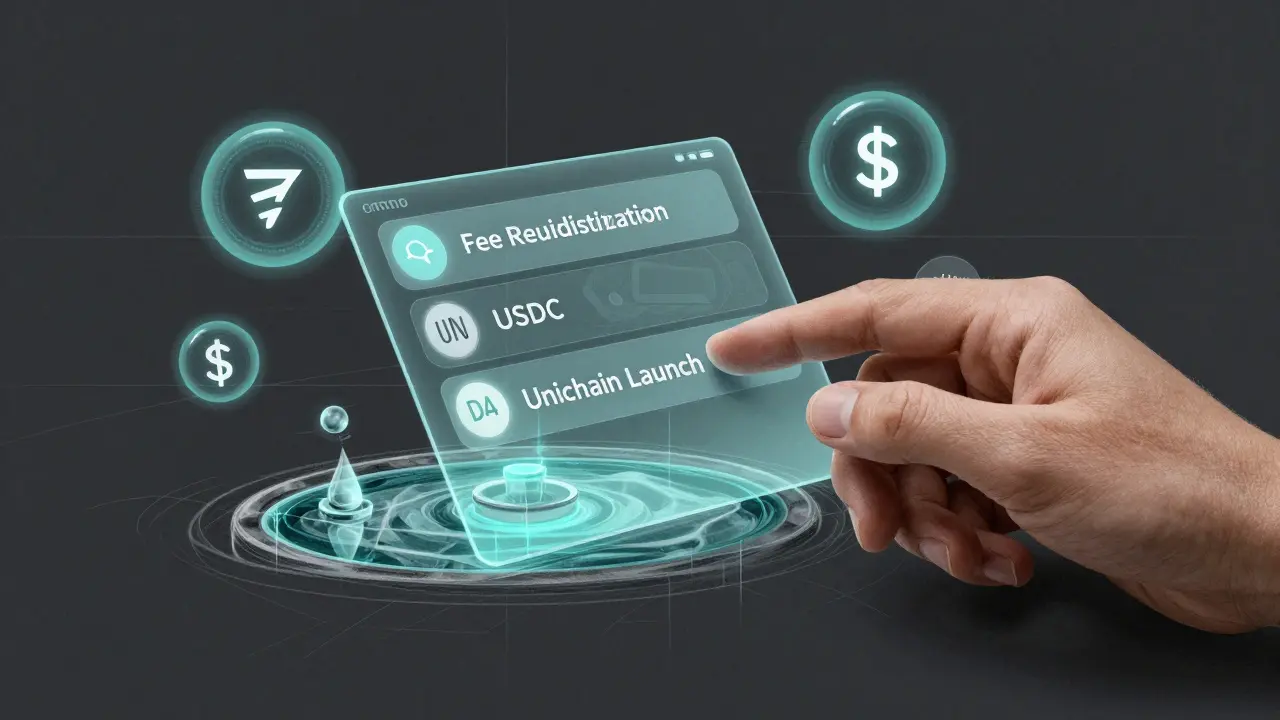
Most UNI holders fall into two groups: traders and liquidity providers. Traders use it to vote on protocol upgrades that could make swaps cheaper or faster. Liquidity providers use it to earn a share of future protocol fees - something that could change in 2025 if Proposal #214 passes. That proposal would give UNI stakers 25% of all trading fees generated by Uniswap, turning the token from a voting tool into a revenue-sharing asset.
On the other side, institutions still avoid UNI. Why? No KYC. No customer support. No chargebacks. The SEC hasn’t labeled UNI a security - yet - but the lack of regulatory clarity keeps big players away. Right now, 92% of Uniswap users are retail traders. The biggest adoption is in Southeast Asia, North America, and Europe. People like it because they can trade any token, anytime, with no permission.
The downsides
UNI isn’t risk-free. Here’s what you lose sleep over:
- Impermanent loss: If the price of a token in your liquidity pool swings hard, you can lose money compared to just holding it. One user lost 8.7% on a UNI/USDC pool during a 35% ETH drop in mid-2023.
- High gas fees: On Ethereum, swapping small amounts can cost more than the trade is worth. During congestion, gas spikes to $50+.
- Complex interface: Uniswap’s interface isn’t beginner-friendly. Slippage settings, approval transactions, and gas estimators confuse new users. 58% of negative reviews on Trustpilot mention this.
- No fiat on-ramp: You can’t buy UNI with a credit card on Uniswap. You need ETH first - which means you have to go to Coinbase, Kraken, or another exchange to get started.
- No advanced trading: No limit orders. No margin. No stop-losses. If you’re a professional trader, you’ll still need Binance or Bybit.
And then there’s the inflation. With 27.6% annual issuance, UNI’s value could get diluted if demand doesn’t keep up. Vitalik Buterin warned about this in 2022. Some analysts think it’s unsustainable. Others say it’s necessary to keep the protocol growing.
Where UNI stands today
As of December 2023, Uniswap handles 58.3% of all decentralized exchange volume. That’s more than SushiSwap, Curve, and PancakeSwap combined. It processes over $42 billion in trades every month. The total value locked (TVL) across all chains sits at around $5 billion.
UNI itself has fluctuated wildly. It hit an all-time high of over $44 in 2021. In late 2023, it traded between $4 and $6. Some analysts predict it could hit $15.50 by 2025 - if Unichain succeeds and fee-sharing kicks in. Others, like Messari’s Ryan Watkins, say UNI’s price is disconnected from real revenue. Right now, Uniswap earns about $1.2 billion a year in fees - but none of that goes to UNI holders. Not yet.
How to get started with UNI
If you want to use UNI, here’s what you need:
- An Ethereum-compatible wallet (MetaMask is the most popular)
- Some ETH for gas fees (at least $5 worth)
- A basic understanding of public/private keys and blockchain safety
You can buy UNI on Coinbase, Kraken, or directly on Uniswap using ETH. Once you have it, you can:
- Hold it as a governance asset
- Stake it in Uniswap’s governance pool to earn voting power
- Provide liquidity to UNI/ETH or UNI/USDC pools to earn trading fees
Beginners should spend 8-12 hours learning the basics. Use Uniswap’s official docs, the Reddit community (r/Uniswap has 89,000 members), or YouTube tutorials. Don’t rush. One wrong click can cost you money.
What’s next for UNI
The roadmap is ambitious:
- Unichain (Q2 2024): A single Layer 2 chain unifying all Uniswap deployments. Could reduce gas fees by 90% and fix liquidity fragmentation.
- Protocol V4 (Q4 2024): Dynamic fee markets that adjust fees based on demand - similar to how Uber prices surge during rush hour.
- Fiat on-ramps (Q2 2025): Partnerships with MoonPay to let users buy UNI directly with credit cards.
- Fee redistribution (2025): If approved, 25% of all trading fees will go to UNI stakers - turning it into a true yield asset.
If all this happens, UNI could become more than a governance token. It could become the backbone of a new kind of financial system - one where users own the platform they use.
Is UNI a good investment?
UNI isn’t a traditional investment like stocks or bonds. It doesn’t pay dividends. Its value comes from its role in Uniswap’s ecosystem. If you believe in decentralized finance and think Uniswap will keep dominating DEX trading, then holding UNI makes sense. But if you’re looking for steady returns, it’s risky. The token’s price depends on protocol usage, governance decisions, and market sentiment - not earnings or revenue. Only invest what you can afford to lose.
Can I earn interest on UNI?
Not directly. But you can earn trading fees by providing liquidity to UNI pairs (like UNI/ETH or UNI/USDC). You can also stake UNI in the governance pool to gain voting power. Starting in 2025, if Proposal #214 passes, UNI stakers could earn 25% of all protocol fees - which would be the closest thing to interest.
Is UNI safe?
The Uniswap smart contracts have been audited and are considered secure. But safety depends on you. Never share your private key. Double-check token addresses before trading. Be careful with approvals - malicious sites can trick you into giving away unlimited access to your wallet. And remember: DeFi has no customer service. If you send funds to the wrong address, there’s no way to get them back.
Why does UNI have such a high inflation rate?
The 27.6% annual issuance is designed to incentivize participation. Most of it goes to liquidity providers, developers, and governance participants to keep the protocol growing. It’s not meant to enrich early holders - it’s meant to attract new users and capital. Critics say it’s unsustainable. Supporters argue that without it, Uniswap couldn’t compete with centralized exchanges that have billions in marketing budgets.
Can I use UNI on other blockchains?
Yes. UNI is available on Ethereum, Polygon, Arbitrum, Optimism, ZKsync, and more. But the token on each chain is a wrapped version - not the original. To move UNI between chains, you need to use a bridge like the Uniswap Multichain Bridge. Be careful: bridges can be hacked. Always use official ones.
Final thoughts
UNI isn’t just another crypto token. It’s a vote. A tool. A stake in the future of finance. If you believe in open, permissionless systems where users control the rules - then UNI matters. But if you want simple, fast, and safe trading with fiat support, you’re better off with a centralized exchange. UNI rewards those who understand DeFi. It punishes those who treat it like a get-rich-quick scheme. The real question isn’t whether UNI will go up in price. It’s whether you want to be part of a system that runs without bosses, banks, or brokers - and are willing to learn how to use it right.
Sammy Tam
December 16, 2025 AT 05:57Uniswap’s whole vibe is wild - no CEOs, no customer service, just code and community. I remember when I first tried swapping tokens and accidentally approved a contract for my entire wallet balance. Took me 3 days to recover. Still love it though. This isn’t banking - it’s digital anarchism with a UI that hates you.
Dionne Wilkinson
December 16, 2025 AT 19:57I like that UNI lets regular people have a say. Not everything has to be about profit. Sometimes it’s nice to be part of something that’s actually run by users.
Cheyenne Cotter
December 17, 2025 AT 23:39Let’s be real - 27.6% inflation is a joke. You can’t have a ‘token’ that’s being printed like Monopoly money and expect it to hold value. Vitalik called it out and everyone just shrugged. The whole system is built on the assumption that new users will always show up to absorb the dilution. What happens when the hype dies? The price crashes, the liquidity providers flee, and suddenly you’re holding a digital paperweight. This isn’t finance - it’s a Ponzi with a whitepaper.
And don’t get me started on Unichain. Another Layer 2? We already have 7 different chains running Uniswap, each with fragmented liquidity. You think slapping them all together under one roof will fix it? Nah. It’ll just create one giant single point of failure. If Unichain gets hacked, the entire DeFi ecosystem bleeds. And who’s auditing it? The same devs who didn’t audit the original contracts properly? Please.
Also, fee redistribution? Yeah right. That proposal has been in the works since 2022. It’s like saying ‘we’ll fix the economy next quarter’ while the building burns. The team’s just buying time until they can dump their bags. You think they’re not sitting on 10% of the total supply? Of course they are. They’re the ones who wrote the code. They get the first dibs. The rest of us just get to vote on how we get crumbs.
And the interface? Still a nightmare. I showed my mom how to swap ETH for DAI. She spent 45 minutes trying to understand slippage. Then she sent 0.05 ETH to a fake token contract because the UI didn’t show the address clearly. She lost $200. She hasn’t touched crypto since. That’s not innovation. That’s predatory design.
People act like this is the future of finance. It’s not. It’s the future of gambling with extra steps. And if you think UNI is going to hit $15.50 in 2025, you’re not seeing the numbers - you’re seeing the hype. The protocol makes $1.2B in fees a year. That’s great. But UNI holders get zero of it. Not yet. Not ever. Unless you believe in fairy tales.
Stop romanticizing decentralization. Real finance has lawyers, regulators, and recourse. This? This is the Wild West with MetaMask.
Bradley Cassidy
December 19, 2025 AT 20:23Bro i just bought UNI because i saw it on coinmarketcap and thought ‘oh cool its like a voting thing’ and then i realized i had to connect my wallet and now i’m scared to touch anything cause i dont wanna lose my eth
Heather Turnbow
December 20, 2025 AT 16:46Thank you for this thorough breakdown. I appreciate how you framed UNI not as an investment, but as a tool - a digital ballot. Too many people treat crypto like a slot machine, but this is about governance, participation, and shared ownership. It’s easy to dismiss DeFi as chaotic, but the alternative - centralized control by corporations with opaque decision-making - is far more dangerous. I’ve watched friends lose everything to shady ICOs, and yet here, the code is open, the votes are public, and the rules can be changed by the people who use it. That’s revolutionary, even if the interface is clunky and the gas fees are brutal. The future isn’t perfect. But it’s ours to shape.
Emma Sherwood
December 22, 2025 AT 01:40As someone from a country where banking access is limited, Uniswap changed my life. I can trade tokens without a bank account, without ID, without permission. No one asked me for my passport. No one said ‘you’re not eligible.’ That’s power. And UNI? It’s not just a token - it’s a door. Maybe the door’s rusty, maybe the stairs are steep, but at least it’s open. I’ve seen women in rural India use Uniswap to send money home. I’ve seen students in Nigeria buy USDC to pay for online courses. This isn’t about speculation. It’s about dignity. The fact that some people here are complaining about gas fees while living in countries where you need a bribe to open a checking account… it’s a little tone-deaf.
Yes, the interface is confusing. Yes, there’s risk. But the alternative is silence. And silence is what keeps people poor.
Craig Nikonov
December 22, 2025 AT 10:51UNI is a Fed backdoor. You think the team didn’t get a call from the Treasury before the airdrop? 400 tokens to every wallet? That’s too clean. Too coordinated. They seeded it to create a ‘community’ that looks organic but is actually a Trojan horse for institutional control. Wait till the SEC labels it a security - then watch the ‘governance’ votes suddenly align with Wall Street’s interests. They’re building a decentralized empire… so they can regulate it later. I’m not paranoid. I’m informed.
Chevy Guy
December 23, 2025 AT 05:05so uniswap is like the amazon of crypto but with worse customer service and more ways to lose your money lol
Tom Joyner
December 24, 2025 AT 15:24The notion that governance tokens represent true decentralization is a charming delusion. Real decentralization requires entropy, not curated proposals voted on by a subset of whales who bought their UNI during the airdrop. The average voter has no idea what they’re approving. They just see ‘25% fee share’ and click yes. This isn’t democracy. It’s plutocracy with a blockchain logo.
Sue Bumgarner
December 25, 2025 AT 18:55Why are we letting some Silicon Valley devs decide how we trade? This isn’t freedom - it’s colonialism with smart contracts. The US owns this. The ‘community’ is just a PR stunt. Real sovereignty means owning your own currency, not some token controlled by a DAO full of guys in hoodies who went to Stanford. UNI is a Trojan horse for American tech hegemony. We should be building our own chains - not worshiping Ethereum.
George Cheetham
December 27, 2025 AT 12:43There’s something beautiful about a system that doesn’t need permission. You don’t need to beg a bank. You don’t need a credit score. You just need a seed phrase and the courage to click ‘approve’. I’ve seen people who’ve been rejected by banks for 10 years use Uniswap to start a business. That’s not tech. That’s liberation. Yeah, the fees are high. Yeah, the UI sucks. But you know what? So did the first internet. So did the first ATM. We don’t throw out progress because it’s messy. We fix it - together.
UNI isn’t about price. It’s about presence. It’s about saying: ‘I’m here. I matter. I get a vote.’ And that? That’s worth more than any $15.50 prediction.
Jesse Messiah
December 27, 2025 AT 22:47Hey everyone - just wanted to say I appreciate the thoughtful comments here. I’ve been holding UNI since the airdrop, and honestly? I don’t care if it goes up or down. What matters is that I can vote on whether the protocol charges fees or not. That’s huge. I used to feel powerless in finance. Now I feel like I’m part of the team. Even if I’m just one voice in 10,000. Keep learning. Keep voting. We’re building something real here.
Florence Maail
December 29, 2025 AT 00:41lol i knew it. this is all a scam. they’re gonna rug pull after unichain launches. watch. 100% guaranteed. i’m already selling my UNI and buying bitcoin. at least btc has a story that makes sense. this? this is just code pretending to be a revolution. 🤡
Greg Knapp
December 30, 2025 AT 12:19why do people keep saying 'no customer service' like its a bad thing i mean if you lose your money its your fault not the apps fault you shouldve been more careful
SeTSUnA Kevin
December 31, 2025 AT 06:56The structural inefficiencies of Uniswap V3’s concentrated liquidity model render it fundamentally incompatible with sustainable protocol-wide fee redistribution. The mathematical underpinnings of impermanent loss are non-linear and asymmetric - thus, any attempt to monetize fee sharing without addressing liquidity distribution skew is economically incoherent. In layman’s terms: you’re building a house on sand and calling it a foundation.
Madhavi Shyam
December 31, 2025 AT 22:44UNI’s inflation model is a classic case of misaligned incentives. Liquidity mining rewards are front-loaded, creating a speculative frenzy while discouraging long-term commitment. The 27.6% issuance rate is not an incentive - it’s a subsidy for arbitrage bots. Real yield should come from protocol revenue, not token dilution. This is not DeFi. This is crypto-economics 101 - and the class is failing.
Shruti Sinha
January 2, 2026 AT 15:53I’ve been using Uniswap for 3 years. Never lost money. Just take your time. Read the warnings. Don’t approve more than you need. And never trust a link someone DMs you. Simple.
Kayla Murphy
January 3, 2026 AT 06:32If you’re scared of crypto, that’s okay. But don’t let fear stop you from learning. I started with $10. I read one article a day. Now I help my neighbors set up wallets. You don’t need to be a genius. You just need to be curious. And maybe a little patient.
Sally Valdez
January 3, 2026 AT 22:10UNI is the ultimate woke crypto. Voting on everything. No bosses. No rules. Just a bunch of tech bros debating whether to add a new color to the logo. Meanwhile, real people are getting evicted, prices are rising, and the Fed’s printing trillions - but we’re here arguing about slippage settings like it’s a TED Talk. This isn’t revolution. It’s performance art for the privileged. If you think this is changing the world, you’re not paying attention to the real world.