
Why Proof of Work Makes Bitcoin Secure
Bitcoin doesn’t work because it’s clever code. It works because it’s expensive to break.
How Proof of Work Stops Hackers Before They Start
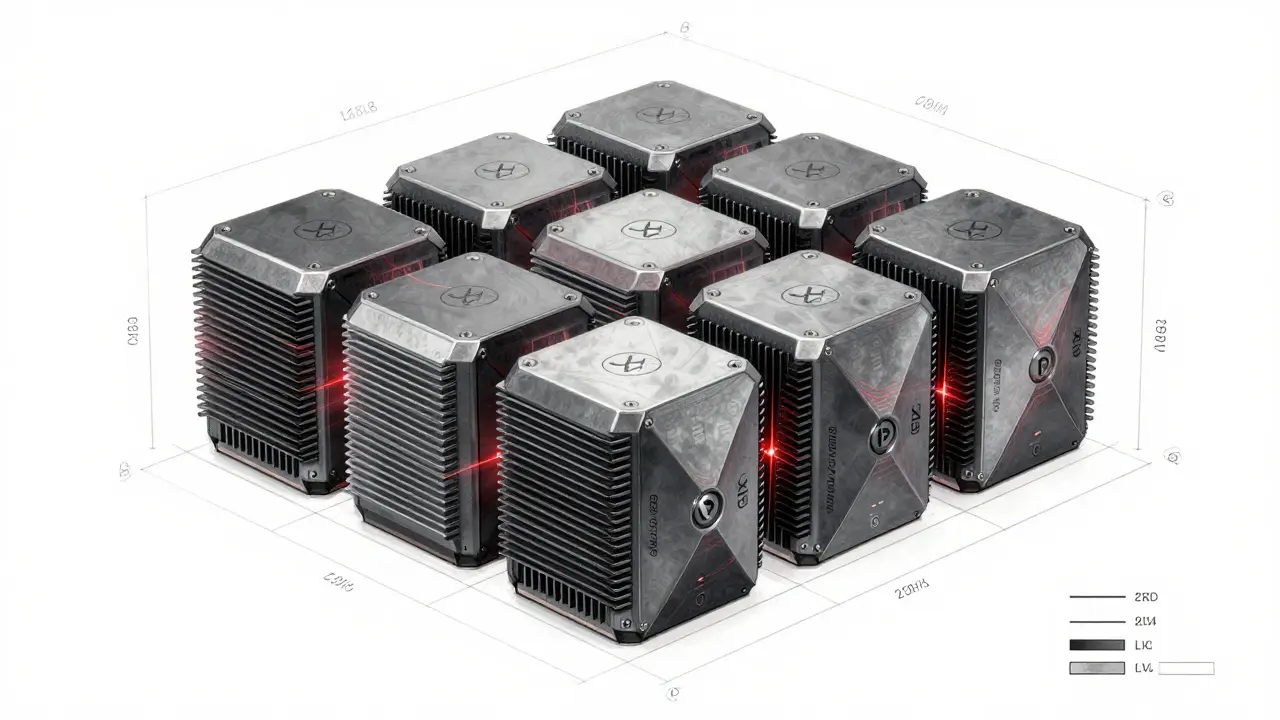
Imagine trying to steal $500 billion. Not just any $500 billion - the total value locked in Bitcoin. You’d need to rewrite every transaction ever made, starting from the very first block. And you’d have to do it faster than the entire world’s mining network can add new blocks. That’s not a technical challenge. That’s a financial impossibility. And that’s exactly what Proof of Work (PoW) was designed to do. PoW forces anyone who wants to control the network to spend real money - on electricity, hardware, and cooling systems. Miners compete to solve a cryptographic puzzle using the SHA-256 algorithm. This isn’t a simple math problem. It’s a brute-force guessing game: try trillions of combinations per second until you find a hash that meets the network’s target. The first one to find it gets to add the next block and earns 6.25 BTC plus transaction fees. The puzzle gets harder over time to keep block times steady at 10 minutes. As of late 2023, the difficulty sat at 83.15 trillion - meaning miners need to find a hash with 19 leading zeros in hexadecimal. That’s not luck. That’s computational muscle.The Cost of Attack Is Higher Than the Reward
Here’s the key: attacking Bitcoin costs way more than you’d ever make. The network’s total hashrate hit 600 exahashes per second (EH/s) in 2023. That’s 600 quintillion calculations every second. To pull off a 51% attack - where you control more than half the network’s power - you’d need to match or exceed that. According to River Financial’s 2023 analysis, sustaining such an attack would cost about $15.8 billion per month. You’d need thousands of top-tier ASIC miners, massive power plants, and cooling infrastructure spanning industrial parks. And even if you pulled it off, you’d destroy Bitcoin’s price. Your stolen coins would be worthless. The whole system would collapse. Who’s going to risk $15 billion to steal a few million? This is called economic asymmetry. Honest miners earn predictable rewards. Attackers face ruinous costs. The network doesn’t trust anyone. It just trusts math and money.Why Physical Resources Matter More Than Digital Tokens
Compare this to Proof of Stake (PoS), where security is based on how many coins you own. In PoS systems like Ethereum after its 2022 upgrade, you can theoretically buy enough ETH to control the network. But in Bitcoin’s PoW, you can’t buy your way in. You can’t print electricity. You can’t fabricate ASIC chips overnight. You need real-world infrastructure: power grids, cooling systems, warehouses, engineers. These are tangible, physical assets that take months to deploy and billions to build. And once you spend that money, you’re locked in. You can’t undo it. You can’t repossess your hardware if the network crashes. This is why Bitcoin’s security is irreversible. PoS relies on internal incentives - “don’t be bad, or you lose your stake.” PoW relies on external costs - “you spent $10 billion, so you better not mess this up.” One is a promise. The other is a bill you already paid.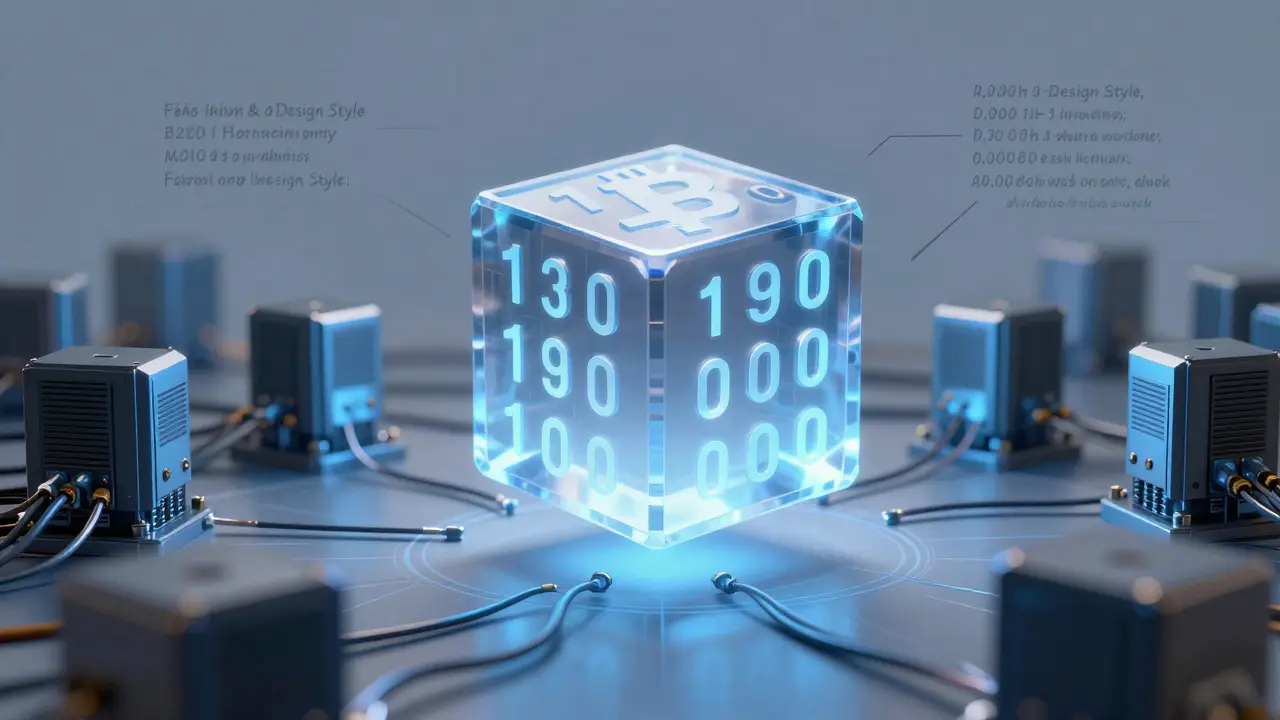
The Network’s Immune System: The Longest Chain Wins
Every Bitcoin block contains the hash of the one before it. That creates a chain. If you change a transaction in block 100,000, you have to recalculate every single block after it - all the way to the latest one. And you have to do it faster than the rest of the network adds new blocks. The network doesn’t care who you are. It doesn’t care if you’re a billionaire or a hacker in a basement. It only cares about which chain has the most accumulated work. The longest chain is the truth. That’s how consensus works without a central authority. This is called the Byzantine Generals Problem solved. Imagine generals surrounding a city, trying to coordinate an attack. Some might be traitors. How do they agree on a time? Bitcoin’s answer: the side that spends the most energy wins. No voting. No trust. Just math and cost.Real-World Proof: No Successful 51% Attacks in 14 Years
Despite billions in stolen crypto from exchanges, Bitcoin’s blockchain has never been altered. There have been attempts. In 2014, GHash.io briefly controlled 55% of the hashrate. The community panicked. But instead of attacking, GHash.io voluntarily cut its share. Why? Because they knew the backlash would kill Bitcoin’s value - and their own profits. That’s the power of incentives. Since 2009, there have been 47 exchange hacks totaling over $3.8 billion. Not one of them touched Bitcoin’s blockchain. Why? Because the ledger is secured by physics, not passwords. You can hack a wallet. You can phish a private key. But you can’t rewrite history without spending more than the entire value of the network.Energy Use Isn’t Waste - It’s Security Budget
Critics say Bitcoin uses too much electricity. They’re right - it uses about 121 terawatt-hours per year. But that’s not a flaw. It’s the price of security. Think of it like a vault. A bank vault doesn’t use electricity to sit there. It uses steel, concrete, alarms, guards. Bitcoin uses energy. And 48.1% of that energy comes from renewable sources, according to the Bitcoin Mining Council’s 2023 report. Miners don’t care where the power comes from - only that it’s cheap. So they go where surplus wind, solar, or hydro is being wasted. In Texas, they use excess power during low-demand hours. In Canada, they tap into hydroelectric overproduction. In Kazakhstan, they use stranded gas flares. Bitcoin mining doesn’t create demand - it absorbs waste. The National Bureau of Economic Research confirmed in a 2021 study that PoW is mathematically secure against network partitions. Even if half the world goes offline, the remaining nodes will still agree on the longest chain. No central server. No single point of failure.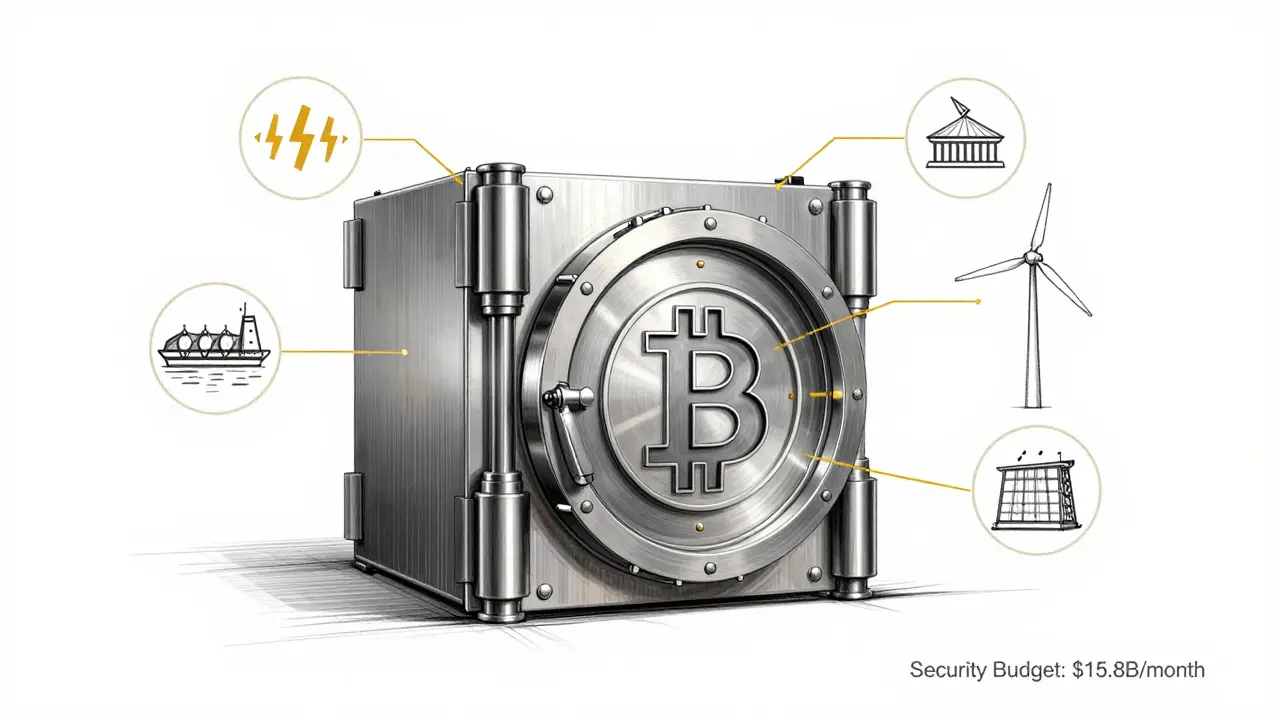
What PoW Can’t Do - And Why That’s Okay
PoW isn’t perfect. It’s slow. Bitcoin handles only 7 transactions per second. It’s not meant for buying coffee. It’s meant for storing trillions in value. You wouldn’t use a bank vault to store your lunch. You’d use a fridge. Bitcoin is the vault. Layer-two solutions like the Lightning Network handle fast payments. PoW secures the base layer. It’s also capital-intensive. Setting up a mining operation costs $15,000 to $500,000. ASICs become obsolete every 18 months. That’s why most miners are now institutions - companies like Marathon Digital and Riot Platforms. They’ve got the capital, the expertise, and the long-term view. Individual miners? They’re mostly gone. But that’s not a weakness. It’s a feature. Centralization of mining power doesn’t threaten security - it strengthens it. The Nakamoto coefficient (the number of entities needed to control 51% of hashrate) is just 3 as of late 2023. That’s more resilient than Ethereum’s PoS, which has a coefficient of 19, with one entity (Lido) holding over 30% of staked ETH.Why No One’s Replacing It
Ethereum switched to PoS to save energy. But that wasn’t a win for security - it was a trade-off. Ethereum’s attack cost dropped from $28 billion to $18.6 billion. Bitcoin’s remains at $15.8 billion per month. And that’s not even counting the cost of building the hardware from scratch. You can’t just buy a 600 EH/s mining farm. It takes years to design, manufacture, ship, and install. PoW’s security isn’t just about current spending. It’s about the barrier to entry. No one can suddenly show up and take over. And that’s why Bitcoin’s PoW still stands unchallenged. It’s the only consensus mechanism that has proven itself against real-world attacks, market crashes, regulatory crackdowns, and global crises. It’s not elegant. It’s not efficient. But it’s unbreakable - because it’s too expensive to break.What’s Next? Halvings, Renewables, and the Future of Security
The next Bitcoin halving - scheduled for April 2024 - will cut block rewards from 6.25 BTC to 3.125 BTC. Miners will rely more on transaction fees. That’s a concern. But experts like Andreas Antonopoulos and Dr. Adam Back argue that as Bitcoin’s value grows, fees will rise too. The security budget won’t vanish - it’ll just shift from inflation to fees. Fidelity Digital Assets forecasts Bitcoin’s annual security spending will hit $25 billion by 2025. Meanwhile, mining is getting greener. The Network for Greening the Financial System noted in 2023 that over 53% of Bitcoin mining energy now comes from carbon-free sources. The industry is adapting. The protocol isn’t changing. Because the protocol doesn’t need to. It’s working.Can Bitcoin be hacked through a 51% attack?
Technically, yes - but it’s economically impossible. A 51% attack would require controlling more than half of Bitcoin’s global hashrate, which as of late 2023 was 600 exahashes per second. The estimated monthly cost to sustain such an attack is $15.8 billion. Even if successful, the attack would crash Bitcoin’s price, making stolen coins worthless. No successful 51% attack has ever occurred in Bitcoin’s 14-year history.
Why does Bitcoin use so much electricity?
Bitcoin uses electricity because that’s how Proof of Work creates security. Miners compete to solve cryptographic puzzles, and the more computing power they use, the harder it is for anyone to cheat. The network consumes about 121 terawatt-hours per year - equivalent to the annual usage of a country like Argentina. But this isn’t waste. It’s the cost of securing $500+ billion in value. Over 53% of this energy comes from renewable or stranded sources, and miners actively seek out cheap, underutilized power.
Is Proof of Work better than Proof of Stake for security?
For long-term value storage, yes. Proof of Work relies on real-world, irreversible costs - electricity and hardware - that can’t be created within the system. Proof of Stake relies on digital token ownership, which can be bought or borrowed. Bitcoin’s PoW requires $15.8 billion to attack monthly; Ethereum’s PoS requires $18.6 billion - but that’s based on staked ETH, which can be acquired without physical infrastructure. PoW’s security is harder to fake, making it more suitable for a global reserve asset.
What happens if mining becomes unprofitable?
If mining becomes unprofitable, some miners will shut down, reducing the network’s hashrate. Bitcoin’s difficulty adjustment automatically lowers the puzzle’s complexity every 2,016 blocks (about every two weeks) to maintain a 10-minute block time. This ensures the network remains secure even with fewer miners. The system is self-correcting. The real risk isn’t low profitability - it’s a sudden, massive drop in hashrate caused by coordinated regulatory shutdowns, which has never happened.
Why hasn’t Bitcoin switched to a more energy-efficient consensus?
Because the community values security over efficiency. Bitcoin’s design goal isn’t to be fast or green - it’s to be unstoppable. Every change to the protocol is scrutinized for security risks. Proof of Work has stood for 14 years without compromise. While other blockchains like Ethereum switched to Proof of Stake to reduce energy use, Bitcoin’s users believe the trade-off isn’t worth it. The network’s resilience, not its speed, is its main selling point.
Elvis Lam
December 17, 2025 AT 22:45Let’s cut through the noise - Bitcoin’s security isn’t about code, it’s about physics. You can’t hack energy. You can’t steal electricity without leaving a trace. The 600 EH/s hashrate? That’s not a number, it’s a wall made of silicon and watts. And no, you can’t just rent it. ASICs aren’t AWS instances. You need factories, power contracts, and a team of engineers who’ve seen a motherboard melt in real time. That’s the real moat.
Proof of Stake looks elegant on paper. But paper doesn’t have a power bill.
And yes, I’ve mined. I know what it costs to run a rig. The heat alone will ruin your garage. This isn’t magic. It’s engineering with teeth.
Kayla Murphy
December 18, 2025 AT 03:01This is why I believe in Bitcoin. Not because it’s perfect, but because it’s stubborn. It doesn’t bend for trends, politics, or hype. It just keeps going. Even when people say it’s dead, it’s still mining. Even when the price drops, the chain stays intact. That’s the quiet kind of strength you don’t see in other systems. It’s not flashy - but it’s real.
Keep building, keep securing. The world needs this kind of resilience.
Chevy Guy
December 18, 2025 AT 15:18they told us the internet would be free too
now we pay for ads tracking and data harvesting
bitcoin mining is just the next subscription model
theyll make you pay for security with your power bill
and then theyll say you owe them for the privilege of owning your own money
the real scam is believing this is freedom
Amy Copeland
December 19, 2025 AT 21:14How quaint. You think electricity is a barrier to entry? In 2024, the average person can rent cloud mining power for $20/month. The ‘physical infrastructure’ argument is a relic from the pre-2020 era. The real security lies in liquidity, not hash rate. And let’s be honest - the only thing more centralized than Bitcoin mining is the SEC’s grip on Wall Street. You’re romanticizing a system that’s been co-opted by venture capital and hedge funds. Wake up.
Also, 53% renewable? That’s not ‘green.’ That’s greenwashing with a power meter.
Abby Daguindal
December 21, 2025 AT 10:48Bitcoin is a monument to wasted potential. Why burn energy when we could be using consensus algorithms that don’t require planetary-scale carbon output? This isn’t ‘security’ - it’s arrogance. The fact that people defend this as ‘truth’ just proves how little they understand systems theory. You don’t secure value by consuming resources. You secure it by designing incentives that align behavior. PoW is the digital equivalent of locking your car with a brick.
It works. But it’s not smart.
Sean Kerr
December 21, 2025 AT 13:52OMG YES THIS!!! 😍🔥
POW IS THE ONLY THING THAT ACTUALLY WORKS!!!
I MEAN LIKE... HOW CAN YOU TRUST A SYSTEM WHERE YOU JUST BUY COINS TO BE SECURE?? THAT'S LIKE TRUSTING A BANK BECAUSE YOU HAVE A BIGGER WALLET THAN THE GUY NEXT DOOR!!!
POW IS THE ONLY THING THAT'S ACTUALLY REAL!!!
THE HARDWARE. THE POWER. THE HEAT. THE NOISE. THE 3AM RERUNS OF THE MINING RIGS.
THAT'S REAL SECURITY.
POW > POS. PERIOD.
AND YES I'M A MINER. YES I'VE BURNED OUT 3 PSUs. YES I'M STILL HERE. 😎💪
Jesse Messiah
December 21, 2025 AT 15:27I really appreciate how clearly this breaks down the economics of Bitcoin’s security. Most people don’t realize that the cost of attack isn’t just about hardware - it’s about time, geography, and infrastructure. You can’t just buy a 600 EH/s rig overnight. You need access to cheap power, regulatory tolerance, and supply chains that don’t exist in most countries.
It’s not just a blockchain. It’s a global industrial ecosystem. And that’s why it’s so hard to replicate. PoS is like a digital lock. PoW is a castle built on bedrock.
Thanks for writing this. I’ll be sharing it with my students.
Rebecca Kotnik
December 22, 2025 AT 03:20It is imperative to recognize that the structural integrity of Bitcoin’s consensus mechanism is not predicated upon the abstract notion of cryptographic complexity, but rather upon the tangible, material, and economically irreversible investment of capital into physical infrastructure. The expenditure of energy is not a byproduct - it is the foundational axiom of trustlessness. Unlike proof-of-stake systems, which rely upon the internal valuation of tokens - a metric inherently susceptible to speculative inflation, market manipulation, and centralized stewardship - proof-of-work externalizes the cost of security into the real world, where it is subject to the immutable laws of thermodynamics, capital allocation, and supply chain logistics. This is why, despite the allure of efficiency, no alternative has succeeded in replicating the resilience of Bitcoin’s model. The network’s security is not a function of software, but of geology, engineering, and economics - a triad that cannot be simulated, borrowed, or rented. The fact that this mechanism has endured for fourteen years without compromise, despite unprecedented adversarial pressure, is not an accident. It is a design feature - one that prioritizes permanence over expediency, and durability over elegance.
Sally Valdez
December 22, 2025 AT 23:43Oh wow another white guy from Texas telling us energy is good because he owns a mining rig
you think you're saving the planet by mining with stranded gas? lol
the only thing stranded here is your ethics
you're not a hero. you're a fossil fuel pimp with a GPU
and don't even get me started on how 'decentralized' your mining is when 3 companies control 51%
you call that security? i call it oligarchy with a power bill
Sammy Tam
December 23, 2025 AT 21:18Man, I used to think Bitcoin was just crypto nonsense. Then I saw a mining farm in Texas run on flared gas from oil fields. That’s not waste - that’s recycling. The grid’s got surplus power, Bitcoin’s got idle machines. It’s like the ultimate matchmaker. And the fact that it’s survived 14 years of regulators, memes, and hype cycles? That’s not luck. That’s a system that’s built to outlast everything else.
It ain’t pretty. It ain’t fast. But it’s the only thing that still works when the lights go out.
Jonny Cena
December 25, 2025 AT 14:03For anyone still doubting PoW - just think about this: if you had $15 billion, would you risk it all to steal something that would instantly crash in value? No. You’d buy a private island and retire.
That’s the beauty of it. The system doesn’t need to trust you. It just needs to make it stupid to cheat.
And honestly? That’s the best kind of security. Simple. Brutal. Effective.
George Cheetham
December 27, 2025 AT 00:22There’s a deeper philosophical truth here: security isn’t a function of intelligence - it’s a function of cost. The universe doesn’t care about your clever code. It cares about energy, entropy, and inertia. Bitcoin doesn’t try to outsmart the world - it just makes the cost of disruption greater than the value of the prize. That’s not engineering. That’s wisdom.
Other chains want to be fast. Bitcoin wants to be eternal. And in a world of fleeting trends, that’s the most radical thing you can do.
Emma Sherwood
December 27, 2025 AT 07:54Let’s be real - Bitcoin’s real innovation isn’t the tech. It’s the cultural myth. People believe in it because it feels like a rebellion. The mining rigs? The energy use? The ‘decentralized’ myth? All of it feeds into this narrative of resistance. And that’s why it survives. Not because it’s technically superior - but because it’s a symbol. We don’t need Bitcoin to be perfect. We just need it to be a mirror for our distrust.
And honestly? That’s more powerful than any algorithm.
Florence Maail
December 29, 2025 AT 00:37they're gonna use this energy to track you
the grid's gonna know your every move
they're gonna sell your data from the mining farm
and then they'll say 'but you're safe!'
lol
the real hack is believing you're free when you're just powering a surveillance state
poor you
❤️
Mark Cook
December 29, 2025 AT 01:26proof of work is just capitalism with more wires
you're not securing the network
you're securing the profits of a few big miners
and calling it 'decentralized'
lol
Samantha West
December 29, 2025 AT 08:20The notion that Bitcoin’s security is derived from energy expenditure is a fallacy rooted in a fundamental misunderstanding of economic incentives. The true security mechanism lies in the network’s ability to coordinate behavior through predictable reward structures - not in the brute force of computational power. The energy consumption is a side effect, not the foundation. And to claim that PoW is ‘unbreakable’ because of cost is to ignore the fact that centralized entities - sovereigns, corporations - can and will manipulate energy markets to achieve control. The real vulnerability isn’t technical. It’s geopolitical.
Let’s stop pretending Bitcoin is a fortress. It’s a very expensive casino.
Craig Nikonov
December 29, 2025 AT 12:04600 EH/s? That’s cute. In 2025, China will deploy quantum ASICs that can mine at 10x speed. And guess what? They don’t care about your ‘economic asymmetry.’ They care about control. PoW is a relic of the analog age. The future is adaptive consensus - not brute force. You’re defending a system that’s already obsolete. The world’s moving on. You’re just holding the power cord.
Greg Knapp
December 31, 2025 AT 04:52you think you're safe because you're burning power
but you're just feeding the machine that owns you
who owns the power plants?
who owns the miners?
who owns the grid?
you're not free
you're just a battery
Shruti Sinha
January 1, 2026 AT 16:07Interesting analysis. But I’d add that Bitcoin’s real strength is its simplicity. No governance votes. No tokenomics. Just math and electricity. That’s why it survives in places where governments collapse. You don’t need a bank. You don’t need a judge. You just need a miner and a connection. It’s the most democratic system ever built - because it doesn’t care who you are.
Terrance Alan
January 3, 2026 AT 04:59Let’s be honest - this entire argument is just a way for rich guys to feel good about wasting energy. You talk about ‘security’ like it’s a virtue. But what you’re really defending is a system that enriches corporations, locks out individuals, and burns through natural resources while pretending it’s ‘green’ because it uses flared gas. The real crime isn’t hacking Bitcoin - it’s convincing people that this is the only way to secure value. There are better ways. You just refuse to see them because your ego is tied to the hash rate.
Sue Bumgarner
January 4, 2026 AT 08:46USA owns Bitcoin. The rest of the world is just borrowing our power. You think China’s not building their own chain? They’re just waiting for the right moment. PoW is American exceptionalism with a power strip. And don’t even get me started on how we’re exporting our carbon footprint to Kazakhstan and Texas. This isn’t freedom. It’s colonialism with ASICs.
Dionne Wilkinson
January 6, 2026 AT 00:24I’ve always thought of Bitcoin like a cathedral. It’s not beautiful. It’s not efficient. It takes centuries to build. But once it’s done? No one can tear it down. The energy? That’s the stone. The miners? The builders. The cost? The sacrifice. And maybe that’s the point - real things take time. Real security isn’t fast. It’s slow. And patient. And stubborn. Like a cathedral. Like truth.
SeTSUnA Kevin
January 6, 2026 AT 01:08PoW is a brute-force relic. PoS is elegant. Bitcoin’s security is an illusion. The 51% attack cost is irrelevant - because the real attack vector is regulatory capture. The US government doesn’t need to mine. It just needs to ban mining. And it will. The rest of this is theater.
Timothy Slazyk
January 7, 2026 AT 14:29What’s missing from this analysis is the evolutionary pressure. Bitcoin’s PoW isn’t static. It’s adaptive. Every difficulty adjustment is a feedback loop. Every halving is a stress test. Every miner that shuts down is a signal. The network doesn’t just defend itself - it learns. That’s why it’s lasted 14 years. Not because it’s perfect. But because it’s alive. PoS is a statue. PoW is a living organism. It bleeds power. It sweats heat. It adapts. And that’s why it’s still here.
Bradley Cassidy
January 8, 2026 AT 04:09bro i just wanna say i used to think this was all hype but then i saw a miner in nevada runnin on geothermal and i cried
its not perfect but its real
and hey if you got a rig and you're runnin it on waste power you're basically a climate hero
not saying i'm one
but i want to be
Cheyenne Cotter
January 8, 2026 AT 22:31Everyone talks about energy like it’s the problem. But the real problem is the assumption that security must be expensive. What if we could build a system that’s secure, efficient, and decentralized? Why are we so attached to this wasteful model? It’s not innovation - it’s nostalgia. We’re clinging to the idea that value must be ‘earned’ through suffering. That’s not economics. That’s religion.
Heather Turnbow
January 9, 2026 AT 16:28I appreciate the depth of this post. It’s rare to see someone articulate the physicality of Bitcoin’s security so clearly. Most discussions stay abstract - but this reminds us that behind every block is a machine, a wire, a power plant, a person working a shift. This isn’t magic. It’s labor. And that labor - real, tangible, physical - is what makes Bitcoin unbreakable. Thank you for honoring that.
Kelsey Stephens
January 9, 2026 AT 20:53My dad used to say: ‘If it costs too much to break, no one will try.’ That’s Bitcoin in one sentence. You don’t need to trust anyone. You just need to know the price of cheating is higher than the reward. Simple. Brilliant. Human.
Patricia Amarante
January 11, 2026 AT 03:17Yup. This is why I hodl. Not for the money. For the fact that no one can erase it. Even if the world burns, the chain will still be there. That’s peace of mind.
Elvis Lam
January 11, 2026 AT 22:34Re: @1450 - renting cloud mining? That’s not mining. That’s leasing a slot in someone else’s factory. You don’t control the hardware. You don’t control the power. You don’t control the risk. You’re just a tenant. PoW isn’t about access - it’s about ownership. And ownership requires skin in the game. You can’t rent resilience.
Jesse Messiah
January 13, 2026 AT 11:15Re: @1451 - you’re right that PoW isn’t elegant. But elegance doesn’t stop a war. It’s like saying a tank is inefficient because it’s heavy. It doesn’t need to be fast. It needs to survive. Bitcoin’s job isn’t to be pretty. It’s to be unkillable. And so far, it’s winning.