
CEO Global Crypto Exchange Review: Who Leads the Pack in 2025?
Crypto Exchange Compatibility Checker
Find Your Best Crypto Exchange
Based on your country and trading needs. All exchanges shown comply with major regulations in 2025.
Recommended Exchanges
Key Considerations
Regulatory compliance is the new currency in 2025. All recommended exchanges meet major jurisdictional requirements. Remember: never store large amounts on exchanges—use hardware wallets for long-term holding.
By 2025, the global crypto exchange landscape isn't just about trading volume anymore. It's about who you trust, where you're allowed to operate, and how well your CEO is navigating a world that just flipped from crackdown to clarity. The days of wild west crypto exchanges are over. Now, the biggest players are being judged by their leadership, their legal standing, and their ability to work within real regulations-not around them.
Who’s Really Running the Show?
The face of crypto exchanges changed in 2023 when Richard Teng took over as CEO of Binance, replacing Changpeng Zhao. By early 2025, Teng was standing on the stage at Davos, telling CNBC that the U.S. crypto market could hit new all-time highs this year. Why? Because Gary Gensler, the SEC chair who spent years chasing crypto firms like criminals, was gone. Replaced by Paul Atkins, who signaled a shift toward working with the industry, not against it. Teng didn’t just talk about hope. He laid out a plan: rebuild trust, expand institutional access, and keep innovating-without an IPO. That’s a big deal. Most companies chase IPOs to raise cash. Binance doesn’t need to. It’s still the largest exchange by volume, handling over 70% of global crypto trades at its peak. But after the SEC’s $4.3 billion settlement in 2024, trust was broken. Teng’s job now isn’t to grow faster-it’s to grow smarter.Kraken: The Compliance Machine
While Binance fights legal battles globally, Kraken has been quietly building a fortress. Under CEO Dave Ripley, Kraken operates with licenses in 190 countries, including the U.S., UK, Australia, Japan, and Canada. That’s not luck. It’s strategy. Founder Jesse Powell spent two years before launch testing security protocols with banks and regulators, setting a tone that still runs through the company today. But even Kraken isn’t immune. The SEC sued them twice. The first case ended with a $30 million fine and the shutdown of staking services in the U.S. The second lawsuit, filed in November 2023, is still alive after a federal judge refused to throw it out. That’s not a death sentence-it’s a warning. Kraken’s model proves you can be compliant and still grow, but it costs money, time, and legal firepower. Most exchanges can’t afford it. Kraken did.Coinbase: The U.S. Favorite
If you’re a retail trader in the U.S. or Europe, Coinbase is probably your go-to. Why? Because it’s the only major exchange that’s actually registered with the SEC as a broker-dealer. It’s also one of the few with a public stock ticker (COIN). That gives it legitimacy. And for everyday users, that matters. On-ramping crypto with a bank transfer? Free. Security? Top-tier. Customer support? Actually responsive. But here’s the catch: Coinbase isn’t built for high-volume traders. Their fees are higher than Binance’s, and their interface feels clunky if you’re doing more than buying Bitcoin once a month. That’s why professional traders still use Binance or Bybit. Coinbase knows this. That’s why they’re pushing into institutional services-crypto ETFs, custody solutions, and even crypto-backed lending. They’re not trying to beat Binance at its own game. They’re playing a different one entirely.
Regulatory Clarity Is the New Currency
The biggest shift in 2025 isn’t a new coin or a tech upgrade. It’s regulation. The SEC’s new leadership, the CFTC stepping into crypto oversight, and the CFPB stepping back from regulating crypto as a financial product-all of it adds up to what industry insiders call a “sunny” outlook. That’s not marketing speak. It’s reality. In Malaysia, the Securities Commission launched a regulatory sandbox in 2024 to test tokenized bonds and digital asset exchanges. They’re not banning crypto-they’re trying to make it part of their national startup strategy. The same is happening in Singapore, the UAE, and even parts of the EU under MiCA (Markets in Crypto-Assets Regulation). Countries that used to ignore crypto are now competing to attract exchanges. That’s why CEOs can’t just focus on tech anymore. They need lawyers, compliance officers, and government relations teams. The best exchanges in 2025 aren’t the ones with the fastest order matching-they’re the ones with the clearest legal roadmap.What Makes a Crypto Exchange Stand Out Now?
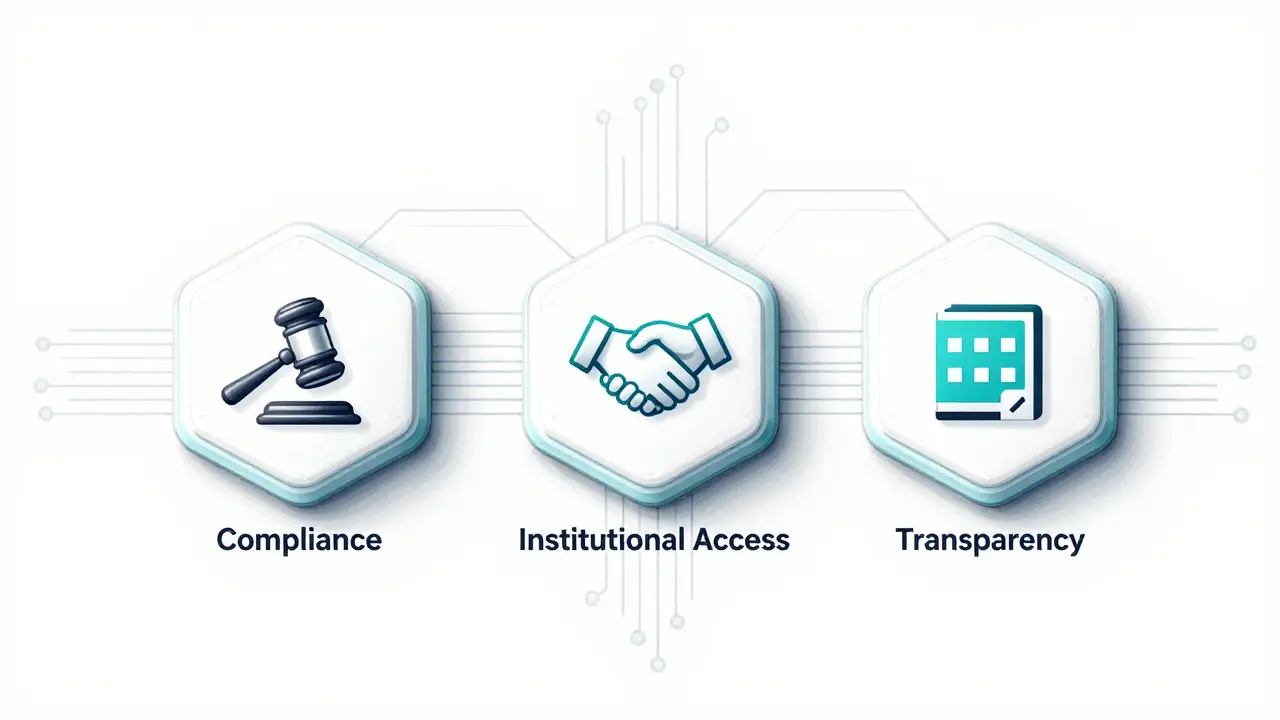
Forget “lowest fees” or “most coins.” Those are table stakes. In 2025, the real differentiators are:- Regulatory licenses-Can you operate legally in the U.S., EU, or Japan? If not, you’re a liability.
- Institutional access-Are hedge funds and family offices using your platform? That’s the next wave of capital.
- Security track record-No major hacks in the last 3 years? That’s rare. And valuable.
- Transparency-Do you publish proof-of-reserves? Can users verify their holdings on-chain?
- Geographic flexibility-Can users from Brazil, Nigeria, or Indonesia sign up without a VPN?
The Future Isn’t One Exchange-It’s a Network
The idea that one exchange will dominate the world is dead. Instead, we’re seeing a network of specialized platforms. Some focus on derivatives. Others on stablecoins. Some are built for DeFi. Others for NFTs. The CEOs who win aren’t trying to be everything to everyone. They’re doubling down on what they do best. Richard Teng isn’t chasing Coinbase’s U.S. users. He’s building bridges with institutional investors in Europe and Asia. Dave Ripley isn’t trying to undercut Binance on fees-he’s making sure Kraken stays on the right side of every regulator. Coinbase isn’t becoming a derivatives hub. It’s becoming the gateway for mainstream finance to enter crypto. The winner in 2025 won’t be the loudest. It’ll be the most reliable.What Should You Look For in a Crypto Exchange?
If you’re choosing a platform today, here’s what actually matters:- Check if it’s licensed in your country. A license isn’t a guarantee-but an unlicensed exchange is a gamble.
- Look for proof-of-reserves. If they won’t show it, don’t trust them.
- Don’t chase the highest yield on staking. High returns often mean high risk.
- Use two-factor authentication. Always. Even if it’s annoying.
- Keep large holdings off exchanges. Use a hardware wallet. Seriously.
Is Binance still the biggest crypto exchange in 2025?
Yes, Binance still handles the largest share of global crypto trading volume, despite ongoing legal challenges. Under CEO Richard Teng, the platform has shifted focus from rapid growth to regulatory compliance and institutional adoption. While its U.S. operations are limited, it remains dominant in Europe, Asia, and emerging markets.
Is Kraken safe to use in 2025?
Yes, Kraken is considered one of the safest exchanges due to its long-standing compliance efforts and multi-jurisdictional licensing. It has licenses in the U.S., EU, UK, Australia, Japan, and Canada. Although it settled an SEC case for $30 million and still faces a second lawsuit, its operational transparency and security record make it a trusted option for users prioritizing regulation over low fees.
Why is Coinbase more trusted than other exchanges?
Coinbase is the only major crypto exchange registered as a broker-dealer with the U.S. SEC. It also has public financial reporting, strong security protocols, and a clean record with regulators in the U.S. and Europe. While its fees are higher and its platform less suited for advanced traders, it’s the go-to choice for beginners and institutions looking for legal legitimacy.
What changed in U.S. crypto regulation in 2025?
The biggest change was the resignation of SEC Chair Gary Gensler in January 2025 and his replacement by Paul Atkins, who signaled a more collaborative approach toward crypto. Combined with new leadership in the White House, this created a more favorable regulatory environment. The CFTC is now being considered as a primary crypto regulator, and the CFPB has stepped back from applying consumer rules to crypto assets-reducing legal uncertainty for exchanges.
Should I use a crypto exchange for long-term storage?
No. Exchanges are designed for trading, not storage. Even the most secure platforms have been hacked in the past. For long-term holding, move your crypto to a hardware wallet like Ledger or Trezor. Exchanges should only hold what you plan to trade in the next few days.
Are there crypto exchanges that are completely legal in the U.S.?
Yes. Coinbase, Kraken, and Gemini are fully licensed and regulated in the U.S. They comply with state money transmitter laws and federal reporting requirements. Other exchanges either don’t serve U.S. users or operate in a legal gray area. Always verify a platform’s U.S. licensing status before depositing funds.

Sammy Tam
December 15, 2025 AT 15:06Really liked how this broke down the real differentiators now-licenses, transparency, institutional access. It’s wild how much the game changed from ‘get rich quick’ to ‘don’t get sued.’ Binance’s volume is insane, but Kraken’s compliance is the quiet hero here. And Coinbase? They’re the gateway drug for grandma’s 401k now. 😅
Madhavi Shyam
December 17, 2025 AT 02:33Proof-of-reserves is non-negotiable. If they can’t show on-chain attestations via Merkle trees, it’s not a custody solution-it’s a ponzi waiting to happen.
Terrance Alan
December 17, 2025 AT 22:34Let’s be real nobody cares about compliance when your wallet’s empty. The whole system is rigged. SEC didn’t change its mind they just got bored chasing ghosts and found a new target-your savings.
Craig Nikonov
December 19, 2025 AT 05:06Paul Atkins? That’s the same guy who helped deregulate derivatives in 2008. This isn’t clarity-it’s a trap. They’re letting crypto breathe so they can strangle it later with a compliance noose.
Cheyenne Cotter
December 21, 2025 AT 02:56I’ve been using Kraken since 2020 and honestly their support team is the only one that ever replied to my ticket without auto-replies. They’ve got this weird culture where compliance isn’t a department-it’s a religion. And yeah, it’s expensive, but when you’ve got $200k in BTC and you’re not getting hacked, you’ll pay for it. I don’t care if their UI looks like it was designed in 2014.
Meanwhile Binance’s app still crashes if you try to swap a meme coin during peak volatility. And don’t even get me started on their ‘trust center’-it’s a PR page with 17 different PDFs and zero real transparency. They say they’re rebuilding trust but their last audit was done by a firm that also audited FTX. Coincidence? I think not.
And Coinbase? They’re the corporate version of a Starbucks barista who remembers your name. Friendly, safe, but you’re paying $5 for a latte that tastes like lukewarm water. Great for beginners, useless if you’re doing anything beyond buying ETH once a quarter. Their fee structure is a joke for active traders.
But here’s the thing nobody’s talking about-regulatory arbitrage. The exchanges that are thriving now aren’t the ones that played nice with the U.S. They’re the ones that moved their HQ to Dubai or Singapore and built their tech stack around jurisdictional flexibility. That’s why you can still trade on Binance from Nigeria without a VPN but you can’t even open an account if you’re in Texas.
And the ‘network of specialized platforms’ idea? Spot on. Derivatives exchanges like Bybit and OKX are eating lunch on Binance’s leftovers. NFT marketplaces are becoming standalone entities. Even stablecoin issuers like Tether are acting like mini-banks now. The old model of one-stop-shop crypto malls is dead.
What’s scary is how many retail users still think ‘lowest fees’ means ‘safest.’ I saw someone on Twitter bragging about earning 28% APY on a new altcoin staking pool. Bro, that’s not yield, that’s a suicide pact. If it sounds too good to be true, it’s probably a rug pull wrapped in a whitepaper.
And don’t even get me started on the new ‘crypto ETFs’-they’re just Wall Street’s way of repackaging volatility as a mutual fund. You think you’re getting exposure to Bitcoin but you’re actually paying 0.95% management fees to someone who doesn’t even hold the actual coin.
Bottom line: if you’re not using a hardware wallet, you’re not serious. If you’re not checking proof-of-reserves monthly, you’re gambling. And if you think any CEO is ‘saving’ crypto… you’re still living in 2021.
Bradley Cassidy
December 21, 2025 AT 09:40kraken is legit but their customer service still takes 3 days to reply to a simple withdraw issue… i swear they hire interns from a different planet
Shruti Sinha
December 23, 2025 AT 02:51Actually, Kraken’s response time improved after hiring a dedicated compliance support team in 2024. Their ticket resolution time dropped from 72 to 18 hours.
Heather Turnbow
December 24, 2025 AT 03:49I appreciate the nuance in this piece. It’s rare to see a discussion that doesn’t reduce crypto leadership to either ‘crypto bros’ or ‘corporate sellouts.’ The real story is the quiet, unglamorous work of legal teams, auditors, and compliance officers-who don’t get headlines but keep the lights on.
Jesse Messiah
December 25, 2025 AT 16:43totally agree with heather. the unsung heroes here are the compliance officers who work weekends so you don’t get your account frozen. shoutout to the people who make this stuff actually work 💪
Donna Goines
December 26, 2025 AT 03:40Paul Atkins was on the board of a crypto firm that got fined $120M in 2021. This is a puppet. The real power is still in the DOJ and the Treasury’s OFAC. They’re just letting the SEC be the face while they quietly freeze wallets behind the scenes.
Jonny Cena
December 27, 2025 AT 20:07Everyone’s got their favorite exchange but honestly? You don’t need to pick one. Use Coinbase for buying, Kraken for holding, and Binance for trading altcoins if you’re outside the U.S. It’s not ideal but it’s the reality. Just don’t leave more than you’re willing to lose on any of them.
Greg Knapp
December 28, 2025 AT 01:33they’re all scams anyway why are we even talking about who’s the least bad
Jack Daniels
December 29, 2025 AT 15:42if you think any of these exchanges are safe you’re the one who’s gonna lose everything. remember Mt. Gox? remember FTX? they’re all the same. just different logos.
Mark Cook
December 31, 2025 AT 13:32the SEC is just waiting for us to get comfortable 😈
Sean Kerr
January 1, 2026 AT 15:47YESSSS!! 🙌 I’ve been saying this for years-use a hardware wallet! I got a Ledger Nano X last year and my peace of mind? Priceless. Also, stop trusting exchanges with your life savings. They’re not banks. They’re tech companies with a wallet app. 🛡️
Sally Valdez
January 2, 2026 AT 05:16USA is weak. You guys let your government dictate your financial freedom? In India we just use P2P and laugh while you guys fill out KYC forms. Binance doesn’t care about your passport-it cares about your volume. Real traders don’t need licenses, they need liquidity.
Samantha West
January 2, 2026 AT 08:07Regulatory clarity, as it pertains to the current iteration of federal oversight, is a semantic construct designed to mask the institutional capture of nascent financial technologies by entrenched interests. The appearance of cooperation is not synonymous with substantive reform.
Timothy Slazyk
January 4, 2026 AT 00:00There’s a deeper truth here that nobody’s naming: the real winners aren’t the exchanges. They’re the lawyers. The compliance consultants. The auditors. The PR firms. Crypto’s biggest profit center in 2025 isn’t trading-it’s paperwork. And the people who built empires on this aren’t coders or traders. They’re the ones who turned chaos into contracts.
Richard Teng didn’t save Binance-he turned it into a compliance consultancy with a trading platform attached. Dave Ripley didn’t build a safer exchange-he built a legal fortress. And Coinbase? They’re not a crypto company anymore. They’re a fintech subsidiary of a Wall Street bank with a shiny app.
The real question isn’t who’s leading the pack. It’s who’s profiting from the illusion that anyone’s leading at all.
Every time you hear ‘regulatory clarity,’ translate it in your head as ‘we’ve priced the cost of compliance into your fees.’ Every time a CEO says ‘we’re building for the future,’ they mean ‘we’ve hired 50 new lawyers and raised our fees by 40%.’
The innovation isn’t in the tech anymore. It’s in the bureaucracy. And that’s the most disturbing part.
We used to believe crypto was about freedom. Now it’s about filing Form 10-Ks in triplicate.
And we’re calling this progress.