
CPUfinex Crypto Exchange Review: Is It Legit or a Scam?
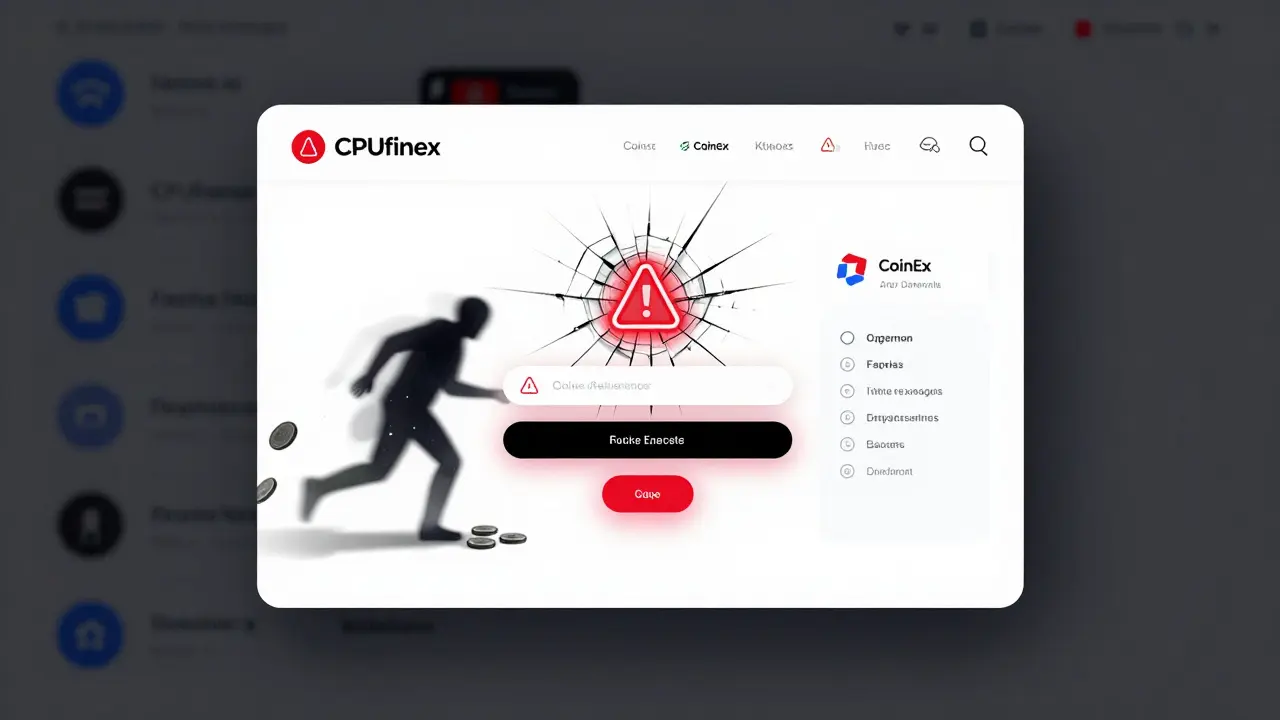
There’s no such thing as a legitimate crypto exchange called CPUfinex. If you’ve seen ads, pop-ups, or social media posts pushing CPUfinex as a new trading platform, you’re being targeted by a scam. This isn’t a glitch or a new startup-it’s a carefully designed fraud that copies the names of real exchanges like CoinEx to trick people into depositing money they’ll never see again.
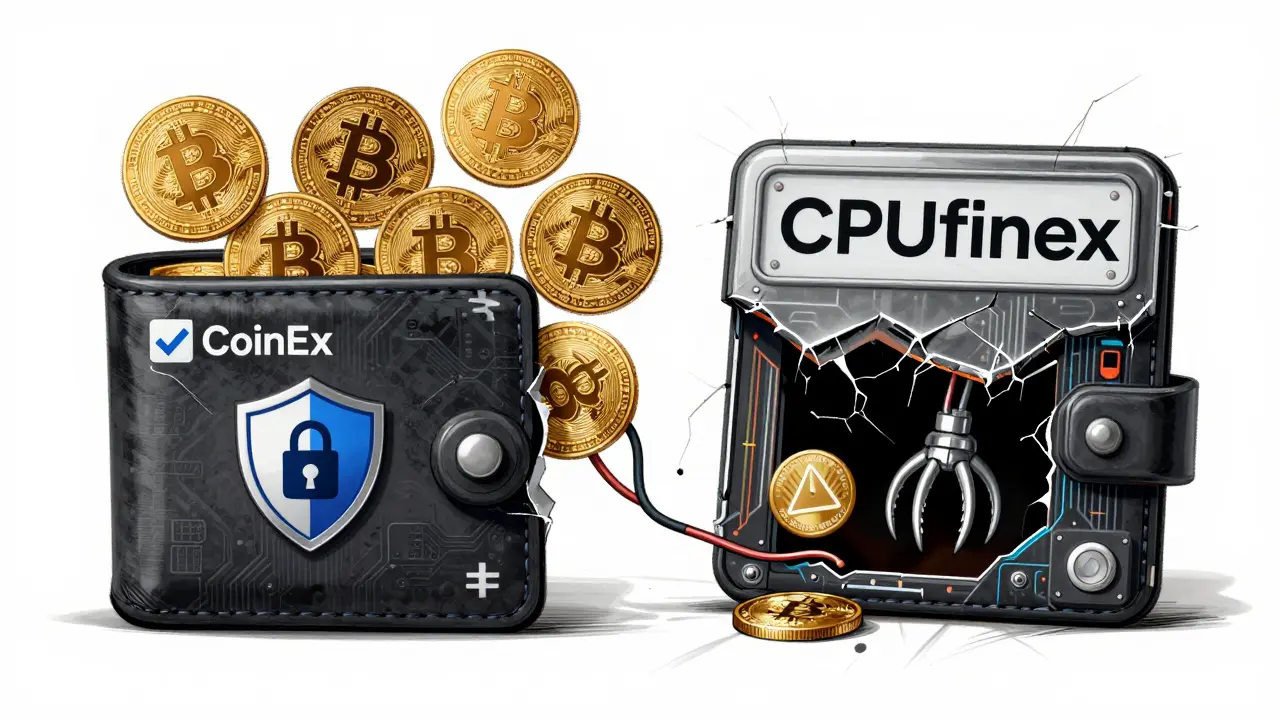
Scammers don’t randomly pick names. They study what users search for. CoinEx is a real, well-known exchange with over 1,200 cryptocurrencies, verified reserves, and a trust score of 94 on CoinGecko. So scammers change one letter: CoinEx becomes CPUfinex. It’s the same pattern used by fake sites like 24bitexup.com, 24bitfex.com, and 24bitnex.com. All of them follow the same trick: take a trusted name, swap out a word, and hope you don’t notice.
How CPUfinex Tricks You
The scam starts with a simple promise: "High returns," "No KYC," "Instant withdrawals." You land on a website that looks professional-clean design, fake testimonials, even a "24/7 support" chatbot. But here’s the catch: there’s no real team behind it. No LinkedIn profiles. No registered office. No public history. CoinEx was founded in 2017. CPUfinex? Zero traceable history.
When you sign up, you’re asked to deposit crypto. Maybe it’s Bitcoin, Ethereum, or USDT. The site shows your balance going up. It even sends fake confirmation emails. But here’s what doesn’t happen: your funds never enter a real exchange wallet. They go straight into a wallet controlled by criminals. Once you try to withdraw, you’ll be hit with fees-sometimes over 50%-or told your account needs "verification" before you can access your money. That’s when the silence starts.
Why You Won’t Find CPUfinex on Any Trusted Platform
Check CoinGecko. Check CoinMarketCap. Check TradingFinder. Check Coinspeaker’s 2025 best exchanges list. You won’t find CPUfinex anywhere. Not because it’s new. Not because it’s niche. Because it doesn’t exist. Legitimate exchanges must prove their trade volume, security practices, and team background to be listed. CPUfinex meets none of these standards.
Even no-KYC exchanges like Pionex or Koinly have clear rules: name, country, email. CPUfinex either asks for nothing-or asks for too much, like your ID and selfie, just to steal your personal data. That’s not convenience. That’s identity theft.
What Real Exchanges Do vs. What CPUfinex Does
| Feature | CoinEx (Legitimate) | CPUfinex (Scam) |
|---|---|---|
| Founded | 2017 | No verifiable date |
| Regulatory Status | Clear jurisdiction policy (avoids USA/Canada) | No regulatory info, targets restricted markets |
| Proof of Reserves | Verified by third-party audits ($1.2B in reserves) | No audits, no transparency |
| Security | 256-bit SSL, multi-sig cold wallets, 8 global data centers | Basic WordPress site, no encryption details |
| Customer Support | 24/7 live chat, ticket system, verified social media | Fake chatbots, unresponsive contact forms |
| Trust Score | 94/100 on CoinGecko | No rating on any trusted platform |
| Withdrawal Fees | 0.1%-0.2% standard | Up to 50% or blocked entirely |

Red Flags You Can’t Ignore
- No official social media-No verified Twitter, Telegram, or Discord. Real exchanges have active, verified accounts with thousands of followers.
- URL tricks-Look closely: is it cpufinex.com? cpufinex.io? cpufinex.net? Real exchanges use clean domains like coinex.com.
- Too-good-to-be-true bonuses-"Deposit $100, get $500 free"? That’s not a bonus. It’s bait.
- No mobile app-CoinEx has apps on iOS and Android. CPUfinex? Only a mobile website. Real exchanges invest in apps.
- Zero reviews-Check Trustpilot, Reddit, or even ScamAdviser. CPUfinex has no history. Legitimate exchanges have hundreds of verified user reviews.
What Happens When You Deposit
Let’s say you ignore the red flags and send over 0.5 BTC. Here’s what happens next:
- Your funds disappear from your wallet and show up as a balance on the CPUfinex site.
- You try to trade. The interface works. You even see "profits."
- You try to withdraw. You’re asked to pay a "security fee" or "tax fee"-often 30%-50% of your balance.
- You pay it. Now they say your account is "under review."
- You contact support. The chatbot stops responding. Emails bounce.
- Within days, the site vanishes. The domain goes offline. Your crypto is gone.
There’s no appeal. No legal recourse. These operations are run from offshore locations with no extradition treaties. Law enforcement can’t touch them.
What to Use Instead
If you want to trade crypto safely, stick to platforms with real track records:
- CoinEx-1,200+ coins, low fees, CET token discounts, verified reserves.
- Bybit-Strong futures trading, transparent audits, 24/7 support.
- KuCoin-No-KYC option available, wide asset selection, active community.
- Bitget-Copy trading, educational resources, solid security.
All of these are listed on CoinGecko with trust scores above 85. They have public team members, real offices, and documented security practices. You can verify their existence. You can’t do that with CPUfinex.
How to Protect Yourself
- Always check the exact URL before logging in. A single letter change is all scammers need.
- Search the exchange name + "review" on Reddit or CryptoScams forums. If people are reporting losses, walk away.
- Never trust a platform that doesn’t list its headquarters or legal entity.
- Use hardware wallets like Ledger or Trezor for long-term storage. Don’t leave crypto on any exchange longer than needed.
- If something feels off, it is. Trust your gut.
The crypto space is full of innovation-but also full of predators. CPUfinex isn’t an exchange. It’s a digital pickpocket. And right now, it’s targeting people who just want to trade crypto safely.
Is CPUfinex a real crypto exchange?
No, CPUfinex is not a real crypto exchange. It has no presence on CoinGecko, CoinMarketCap, or any legitimate review platform. It follows the naming pattern of known scam operations that mimic real exchanges like CoinEx. All evidence points to it being a fraudulent site designed to steal user funds.
What’s the difference between CoinEx and CPUfinex?
CoinEx is a legitimate exchange founded in 2017 with verified reserves, real team members, and a trust score of 94 on CoinGecko. It offers spot, margin, and futures trading with transparent fees. CPUfinex has no verifiable history, no audits, no customer support, and no regulatory standing. The only similarity is the name-used deliberately to confuse users.
Can I recover my money if I deposited into CPUfinex?
Almost certainly not. CPUfinex operates from offshore jurisdictions with no legal accountability. Once funds are sent, they are immediately moved to untraceable wallets. Law enforcement rarely recovers money from these scams. The best defense is prevention-never deposit into unverified platforms.
Why do scams use names like CPUfinex?
Scammers use names that sound similar to trusted exchanges because people search for "CoinEx" and accidentally type "CPUfinex." It’s called typosquatting. These sites rank in search results because they copy the branding, logos, and language of real exchanges. The goal is to catch users in a moment of distraction.
How do I verify if a crypto exchange is real?
Check if it’s listed on CoinGecko or CoinMarketCap. Look for a clear company registration, verified social media, public team profiles, and third-party audit reports. Real exchanges have transparent fee structures and customer support channels that respond within hours. If you can’t find any of this, it’s not safe.
Final Warning
If you’re considering CPUfinex, stop. There’s no hidden benefit. No secret advantage. No loophole. This isn’t a risky investment-it’s a guaranteed loss. The crypto world is hard enough without adding fake exchanges into the mix. Stick to platforms with real names, real history, and real transparency. Your crypto is too valuable to gamble on a name that doesn’t exist.



Bruce Doucette
March 15, 2026 AT 09:50LOL so CPUfinex is a scam? DUH. I saw this on Twitter and thought it was a meme. Like, who even types "CPUfinex"? 🤦♂️
Arlene Miles
March 17, 2026 AT 02:43It’s heartbreaking how many people get lured in by these tiny spelling tricks. You’re not dumb for clicking - the scammers are *brilliantly* manipulative. They exploit hope, not ignorance. Please, if you know someone who’s considering this - send them this post. Gently. With love.
Jessica Beadle
March 18, 2026 AT 23:20Typo squatting is a well-documented vector in phishing infrastructure, particularly in high-velocity, low-friction domains like crypto. The attack surface is amplified by SEO poisoning via keyword cannibalization - scammers register domain variants with high lexical similarity to established TLDs, then leverage paid social ads with lookalike UI/UX to achieve conversion rates upwards of 3.7% in certain demographic cohorts. This isn’t random. It’s a scalable business model with near-zero overhead.
Patty Atima
March 20, 2026 AT 00:25Just don’t click. That’s it.
Carol Lueneburg
March 20, 2026 AT 16:00So many people are just trying to get ahead 💔 I get it. But fake exchanges? They prey on that hope. Please, if you’re new - stick to the big names. CoinEx, KuCoin, Bybit. They’ve earned it. And if you’ve been scammed? You’re not alone. We’ve got your back. 🫂
Tobias Wriedt
March 22, 2026 AT 08:41Anyone who deposits into CPUfinex deserves to lose it. No KYC? "Instant withdrawals"? That’s not innovation - it’s a neon sign saying "I’m a sucker."
Taylor Holloman.
March 23, 2026 AT 03:51It’s wild, isn’t it? How something so simple - a single letter swapped - can unravel years of trust. I’ve seen people lose life savings over this. Not because they were greedy. Just because they were tired. Overworked. Hoping for a break. And scammers? They smell that. They don’t just steal money. They steal peace.
Bryan Roth
March 23, 2026 AT 10:38Real talk: crypto’s biggest enemy isn’t regulation. It’s laziness. People don’t check domains. They don’t Google reviews. They just see "CoinEx" and click. The scammers aren’t hackers - they’re psychologists. And we’re all just one distracted moment away from disaster. Stay sharp. Double-check. Always.
sai nikhil
March 23, 2026 AT 12:23Interesting analysis. In India, we see many such scams targeting new investors. The language used is often Hindi-English mix, and the websites are hosted on .in domains. The pattern is identical - fake testimonials, urgent offers, no legal info. Awareness is the only defense.
Sahithi Reddy
March 24, 2026 AT 10:18George Hutchings
March 25, 2026 AT 04:28Just came back from a trip to Mumbai. Saw three people trying to "invest" in something called "Cpufinex" on their phones. One guy said, "It’s the new CoinEx, bro." No joke. We need better public education. Not just tech literacy - emotional literacy too.
Steph Andrews
March 25, 2026 AT 10:12I’ve been in crypto since 2017 and I still double-check URLs. It’s not paranoia - it’s hygiene. Like washing your hands. No one thinks twice about it. Why should crypto be any different?
Prakash Patel
March 26, 2026 AT 15:46Wait - so you’re saying CoinEx is legit? I thought they were just another pump-and-dump. Maybe this whole thing is a distraction. Maybe CPUfinex is real and the others are the scam. Just saying.
Anastasia Thyroff
March 27, 2026 AT 06:01Oh my god I just lost $8,000 to this. I thought it was CoinEx. I swear I typed it right. I’m so stupid. I don’t even know what to do anymore. Please tell me there’s a way to get it back. I need help.
iam jacob
March 27, 2026 AT 18:57Why do you think they don’t shut these down? Because the same people who run the exchanges also run the regulators. This isn’t a scam - it’s a system. And you’re just a data point.
Jesse Pals
March 28, 2026 AT 04:21My cousin got burned by this last month. She cried for three days. I told her: "You didn’t lose money. You bought a lesson. Now you’re smarter." She’s using Ledger now. And she’s helping others check URLs. That’s growth. 💪
anshika garg
March 29, 2026 AT 11:16There’s a deeper layer here. It’s not just about crypto. It’s about how we assign trust in a digital world. We’ve outsourced verification to algorithms, domains, and logos. But none of that is real. Real trust is built through transparency, history, and accountability. CPUfinex thrives because we’ve forgotten how to build that. We’re all just clicking now.
Cheri Farnsworth
March 30, 2026 AT 17:09It is imperative that individuals engaged in digital asset transactions exercise due diligence prior to the deployment of capital into any unverified financial intermediary. The absence of verifiable corporate registration, coupled with the utilization of deceptive nomenclature, constitutes a prima facie indicator of illicit activity. One must not conflate convenience with credibility.
Gene Inoue
March 31, 2026 AT 16:36Oh please. You think this is the worst scam? Try "BitKan" or "Binance.US" - those are worse. And don’t even get me started on Coinbase’s tax lies. You’re focusing on the wrong monster. The real scam is the entire system.
Ricky Fairlamb
April 2, 2026 AT 01:28It is a well-established fact that typosquatting constitutes a form of cyber-squatting under the Anticybersquatting Consumer Protection Act (15 U.S.C. § 1125(d)). The deliberate registration of cpufinex.com - a domain phonetically and orthographically confusable with coinex.com - is not merely unethical; it is actionable under U.S. federal law. The fact that this has not been litigated speaks to systemic regulatory failure.
Tony Weaver
April 3, 2026 AT 04:48Let’s be honest - if you’re using CoinEx, you’re probably still getting rekt. They’re not "legit." They’re just better at PR. CPUfinex? At least they’re honest about being a scam. No fake audits. No LinkedIn influencers. Just pure greed. I respect that.
Lucy de Gruchy
April 3, 2026 AT 05:53What if this whole "scam" narrative is a cover? What if CoinEx is the real scam? They’ve been quietly draining wallets for years. CPUfinex? Maybe it’s a decoy. A honeypot. The government’s way of flushing out the real predators. Just saying.
Lauren J. Walter
April 3, 2026 AT 12:25I’m not saying CPUfinex is real… but what if it’s a test? Like, a government-run sting operation? To catch the scammers? Maybe they’re letting it run so they can track who falls for it. I mean… think about it.
Manali Sovani
April 5, 2026 AT 10:15This is not a scam. This is capitalism. People are poor. They want quick money. Scammers give them hope. That is the system. You cannot blame the fish for biting the hook. You must blame the pond.
Konakuze Christopher
April 6, 2026 AT 12:31They’re all scams. Every single one. Even Coinbase. They just have lawyers. CPUfinex? At least they don’t pretend to be clean. I’d rather lose to a liar than a liar with a degree.
S F
April 6, 2026 AT 18:27USA is weak. We let this happen. In China, they shut this down in 24 hours. In Russia, they jail the guys. Here? We write blog posts. Pathetic.