Lifinity Crypto Exchange Review: Solana DEX, LFNTY Token & Safety Guide
Have you ever watched your liquidity vanish because of impermanent loss? It is one of the most frustrating parts of being a liquidity provider in DeFi. You put your assets into a pool to earn fees, but if the price moves too far from when you entered, you end up with less value than if you had just held the coins in your wallet. This problem plagues almost every automated market maker (AMM) out there. But what if there was a protocol designed specifically to fix this?
Enter Lifinity, a decentralized exchange built on the Solana blockchain that uses oracle-based pricing to reduce impermanent loss for liquidity providers. Unlike traditional AMMs that rely solely on the ratio of tokens in a pool, Lifinity integrates external price data to keep trading pairs stable. It claims to be the first "proactive" market maker on Solana. But does it actually work? And more importantly, is it safe to use right now?
How Lifinity Works: The Oracle Advantage
To understand why Lifinity is different, you need to look at how standard decentralized exchanges operate. Most DEXs, like Uniswap or Raydium, use a constant product formula ($x \times y = k$). This means the price of an asset is determined entirely by the supply of tokens in the pool. If someone buys a large amount of Token A, its price goes up, and Token B’s price goes down. For liquidity providers, this creates a risk: if the real-world price of Token A skyrockets, the pool sells off Token A to buy Token B, leaving you holding mostly Token B when you withdraw.
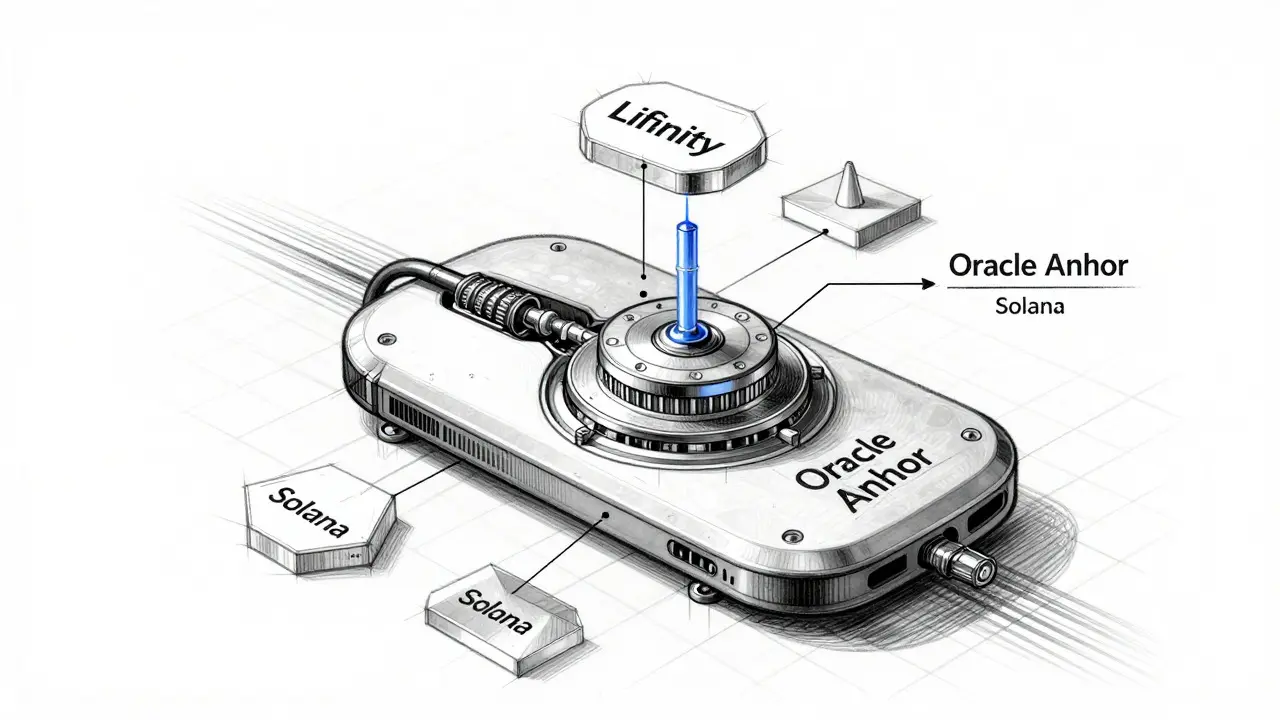
Lifinity changes this dynamic by introducing Oracle technology, which feeds real-time price data from trusted sources directly into the smart contract. Instead of letting the pool price drift wildly based on trade volume, Lifinity anchors the price to the oracle. This mechanism significantly reduces slippage for traders and minimizes impermanent loss for providers. In simple terms, the pool stays closer to the true market price, so your assets don't get rebalanced as aggressively against market trends.
This approach makes Lifinity particularly attractive for stablecoin pairs or volatile assets where you want to earn yield without betting heavily on price direction. However, relying on oracles introduces a new dependency. If the oracle fails or provides incorrect data, the pool could freeze or trade at unfair prices. This is a trade-off users must accept.
The LFNTY Token: Price, Supply, and Utility
Every DeFi protocol has a governance or utility token, and for Lifinity, that is LFNTY. As of August 2026, the token has seen significant volatility. Recent data shows LFNTY trading around $1.48, though this figure fluctuates daily. The token's performance is often tied to the broader sentiment of the Solana ecosystem and the overall health of the DeFi sector.
Here are some key metrics to consider before buying or holding LFNTY:
- Current Price Trend: The 50-day simple moving average sits at approximately $1.69, while the 200-day average is lower at $1.18. When the short-term average is below the long-term average, it often signals bearish momentum.
- Trading Volume: Daily volume remains relatively low, hovering around $2,840. Low volume can make it harder to enter or exit large positions without affecting the price.
- Market Rank: LFNTY ranks outside the top 5,000 cryptocurrencies by market cap, indicating it is a smaller-cap asset with higher risk.
- Technical Indicators: The 14-day Relative Strength Index (RSI) is around 33.83, suggesting the token may be oversold. The Fear and Greed Index stands at 43.61, reflecting caution among investors.
While some analysts project potential growth to $3.12 in the near term, these predictions are highly speculative. Long-term forecasts extending to 2034 suggest possible highs between $27 and $28, but remember: crypto markets are unpredictable. Always do your own research (DYOR) before investing.
| Feature | Lifinity | Raydium | Orca |
|---|---|---|---|
| Primary Mechanism | Oracle-anchored AMM | Standard AMM + CLMM | Whirlpool (Concentrated Liquidity) |
| Impermanent Loss Protection | High (via Oracles) | Low to Medium | Medium (User-controlled ranges) |
| Trading Volume (Daily) | Low (~$2.8K) | Very High | High |
| Best For | Stable pairs, LPs seeking reduced IL | High-volume trading, meme coins | Efficient capital deployment |
Safety First: Avoiding Scams and Phishing
If there is one thing you need to take away from this review, it is this: be extremely careful with URLs. Because Lifinity has gained some recognition, scammers have created fake websites to drain wallets. One notorious example is lfinity.io (missing the second 'i'). These sites mimic the legitimate interface perfectly. Once you connect your wallet, malicious scripts execute instantly, sending your funds to the attacker's address.
Blockchain transactions are irreversible. There is no customer support to call, no chargeback option. To stay safe:
- Always bookmark the official website (
lifinity.io) and never click links from social media or ads. - Use a hardware wallet like Ledger or Trezor for larger amounts.
- Check the contract addresses on verified explorers like Solscan before interacting.
- Look for security audits from reputable firms. While specific audit details were not fully detailed in recent reports, always verify the latest status on the project's official documentation.
The prevalence of these scams suggests that while Lifinity has a brand presence, it also attracts bad actors. Vigilance is your best defense.
User Experience and Community Sentiment
Using Lifinity requires a compatible Solana wallet, such as Phantom or Solflare. The process involves connecting your wallet, selecting a pool, and approving the transaction. For beginners, the learning curve is similar to other DeFi protocols. You need to understand concepts like gas fees (which are low on Solana), slippage tolerance, and liquidity provision.
However, community engagement appears limited. Compared to giants like Uniswap or even Solana-native competitors like Raydium, Lifinity has a smaller footprint in forums and discussion groups. Most online chatter focuses on price speculation rather than technical feedback or user experience reviews. This lack of active community discussion can be a red flag for some investors who rely on crowd-sourced insights.
Documentation quality is crucial for any DeFi platform. While Lifinity provides basic guides, the depth of developer resources and troubleshooting help is not as extensive as larger ecosystems. If you run into issues, you might find yourself waiting longer for support or relying on community Discord channels.
Is Lifinity Worth Using in 2026?
Lifinity offers a compelling solution to impermanent loss through its oracle-integrated design. For liquidity providers who want to earn yields on stable pairs or low-volatility assets, it presents a unique advantage over standard AMMs. The technology is sound, and the focus on capital efficiency aligns with the needs of sophisticated DeFi users.
However, the low trading volume and limited market ranking indicate that adoption is still slow. If you are looking for high liquidity and instant execution for large trades, established platforms like Raydium or Jupiter might serve you better. Lifinity is best suited for those who prioritize reduced impermanent loss over raw volume.
Before diving in, start small. Test the waters with a modest amount to familiarize yourself with the interface and withdrawal processes. Keep an eye on the LFNTY token's performance, but treat any price predictions with skepticism. The crypto market moves fast, and today's niche protocol could either grow into a staple or fade into obscurity.
What is the main benefit of using Lifinity?
The primary benefit is reduced impermanent loss for liquidity providers. By using oracle-based pricing, Lifinity keeps pool prices aligned with real-world market values, preventing the aggressive asset rebalancing that causes losses in traditional AMMs.
Is Lifinity safe to use?
The protocol itself is built on secure Solana smart contracts, but users face risks from phishing scams. Always verify the URL is lifinity.io and avoid clicking links from untrusted sources. Use hardware wallets for added security.
What is the LFNTY token used for?
LFNTY is the native governance and utility token of the Lifinity protocol. Holders may participate in governance decisions, and the token is often used for staking rewards or fee discounts within the ecosystem.
How does Lifinity compare to Raydium?
Raydium is a high-volume DEX focused on broad asset coverage and fast trading. Lifinity specializes in reducing impermanent loss via oracles, making it better for stable pairs and conservative liquidity providers, but it has much lower trading volume.
Can I lose money providing liquidity on Lifinity?
Yes. While impermanent loss is reduced, it is not eliminated. Smart contract risks, oracle failures, and general market downturns can still lead to losses. Always assess your risk tolerance before providing liquidity.