PayRue DEX Review: Features, Fees, and Verdict
Imagine swapping Bitcoin for Ethereum without worrying about skyrocketing gas fees eating your lunch money. That is the core promise of PayRue. This London-based platform isn't just another swap interface; it’s a hybrid ecosystem trying to bridge the gap between user-friendly centralized exchanges (CEXs) and the self-custody control of decentralized ones. If you are tired of handing over your private keys to third-party custodians but hate the complexity of traditional DeFi protocols, PayRue claims to have solved that friction.
But does it actually deliver? As someone who has watched the crypto landscape shift from wild speculation to serious infrastructure, I know that "hybrid" often means "compromised." Let’s break down whether PayRue’s DEX (Decentralized Exchange) is a viable tool for your portfolio or just another app cluttering your phone.
The Core Concept: Hybrid Decentralization
PayRue launched its DEX in October 2019 on the Binance Smart Chain (BSC), distinguishing itself by combining a decentralized wallet with a centralized order book model. Unlike pure AMM (Automated Market Maker) exchanges like Uniswap, where you trade against a liquidity pool, PayRue allows limit and market orders similar to what you’d see on Coinbase or Binance. The catch? You retain custody of your assets via the non-custodial PayRue Wallet.
This setup addresses two major pain points:
- Custody Risk: You hold your own private keys. No exchange can freeze your account arbitrarily.
- Trading Experience: You get familiar order types (limit/market) instead of just swapping tokens at whatever price the pool dictates.
The platform operates as part of a broader financial suite including invoicing, lending, staking, and even a chat function. It’s an ambitious attempt to create a one-stop shop for digital asset management, primarily targeting users who want autonomy without the steep learning curve of raw blockchain interactions.
Fees and The Propel Token Utility
Let’s talk money. One of PayRue’s biggest selling points is its fee structure. The platform advertises no gas fees when using the exchange directly because transaction costs are bundled into the trading fees. This is a significant advantage if you are trading smaller amounts where standard BSC gas fees might otherwise eat up 5-10% of your capital.
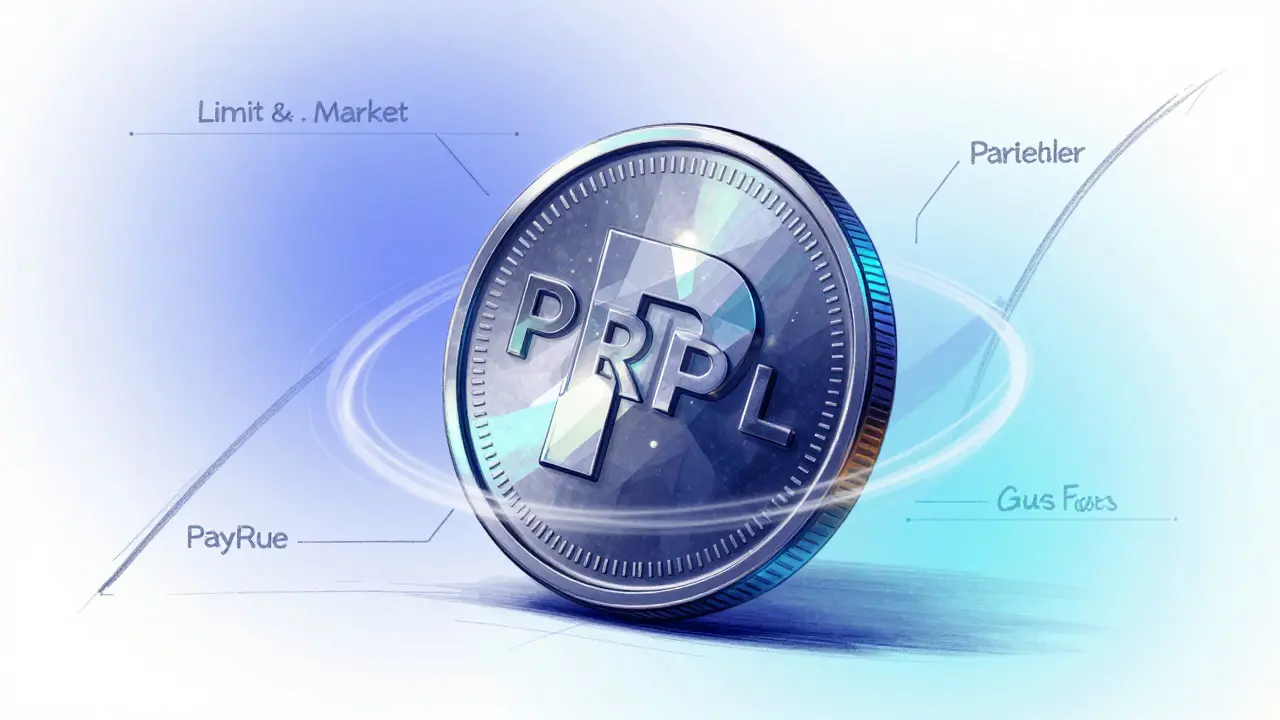
However, there is a twist involving the native token, Propel (PRPL). Built on the Stellar blockchain network, PRPL is not just a governance token; it’s the fuel for discounts. Holders receive reduced fees on market orders, and crucially, all limit orders are commission-free for PROPEL holders.
| Feature | Standard User | PROPEL Holder |
|---|---|---|
| Market Orders | Standard Trading Fee + Gas included | Discounted Trading Fee |
| Limit Orders | Standard Trading Fee | Commission-Free |
| Gas Fees | Included in trade cost | Included in trade cost |
| Staking Rewards | N/A | Earn PRPL rewards |
As of early 2026, PRPL trades at a fraction of a cent (approx. $0.0000098 USD). While this makes acquiring large quantities cheap, remember that low price doesn’t equal high value. The token’s utility is tied strictly to the PayRue ecosystem’s growth. If the user base shrinks, the demand for PRPL for fee discounts and governance likely follows suit.
Wallet Capabilities and Multi-Chain Support
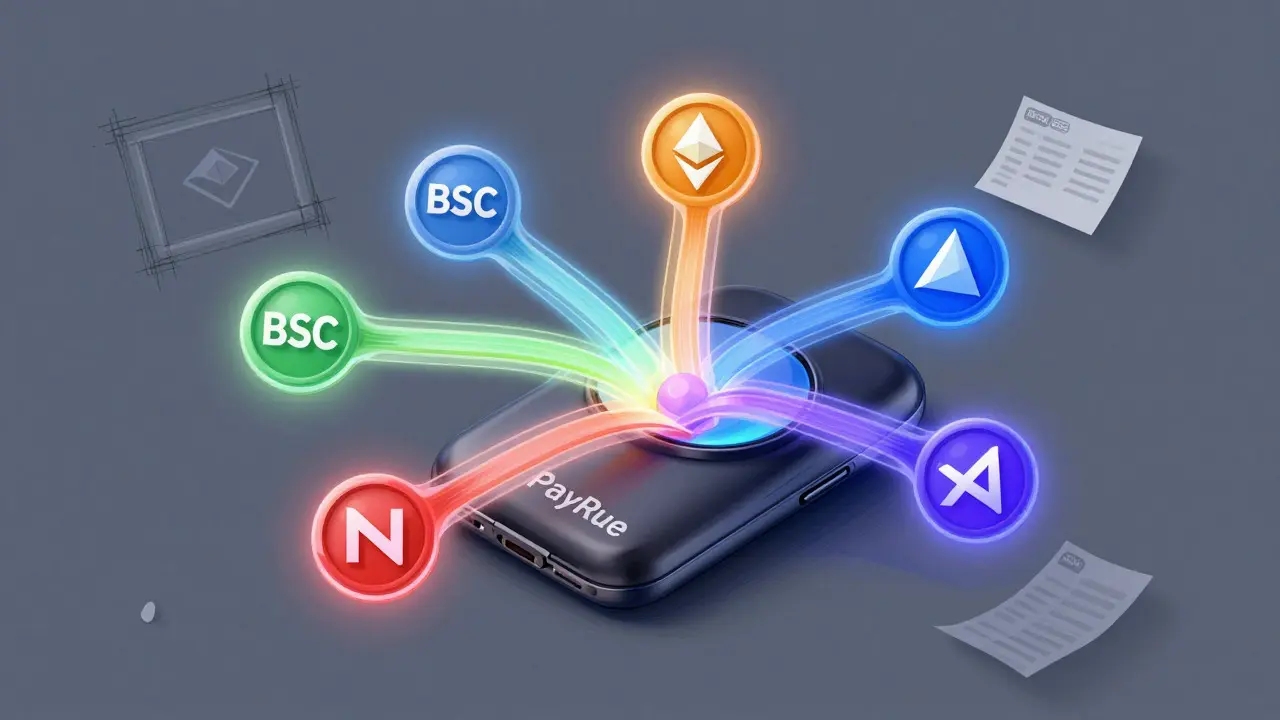
The PayRue Wallet is a multichain decentralized wallet supporting Binance Smart Chain (BSC), Ethereum, Polygon, Fantom, and Avalanche. This multi-chain support is vital for modern traders who don’t want to juggle five different wallets for five different ecosystems.
Key features include:
- Instant Swaps: Direct token swaps from the mobile app interface.
- NFT Management: View and manage NFTs across supported chains.
- WalletConnect Integration: Connect to other dApps seamlessly.
- Security Control: Full ownership of seed phrases and private keys.
The mobile-first design is evident here. The app emphasizes simplicity, hiding the complex RPC settings and contract addresses that often confuse newcomers. For a user in Wellington or anywhere else wanting to check balances across ETH and BSC without switching apps, this consolidation is genuinely useful.
Beyond Trading: Invoicing and Lending
Why would a freelancer care about a DEX? Because of the Invoicing feature. PayRue allows freelancers to send invoices payable in cryptocurrency, eliminating the need to manually convert fiat earnings later. This supports their mission of mass adoption by making crypto usable for actual work compensation.
Additionally, the platform offers lending and borrowing services for major assets like BTC and ETH. While interest rates are advertised as competitive, always compare them against established DeFi protocols like Aave or Compound. PayRue’s rates may be lower due to lower liquidity depth, which introduces slippage risk during large transactions.
The inclusion of PayRue Chat adds a social layer, allowing voice/video calls and group chats. It’s an interesting move to keep users engaged within the app rather than sending them to Telegram or Discord, though its practical impact on trading decisions remains debatable.
Risks and Limitations
No review is complete without highlighting the downsides. PayRue is not a giant like Binance or Kraken. Here is what you need to watch out for:
- Liquidity Depth: As a smaller player, liquidity pools may be shallower. Large trades could suffer from higher slippage compared to major CEXs.
- Token Volatility: PRPL’s extremely low price point ($0.0000098) indicates high volatility and potential lack of institutional backing. It is not listed on major CEXs like Binance, limiting exit liquidity for token holders.
- Regulatory Ambiguity: Being based in London provides some regulatory clarity, but DeFi regulations globally are still evolving. Ensure compliance with your local tax laws regarding crypto-to-crypto swaps.
- Smart Contract Risk: Like any DeFi protocol, bugs in smart contracts are possible. While PayRue has been operating since 2019, audits should always be reviewed for the latest versions.
Also, note that PayRue raised funds through Crunchbase rather than a traditional ICO/IEO. They distributed free tokens (2000 PRPL) to verified users. This distribution model helps decentralize ownership but also puts constant sell-pressure on the token as recipients cash out.
Who Should Use PayRue?
PayRue isn’t for everyone. It shines for specific personas:
Is PayRue safe to use?
PayRue is a non-custodial platform, meaning you hold your own keys. This reduces counterparty risk compared to centralized exchanges. However, you must secure your seed phrase properly. Always verify the official app download links to avoid phishing scams.
How do I buy Propel (PRPL) tokens?
You cannot buy PRPL directly on major centralized exchanges like Binance. You typically acquire it through decentralized exchanges on the Stellar network or via Latoken. New users often receive free PRPL upon KYC verification on the PayRue app.
Does PayRue charge gas fees?
When trading on the PayRue DEX, gas fees are bundled into the trading fee. You won't see separate gas deductions for each trade on the interface, simplifying cost calculation. However, standard network fees apply when withdrawing assets to external wallets.
Can I use PayRue for NFTs?
Yes, the PayRue Wallet supports holding and managing NFTs across multiple chains including Ethereum and Polygon. You can view your collection directly in the app and interact with marketplaces via WalletConnect.
What blockchains does PayRue support?
The wallet supports Binance Smart Chain (BSC), Ethereum, Polygon, Fantom, and Avalanche. The Propel token itself is built on the Stellar blockchain, while the sister exchange Propel DEX operates on Stellar.
If you are a casual trader who wants self-custody without the hassle of MetaMask extensions and confusing gas estimators, PayRue is worth a look. The integrated invoicing is a killer feature for freelancers paid in crypto. But if you are a high-frequency trader needing deep liquidity and tight spreads, stick to major CEXs or top-tier DEXs like Uniswap V3.