What Are Public and Private Keys in Cryptocurrency?

When you send or receive Bitcoin, Ethereum, or any other cryptocurrency, you’re not just typing in a string of letters and numbers. You’re using a pair of digital keys that work like a lock and key - but with one huge difference: the lock can be shared, and the key must never leave your hands.
How Public and Private Keys Work Together
Think of your public key as your cryptocurrency address. It’s the only thing you give to someone who wants to send you coins. It’s like your email address or your bank account number - you can post it on Twitter, print it on a business card, or even tattoo it on your arm (please don’t). Anyone can see it on the blockchain. It’s public. It’s meant to be shared. Your private key? That’s the secret. It’s a long, random string of letters and numbers - usually 64 characters long - that only you should ever know. It’s not a password you set. It’s mathematically generated from a random number and locked to your public key. If you lose it, you lose access to your funds forever. There’s no "forgot password?" button. No customer support. No recovery option. These two keys are linked through a one-way mathematical function called elliptic curve cryptography. That means: you can generate a public key from a private key. But you can’t go backward. Even the most powerful supercomputer on Earth can’t reverse-engineer a private key from its public key. That’s what makes the system secure.What Each Key Actually Does
- Public key: Used to receive funds and verify digital signatures. When someone sends you Bitcoin, they’re sending it to an address derived from your public key. When you sign a transaction, the network checks that the signature matches your public key - without ever seeing your private key.
- Private key: Used to sign transactions and prove ownership. Every time you move your crypto, your wallet uses your private key to create a unique digital signature. The network then uses your public key to confirm that the signature is valid. No private key? No signature. No signature? No transaction.
Here’s the catch: your wallet address - the one you copy and paste - isn’t your public key. It’s a shortened, hashed version of it. Think of it like an alias. But behind that alias is your real public key, and behind that is your private key. All three are connected. Lose one, and you lose everything.
Why Losing Your Private Key Means Losing Your Money Forever
There are millions of dollars locked in wallets where the owners lost their private keys. Some accidentally deleted their wallet files. Others wrote down their keys on paper, then lost the paper. A few even threw away old hard drives without realizing they held crypto. There’s no way to recover them. No bank to call. No reset button. The blockchain doesn’t care who you are - it only cares if you have the right key. Compare that to traditional banking. If you forget your bank password, you call customer service. They verify your identity. They reset it. In crypto? No one has that power. The whole point of the system is that no central authority controls your money. That’s freedom. But it’s also responsibility - and it’s absolute.
Public Keys Are Safe to Share. Private Keys Are Not.
You might hear someone say, "I gave my public key to a friend so they could send me ETH." That’s fine. Totally normal. Public keys are designed to be shared. Even if someone gets your public key, they can’t spend your coins. They can’t even see your balance unless they look up your address on a blockchain explorer. But if someone gets your private key? Game over. They can drain your wallet in seconds. No warning. No alert. Just gone. That’s why you’ll see crypto veterans warning new users: "Never type your private key into a website. Never screenshot it. Never store it in the cloud. Never share it with anyone - not even your mom."Recovery Phrases: Your Safety Net
Most wallets today don’t make you memorize or manually save a 64-character private key. Instead, they give you a recovery phrase - usually 12 or 24 words like "apple banana cat dog..." - generated from your private key. This phrase is the master key to your entire wallet. If you lose your phone or your wallet app, you can reinstall the app and enter this phrase to restore access to all your funds. But here’s the problem: if someone else gets your recovery phrase, they can restore your wallet on their device and steal everything. So treat your recovery phrase like your private key: write it down on paper, store it in a safe place, and never digitize it. No photos. No cloud backups. No Google Docs.How Wallets Handle Keys Automatically
Most people don’t see their private keys at all. Software wallets like MetaMask, Trust Wallet, or Exodus generate them automatically when you create an account. They store them encrypted on your device. You interact with them through a simple interface: click "send," enter the amount, confirm. Behind the scenes, your wallet uses your private key to sign the transaction. Hardware wallets - like Ledger or Trezor - take it further. They generate and store your private key inside a physical device, disconnected from the internet. When you send crypto, you plug in the device, confirm the transaction on its screen, and sign it there. Even if your computer gets hacked, your keys stay safe.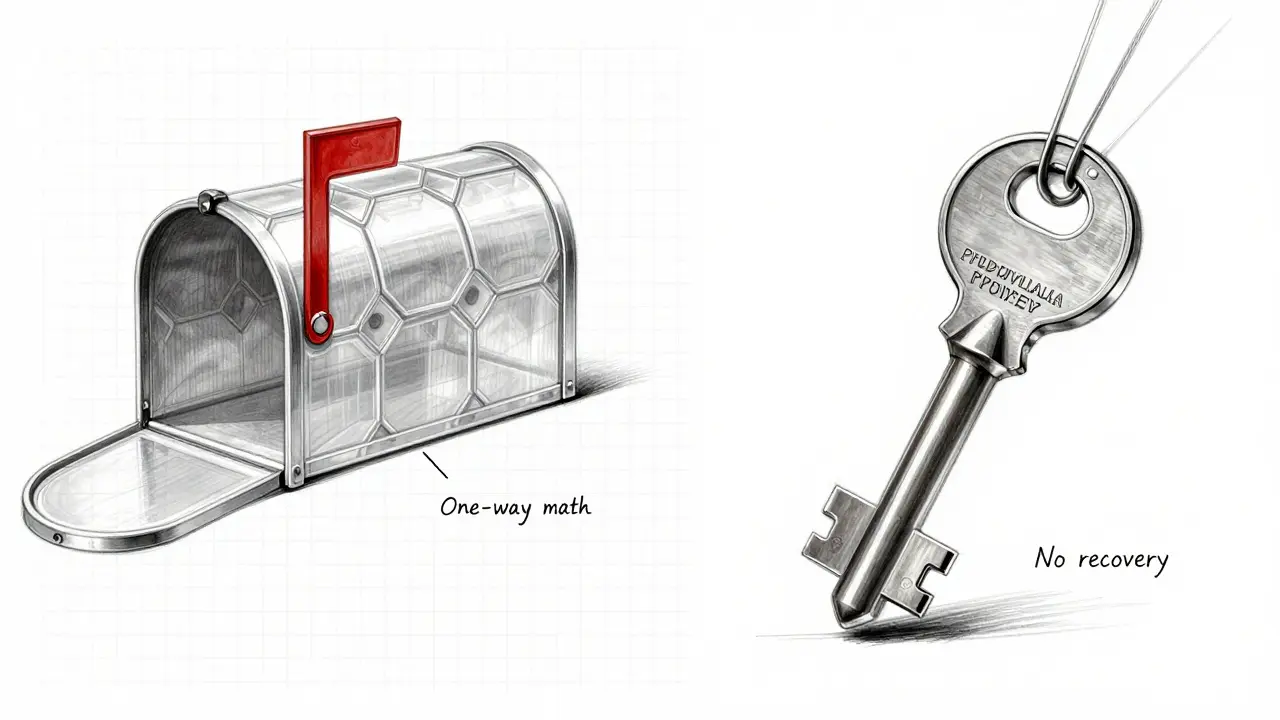
What Happens If Your Private Key Is Stolen?
If your private key is compromised - say, you downloaded a fake wallet app or clicked a phishing link - your funds are at risk. Once a thief has it, they can transfer your coins to their own wallet. The blockchain records the transfer as valid. The network doesn’t know it was stolen. It just sees a valid signature. That’s why security experts say: the most important thing in crypto isn’t the price of Bitcoin - it’s how you store your keys. A $50,000 wallet is worthless if the key is stored on an unsecured phone. A $100 wallet is safe if the key is printed and locked in a fireproof safe.Why This System Is Revolutionary
Before crypto, money was controlled by banks, governments, and payment processors. They held your funds. They froze accounts. They reversed transactions. They charged fees. Crypto changed that. It gave you direct ownership. But that ownership only exists because of public and private keys. No middleman. No approval. No permission. Just math. And if you understand how these keys work, you’re not just using crypto - you’re truly in control of it.What You Should Do Right Now
- If you own crypto: Check where your private key or recovery phrase is stored. Is it on paper? In a safe? Or on your phone, cloud, or email?
- If you don’t have a recovery phrase written down: Back it up now. Use a piece of paper. Write clearly. Store it away from your devices.
- If you’re new: Don’t trust any app that asks for your private key. Legitimate wallets never ask for it. If they do, close the app. Walk away.
Public keys let you receive money. Private keys let you own it. One is a mailbox. The other is the only key to that mailbox. Treat them differently. Because in crypto, you are your own bank - and the only thing standing between you and total loss is whether you know where your private key is.
Can someone steal my crypto if they have my public key?
No. Your public key is like your bank account number - it’s meant to be shared. Anyone can see it and send you funds, but they can’t take money out. Only the private key can sign transactions and move funds. So if someone has your public key, they can’t steal from you.
What happens if I lose my private key?
You permanently lose access to your cryptocurrency. There is no recovery option. No customer service. No reset. The blockchain doesn’t store your private key - it only records transactions tied to your public key. Without the private key, there’s no way to prove ownership. Millions of dollars are locked in wallets because their owners lost their keys.
Is my wallet address the same as my public key?
Not exactly. Your wallet address is a shortened, hashed version of your public key. It’s designed to be easier to copy and paste. But behind every address is a public key, and behind that is a private key. If you lose your private key, you lose access even if you still have the address.
Why do wallets use recovery phrases instead of private keys?
Recovery phrases (also called seed phrases) are easier to write down and remember than a 64-character string of random letters and numbers. They’re generated from your private key and can recreate all your keys if you lose your wallet. But they’re just as powerful - if someone gets your recovery phrase, they can steal everything. Treat it like your private key.
Can quantum computers break private keys?
Theoretically, yes - but not yet. Quantum computers could one day break the elliptic curve cryptography used in most cryptocurrencies. But current quantum machines are nowhere near powerful enough. Experts estimate it could take 10-20 years. Until then, the system remains secure. Some blockchains are already preparing for this with quantum-resistant algorithms.