Cellana Finance Review: Is This Aptos DEX Safe in 2026?
Imagine finding a new decentralized exchange that promises to solve the biggest headache in DeFi: unsustainable token emissions. That’s exactly what Cellana Finance is a community-owned decentralized exchange (DEX) built on the Aptos network, pioneering the ve(3,3) governance model to create sustainable liquidity incentives without continuous token inflation. It launched in 2023 as a division of Ocean Floors Technology Ltd, aiming to fix the flaws seen in giants like Uniswap and PancakeSwap. But does it actually work, or is it just another shiny new protocol destined for obscurity? As we look at the landscape in 2026, Cellana presents a fascinating case study in niche innovation versus mainstream viability.
The Core Problem Cellana Tries to Solve
Most major DEXs rely on printing more tokens to reward liquidity providers. This sounds great until you realize your rewards are worth less every day because there are so many of them. This is known as "token emission" or inflation. Projects like SushiSwap have struggled with this, seeing their native tokens lose value rapidly despite high trading volumes. Cellana Finance was built to break this cycle. Instead of printing endless tokens, it uses a system where existing holders lock up their tokens to earn fees. This creates scarcity and aligns the interests of traders, liquidity providers, and long-term holders.
How the ve(3,3) Model Works
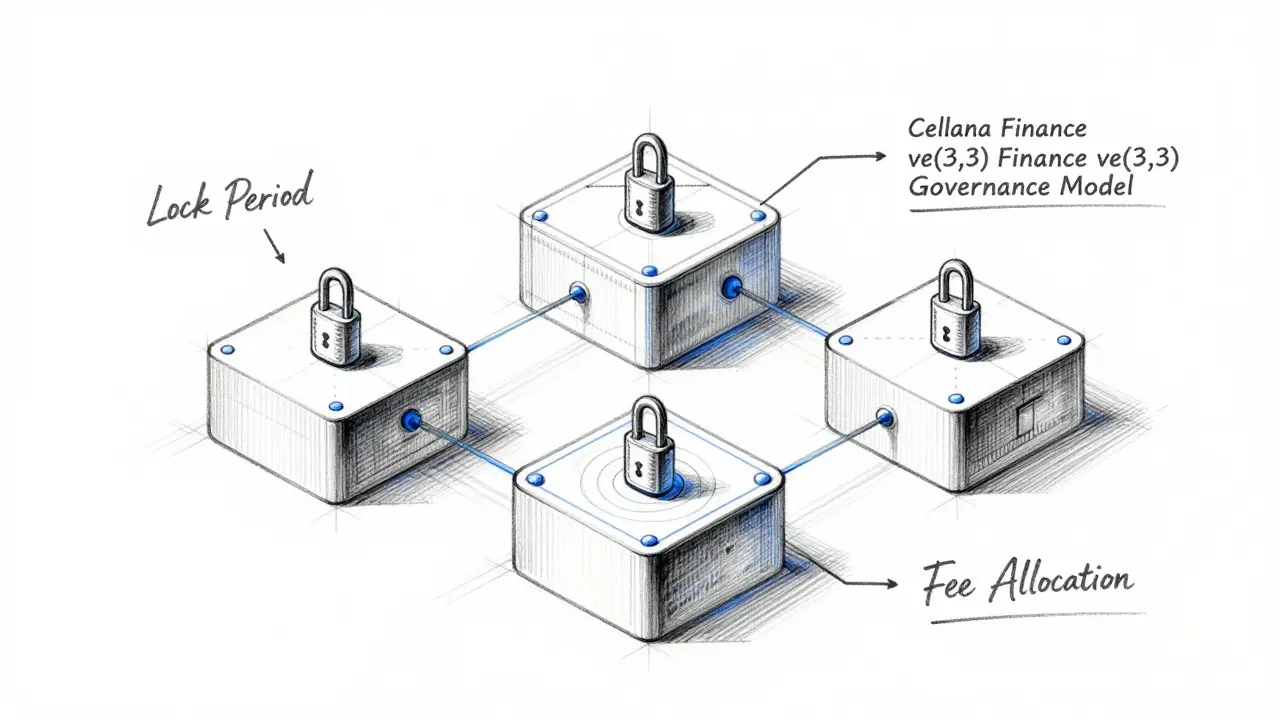
The heart of Cellana’s strategy is its implementation of the ve(3,3) model, which is a governance mechanism where users lock CELL tokens to receive vote-escrowed NFTs (veCELL), granting them voting power over liquidity pool emissions proportional to their lock duration. Here is how it plays out in practice:
- Locking Tokens: You take your CELL token, which has a total supply of 1,083,370,166 tokens, serving as the native governance and utility asset for the Cellana Finance ecosystem and lock them in the protocol. The lock period can range from two weeks to two years.
- Earning Voting Power: The longer you lock, the more voting power you get. This power isn’t just for show; it determines which liquidity pools receive trading fee incentives.
- Sustainable Incentives: Because the incentives come from actual trading fees rather than newly printed tokens, the system doesn’t dilute the value of the token over time. This is a significant departure from the standard Automated Market Maker (AMM) models used by most competitors.
This model was originally popularized by Curve Finance on Ethereum, but Cellana is notable for being the first to successfully implement it on the Aptos blockchain, using the Move programming language to ensure resource-oriented security and prevent common smart contract vulnerabilities found in Solidity-based contracts. Move is designed to treat digital assets as resources that cannot be accidentally duplicated or destroyed, adding a layer of safety that Ethereum’s older codebase sometimes lacks.
Trading Experience and Liquidity Realities
If you are looking to trade large amounts of crypto, Cellana might not be your first stop. Let’s look at the numbers. As of late 2024 data, Cellana’s daily trading volume hovered around $118,000. Compare that to Uniswap, which handles billions daily. Why such a huge gap? It comes down to liquidity depth. With only about seven active trading pairs, the order books are shallow. If you try to swap a large amount-say, $5,000-you will likely experience significant slippage, meaning you get fewer tokens than expected because your trade moves the market price too much.
However, for smaller trades under $1,000, the experience can be smooth. The platform uses a hybrid swap engine tailored for different asset correlations, which helps optimize prices for specific pair types. Users report that the interface is clean and intuitive, especially if you are already familiar with other DeFi platforms. But don’t expect advanced features yet. There are no limit orders, no stop-losses, and no fiat on-ramps. You need to bridge crypto onto Aptos first using wallets like Petra or Martian.
| Feature | Cellana Finance | Uniswap | PancakeSwap |
|---|---|---|---|
| Network | Aptos | Ethereum / L2s | BNB Chain |
| Governance Model | ve(3,3) (Fee-based) | ERC-20 Vote | Token Staking |
| Daily Volume (Approx.) | $118k | $12.8B+ | $3.8B+ |
| Security Audits | Limited/None Public | Multiple Top-Tier | Multiple Top-Tier |
| Best For | Niche Arbitrage / Early Adoption | High Volume / Stability | Retail Trading / Low Fees |

Security Concerns and Due Diligence
Here is where things get tricky. In the world of DeFi, trust is earned through transparency, specifically security audits. Major projects hire firms like CertiK or OpenZeppelin to review their code. For Cellana, public documentation regarding comprehensive third-party security audits is scarce. This is a red flag for conservative investors. According to Chainalysis data from 2024, nearly 80% of DeFi hacks involved unaudited or poorly audited code. While the Move language itself is secure, the specific implementation of Cellana’s contracts needs verification.
Furthermore, the regulatory environment is shifting. The SEC has hinted that certain veToken models could be classified as securities, which adds legal uncertainty. If Cellana wants to survive long-term, it needs to address these compliance issues. Currently, the project relies heavily on its small but active community for support, with response times via Telegram ranging from 12 to 24 hours. There is no dedicated customer service team, which is typical for early-stage DeFi protocols but risky for newcomers.
Tokenomics and Market Performance
The CELL token has had a volatile ride. After reaching an all-time high of $0.0672 in October 2024, it dropped roughly 91% to trade around $0.0061. This sharp decline reflects broader market skepticism toward low-cap DeFi projects. With a fully diluted valuation of only $6.63 million, Cellana is a micro-cap asset. This means it has high potential for growth if adoption spikes, but also high risk of failure if liquidity dries up completely.
The token distribution is critical here. Since the total supply is fixed and locked tokens are removed from circulation, the circulating supply decreases over time as people lock their tokens for votes. This deflationary pressure *could* support the price if demand remains steady. However, without increased trading volume to generate real fees, the economic model struggles to sustain itself against larger competitors.

Who Should Use Cellana Finance?
Not everyone should jump into Cellana right now. Here is who fits the profile:
- Early Adopters: You believe in the Aptos ecosystem and want to bet on its future growth before it becomes mainstream.
- DeFi Veterans: You understand gas fees, slippage, and impermanent loss, and you know how to use wallets like Petra safely.
- Small Traders: You are swapping small amounts (<$1,000) and want to avoid the higher congestion costs of Ethereum during peak times.
Who should stay away? Beginners who don’t understand how DEXs work, large institutional traders who need deep liquidity, and anyone looking for a "set and forget" passive income stream without doing research. The lack of educational resources on the platform makes it difficult for novices to navigate safely.
Future Roadmap and Viability
Cellana’s team has outlined plans for cross-chain bridging to Ethereum and Solana, along with mobile app development and limit order functionality. These features would significantly improve usability and expand the user base. However, execution is key. Many projects promise these upgrades and fail to deliver. Given the Delphi Digital report noting that 83% of sub-$5M market cap projects struggle to survive past 18 months, Cellana needs to move fast. Securing proper security audits and increasing liquidity depth are non-negotiable steps for survival.
Is Cellana Finance safe to use?
Safety depends on your risk tolerance. While the underlying Aptos blockchain is secure, Cellana lacks publicly documented third-party security audits for its smart contracts. This increases the risk of bugs or exploits. Always start with small amounts and verify transaction details carefully.
What is the minimum lock period for veCELL?
The minimum lock period for receiving veCELL voting power is two weeks. The maximum is two years. Longer locks provide exponentially more voting power, allowing you to influence which pools receive fee incentives.
Why is the CELL token price so low?
The CELL token experienced a ~91% drop from its all-time high due to low liquidity, limited trading pairs, and broader market skepticism toward niche DeFi projects. Its low market cap ($1.95M) makes it highly volatile compared to established tokens.
Can I buy CELL with USD directly?
No, Cellana currently lacks fiat on-ramps. You must first acquire APT or USDC on a centralized exchange, transfer it to an Aptos-compatible wallet like Petra, and then swap for CELL on Cellana or another Aptos DEX.
How does Cellana differ from Uniswap?
Uniswap relies on token emissions for liquidity incentives, leading to inflation. Cellana uses the ve(3,3) model, where incentives come from trading fees allocated by voters who lock tokens. This aims for sustainability but currently offers much lower liquidity and volume than Uniswap.