Sanctions Evasion with Crypto: Why the Penalty Is Now 30 Years in Prison
You might think that moving money through a decentralized network makes you invisible to the law. For a long time, that was the hope of many people trying to bypass international restrictions. But the window for that mindset has slammed shut. Today, using cryptocurrency to evade financial sanctions is not just a regulatory slip-up; it is a serious criminal offense that can land you behind bars for decades.
We are talking about sentences that can reach up to 30 years imprisonment. This isn't a theoretical risk anymore. It is the new reality enforced by agencies like the US Department of Justice (DOJ) and the UK's Office for Financial Sanctions Implementation (OFSI). The era of "move fast and break things" is over when it comes to crossing sanctioned borders. If you are involved in the crypto industry, or even just using it to move funds across restricted lines, you need to understand exactly why the stakes have become so lethal.
The Shift from Fines to Federal Prison
For years, the penalty for breaking sanctions rules was usually a heavy fine. Companies would pay millions, issue an apology, and keep operating. That model collapsed in 2024 and 2025. Regulators realized that fines were just being treated as a cost of doing business. So, they changed tactics. They started treating crypto sanctions evasion as a form of organized crime.
This shift means prosecutors are no longer just looking at civil violations. They are bringing federal charges that stack up quickly. When you combine charges like wire fraud, bank fraud, money laundering, and operating an unlicensed money transmitting business, the potential prison time adds up fast. Wire fraud alone carries up to 20 years per count. Bank fraud can hit 30 years per count. When these are combined with specific sanctions violation charges, which can also carry up to 30 years, the cumulative sentence becomes astronomical.
The message from Washington and London is clear: if you use blockchain technology to hide transactions for sanctioned entities, you are committing a felony comparable to traditional banking crimes. There is no special exemption for digital assets. In fact, because crypto is harder to trace without specialized tools, regulators view the intent to use it for evasion as more malicious.
Real Cases: How People Got Caught
To understand the severity, look at what happened to major players in recent months. These aren't small-time operators; these were established companies that thought they could fly under the radar.
In February 2025, the DOJ fined OKX Crypto Exchange over $500 million. Founded in 2017, OKX had officially banned US users but allegedly instructed staff to help American customers falsify identification documents to get around those blocks. They facilitated over $5 billion in suspicious transactions. The result? A guilty plea, massive forfeiture of illegal proceeds, and criminal charges against leadership. This case proved that having a "block" on your website doesn't protect you if your internal processes encourage workarounds.
Then there was the case of Iurii Gugnin, founder of the payments company Evita. In June 2025, he was indicted on multiple counts including sanctions evasion and money laundering. He allegedly funneled more than $500 million through US banks and crypto exchanges while hiding transactions linked to sanctioned Russian entities. His indictment included charges that collectively exposed him to sentences exceeding 30 years. This shows that even if you operate outside the US, if your money touches the US financial system or US-based exchanges, you are within their jurisdiction.
Another stark example involves North Korea. On June 5, 2025, the DOJ filed a complaint to seize $7.74 million in cryptocurrency laundered by North Korean IT workers. These workers bypassed identity checks to send funds back to their government. The speed at which authorities identified and froze these assets demonstrates how advanced their monitoring capabilities have become.
| Entity / Individual | Key Violation | Penalty / Charge | Year |
|---|---|---|---|
| OKX Crypto Exchange | Aiding US users via fake IDs; $5B+ suspicious txs | $500M+ fine; Criminal plea | 2025 |
| Iurii Gugnin (Evita) | Funneling $500M+ for sanctioned Russian entities | Indictment; Potential 30+ years prison | 2025 |
| North Korean IT Workers | Laundering crypto for state actors | $7.74M asset forfeiture | 2025 |
| NetEx24, Bitpapa, Cryptex | Facilitating illicit transactions for Trickbot group | OFAC Sanctions; 82% drop in inflows | 2024 |
Why the 30-Year Sentence Threat Is Real
Where does the number 30 come from? It stems from the way US federal sentencing guidelines work. Prosecutors don't just charge you with "breaking sanctions." They build a case that includes conspiracy, fraud, and money laundering. Each of these is a separate crime with its own maximum penalty.
Consider this breakdown:
- Wire Fraud: Up to 20 years per count.
- Bank Fraud: Up to 30 years per count.
- Money Laundering: Up to 20 years.
- Sanctions Violations: Up to 20-30 years depending on the specific statute and intent.
- Unlicensed Money Transmitting: Up to 5 years.
If prosecutors file multiple counts-which they almost always do in complex crypto cases-and seek consecutive sentences (meaning you serve one term after another), the total time adds up rapidly. Even if some sentences run concurrently (at the same time), the base exposure remains extremely high. This structure is designed to deter anyone from thinking they can profit from sanctions evasion without facing life-altering consequences.
The Role of Blockchain Analytics
A common misconception is that privacy coins or mixing services make you safe. They don't. In July 2025, the UK's OFSI published a threat assessment stating that "passive compliance is no longer sufficient." They emphasized that crypto-assets are treated like any other asset, and circumvention is a serious criminal offense.
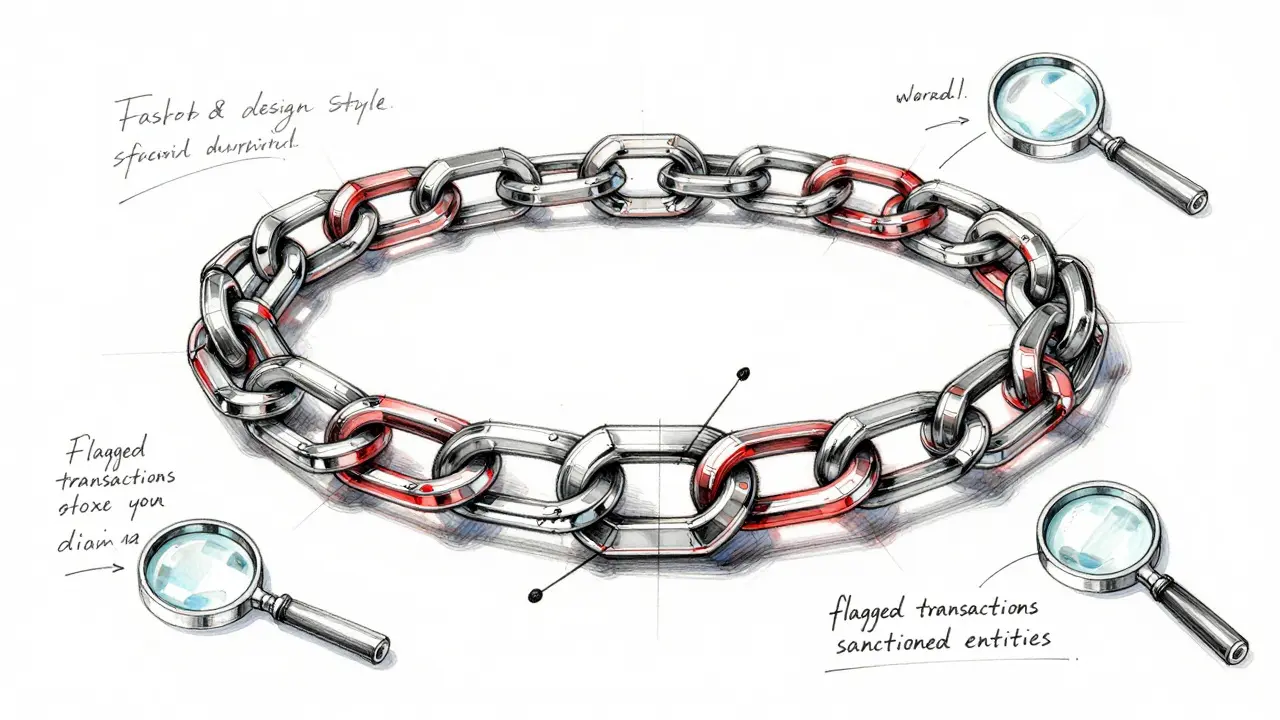
Regulators now use sophisticated blockchain analytics tools. These platforms map transaction flows in real-time. They can identify clusters of addresses linked to known sanctioned entities, such as the Trickbot ransomware group or specific Russian oligarchs. If your wallet interacts with a cluster flagged as high-risk, even indirectly through several hops, you leave a digital footprint.
Unlike traditional banks, crypto firms cannot simply reject incoming transactions once they arrive on the chain. However, they are required to monitor, detect, and report suspicious activity. Failure to do so leads to liability. For individuals, this means that using a mix of legitimate and illicit sources creates a pattern that analysts can reconstruct. The transparency of the public ledger is actually your biggest enemy when trying to hide illicit funds.
Compliance Requirements for Businesses
If you run a crypto business, the pressure is on you. The average penalty for non-compliance rose to $3.8 million globally in 2025. More importantly, 31% of penalized exchanges faced license revocations. You lose your business entirely.
Regulators expect you to implement robust Anti-Money Laundering (AML) and Know Your Customer (KYC) frameworks. This isn't just about collecting ID cards. It requires:
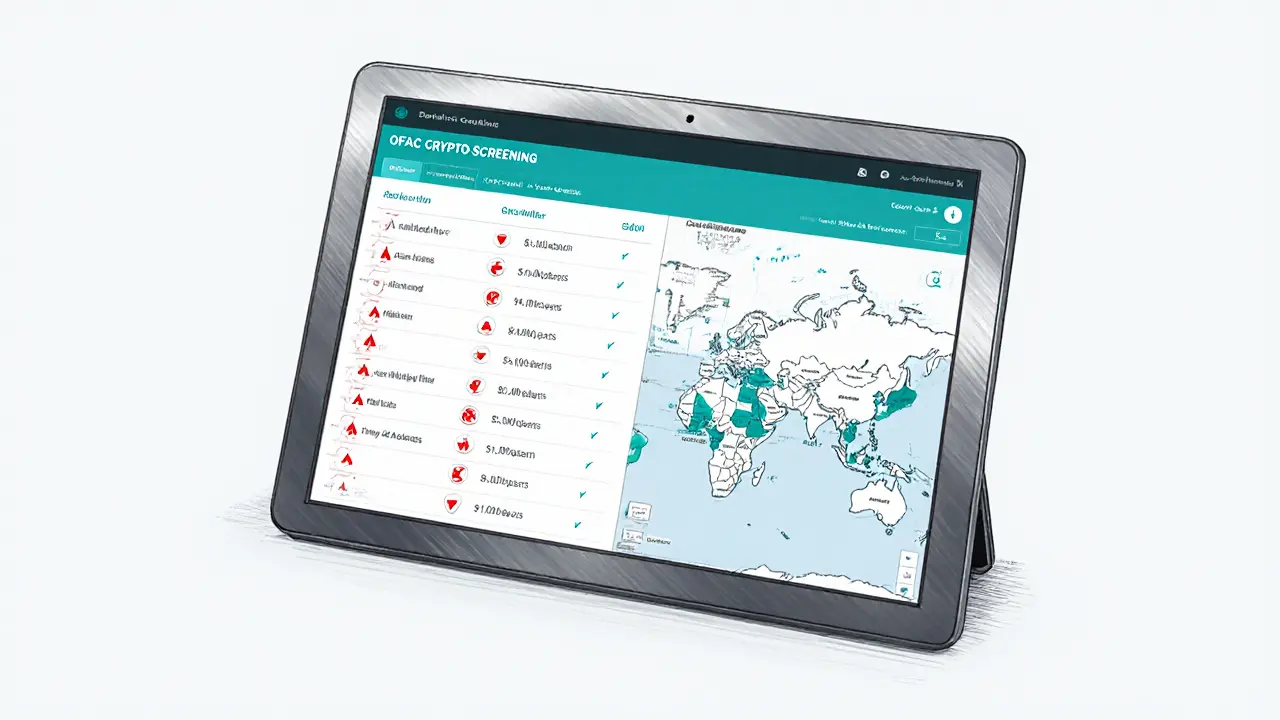
- Real-Time Screening: Checking every transaction against updated sanctions lists (like OFAC's SDN list) before processing.
- Blockchain Monitoring: Using third-party analytics providers to flag interactions with darknet markets, ransomware groups, or sanctioned jurisdictions.
- Suspicious Activity Reporting (SAR): Filing reports with financial intelligence units when you see red flags.
- Employee Training: Ensuring staff know not to help users bypass geo-blocks or ID checks.
The UK's "Failure to Prevent Fraud" offense adds another layer. Large firms can be held criminally liable for fraud committed by employees unless they had "reasonable procedures" in place. This means your compliance program must be proactive, not reactive. You need to show regulators that you actively tried to stop the bad behavior, not just that you cleaned up after it happened.

What This Means for Everyday Users
You might not be running an exchange, but you are still at risk. Many everyday users inadvertently trigger sanctions alerts by interacting with de-anonymized addresses. For example, if you trade tokens on a decentralized exchange (DEX) that lists tokens associated with sanctioned projects, your wallet address gets tagged.
Once tagged, centralized exchanges may freeze your account. While freezing isn't prison, it can lead to investigations. If investigators find that you knowingly moved funds to avoid restrictions, the criminal path opens up. Ignorance is rarely a valid defense in federal court, especially when the rules are publicly available.
Here is what you should do to stay safe:
- Verify Counterparties: Ensure the people or entities you are sending money to are not on sanctions lists.
- Avoid High-Risk Jurisdictions: Be extremely cautious with transactions involving countries under broad sanctions (e.g., Russia, Iran, North Korea, Syria).
- Keep Records: Maintain clear records of why you are making transactions. Legitimate business purposes are a strong defense.
- Use Reputable Platforms: Stick to regulated exchanges that perform their own due diligence. Unregulated offshore platforms are where most enforcement actions happen.
The Future of Enforcement
Looking ahead, expect tighter coordination between global regulators. The Asia-Pacific region saw a 55% rise in enforcement actions in 2024, driven by new laws in Singapore and Japan. Europe saw fines rise by 28%, totaling €1.2 billion. This is a worldwide crackdown, not just a US phenomenon.
Senior executives are increasingly being held personally liable. Regulators are imposing penalties on individuals for lack of oversight. This means the CEO or CFO of a crypto firm can face personal criminal exposure if the company fails to comply. The days of hiding behind corporate structures are ending.
The integration of sanctions screening into crypto infrastructure is becoming mandatory. Stablecoin issuers, payment processors, and exchanges are all being forced to upgrade their systems. Those who fail will be prosecuted. The goal is to cut off the funding streams for sanctioned regimes and criminal organizations.
If you are considering using crypto to move money across restricted borders, stop. The risk is no longer worth the reward. With 30-year prison sentences on the table, the legal system is sending a loud and clear message: compliance is mandatory, and evasion is a career-ending, life-ruining crime.
Can I go to jail for accidentally sending crypto to a sanctioned address?
Accidental transfers are generally treated differently than intentional evasion. However, "accident" is hard to prove if you ignored warnings or used high-risk platforms. You may face frozen assets and investigations. If prosecutors believe you acted with reckless disregard or intent to conceal, criminal charges could follow. Always verify recipient details and use reputable exchanges to minimize risk.
Why is the penalty for crypto sanctions evasion so much higher now?
Regulators shifted from viewing violations as civil infractions to serious federal crimes. By combining charges like wire fraud, money laundering, and bank fraud, prosecutors can stack sentences. The 30-year figure comes from the cumulative maximums of these stacked federal offenses, designed to create a strong deterrent effect against using crypto to bypass international laws.
Do privacy coins protect me from sanctions enforcement?
No. Privacy coins often raise immediate red flags for regulators and exchanges. Most compliant platforms ban them entirely. Furthermore, blockchain analytics firms are developing techniques to de-anonymize privacy coin transactions. Using them can actually increase suspicion of illicit intent, leading to stricter scrutiny rather than protection.
What should my crypto business do to avoid criminal liability?
Implement robust AML/KYC procedures, use real-time blockchain screening tools, and train employees to recognize and report suspicious activity. Do not allow staff to help users bypass geo-restrictions or ID checks. Document your compliance efforts thoroughly to demonstrate "reasonable procedures" in case of an audit or investigation.
Are foreign citizens protected from US sanctions if they live outside the US?
Not necessarily. If your transactions involve US dollars, US-based banks, or US-registered exchanges, you fall under US jurisdiction. The US applies extraterritorial enforcement to sanctions violations. Cases like that of Iurii Gugnin show that individuals operating abroad can still be indicted and prosecuted in US courts for facilitating sanctions evasion.