
Understanding BIP39 Seed Phrase Standard: How It Works and Why It Matters
Imagine losing your laptop, phone, or hardware wallet. In the digital age, that usually means a trip to customer support to reset a password. But in the world of cryptocurrency, there is no customer support. There is no 'Forgot Password' button. If you lose access to your crypto assets, they are gone forever-unless you have one specific thing: your BIP39 seed phrase, also known as a mnemonic recovery phrase.
This standard, formally known as Bitcoin Improvement Proposal 39, is the invisible backbone of modern cryptocurrency security. It’s what allows you to restore your entire digital life from just 12 or 24 words written on a piece of paper. But how does it actually work? And more importantly, why do some people still lose millions despite having this safety net?
The Core Problem BIP39 Solves
Before BIP39 existed, managing cryptocurrency was a nightmare. You had to copy long strings of hexadecimal characters (like 5KJvsngHePpmW8cLqTFe87b6sZt...)) for every single address you wanted to use. If you lost one character, your funds were inaccessible. There was no easy way to back up multiple accounts, and moving between different cryptocurrencies meant starting from scratch.
BIP39 changed everything by introducing a standardized method for generating human-readable backup phrases. Instead of memorizing complex code, users could write down a list of common words. This simple shift made cryptocurrency accessible to non-technical users while maintaining high-level security. The standard ensures that any wallet supporting BIP39 can restore your accounts, regardless of which software originally generated the phrase.
| Feature | Raw Private Keys | BIP39 Seed Phrase |
|---|---|---|
| Human Readability | Low (Hexadecimal strings) | High (Common words) |
| Error Tolerance | None (One wrong char = loss) | Moderate (First 4 letters often suffice) |
| Interoperability | Wallet-specific | Universal across BIP39 wallets |
| Backup Complexity | High (Multiple keys) | Low (Single phrase for all assets) |
How the 2048-Word List Works
The magic behind BIP39 lies in its carefully curated wordlist. The standard uses exactly 2,048 unique English words. These aren’t random selections; they are chosen specifically so that the first four letters of each word are unique. This design feature provides built-in error correction. If you’re handwriting your phrase and your pen runs out of ink halfway through a word, or if a coffee stain obscures the last letter, you can likely still identify the correct word based on the first four characters.
Here is how the generation process works under the hood:
- Entropy Generation: Your wallet software generates a sequence of random bits (entropy). For a 12-word phrase, this is typically 128 bits of randomness.
- Checksum Creation: A SHA-256 hash is calculated from the entropy, and the first few bits of this hash are appended to the original entropy. This acts as a checksum to verify the phrase hasn’t been mistyped.
- Bit Slicing: The combined bit string is split into chunks of 11 bits each. Since 2^11 equals 2,048, each chunk corresponds to a number between 0 and 2,047.
- Word Mapping: Each number maps to a specific word in the standardized dictionary. For example, the number 0 might map to "abandon" and 2,047 to "zoo".
This structure means that a 12-word phrase doesn’t just provide 12 independent choices. The last word contains checksum data that validates the rest of the phrase. If you make a mistake when typing it into a new wallet, the software will immediately reject it, preventing you from accidentally locking yourself out due to a typo.
Security Levels: 12 Words vs. 24 Words
You’ll often see two options when setting up a wallet: 12 words or 24 words. Which should you choose? The answer depends on your threat model and technical comfort level.
A 12-word BIP39 phrase provides approximately 128 bits of security. To put that in perspective, breaking a 128-bit key via brute force would require computational power far beyond anything currently available on Earth. Even with future quantum computing advancements, 128 bits is considered sufficiently secure for most individual users. This is the same security level used for Bitcoin private keys.
A 24-word phrase offers roughly 256 bits of security. While this sounds like double the protection, the practical difference for an average user is negligible. The primary advantage of 24 words isn’t necessarily stronger encryption against hackers, but rather a larger entropy pool during generation, which reduces the risk of collisions (two people having the same seed) in extremely large-scale deployments. However, the trade-off is convenience. Writing down and storing 24 words is more prone to human error than writing down 12.
For most people, a 12-word phrase is perfectly adequate. The real vulnerability isn’t the math-it’s you. Human error in transcription or storage is the leading cause of lost funds, not cryptographic breaks.
The Optional Passphrase: Security Double-Edged Sword
One of the most misunderstood features of BIP39 is the optional passphrase, sometimes called the "25th word." This is a custom string of text you add *after* your 12 or 24 words. It is not part of the standard wordlist and can be anything you want-a sentence, a song lyric, or a random string of characters.
Why use it? A passphrase adds a layer of plausible deniability and extra security. If someone steals your seed phrase paper but doesn’t know the passphrase, they cannot access your funds. It effectively creates a second, hidden wallet derived from the same seed.
However, this feature is dangerous for many users. Here is why:
- No Recovery Path: If you forget your passphrase, there is absolutely no way to recover it. Not even the wallet provider can help you. Your funds are permanently locked.
- Complexity: You now have two critical pieces of information to store securely: the seed phrase AND the passphrase. Losing either one results in total loss.
- User Confusion: Many users mistakenly believe the passphrase is stored by the wallet software. It is not. It exists only in your head (and hopefully on a separate backup).
Most consumer wallets disable this feature by default for good reason. Unless you are an advanced user with a specific need for multi-layered security, skip the passphrase. Stick to the 12 or 24 words.
Critical Storage Best Practices
Having a BIP39 seed phrase is useless if you don’t store it correctly. The goal is to protect against three main threats: physical damage, theft, and digital compromise.
Never store your seed phrase digitally. Do not save it in a text file, email, cloud note, or screenshot. Computers are vulnerable to malware, hacking, and accidental deletion. The beauty of BIP39 is that it is air-gapped-existing only on paper or metal.
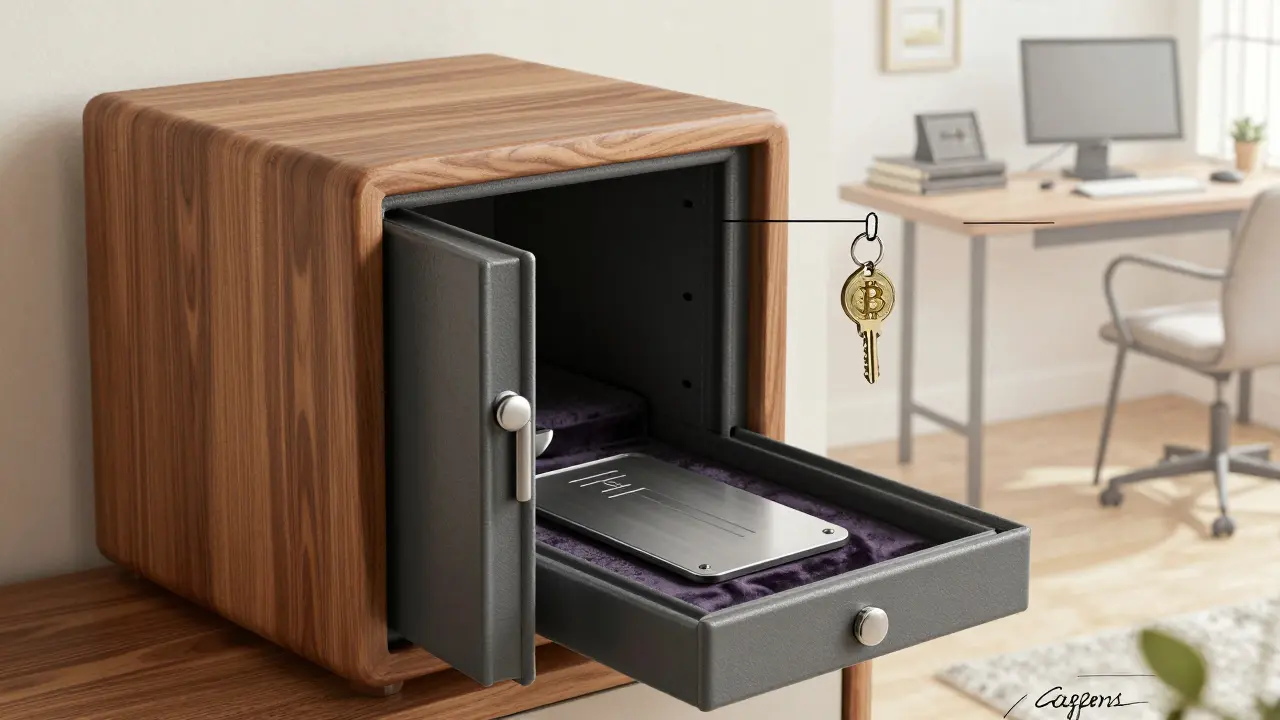
Use durable materials. Paper can burn, rot, or fade. Consider using stainless steel plates designed for seed phrase storage. These are fireproof, waterproof, and tamper-evident. They ensure your words survive disasters that would destroy paper backups.
Diversify your locations. Don’t keep all copies in one place. If your house burns down, you lose everything. Store one copy in a home safe, another in a bank deposit box, and perhaps a third with a trusted family member. Ensure each location is secure from both natural disasters and unauthorized access.
Verify your backup. After writing down your phrase, perform a test restoration. Create a small transaction to a new address generated from your backup phrase to confirm it works. This step catches transcription errors before they become catastrophic.
Common Mistakes That Lead to Loss
Despite the robust design of BIP39, thousands of users lose access to their funds annually. Here are the most frequent pitfalls:
- Fake Wallet Apps: Malicious apps may ask you to "verify" your seed phrase. Legitimate wallets never ask for your seed phrase to send transactions or verify identity. If an app asks for it, it is stealing your funds.
- Partial Phrases: Some users try to remember only half the phrase or write it down incompletely. Without the full sequence, the mathematical derivation fails completely.
- Language Mismatch: BIP39 supports multiple languages, but the wordlists are distinct. A seed phrase generated in English must be restored using an English-compatible wallet. Mixing languages can result in invalid seeds.
- Over-Complication: Users creating their own "random" phrases instead of letting the wallet generate them. Humans are terrible at generating true randomness. Always let the software handle the entropy generation.
If you suspect your seed phrase has been compromised, move your funds to a new wallet with a freshly generated seed phrase immediately. Treat your seed phrase like the combination to a nuclear launch code-never share it, never digitize it, and always verify it.
Can I change my BIP39 seed phrase?
No, you cannot change the words themselves. The seed phrase is a static representation of your private keys. To "change" it, you must generate a brand new seed phrase in your wallet software and transfer all your funds to the addresses associated with the new phrase. The old phrase then becomes obsolete.
Is BIP39 compatible with all cryptocurrencies?
BIP39 is a standard for generating the seed, not the addresses themselves. Most major cryptocurrencies like Bitcoin, Ethereum, Litecoin, and others support BIP39 seeds. However, the actual address derivation follows other standards like BIP44 or BIP84. As long as your wallet supports these derivation paths, your BIP39 seed will work across different blockchains.
What happens if I lose one word from my 12-word phrase?
If you lose even one word, you cannot restore your wallet directly. However, because there are only 2,048 possible words, you could theoretically try every combination for the missing slot. This requires specialized software and significant time, but it is mathematically feasible. Professional recovery services often assist with this process.
Does BIP39 protect against quantum computers?
BIP39 itself relies on elliptic curve cryptography (ECDSA), which is vulnerable to future quantum attacks. However, the seed phrase generation process is secure. The vulnerability lies in the key derivation and signature algorithms, not the mnemonic standard. Post-quantum cryptography solutions are being developed to address this future threat.
Can I split my seed phrase among multiple people?
Not directly with standard BIP39. BIP39 produces a single phrase. To achieve multi-party control, you would need to use Shamir's Secret Sharing or similar threshold signature schemes, which are implemented by specific hardware wallets and services, not the BIP39 standard itself.

Elle Kharitou
May 4, 2026 AT 09:30Oh my gosh, this is such a vital topic for everyone to truly understand and embrace in their daily digital lives! 🌟 It really makes you stop and think about the fragility of our modern existence when we place so much trust in invisible systems that have no safety net whatsoever. I always feel a bit anxious just thinking about how easily one could lose everything if they aren't careful with these seed phrases, but then I remember that knowledge is power and understanding BIP39 gives us that control back. 💫 The way it simplifies complex cryptography into human-readable words is just beautiful, isn't it? It’s like magic but grounded in solid mathematics and logic which I find incredibly soothing. We should all take the time to write down our phrases on metal plates because paper just feels too flimsy and vulnerable to the elements of life. ☕️🔥 Imagine your house burning down and losing your only backup, that would be absolutely heartbreaking and preventable with just a little extra effort upfront. Let's support each other in being more secure and mindful about our digital assets, friends! 🙏✨
AP Fisher
May 5, 2026 AT 17:19I never knew it was this simple before reading this. So basically if I write down 12 words I can get my money back even if my computer breaks?
Wayne Gillis
May 6, 2026 AT 07:14Hey buddy, why are you still using paper? 🤨 You should be using those steel plates everyone talks about or you're just asking for trouble. Don't be lazy about your security. 😤
Noel Mandotah
May 6, 2026 AT 11:12Newsflash: it's not magic, it's math. Stop acting like you discovered fire.
edie rosa
May 7, 2026 AT 08:18This article is completely ignoring the emotional toll of losing access to funds. It's cold and calculated. People need empathy not technical specs.
Michael Repak
May 9, 2026 AT 02:14I totally agree with the points made here!!! It is really important to verify your backup by doing a test transaction!!! Many people skip this step and regret it later!!! Please make sure you follow the best practices outlined above!!!
Livvy Cooper
May 11, 2026 AT 00:16Boring stuff. Just buy Bitcoin and forget about the rest.
Rain Richardsson
May 12, 2026 AT 12:29Thanks for sharing this info. It helps clear up some confusion.
Iestyn Lloyd
May 13, 2026 AT 14:22A well-articulated explanation of the standard. The distinction between entropy generation and word mapping is crucial for understanding why partial phrases fail. One might consider the checksum mechanism as a safeguard against transcription errors, which is indeed a common pitfall for novice users.
April D Thompson
May 14, 2026 AT 01:58OMG this changes everything!! I was so scared of losing my crypto but now I feel empowered to take charge of my own security!! Who else is going to buy steel plates today?? 🔥💪
Kara Spadone
May 14, 2026 AT 18:54The universe provides the words, but we must provide the discipline. :) Without the right mindset, even the best tool fails.
Arun Prabhu
May 16, 2026 AT 00:09Pah. Commoners writing words on paper. How quaint. True sophistication lies in hardware wallets with biometric locks, not scribbles on scrap paper. The plebeian approach is fraught with error.
Jehan ZA
May 17, 2026 AT 04:00It is imperative that one adheres strictly to the protocol described herein. Deviation from established standards often leads to catastrophic loss of assets. Prudence is advised.
debra hoskins
May 18, 2026 AT 14:11Everyone says paper is bad but metal is overpriced hype. I keep mine in a safe and it works fine. Stop listening to influencers.
Pramendra Singh
May 20, 2026 AT 08:54Good read. Hopefully this helps people avoid mistakes.
Mitali Rajvanshi
May 21, 2026 AT 17:55Nice summary. It is good to know the basics.
Veronica Bago
May 22, 2026 AT 13:00Hi there! This is super helpful. I'm glad I found this post.
Arti Jain
May 23, 2026 AT 17:19Only fools lose their keys. Be smarter than the herd.
VIVEK SINGH
May 24, 2026 AT 03:10Oh great, another tutorial on how not to be an idiot. Thanks for reminding me that humans are the weakest link. Truly inspiring. /s
Lloyd I
May 24, 2026 AT 07:43You got this! Taking control of your finances is awesome. Let's do it together!
Robert Smith
May 24, 2026 AT 22:15Cool post 👍
Felix Eduardo Velasquez
May 26, 2026 AT 21:55The technical explanation of the SHA-256 checksum integration is accurate. It is worth noting that the first four letters uniqueness is a design choice for error correction during manual transcription. However, relying solely on this without proper storage is negligent. Digital storage is a non-starter due to malware risks.
Emily A
May 28, 2026 AT 09:43Your grammar in the previous comments was atrocious. Furthermore, you misunderstand the cryptographic implications of entropy. Read a book.
Lynne Teperman
May 29, 2026 AT 20:44Words are powerful. Use them wisely. Keep your secrets secret.
Ipsita Seal
May 31, 2026 AT 11:07Ugh, so much text. Can't anyone just tell me what to do without all the philosophy?