Uniswap V1 Review: The Protocol That Changed Crypto Trading Forever
Imagine a world where you didn't need to trust a company with your money to trade it. No account creation, no ID checks, and no customer support tickets that go unanswered for weeks. This wasn't just a dream; it became reality in November 2018 with the launch of Uniswap V1. While today's users interact with sophisticated versions like Uniswap V3, understanding the original protocol is crucial. It was the spark that ignited the entire Decentralized Finance (DeFi) revolution.
If you are looking at Uniswap V1 today, you might be asking why it matters when newer versions exist. The answer lies in its legacy. Uniswap V1 proved that an Automated Market Maker (AMM) could work on a massive scale. It replaced the traditional order books used by centralized exchanges like Binance or Coinbase with a simple mathematical formula. This review breaks down what made V1 revolutionary, where it failed, and how those failures shaped the crypto landscape we see in 2026.
The Birth of the Automated Market Maker
To understand Uniswap V1, you have to look at what came before. Traditional exchanges relied on order books-lists of buyers and sellers matching prices manually. If there were no buyers, you couldn't sell. Uniswap V1 changed this by introducing liquidity pools. Instead of matching traders, it matched traders against a pool of funds provided by other users.
The core mechanism was deceptively simple. It used the constant product formula ($x \times y = k$). In plain English, this meant that as someone bought a token from the pool, the price automatically adjusted based on the remaining supply. You didn't need to wait for another person to agree on a price. The smart contract handled it instantly. This innovation allowed anyone with an Ethereum wallet to swap tokens directly on the blockchain without intermediaries.
This shift was monumental. It removed the central point of failure. There was no CEO to resign, no server to hack in the traditional sense, and no office to raid. The code was law. For early adopters, this level of sovereignty was the primary draw. It aligned perfectly with the ethos of Bitcoin and Ethereum: disintermediation.
User Experience: Simple But Costly
When Uniswap V1 launched, the user interface was stark. A single menu, a search bar, and two input fields for swapping tokens. It was minimalist, almost barebones compared to the data-rich dashboards of modern platforms. However, this simplicity had a purpose. It lowered the barrier to entry. You didn't need to understand complex trading charts to execute a basic swap.
However, "simple" did not mean "cheap." Every transaction on Uniswap V1 required paying Ethereum gas fees. These fees were paid to miners to process the transaction on the network, not to Uniswap itself. During periods of high network congestion, which became common as DeFi grew, these fees could skyrocket. A simple token swap could cost more than $50 or even $100 in gas, making small trades economically unviable.
Furthermore, the fee structure included a 0.3% charge on every swap. This fee went directly to the liquidity providers-the people who deposited their tokens into the pool. This incentive model was critical. Without it, the pools would be empty, and the exchange wouldn't function. Users had to weigh the convenience of instant, permissionless trading against the high cost of doing business on Ethereum.
Technical Limitations and Security Risks
While Uniswap V1 was a groundbreaking proof-of-concept, it was far from perfect. Its architecture had several critical flaws that exposed users to significant risks. Understanding these limitations is essential for anyone studying the evolution of DeFi security.
One major issue was the lack of decentralized price feeds. The protocol relied on spot prices within the pool, which could be easily manipulated. Large traders could execute a series of trades to distort the price, affecting other users who relied on those prices for borrowing or lending elsewhere in the ecosystem. This vulnerability highlighted the danger of trusting a single source of truth for asset valuation.
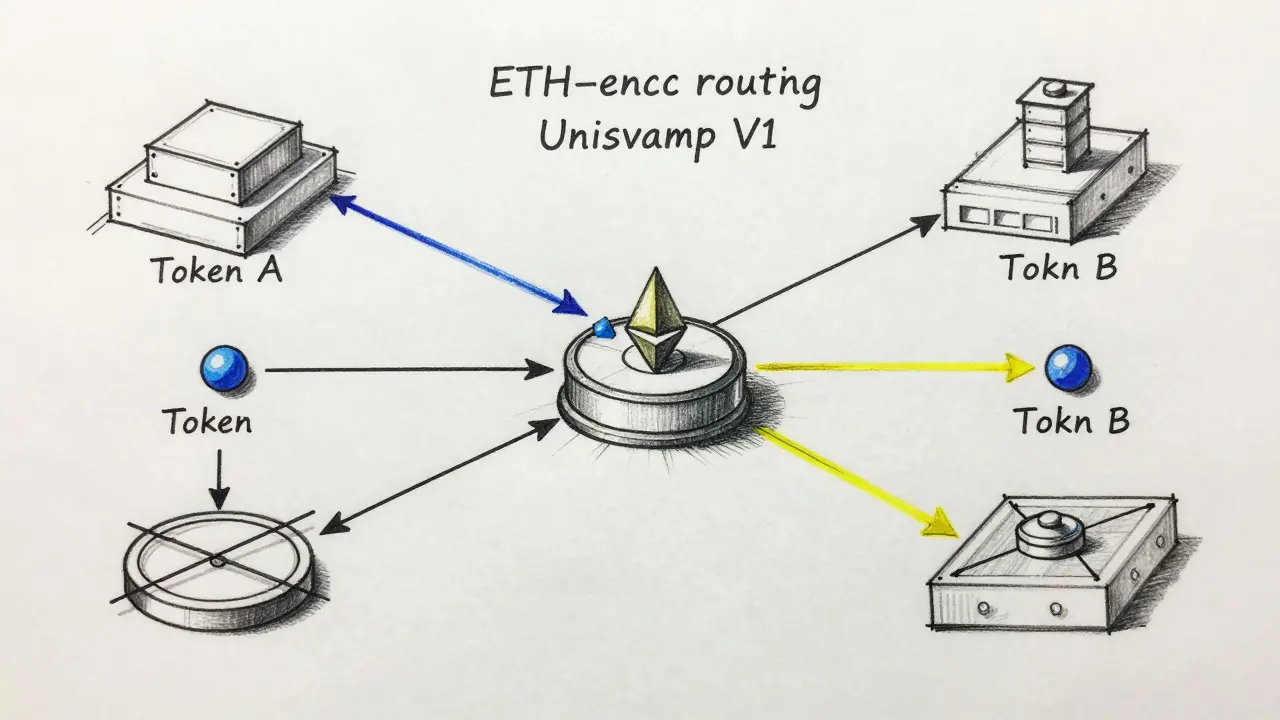
Another technical weakness was ETH-centric routing. All trades had to route through Ethereum (ETH). If you wanted to swap Token A for Token B, the system would first convert Token A to ETH, and then ETH to Token B. This indirect routing introduced inefficiencies and higher slippage for pairs that didn't involve ETH directly. It also meant that if ETH liquidity dried up, the entire market suffered.
Security-wise, V1 was susceptible to reentrancy attacks. These are exploits where a malicious contract repeatedly calls a function before the previous execution completes, draining funds. While Uniswap itself was relatively secure due to its simple design, non-standard tokens interacting with the pool could trigger these vulnerabilities. Additionally, failed transactions still consumed full gas fees, punishing users for errors or network issues.
| Feature | Uniswap V1 (2018) | Modern DEX Standards (V3+) |
|---|---|---|
| Trading Mechanism | Automated Market Maker (Constant Product) | Concentrated Liquidity / Hybrid Models |
| Supported Chains | Ethereum Only | Multi-chain (Polygon, Arbitrum, Optimism, etc.) |
| Price Feeds | Insecure Spot Price Oracle | Decentralized Time-Weighted Average Price (TWAP) |
| Routing Efficiency | ETH-Centric (Indirect Swaps) | Direct Pair Routing Available |
| Gas Optimization | Poor (Full gas on failed txs) | Improved (Partial refunds, Layer 2 scaling) |
| Liquidity Depth | Basic Pools | High Capital Efficiency via Ranges |
The Impact on Decentralized Finance
Despite its flaws, Uniswap V1's impact cannot be overstated. It demonstrated that decentralized exchanges could handle significant volume. Before V1, most DEXs struggled with low liquidity and poor usability. Uniswap showed that with the right incentives, users would provide the necessary capital to make markets efficient.
The success of V1 led to an explosion of new protocols. Developers copied the AMM model, adapting it for different use cases. Some focused on stablecoins, others on cross-chain swaps. This competitive environment drove rapid innovation. The governance token UNI, introduced later, further empowered the community, allowing token holders to vote on protocol changes and fee structures. This shift towards decentralized governance set a new standard for how financial infrastructure should be managed.
Moreover, Uniswap V1 forced centralized exchanges to adapt. They could no longer rely solely on their walled gardens. The transparency and accessibility of DeFi attracted a growing segment of crypto-native users who valued self-custody. This competition improved services across the board, leading to lower fees and better features even on traditional platforms.
Evolution: From V1 to V3
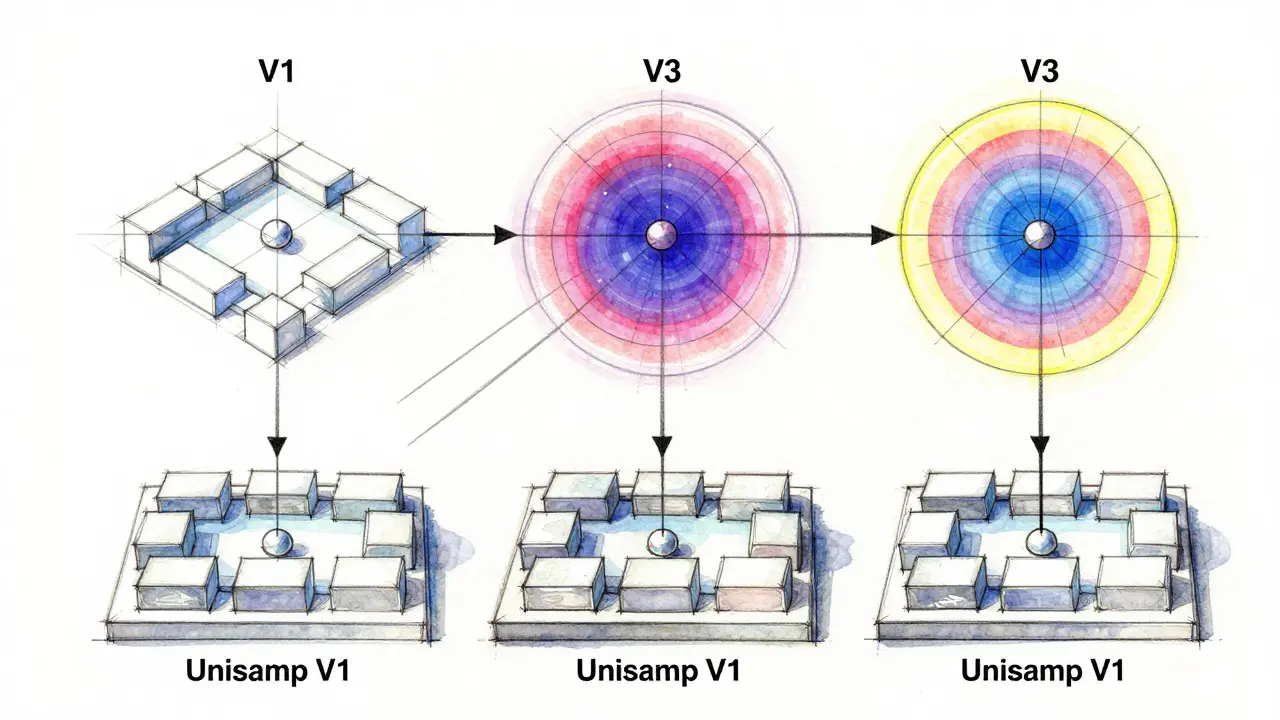
Uniswap didn't stop at V1. The lessons learned from its initial deployment directly informed subsequent upgrades. Uniswap V2, released in May 2020, addressed many of V1's shortcomings. It introduced direct ERC-20 to ERC-20 trading pairs, eliminating the need for ETH-centric routing. It also implemented a more robust oracle system, providing accurate historical price data for other DeFi protocols to use.
V2 also improved gas efficiency. Failed transactions no longer consumed the full gas limit, reducing costs for users. These improvements made the platform more practical for everyday trading. Later, Uniswap V3 took things further with concentrated liquidity. This feature allowed liquidity providers to allocate their capital within specific price ranges, increasing capital efficiency and reducing slippage for traders.
Today, Uniswap operates across multiple blockchain networks, including Polygon, Optimism, and Arbitrum. This multi-chain approach reduces reliance on Ethereum's high gas fees, making DeFi accessible to a broader audience. The journey from V1 to V3 illustrates the iterative nature of software development in a decentralized context. Each version built upon the last, refining the core principles while addressing real-world challenges.
Why Uniswap V1 Still Matters
You might wonder why we discuss a protocol that is no longer the primary interface for users. The answer is educational value. Uniswap V1 serves as a case study in innovation versus optimization. It prioritized simplicity and decentralization over efficiency and cost. This trade-off was necessary to prove the concept.
For developers, studying V1's codebase offers insights into smart contract design. Its simplicity makes it easier to audit and understand compared to the complex logic of V3. For investors, it highlights the importance of foundational technologies. The companies and protocols that emerged from the V1 era are now industry leaders.
Additionally, V1 reminds us of the risks inherent in early-stage technology. The security vulnerabilities and high costs were not bugs but features of a nascent ecosystem. As DeFi matures, these issues have been largely mitigated, but they remain relevant for new projects launching on emerging blockchains.
Is Uniswap V1 still usable today?
Technically, yes, but practically, no. Most users interact with Uniswap V2 or V3 interfaces. V1 contracts are still on the Ethereum blockchain, but they offer inferior routing, higher slippage, and no direct pair support. Using V1 today would result in unnecessary losses due to inefficient pricing mechanisms.
What was the main flaw in Uniswap V1's security?
The primary security flaw was the reliance on insecure spot price oracles. Because the price was determined solely by the current state of the liquidity pool, large trades could manipulate the price temporarily. This manipulation could be exploited by other DeFi protocols that used Uniswap prices as reference points for loans or derivatives.
How did Uniswap V1 handle fees?
Uniswap V1 charged a flat 0.3% fee on every swap. This fee was distributed pro-rata to all liquidity providers in the pool. This model incentivized users to deposit capital, ensuring sufficient liquidity for traders. Unlike centralized exchanges, there were no withdrawal fees or hidden charges beyond the network gas fees.
Why did Uniswap move away from ETH-centric routing?
ETH-centric routing meant every trade had to pass through Ethereum, even if neither asset was ETH. This caused inefficiencies, higher slippage, and increased gas costs. Direct routing, introduced in V2, allowed tokens to be swapped directly if a liquidity pool existed for that specific pair, improving speed and cost-effectiveness.
Did Uniswap V1 require KYC verification?
No. One of Uniswap V1's key selling points was its permissionless nature. Users only needed an Ethereum-compatible wallet (like MetaMask) to connect and trade. There were no identity checks, email registrations, or geographic restrictions, aligning with the decentralized ethos of cryptocurrency.