
Understanding Merkle Root: How Blockchain Verifies Transactions Without Storing Everything

Merkle Proof Calculator
How Many Hash Values Do You Need?
Merkle trees allow blockchain verification without downloading entire blocks. Enter the number of transactions to see how many hash values you need to verify one transaction.
The Merkle root is the secret sauce that lets your phone wallet verify a Bitcoin transaction without downloading the entire blockchain. Imagine trying to check if one specific payment made it into a giant ledger with millions of entries. You wouldn’t sit there reading every line. You’d want a shortcut. That’s what the Merkle root gives you - a single, tiny fingerprint that proves everything in a block is exactly as it should be.
What Exactly Is a Merkle Root?
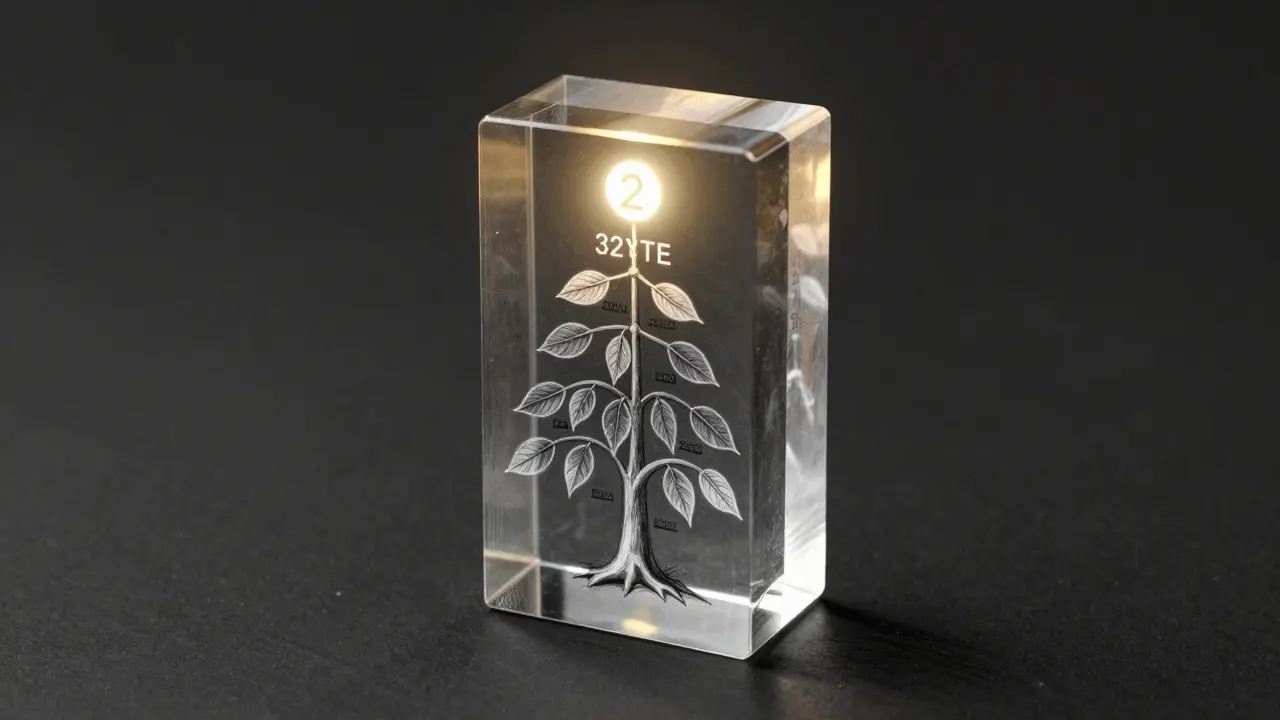
A Merkle root is a single 32-byte hash - a unique string of letters and numbers - that represents all the transactions in a Bitcoin block. It’s created by repeatedly hashing pairs of transaction IDs until only one hash remains. This structure is called a Merkle tree, named after Ralph Merkle, who patented it in 1979. It’s not magic. It’s math. And it’s built on SHA-256, the same hashing algorithm Bitcoin uses everywhere.
Each transaction in a block gets hashed first. These become the bottom layer, called leaf nodes. Then, those hashes are paired up, combined, and hashed again. This keeps happening until you get one final hash at the top: the Merkle root. If there’s an odd number of transactions, the last one gets duplicated to make a pair. Simple, but powerful.
That one hash is stored in the Bitcoin block header - a 80-byte chunk of data that includes the version, previous block hash, timestamp, nonce, and difficulty target. The Merkle root is the only part of the header that changes when transactions change. If even one transaction is altered, the entire Merkle root changes. That’s how you know something’s been tampered with.
Why Does It Matter for Blockchain?
Without the Merkle root, every light client - like your phone wallet - would need to download every single transaction ever made to verify one payment. That’s impossible on mobile. A full Bitcoin block can be over 1 MB. The blockchain is over 600 GB and growing. No phone can handle that.
The Merkle root fixes this. Instead of downloading the whole block, your phone only needs the Merkle root and a small set of hashes - called a Merkle proof - that connect your transaction to the root. For a block with 1,000 transactions, you only need about 10 hashes to prove your transaction is included. That’s a few hundred bytes, not megabytes. This is called Simplified Payment Verification, or SPV. It’s what makes Bitcoin usable on phones and smart devices.
It’s not just Bitcoin. Ethereum, Polygon, and nearly every major blockchain use Merkle trees - though Ethereum uses a variation called a Merkle Patricia Trie to handle account states, not just transactions. The core idea stays the same: compress a huge dataset into one verifiable hash.
How It Keeps the Network Secure
Security here comes from three properties: integrity, efficiency, and immutability.
- Integrity: If someone tries to change a transaction, the hash changes. That changes the parent hash. Then the next one. Eventually, the Merkle root changes. Any node checking the block will see the root doesn’t match the transactions and reject it.
- Efficiency: Verifying one transaction among thousands takes seconds, not minutes. The time grows logarithmically, not linearly. Ten transactions? Ten hashes. A thousand? Around ten hashes. A million? Still around twenty.
- Immutability: Once a block is confirmed and the Merkle root is buried under hundreds of new blocks, changing an old transaction would require redoing every single block after it - and outpacing the entire network. That’s computationally impossible.
Dr. Pieter Wuille, a lead Bitcoin Core developer, put it simply: "Merkle trees are what make Bitcoin’s light client model possible, reducing verification requirements from gigabytes to mere kilobytes."
What It Can’t Do
It’s not perfect. The Merkle root only proves a transaction is included. It doesn’t prove a transaction isn’t there. If you want to know if your payment was rejected, you still need to check a full node. Also, if a malicious node gives you a fake sibling hash during verification, you might be fooled - unless you’re connected to multiple honest nodes.
That’s why newer systems like Ethereum’s Verkle trees are being developed. Verkle trees use a different math (polynomial commitments) to make proofs even smaller and faster. But they’re still building on the same idea: compress data into a single, verifiable root.
Another limitation: Merkle trees assume all data is available. If a node deletes old transactions, the Merkle root can’t help you recover them. That’s why full nodes still matter. They store everything. Light nodes just trust that the root is correct - and that’s fine for most users.
Real-World Uses Beyond Bitcoin
Today, Merkle roots aren’t just for payments. They’re used everywhere trust needs to be proven without revealing everything.
Exchanges like Coinbase and Binance now publish quarterly proof-of-reserves reports using Merkle trees. They show they hold enough Bitcoin to cover all customer balances - without leaking who owns what. After the FTX collapse in 2022, this became standard. Investors want proof. Merkle trees give it to them without breaking privacy.
Supply chains use it too. IBM’s Food Trust blockchain tracks produce from farm to store. Each step gets hashed and added to a Merkle tree. A retailer can verify a mango came from a specific farm in Mexico without seeing every other shipment in the system.
Even rollups like Optimism use Merkle trees to compress thousands of transactions into one proof that gets posted to Ethereum’s main chain. This cuts costs and increases speed - and it all hinges on that same root hash.

How Developers Work With It
If you’re a developer, you’ll encounter Merkle roots in APIs. In Bitcoin Core, the getblock RPC command returns a field called merkleroot. In Ethereum, you’ll see transactionRoot, stateRoot, and receiptRoot - each a Merkle root for a different dataset.
One common gotcha: Bitcoin displays hashes in reverse byte order. A hash like a1b2c3 might be stored as c3b2a1. If you’re coding a wallet and your Merkle proof doesn’t match, check your endianess.
GitHub repositories like bitcoinjs-lib (with over 12,000 stars) have open-source code that shows exactly how to build a Merkle proof from scratch. It’s not hard - just tedious. Most developers use libraries instead of writing it themselves.
Learning how Merkle trees work takes about 10-15 hours of focused study. You don’t need to be a cryptographer. Just understand hashing, binary trees, and why repetition matters. Once you get it, you’ll see it everywhere in blockchain.
The Future of Merkle Roots
The Merkle root isn’t going away. But it’s evolving. Ethereum’s Verkle tree upgrade - expected in 2024-2025 - will replace traditional Merkle trees for state data. It reduces proof sizes by 90%, making stateless clients possible. That means phones could verify any account balance without storing any blockchain data at all.
Bitcoin is exploring Merkle-based asset issuance through BIP 303 (Taproot Assets). This lets people issue tokens on Bitcoin using the same Merkle structure - no new blockchain needed.
According to MarketsandMarkets, the market for blockchain verification tech using Merkle roots will grow from $7.3 billion in 2023 to over $94 billion by 2030. Gartner predicts 70% of enterprise blockchains will rely on Merkle structures by 2026. Why? Because regulators demand proof. And Merkle roots give it without exposing secrets.
So while new systems like ZK-SNARKs and Verkle trees are coming, they’re not replacing Merkle roots. They’re upgrading them. The core idea - compress trust into a single hash - is too good to abandon.
Final Thought
The Merkle root is one of those quiet, foundational pieces of tech that most people never think about - until they use Bitcoin on their phone. It’s what makes decentralized systems scalable. It’s what lets you trust a network without trusting any single person. And it’s why you can verify a payment in milliseconds, even when the whole blockchain is the size of a hard drive.
It’s not flashy. But it’s essential. And without it, blockchain as we know it wouldn’t work.
What is the purpose of a Merkle root in blockchain?
The Merkle root is a single cryptographic hash that summarizes all transactions in a block. It allows nodes and lightweight wallets to verify that a transaction is included in the block without downloading the entire dataset. This makes blockchain verification fast, efficient, and scalable.
How is a Merkle root calculated?
Each transaction is hashed individually. These hashes are paired and hashed together in a binary tree structure. If there’s an odd number of transactions, the last one is duplicated. This process repeats until only one hash remains - the Merkle root. For example, with four transactions, you hash H1+H2, H3+H4, then hash those two results together to get the final root.
Can you trust a Merkle root?
Yes - because of cryptographic properties. SHA-256 ensures that changing even one transaction alters the entire Merkle root. If the root in the block header doesn’t match the calculated root from the transactions, the block is invalid. This makes tampering immediately obvious to all nodes.
Does every blockchain use Merkle roots?
Almost all major blockchains do. Bitcoin, Ethereum, Polygon, and others use Merkle trees or variations (like Merkle Patricia Tries) to verify transactions or account states. A 2023 report found 97 out of 100 top blockchains use some form of Merkle structure for data verification.
What’s the difference between a Merkle root and a block hash?
The block hash is a SHA-256 hash of the entire block header - including the Merkle root, timestamp, nonce, and previous block hash. The Merkle root is just one field inside the header, representing the transactions. The block hash identifies the block; the Merkle root proves the transactions inside it are valid.
Why do exchanges use Merkle trees for proof-of-reserves?
Exchanges use Merkle trees to prove they hold enough cryptocurrency to cover all customer balances - without revealing individual account details. Each customer’s balance is hashed and included in the tree. The final Merkle root is published. Customers can verify their own balance is included using a Merkle proof, confirming solvency privately and securely.
Is the Merkle root the same in Ethereum and Bitcoin?
The concept is the same, but the structure differs. Bitcoin uses a binary Merkle tree for transactions. Ethereum uses a Merkle Patricia Trie to handle account states, smart contracts, and transaction receipts. The trie is more complex and supports dynamic data, but both rely on a root hash to verify integrity.
Can a Merkle root prove a transaction was never included?
No. A Merkle proof can only prove a transaction is included. It cannot prove something is missing. To know if a transaction was rejected, you need to check a full node or a reliable source that tracks mempool and chain state. This is a known limitation of Merkle trees.
Joe B.
December 2, 2025 AT 12:17Bro, the Merkle root is basically the blockchain’s version of a summary tweet. You don’t need the whole thread to know if someone said something wild - just check the pinned quote. 🤯 I’ve seen people lose their minds over 600GB of data when all they needed was 300 bytes. Mind blown. Again. 🧠💥
Rod Filoteo
December 3, 2025 AT 21:14They dont want you to know this but the merkle root is how the gov and big bank control what transactions get verified. they pick which hashes to include and which to bury. you think your phone wallet is safe? think again. they can fake the proof and youll never know. its all a lie. #deepstate #blockchainisfake
Layla Hu
December 4, 2025 AT 23:33Interesting breakdown. I appreciate how clearly it explains SPV without oversimplifying.
Nora Colombie
December 6, 2025 AT 22:48Of course Americans think this is genius. We built the internet and now we’re proud of a hash? Meanwhile China’s building quantum-resistant ledgers and Europe’s got privacy laws. This is 2012 tech dressed up like innovation. Pathetic.
Greer Dauphin
December 7, 2025 AT 10:15Wait so if I’m reading this right - you only need like 10 hashes to prove a tx is in a block with 1000 txs? That’s wild. I tried coding a Merkle proof once and kept mixing up the byte order and spent 3 hours wondering why it didn’t work. 😅 turns out I was reading it backwards. Bitcoin’s little gotcha. Thanks for the reminder - and yes, bitcoinjs-lib is your friend.
Bhoomika Agarwal
December 8, 2025 AT 23:08Merke root? More like Merkle *rope* - hanging the future of finance on a single hash? Ha! India’s been doing peer-to-peer verification since the 90s with paper ledgers and chai breaks. You call this innovation? We call it basic math with extra steps. 🇮🇳🔥
Katherine Alva
December 10, 2025 AT 15:20It’s beautiful how something so technical - a chain of hashes - becomes the quiet foundation of trust in a world where we’re taught to distrust everything. No central authority. No CEO. Just math, consistency, and the stubborn belief that truth can be compressed. 🌱
Nelia Mcquiston
December 12, 2025 AT 04:14People treat Merkle roots like magic, but it’s just smart engineering. The real breakthrough isn’t the tree - it’s that we built a system where you don’t need to trust the person giving you the proof, just the math. That’s revolutionary. And it’s not even flashy. Just… quietly working.
Mark Stoehr
December 12, 2025 AT 21:42merkle root is just a hash of hashes and people act like its the second coming of jesus. its not. its just math. stop acting like its deep. its just a tree with no leaves you can see. end of story.
Shari Heglin
December 13, 2025 AT 05:00While the Merkle root is technically accurate as described, the assertion that it enables "verification without storing everything" is misleading. Light clients still rely on trust assumptions - namely, that the block header they receive is authentic. This is not true decentralization; it is delegated trust. The architecture remains fundamentally hierarchical.
Reggie Herbert
December 14, 2025 AT 06:43Let’s cut through the crypto-bro jargon. Merkle root = checksum. That’s it. It’s not a revolution. It’s a checksum. You use checksums to verify downloads. Bitcoin just uses it for transactions. Big whoop. Stop pretending this is quantum computing.
Murray Dejarnette
December 15, 2025 AT 09:06Bro I just used my phone to send $500 in BTC and it verified in 2 seconds. I didn’t download 600GB. I didn’t call a node. I just clicked send. That’s the Merkle root. That’s the magic. And yeah, it’s fucking brilliant. I don’t care if it’s just math - it works. And it changed my life.
Sarah Locke
December 17, 2025 AT 03:13THIS. RIGHT HERE. This is the quiet hero of Web3. No applause. No memes. No influencer posts. Just a tiny hash holding up a global network. 🙌 If you’re building something - whether it’s a wallet, a supply chain, or a voting system - steal this idea. It’s elegant. It’s scalable. It’s human-centered tech at its finest.
Mani Kumar
December 17, 2025 AT 21:53The Merkle root is a basic cryptographic primitive. Its application in blockchain is trivial. Real innovation lies in zero-knowledge proofs and stateless clients - not binary trees from 1979. This is undergraduate-level knowledge.
Tatiana Rodriguez
December 19, 2025 AT 07:38I remember when I first learned about Merkle trees. I was sitting in a coffee shop in Portland, staring at a whiteboard full of hashes, and it hit me - this is how we’re going to rebuild trust in a world that’s lost it. Not with laws. Not with CEOs. Not with ads. But with math that anyone can verify. It’s not just tech. It’s a philosophy. And honestly? It gave me hope.
Now I teach it to my nieces. They’re 9 and 11. They get it faster than most developers I know. Because they don’t have the baggage. They just see: one hash proves many. And that’s enough.
Philip Mirchin
December 19, 2025 AT 18:25As someone who’s worked with blockchain in Nigeria - yeah, this is why we can do mobile payments even with 2G. No one’s got fiber. But phones? Everyone’s got a phone. Merkle roots = lifeline. We don’t care about the math. We care that our uncle in Lagos got paid. This tech? It’s saving lives. Respect.
Britney Power
December 20, 2025 AT 18:55While the Merkle root is functionally sound, its reliance on SHA-256 - a cryptographic hash function with known theoretical vulnerabilities under quantum computing - renders the entire verification paradigm temporally constrained. The architectural assumption of computational intractability is no longer tenable in the context of post-quantum threat models. This is not merely a limitation - it is an existential vulnerability masked as elegance.
Maggie Harrison
December 22, 2025 AT 02:02It’s wild how something so quiet - a single hash - holds so much power. Like the heartbeat of the whole system. You don’t notice it… until it stops. And then everything halts. 🤍
Lawal Ayomide
December 22, 2025 AT 11:24Why are you all talking about math? In Nigeria, we don’t care how it works. We care that the money arrives. This thing? It works. End of story.